EUDR Coffee Compliance Vietnam: How Exporters Pass Simplified Due Diligence Before 30 December 2026
Published
, 10 minute read
Share this article
Quick summary: EUDR coffee compliance Vietnam guide: what low-risk status changes, the geolocation and legality data EU buyers still need, and how to prepare for 30 Dec 2026.
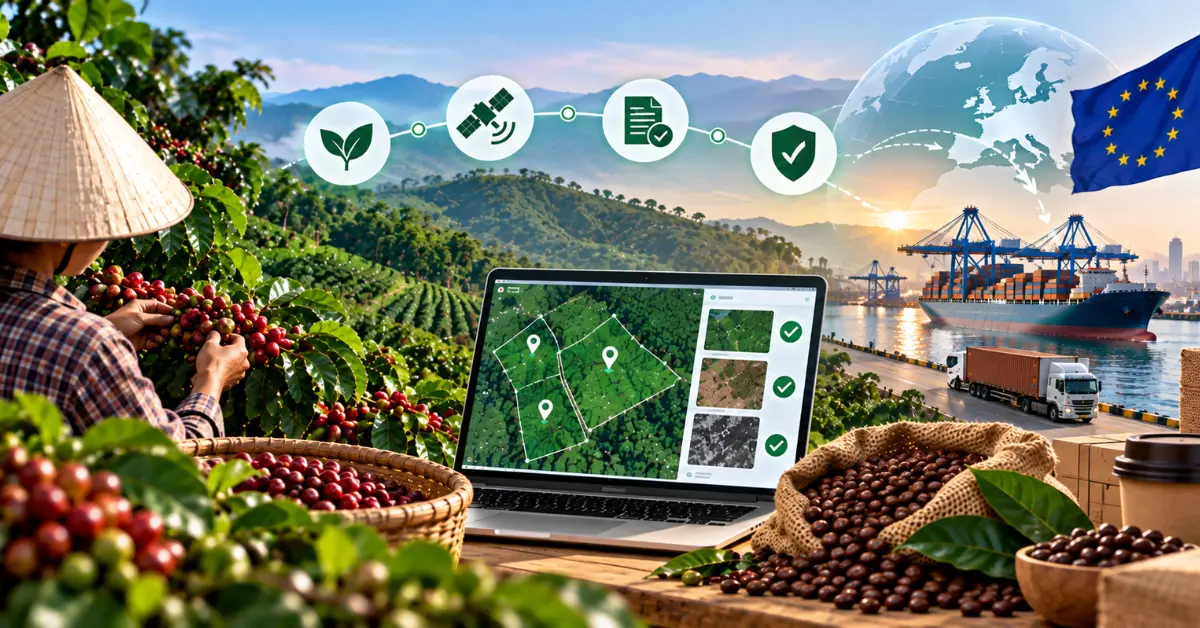
EUDR coffee compliance Vietnam means proving that each lot of Vietnamese coffee sold in the EU was grown on land not deforested after 31 December 2020, was produced legally, and can be traced to plot-level coordinates. Vietnam is classified as low risk, so EU operators can use simplified due diligence, but data collection and the due diligence statement remain mandatory from 30 December 2026.
KEY TAKEAWAYS
1. Vietnam is low risk under Implementing Regulation (EU) 2025/1093, which removes the formal risk assessment and mitigation steps for operators sourcing only from Vietnam.
2. Plot geolocation, legality evidence, and a due diligence statement are still required for every consignment.
3. Large and medium operators apply the rules from 30 December 2026; micro and small operators from 30 June 2027.
4. Blending Vietnamese robusta with standard-risk origins removes the simplified route for that product.
5. Soluble coffee is moving into scope through the July 2026 Annex I delegated act.
EUDR coffee compliance Vietnam has become a data problem more than a forestry problem. Vietnam is the second-largest coffee exporter in the world, and Europe takes about 55 per cent of its export volumes, with the 27 EU member states accounting for more than 45 per cent. The EU classified Vietnam as low risk in May 2025, and many exporters read that as a pass. It is not. Low risk shortens due diligence; it does not remove the duty to prove where every bag was grown.
In plain language, EUDR coffee compliance Vietnam is the set of records an EU operator needs to show that Vietnamese coffee is deforestation-free, legal, and traceable to the plot. This guide covers what low-risk status changes, the data you still owe your EU buyer, where Vietnamese supply chains break, and how to prepare before the deadline.
December 2026 is approaching. Is your supply chain actually ready?
Move from spreadsheets and fragmented supplier data to a traceable, audit-ready EUDR workflow with TraceX.
EUDR Coffee Compliance Vietnam: What Low-Risk Status Changes
Low-risk classification removes two steps of due diligence, not the whole process.
Operators sourcing exclusively from Vietnam can skip the formal risk assessment and risk mitigation steps, but must still collect all Article 9 information and submit a due diligence statement.
The most common misreading in EUDR coffee compliance Vietnam programmes is that low risk means low effort. Under Article 13 of Regulation (EU) 2023/1115, operators sourcing exclusively from low-risk countries do not have to run the Article 10 risk assessment or the Article 11 mitigation measures. They must still collect the Article 9 information, maintain a due diligence system, and file the statement. If they become aware of information pointing to non-compliance, such as a forest-loss alert over a supplying plot, full due diligence applies again.
Enforcement pressure is lighter too. Competent authorities check 1 per cent of operators sourcing from low-risk countries, against 3 per cent for standard risk. A lower check rate still means a check can arrive, and the evidence has to be retrievable in days, not months.
The catch is the word “exclusively.” A roaster blending Vietnamese robusta with Brazilian conilon or Indonesian robusta is also sourcing from standard-risk origins, so that product needs full due diligence. For EU importers, this is why EUDR coffee compliance Vietnam checks start with a sourcing map, not a supplier questionnaire.
EUDR country benchmarking classifies countries or parts of countries as low, standard, or high risk, with different due-diligence implications depending on the classification. Understanding your sourcing country’s risk level is an important part of planning your EUDR compliance approach.
EUDR Coffee Compliance Vietnam Data Requirements for Every Lot
Four groups of data must travel with each consignment, whatever the risk tier of the origin.
Geolocation of every plot: a point for plots up to 4 hectares, a polygon above that
Production date or harvest period for the coffee in the lot
Legality evidence covering land use rights, environmental, labour, and tax law
Product description, HS code, quantity, and supplier and buyer contact details
Every plot that contributed to the consignment needs coordinates, plus proof of legal land use and the harvest period.
Most Vietnamese coffee farms are small, so a single GPS point per plot usually meets the geolocation rule. The harder part of EUDR coffee compliance Vietnam is coverage: one container can draw on hundreds of farms, and one unmapped plot can block the whole lot.
Legality is the second gap. Operators must show the coffee was produced in line with Vietnamese law on land use, environmental protection, labour, and tax. For most smallholders this starts with a land use rights certificate. Documents issued before the July 2025 provincial mergers may carry old administrative names, so reconcile them with current province names before EUDR coffee compliance Vietnam files reach your buyer.
Proof point: a 2025 survey by Forest Trends and Tavina found that nearly 60 per cent of surveyed smallholders did not keep consistent harvest records, and only about 10 per cent kept plot-level data. For EUDR coffee compliance Vietnam teams, that is the true size of the onboarding task.
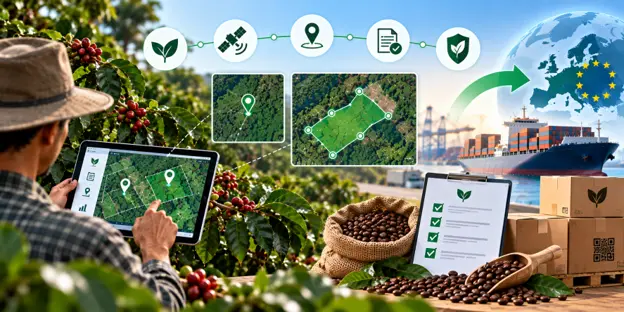
EUDR requires coffee businesses to connect supplier information, production plots, geolocation, deforestation-free evidence, legality information, risk assessment, and due diligence across the supply chain. Understanding these requirements early can help coffee exporters, traders, processors, and importers prepare for compliance.
EUDR Coffee Compliance in Vietnam’s Smallholder Supply Chains
Most failures happen between the farm gate and the export warehouse.
Traceability breaks where local collectors pool beans from many farms without recording which plot each bag came from.
Vietnamese robusta typically moves from farmer to local collector to trader to exporter, and each handoff is a chance for untraced beans to enter a compliant lot. The EUDR has no mixing tolerance: coffee of unknown origin in a lot makes the product non-compliant. EUDR coffee compliance Vietnam programmes that work treat the collector as a data point, recording farmer ID, plot, weight, and date at every purchase.
For EUDR coffee compliance Vietnam, public infrastructure helps but does not replace your own records. The agriculture ministry and IDH piloted a database of forests and coffee-growing areas in Dak Lak and Lam Dong, handed over in December 2024, and GIZ runs mapping and training programmes in coffee provinces. Use these datasets to cross-check plots; your buyer still needs lot-level evidence you can produce on request.
Learn how businesses can strengthen smallholder engagement, source-level traceability and EUDR due diligence without losing visibility across complex supply chains.
EUDR Coffee Compliance Vietnam for Soluble and Processed Coffee
Instant coffee exporters face a scope change that green bean exporters have already absorbed.
Once the delegated act applies, soluble coffee exporters will need the same plot-level data for the green beans behind each batch.
Green beans still make up 91.7 per cent of Vietnam coffee export volume, while instant and other processed products account for 8.3 per cent of volume and 17 per cent of earnings. The Commission proposed adding soluble coffee to Annex I in its May 2026 simplification package and adopted the delegated act in July 2026. For processors, EUDR coffee compliance Vietnam now means linking each soluble batch to the green lots and plots that went into it. That requires batch-level input records in the factory, because mass balance accounting cannot cover coffee of unknown origin.
Low-risk status is a head start, not a finish line. The Vietnamese exporters that secure long-term EU contracts will be the ones who hand buyers a complete, validated data package with every shipment, so the buyer can complete simplified due diligence in hours rather than weeks. Certifications such as Rainforest Alliance or 4C support that package as risk evidence; they do not replace plot geolocation, legality records, or the due diligence statement.
See how plot mapping, legality records, and DDS-ready data packages work for a Vietnamese robusta supply chain.
EUDR Coffee Compliance Vietnam: Manual Process vs TraceX
Spreadsheets can handle a pilot lot; they rarely hold up across a full harvest.
Manual tracking breaks at scale; a platform keeps plot, legality, and lot records linked from farm gate to the due diligence statement.
Picture an illustrative exporter buying from 1,500 farms through 20 collectors. At harvest peak, EUDR coffee compliance Vietnam records must keep pace with thousands of purchases a week, and a spreadsheet cannot flag an unmapped plot before the beans are mixed. The table compares the two approaches.
Task
Manual (spreadsheets and email)
TraceX
Farmer and plot onboarding
Paper forms retyped at the office; frequent gaps
Mobile capture of farmer ID and plot GPS, including offline use
Geolocation validation
Coordinates checked by hand, if at all
Automatic checks for invalid points and polygons on plots over 4 ha
Deforestation screening
Occasional review of free map tools
Screening against satellite datasets such as JRC and Hansen for post-2020 loss
Legality documents
Scans in shared folders, not linked to plots
AI document parsing that links land records to each plot
Collector lot segregation
Relies on collector memory and receipts
Purchases tagged to plots, with alerts when untraced volume enters a lot
EU buyer data package
Compiled manually per shipment
DDS-ready export in PDF, XML, or CSV, with TRACES submission support
Use these eight questions when assessing a Vietnamese supplier or a compliance platform.
Can the supplier provide coordinates for 100 per cent of plots in each lot, with polygons for plots over 4 hectares?
Are land use rights documents collected and matched to each plot?
Is every collector purchase recorded with farmer ID, plot, weight, and date?
Are compliant lots kept separate from untraced coffee through processing and export?
Does any product blend Vietnamese coffee with standard-risk origins, triggering full due diligence?
Can every plot be screened for forest loss after 31 December 2020?
Can the full data package be produced within days if a competent authority asks?
For soluble coffee, can each batch be traced back to its green lots?
Suppliers that answer yes to all eight are ready for EUDR coffee compliance Vietnam checks. Gaps on questions 1, 3, or 4 are the ones most likely to hold a container at the border.
Frequently Asked Questions
Is Vietnam low risk under the EUDR?
Yes. Commission Implementing Regulation (EU) 2025/1093 of 22 May 2025 classifies Vietnam as low risk. Operators sourcing coffee exclusively from Vietnam can use simplified due diligence under Article 13. The classification is reviewed periodically.
Do Vietnamese coffee exporters still need geolocation data?
Yes. Article 9 information, including the geolocation of every plot, is required regardless of the risk tier. Plots up to 4 hectares need a point; larger plots need a polygon.
When does the EUDR apply to coffee from Vietnam?
From 30 December 2026 for large and medium operators and traders, and from 30 June 2027 for micro and small operators, under Regulation (EU) 2025/2650. The deforestation cut-off date is 31 December 2020.
Who files the due diligence statement for Vietnamese coffee?
The operator that first places the coffee on the EU market, usually the EU importer. Since the 2025 amendment, downstream operators and traders pass on reference numbers instead of filing their own statements. The Vietnamese exporter supplies the underlying data.
Does Rainforest Alliance or 4C certification make coffee EUDR compliant?
No. Certifications can support risk evidence, but they do not replace plot geolocation, legality documentation, or the due diligence statement.
Is Vietnamese instant coffee covered by the EUDR?
Soluble coffee under HS 2101 is added through the Annex I delegated act adopted in July 2026. It applies once the act completes scrutiny and publication in the Official Journal, so confirm the current status before shipping.
What are the penalties for non-compliant coffee?
Member states set penalties, including fines with a maximum of at least 4 per cent of EU-wide annual turnover, confiscation of products and revenues, and temporary exclusion from public procurement.
Start using TraceX
Transparency, Trust, & Success for your Climate Journey.
We use cookies on our website to give you the most relevant experience by remembering your preferences and repeat visits. By clicking “Accept All”, you consent to the use of ALL the cookies. However, you may visit "Cookie Settings" to provide a controlled consent.
This website uses cookies to improve your experience while you navigate through the website. Out of these, the cookies that are categorized as necessary are stored on your browser as they are essential for the working of basic functionalities of the website. We also use third-party cookies that help us analyze and understand how you use this website. These cookies will be stored in your browser only with your consent. You also have the option to opt-out of these cookies. But opting out of some of these cookies may affect your browsing experience.
Necessary cookies are absolutely essential for the website to function properly. These cookies ensure basic functionalities and security features of the website, anonymously.
Cookie
Duration
Description
cookielawinfo-checkbox-analytics
11 months
This cookie is set by GDPR Cookie Consent plugin. The cookie is used to store the user consent for the cookies in the category "Analytics".
cookielawinfo-checkbox-functional
11 months
The cookie is set by GDPR cookie consent to record the user consent for the cookies in the category "Functional".
cookielawinfo-checkbox-necessary
11 months
This cookie is set by GDPR Cookie Consent plugin. The cookies is used to store the user consent for the cookies in the category "Necessary".
cookielawinfo-checkbox-others
11 months
This cookie is set by GDPR Cookie Consent plugin. The cookie is used to store the user consent for the cookies in the category "Other.
cookielawinfo-checkbox-performance
11 months
This cookie is set by GDPR Cookie Consent plugin. The cookie is used to store the user consent for the cookies in the category "Performance".
viewed_cookie_policy
11 months
The cookie is set by the GDPR Cookie Consent plugin and is used to store whether or not user has consented to the use of cookies. It does not store any personal data.
Functional cookies help to perform certain functionalities like sharing the content of the website on social media platforms, collect feedbacks, and other third-party features.
Performance cookies are used to understand and analyze the key performance indexes of the website which helps in delivering a better user experience for the visitors.
Analytical cookies are used to understand how visitors interact with the website. These cookies help provide information on metrics the number of visitors, bounce rate, traffic source, etc.
Advertisement cookies are used to provide visitors with relevant ads and marketing campaigns. These cookies track visitors across websites and collect information to provide customized ads.
Download the 2026 Traceability Scorecard and Benchmark Your Supply Chain Across 10 Critical Capabilities.
Download our eBook
Don’t Wait for an Audit to Find Your EUDR Gaps
The 2026 Simplification Package changes how HS codes, DDS pass-through and geolocation rules apply to you. Get the free guide and 20-point readiness checklist before enforcement catches you unprepared.