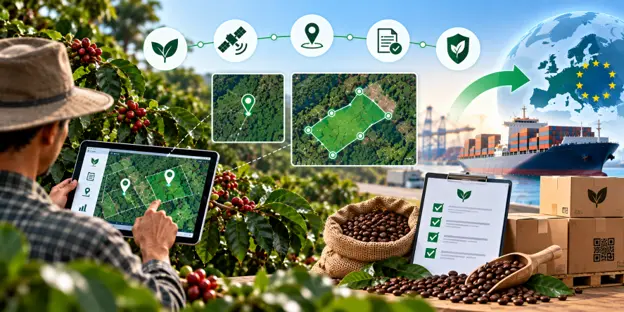
EUDR Coffee Compliance Ethiopia: How EU Importers Get From Plot to DDS
Published
, 8 minute read
Share this article
Quick summary: EUDR coffee compliance Ethiopia guide for EU importers: plot geolocation, ECTMS data, ECX lot risks and DDS steps before the 30 December 2026 deadline.
EUDR coffee compliance Ethiopia means proving that every lot of Ethiopian green coffee entering the EU was grown on land not deforested or degraded after 31 December 2020, was produced legally under Ethiopian law, and is traceable to geolocated plots. Large and medium EU operators must file a due diligence statement (DDS) from 30 December 2026, and micro and small operators from 30 June 2027. Ethiopia is classified as standard risk, so full due diligence applies.
Key Takeaways
Ethiopia sits in the EUDR standard-risk tier, so importers carry full due diligence: information collection, risk assessment and risk mitigation.
The hardest gap is farm identity. Coffee bulked by grade and region loses the plot link that a DDS needs.
The national ECTMS platform supplies geodata, but importers still own the risk assessment and the DDS.
Certifications help mitigate risk but never replace plot geolocation or DDS filing.
EUDR coffee compliance Ethiopia is now an operating problem, not a policy discussion. With the EU taking roughly [30%] of Ethiopian coffee exports and the sector earning more than [USD 2 billion] a year, European importers cannot afford lots that stall at customs for missing plot data. This guide explains what the regulation asks for, where Ethiopian supply chains break, and how importers can build a defensible due diligence file.
The EU will only accept Ethiopian coffee when an operator can show where it was grown, that no forest there was cleared or degraded after 2020, and that it was produced legally.
That burden falls on the importer, not the farmer, which is why EUDR coffee compliance Ethiopia belongs on the buying team’s agenda as much as the sustainability team’s.
December 2026 is approaching. Is your supply chain actually ready?
Move from spreadsheets and fragmented supplier data to a traceable, audit-ready EUDR workflow with TraceX.
EUDR Coffee Compliance Ethiopia: What the Regulation Requires
Coffee (HS 0901) is one of the seven EUDR commodities, and every shipment must satisfy three tests before an operator files.
Deforestation-free: no deforestation or forest degradation on the plot after 31 December 2020.
Legal: produced in line with Ethiopian law on land use, labour, tax and environmental protection.
Geolocated: a point coordinate for plots up to 4 hectares, and a polygon for larger plots.
Declared: a DDS submitted to the EU Information System before the goods are placed on the market.
Under the 2025 amendment, the DDS obligation sits with the operator who first places the coffee on the EU market. Downstream operators keep and pass on that reference number rather than filing their own. For EUDR coffee compliance Ethiopia, all four tests must hold for every plot contributing to a lot. For most Ethiopian supply chains, that first operator is the EU importer or a roaster importing direct.
EUDR Coffee Compliance Ethiopia Timeline and Risk Status
Two dates and one classification shape the planning window.
30 December 2026: application date for large and medium operators and traders.
30 June 2027: application date for micro and small operators.
Standard risk: Ethiopia’s tier in the first country benchmarking list of May 2025.
Standard risk is the middle tier. It denies importers the simplified due diligence available for low-risk origins, and competent authorities check a higher share of shipments than for low-risk countries. Planning for EUDR coffee compliance Ethiopia around the June 2027 date only works if your company genuinely qualifies as micro or small.
Exporting coffee from Ethiopia to the EU requires more than meeting customs requirements. Geolocation, deforestation checks, legality evidence, risk assessment and DDS preparation all need to come together to demonstrate EUDR compliance.
Ethiopian Coffee EUDR Challenges: Where Supply Chains Break
Ethiopia’s coffee model was built for quality grading, not plot traceability, and that design creates four specific gaps. Each one is a point where EUDR coffee compliance Ethiopia files most often fail.
Ethiopian coffee EUDR gap 1: Bulking erases farm identity
Coffee moving through the Ethiopia Commodity Exchange is graded and pooled by region and quality. A buyer purchases a grade from a region, not a mapped plot. Any lot that mixes compliant and unmapped coffee fails the whole DDS.
Ethiopian coffee EUDR gap 2: Smallholder scale
An estimated four million smallholder farms grow coffee, most on well under a hectare. Point coordinates are simple per farm, but collecting and verifying millions of them through cooperatives and washing stations is a volume problem. Farmer lists also change each season as growers switch washing stations, so geodata needs refreshing rather than one-off collection.
Ethiopian coffee EUDR gap 3: Forest and semi-forest systems
Much Ethiopian coffee grows under native canopy. That lowers deforestation risk, yet canopy thinning or conversion of natural forest into managed stands may raise forest degradation questions legal review. Importers should document canopy status, not assume it.
Ethiopian coffee EUDR gap 4: Fragmented regional data
Geodata collected by regions, unions and exporters in different formats rarely reconciles. A polygon that cannot be matched to a lot ID is evidence you paid for but cannot use.
EUDR Coffee Compliance Ethiopia and ECTMS: What the National System Covers
The Ethiopian Coffee and Tea Authority completed the technical handover of the Ethiopian Coffee Traceability and Management System (ECTMS) on 27 March 2026.
What it provides: geolocation data, supply chain tracking and deforestation risk tools, with a mobile app for field capture.
Who built it: ECTA with GIZ support through the SUVASE project, implemented by Vulcan ICT.
What comes next: an ECTA directive requiring regions to centralise geolocation data in the national system.
ECTMS is a strong upstream data source, but it does not file your DDS or carry your legal liability. EUDR coffee compliance Ethiopia still requires the EU operator to assess risk, mitigate it and hold records for five years. The practical task is ingesting ECTMS exports, checking them against satellite imagery and linking them to your purchase contracts.
EUDR Coffee Compliance Ethiopia Steps for EU Importers
A workable sequence runs from supplier contract to filed statement in six steps.
Map suppliers: list every exporter, union, cooperative and washing station per contract.
Collect geodata: request plot points or polygons in GeoJSON, ideally from ECTMS.
Screen plots: run each plot against post-2020 forest-cover change data.
Verify legality: gather land-use, licensing and export permit evidence.
Segregate lots: keep mapped coffee physically and digitally separate from unmapped coffee.
File and retain: submit the DDS and keep the evidence pack for five years.
The most common failure is running these steps in spreadsheets across email threads. For EUDR coffee compliance Ethiopia at volume, the evidence has to sit in one system tied to each lot.
Most importers we speak with already have some Ethiopian plot data. Their problem is that it arrives in five formats and never lines up with lot numbers. TraceX EUDR Solutions ingests geolocation files from exporters and national systems, screens plots against deforestation data, links each plot to a lot, and assembles DDS-ready evidence.
Treat EUDR coffee compliance Ethiopia as a data-matching problem, not a data-collection problem.
See Ethiopian plot data linked to lots and DDS evidence in one workflow.
EUDR Coffee Compliance Ethiopia: Manual Process vs TraceX
The difference shows up in how fast a failed lot gets caught.
Task
Manual (spreadsheets, email)
TraceX
Geodata intake
Files in mixed formats, rekeyed by hand
GeoJSON, KML and CSV ingestion with validation
Deforestation screening
Ad hoc checks by GIS staff
Automated screening against post-2020 cut-off
Plot-to-lot linking
Manual reconciliation, error prone
Each plot mapped to lot and contract
Mixed-lot detection
Found at audit or customs
Flagged before shipment
DDS preparation
Assembled per shipment
DDS-ready data package per lot
Five-year record keeping
Scattered across inboxes
Central audit trail
Teams that automate these tasks usually find EUDR coffee compliance Ethiopia turns into a routine pre-shipment check instead of a customs-stage scramble.
Before choosing a tool for Ethiopian coffee EUDR work, check that it can do the following.
Import plot data from ECTMS exports and exporter files without rekeying.
Handle point coordinates for sub-4-hectare plots and polygons above that.
Screen plots against the 31 December 2020 cut-off with visible imagery.
Link plots to lots, contracts and container numbers.
Flag mixed lots before they ship.
Produce DDS-ready data and a five-year audit trail.
Record certification status without treating it as a substitute for geolocation.
Certifications such as Rainforest Alliance or Fairtrade support good practice, but they do not replace plot-level geolocation, deforestation screening or DDS filing. Treating a certificate as proof is one of the fastest ways to undermine EUDR coffee compliance Ethiopia.
Frequently Asked Questions
When does EUDR coffee compliance Ethiopia become mandatory?
EUDR coffee compliance Ethiopia applies from 30 December 2026 for large and medium operators and traders, and from 30 June 2027 for micro and small operators, under Regulation (EU) 2023/1115 as amended by Regulation (EU) 2025/2650.
What risk category is Ethiopia under the EUDR?
Ethiopia is classified as standard risk in the Commission’s first benchmarking list, so full due diligence applies without the simplified regime for low-risk countries.
Who files the due diligence statement for Ethiopian coffee?
The operator that first places the coffee on the EU market, usually the EU importer. Downstream operators keep and pass on that DDS reference number.
Does ECTMS make Ethiopian coffee EUDR compliant on its own?
No. ECTMS supplies geolocation and traceability data, but the EU operator must still assess and mitigate risk, file the DDS and keep records.
What geolocation data does Ethiopian coffee need?
A point coordinate for plots of 4 hectares or less and a polygon for larger plots, for every plot contributing to a lot.
Is certified Ethiopian coffee automatically EUDR compliant?
No. Rainforest Alliance, Fairtrade and organic certification help with risk mitigation, but plot geolocation and a DDS are still required.
Can coffee bought as a graded regional lot pass EUDR checks?
Only if every contributing plot is mapped and verified. A lot that mixes mapped and unmapped coffee cannot support a valid DDS.
Start using TraceX
Transparency, Trust, & Success for your Climate Journey.
We use cookies on our website to give you the most relevant experience by remembering your preferences and repeat visits. By clicking “Accept All”, you consent to the use of ALL the cookies. However, you may visit "Cookie Settings" to provide a controlled consent.
This website uses cookies to improve your experience while you navigate through the website. Out of these, the cookies that are categorized as necessary are stored on your browser as they are essential for the working of basic functionalities of the website. We also use third-party cookies that help us analyze and understand how you use this website. These cookies will be stored in your browser only with your consent. You also have the option to opt-out of these cookies. But opting out of some of these cookies may affect your browsing experience.
Necessary cookies are absolutely essential for the website to function properly. These cookies ensure basic functionalities and security features of the website, anonymously.
Cookie
Duration
Description
cookielawinfo-checkbox-analytics
11 months
This cookie is set by GDPR Cookie Consent plugin. The cookie is used to store the user consent for the cookies in the category "Analytics".
cookielawinfo-checkbox-functional
11 months
The cookie is set by GDPR cookie consent to record the user consent for the cookies in the category "Functional".
cookielawinfo-checkbox-necessary
11 months
This cookie is set by GDPR Cookie Consent plugin. The cookies is used to store the user consent for the cookies in the category "Necessary".
cookielawinfo-checkbox-others
11 months
This cookie is set by GDPR Cookie Consent plugin. The cookie is used to store the user consent for the cookies in the category "Other.
cookielawinfo-checkbox-performance
11 months
This cookie is set by GDPR Cookie Consent plugin. The cookie is used to store the user consent for the cookies in the category "Performance".
viewed_cookie_policy
11 months
The cookie is set by the GDPR Cookie Consent plugin and is used to store whether or not user has consented to the use of cookies. It does not store any personal data.
Functional cookies help to perform certain functionalities like sharing the content of the website on social media platforms, collect feedbacks, and other third-party features.
Performance cookies are used to understand and analyze the key performance indexes of the website which helps in delivering a better user experience for the visitors.
Analytical cookies are used to understand how visitors interact with the website. These cookies help provide information on metrics the number of visitors, bounce rate, traffic source, etc.
Advertisement cookies are used to provide visitors with relevant ads and marketing campaigns. These cookies track visitors across websites and collect information to provide customized ads.
Download the 2026 Traceability Scorecard and Benchmark Your Supply Chain Across 10 Critical Capabilities.
Download our eBook
Don’t Wait for an Audit to Find Your EUDR Gaps
The 2026 Simplification Package changes how HS codes, DDS pass-through and geolocation rules apply to you. Get the free guide and 20-point readiness checklist before enforcement catches you unprepared.