Ethiopian Coffee Exporters EUDR: Rebuilding the Farm Identity
Published
, 9 minute read
Share this article
Quick summary: Ethiopian coffee exporters face EUDR not as paperwork but as identity rebuilding — an exchange built to bulk coffee must now trace every bag to a geolocated plot.
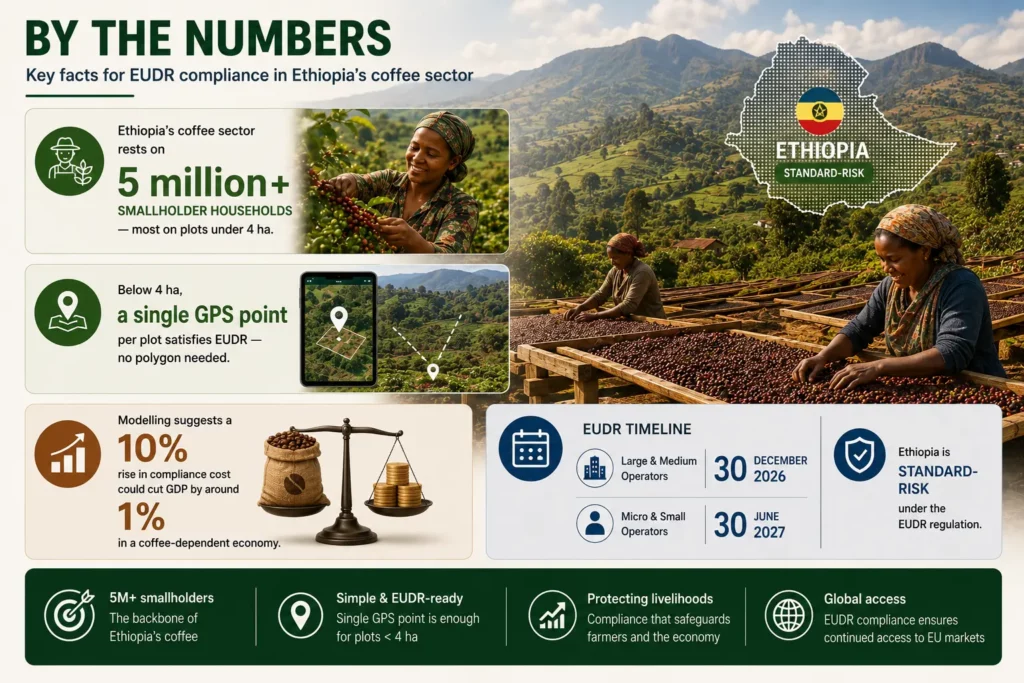
Ethiopian coffee exporters must trace every EU-bound lot to the geolocated plots it came from, prove the land was not deforested after 31 December 2020, confirm legal production, file a Due Diligence Statement, and keep the records for five years. For Ethiopia’s smallholder farms nearly all under 4 hectares a single GPS point per plot is enough. The hard part isn’t the paperwork: it’s that Ethiopian coffee has long been bulked by region and grade through the commodity exchange, which erases the farm-level identity EUDR now requires. Compliance means rebuilding that identity mapping farms, segregating lots, and defending shade-grown forest coffee against satellite false positives before the 30 December 2026 deadline.
Key Takeaways
It’s an identity problem, not a paperwork one. Ethiopia’s market was built to bulk coffee anonymously through the exchange. EUDR requires the opposite every bag traced to a geolocated plot.
The barrier is the supply-chain architecture. The challenge isn’t growing the coffee; it’s reconnecting millions of anonymous smallholder plots to verifiable, deforestation-free identities.
Forest coffee is the false-positive trap. Ethiopia’s shade-grown coffee — among the world’s most sustainable — is the most likely to be wrongly flagged as forest on satellite.
Readiness is now a market-access question. Buyers are already reacting; exporters who reach farm-level traceability protect access and can command an origin premium.
Can you trace an export lot back to the farm — today?
See how TraceX maps smallholder plots offline, segregates lots, and builds EUDR-ready farm identity across Ethiopian coffee supply chains.
Ethiopian Coffee Exporters EUDR: What the Rules Demand
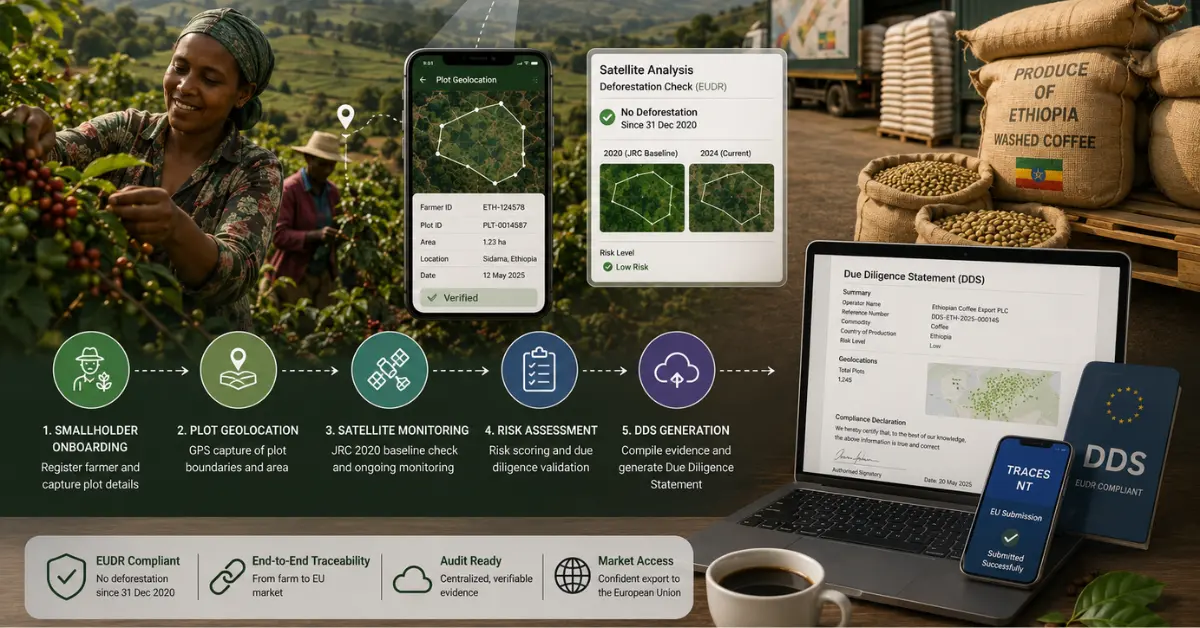
For Ethiopian coffee exporters, EUDR sets a clear bar: every batch of coffee placed on the EU market must be traceable to the plots where it was grown, proven deforestation-free after 31 December 2020, legally produced, and backed by a Due Diligence Statement (DDS) filed in the EU Information System. Records must be kept for at least five years. In practice, that means:
Geolocation of every plot. A single GPS point is sufficient for plots at or under 4 hectares virtually all Ethiopian smallholder farms while larger plots need a polygon boundary.
Deforestation-free proof. Each plot must be shown not to have replaced forest after the 2020 cut-off, verified against satellite data.
Legality and a DDS. Evidence of legal production, compiled into a Due Diligence Statement for each consignment.
Ethiopia sits in the standard-risk tier under the EU’s country benchmarking, so full due diligence applies, and the obligations bite from 30 December 2026 for larger operators and 30 June 2027 for the smallest. Certification such as Rainforest Alliance or Fairtrade supports good practice but does not satisfy EUDR plot-level geolocation is still required. On paper, it’s a checklist. For Ethiopian coffee, the checklist hides the real problem.
Why EUDR Is an Identity Problem for Ethiopian Coffee
Here is what a requirements checklist won’t tell you. Ethiopian coffee has, for years, moved through the Ethiopia Commodity Exchange (ECX), where it is graded and bulked by region and quality to create liquid, tradable lots. That system works precisely because it strips out farm identity a buyer purchases “Grade 2 Sidamo,” not the harvest of a named farmer on a mapped plot. EUDR demands the exact opposite: every bag traceable to a specific geolocation. So Ethiopian coffee exporters aren’t adding a field to a form; they are reversing a market that was engineered around anonymity.
You can see it in how traceability is graded. Most coffee moving through the ECX carries only region-level identity; specialty coffee sold on direct export licences reaches further; full farm-level GPS traceability the only level EUDR accepts remains comparatively rare. The government’s own traceability system is being built to centralise plot data, but adoption is behind schedule, and the exchange has yet to be redesigned to handle segregated, traceable lots. As one analysis put it, the challenge is not coffee production it is the architecture of the supply chain.
Then comes the cruel twist. Much Ethiopian Arabica grows under natural forest shade forest and semi-forest coffee that is among the most biodiverse and sustainable on earth. To a satellite, that canopy reads as forest, and ordinary management can look like change. The farmers doing the least environmental harm are therefore the most exposed to false deforestation flags. For Ethiopian coffee exporters, EUDR compliance is as much about defending genuine forest coffee as it is about catching real risk.
Ethiopian Coffee Exporters EUDR: Real-World Cases
These current examples show the identity problem and what closes it.
The exchange that bulks away the evidence
Coffee bought through the ECX typically arrives identified only by region Sidamo, Yirgacheffe, Guji with the farm-level trail gone. An exporter holding such a lot simply cannot produce the geolocation EUDR requires. What closes it: segregated, traceable lots and direct farmer mapping that keep plot identity intact from cherry to container.
A major buyer starts backing away
The cost of inaction is already visible: a long-standing German buyer, Dallmayr, has signalled plans to wind down Ethiopian sourcing amid the traceability uncertainty. When architecture lags, buyers hedge and volume moves to origins that can prove compliance. What closes it: demonstrable farm-level traceability that gives buyers the confidence to stay.
Forest coffee flagged as forest
Shade-grown coffee from Ethiopia’s forest systems can be misread by satellite as untouched forest, so routine tending or thinning risks tripping a deforestation alert on a compliant, biodiverse farm. What closes it: ground-truth data and forest-coffee land-use context layered onto satellite screening, so genuine forest coffee is defended, not penalised.
A cooperative union rebuilds identity, plot by plot
A union onboarding thousands of members captures a single GPS point per sub-hectare plot all that EUDR needs below 4 hectares linking each farmer to the lot they supply. It is the identity rebuild in miniature, repeated across millions of farms. What closes it: offline-first mobile onboarding that works where connectivity and literacy are limited.
Meeting EUDR means rebuilding identity across the supply chain not bolting documents onto a bulked lot. A platform built for Ethiopian coffee exporters facing EUDR should do six things.
Map smallholders offline. Register farmers and capture a GPS point per plot on mobile, syncing when connectivity returns so no farm is excluded for lack of signal.
Enable Farm Operations Without Connectivity Barriers
Discover how TechnoServe improved farm management, procurement, and compliance by empowering field teams with offline maps, seamless data synchronization, and real-time visibility across remote coffee-growing regions.
Segregate lots to preserve identity. Keep farm-linked lots separate through washing station, processing and export instead of bulking them into anonymity.
Screen plots against satellite — with context. Check each plot against forest data, but layer in forest-coffee land-use context so shade-grown farms aren’t lost to false positives.
Give every lot a digital identity. Tie each lot to verified geolocation, farmer credentials and processing records, so it can prove its origin end to end.
Generate the DDS and retain records. Compile geolocation, legality and risk evidence into a Due Diligence Statement and keep it for five years.
Climb to farm-level traceability. Move lots from region-level identity to full farm-level GPS the only level EUDR accepts and turn it into an origin premium.
Ethiopian Coffee Traceability Levels vs EUDR
EUDR only accepts the top of this ladder. Know where each lot sits.
Traceability level
What it identifies
EUDR-ready?
Level 1 — Region
Origin only (e.g. Sidamo, Yirgacheffe)
No — not plot-level
Level 2 — Woreda / washing station
District or station of processing
No — still not the farm
Level 3 — Cooperative / union
A group of farmers
Partial — closer, not per-plot
Level 4 — Farmer identity
A named farmer, without GPS
Partial — identity, no geolocation
Level 5 — Farm GPS + harvest date
Geolocated plot, farmer and date
Yes — the EUDR standard
TraceX EUDR Solutions helps Ethiopian exporters streamline compliance by digitizing farmer and plot onboarding, validating GPS coordinates, conducting multi-source satellite-based deforestation risk assessments, managing legality and supplier documentation, and generating TRACES-ready Due Diligence Statements (DDS). With continuous monitoring, risk scoring, and centralized compliance records, TraceX enables exporters to reduce compliance costs, accelerate supplier onboarding, build buyer confidence, and ensure their coffee exports remain EUDR-compliant and audit-ready for the European market.
Turn Ethiopia’s traceability challenge into an origin premium.
TraceX maps smallholder plots offline, segregates farm-linked lots, screens against satellite with forest-coffee context, and builds EUDR-ready farm identity from cherry to container.
Before the deadline, confirm you can tick every box.
✓Every supplying farmer is digitally registered with KYC and plot data.
✓Each plot has a GPS point (or polygon above 4 ha), captured offline where needed.
✓Farm-linked lots are segregated through washing station, processing and export.
✓Every plot is screened against satellite data with forest-coffee context applied.
✓Each lot carries a digital identity tying it to geolocation and farmer.
✓A DDS can be produced per consignment, with records kept for five years.
✓Traceability reaches Level 5 (farm GPS), not just region or cooperative.
Frequently Asked Questions
Do Ethiopian smallholder farms need polygon mapping for EUDR?
No. For plots at or under 4 hectares nearly all Ethiopian coffee farms a single GPS point per plot is sufficient. Polygons are only required above 4 hectares.
Why is EUDR so hard for Ethiopian coffee specifically?
Because coffee has traditionally been bulked by region and grade through the commodity exchange, which removes farm-level identity. EUDR requires the opposite plot-level geolocation so exporters must rebuild traceability the market was designed to erase.
Does Rainforest Alliance or Fairtrade certification meet EUDR?
No. Certification supports sustainable practice but does not replace EUDR. Exporters must still provide plot-level geolocation and prove no deforestation occurred after 31 December 2020.
Will forest-shade coffee be treated as deforestation?
Not if it can be evidenced. Shade-grown coffee can be misread by satellite as forest, so ground-truth data and forest-coffee land-use context are needed to defend genuinely deforestation-free farms.
What happens if Ethiopian coffee fails EUDR checks at the EU border?
Shipments can be delayed, blocked or rejected, and authorities may request more documentation, inspect goods or impose penalties. Complete farm-level records are the best protection.
We use cookies on our website to give you the most relevant experience by remembering your preferences and repeat visits. By clicking “Accept All”, you consent to the use of ALL the cookies. However, you may visit "Cookie Settings" to provide a controlled consent.
This website uses cookies to improve your experience while you navigate through the website. Out of these, the cookies that are categorized as necessary are stored on your browser as they are essential for the working of basic functionalities of the website. We also use third-party cookies that help us analyze and understand how you use this website. These cookies will be stored in your browser only with your consent. You also have the option to opt-out of these cookies. But opting out of some of these cookies may affect your browsing experience.
Necessary cookies are absolutely essential for the website to function properly. These cookies ensure basic functionalities and security features of the website, anonymously.
Cookie
Duration
Description
cookielawinfo-checkbox-analytics
11 months
This cookie is set by GDPR Cookie Consent plugin. The cookie is used to store the user consent for the cookies in the category "Analytics".
cookielawinfo-checkbox-functional
11 months
The cookie is set by GDPR cookie consent to record the user consent for the cookies in the category "Functional".
cookielawinfo-checkbox-necessary
11 months
This cookie is set by GDPR Cookie Consent plugin. The cookies is used to store the user consent for the cookies in the category "Necessary".
cookielawinfo-checkbox-others
11 months
This cookie is set by GDPR Cookie Consent plugin. The cookie is used to store the user consent for the cookies in the category "Other.
cookielawinfo-checkbox-performance
11 months
This cookie is set by GDPR Cookie Consent plugin. The cookie is used to store the user consent for the cookies in the category "Performance".
viewed_cookie_policy
11 months
The cookie is set by the GDPR Cookie Consent plugin and is used to store whether or not user has consented to the use of cookies. It does not store any personal data.
Functional cookies help to perform certain functionalities like sharing the content of the website on social media platforms, collect feedbacks, and other third-party features.
Performance cookies are used to understand and analyze the key performance indexes of the website which helps in delivering a better user experience for the visitors.
Analytical cookies are used to understand how visitors interact with the website. These cookies help provide information on metrics the number of visitors, bounce rate, traffic source, etc.
Advertisement cookies are used to provide visitors with relevant ads and marketing campaigns. These cookies track visitors across websites and collect information to provide customized ads.
Download the 2026 Traceability Scorecard and Benchmark Your Supply Chain Across 10 Critical Capabilities.
Download our eBook
Don’t Wait for an Audit to Find Your EUDR Gaps
The 2026 Simplification Package changes how HS codes, DDS pass-through and geolocation rules apply to you. Get the free guide and 20-point readiness checklist before enforcement catches you unprepared.