Declaration of Conformity Examples: What a Valid DoC Actually Looks Like
Published
, 11 minute read
Share this article
Quick summary: Explore practical Declaration of Conformity examples for CE, PPWR, and machinery products, with the key fields, common mistakes, and checklist points needed to create audit-ready compliance documentation.
Declaration of Conformity examplesare worked samples of the signed legal statement a manufacturer issues to declare that a product meets every applicable EU requirement. In plain terms, a Declaration of Conformity (DoC) is a one-page undertaking but the examples below show why the fields on that page are only the visible tip of the obligation.
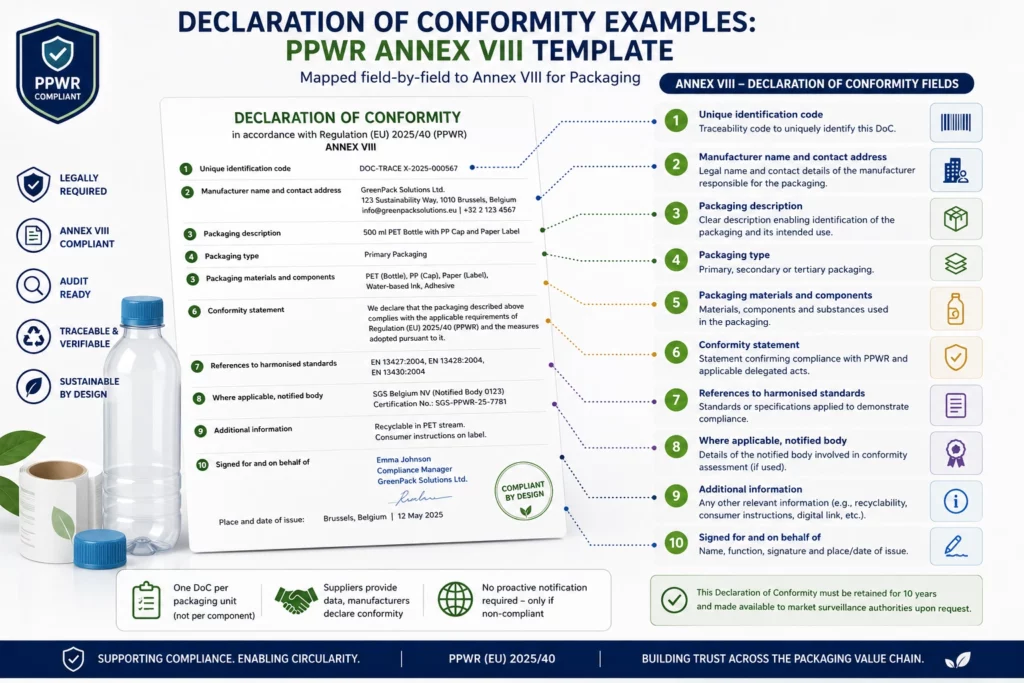
A Declaration of Conformity example is a short document usually one page that follows the Annex III model of Decision No 768/2008/EC (for CE-marked products) or a sector-specific model such as Annex VIII of the PPWR (for packaging). Every valid example contains the same core fields: a unique product identification, the manufacturer’s name and address, the exact “sole responsibility” statement, the object of the declaration, a conformity statement listing each Union act, the dated harmonised standards used, any notified body, additional sector information, and a signature with place and date. The example teaches you the format; the technical file behind each line is what makes the declaration true.
Key takeaways
Most Declaration of Conformity examples share the same nine-field skeleton the Annex III model because every sectoral act incorporates it.
PPWR packaging DoCs use the Annex VIII model and become mandatory for packaging placed on the EU market from 12 August 2026.
A DoC is issued per product type, not per shipment and it is only as valid as the technical file that evidences every claim on it.
Copying a template gets the fields right and the evidence wrong the fastest route to a formally non-compliant declaration.
Download the Free Declaration of Conformity (DoC) Template
Declaration of Conformity examples start with the Annex III model
Most teams searching for Declaration of Conformity examples are not missing the concept they are trying to confirm that their own document has the right fields in the right order. The pain is that a DoC looks deceptively simple: one page, a signature, done. The reality is that Annex III of Decision No 768/2008/EC prescribes nine mandatory elements, and market surveillance authorities treat a missing or vague field as a non-compliance in its own right independent of whether the product is physically safe.
Every CE-marked product from a router to an EV charger draws on the same skeleton, because each sectoral directive or regulation incorporates the Annex III model. Here is a worked CE example for a consumer wireless router:
Annex III field
Example content (illustrative)
1. Product / model / serial
WaveLink AC1200 Wireless Router, Model WL-1200, serial range S0001–S9999
“This declaration of conformity is issued under the sole responsibility of the manufacturer.”
4. Object of the declaration
Wireless router identified above (colour image may be attached for identification)
5. Conformity statement + acts
In conformity with: Radio Equipment Directive 2014/53/EU; RoHS Directive 2011/65/EU
6. Harmonised standards (dated)
EN 300 328 V2.2.2; EN 301 489-1 V2.2.3; EN IEC 63000:2018
7. Notified body
N/A — Module A internal production control (no notified body involved)
8. Additional information
Frequency band 2.4 GHz; maximum RF power 20 dBm
9. Signed for and on behalf of
[Berlin, 12 March 2026 — J. Schmidt, Compliance Manager, signature]
The benefit of anchoring to this model is presumption of correctness: a single declaration can cover all applicable acts, so one document not four carries the product to market. The proof that it is done right is traceability: field 1 must identify the exact unit or production run, and field 6 must cite the dated edition (“EN 60204-1:2018”, not “EN 60204-1”). Undated standards and pre-signed declarations are the two errors that turn a tidy-looking example into an invalid one.
Declaration of Conformity examples under PPWR follow the Annex VIII model
For packaging, Declaration of Conformity examples change shape. From 12 August 2026, Regulation (EU) 2025/40 (PPWR) requires an EU declaration of conformity drawn up under Article 39 to the Annex VIII model for every packaging type placed on the EU market. The pain here is scale: importers and brand owners are not authoring one DoC, they are collecting and verifying them across hundreds of SKUs and suppliers, each backed by an Annex VII technical file.
A worked PPWR example for a corrugated transport box:
Annex VIII field
Example content (illustrative)
Unique identification
Corrugated transport box, ref. CT-450, 450×300×200 mm, DoC No. PPWR-2026-BOX-0091
Manufacturer / authorised rep
[Producer legal entity name and full address; Article 17 authorised representative where non-EU]
Sole-responsibility line
“This declaration of conformity is issued under the sole responsibility of the manufacturer.”
Object of the declaration
Corrugated transport box identified above (image may be attached)
Conformity statement
Complies with the applicable requirements of Regulation (EU) 2025/40, Articles 5–12
Standards / specifications
Technical specifications relied on [harmonised standards under Art. 36 still pending for most requirements]
Additional information
Recycled content [––%]; recyclability grade [A/B/C]; substances of concern (heavy metals, PFAS) within limits
Place, date & signature
[Place, date; name, function and signature of authorised signatory]
Missing any Annex VIII field renders the DoC invalid treated under PPWR as if no declaration existed at all. That is the benefit of a structured platform view over a copied template: the capability to hold the recyclability grade, recycled-content percentage and substances-of-concern evidence [as connected records, and to regenerate the Annex VIII DoC automatically when any input changes] means the declaration and the technical file never drift apart.
Declaration of Conformity examples for machinery add a technical-file signatory
Machinery shows how sector-specific Declaration of Conformity examples extend the baseline. Under Regulation (EU) 2023/1230 (applicable 20 January 2027), the Annex V model keeps every Annex III field and adds: the name, address and function of the person authorised to compile the technical file (who must be established in the EU), the conformity assessment procedure followed, and where applicable the reference of the EU type-examination certificate. Partly completed machinery uses a separate Declaration of Incorporation with its own Annex V Part B model, a distinction that trips up many first-time examples.
The pattern repeats across the framework: toys in scope must carry the unique identifier of their Digital Product Passport in the DoC from 1 January 2026 under Regulation (EU) 2025/2509, and the Ecodesign Regulation (EU) 2024/1781 lets the declaration and supporting documentation live inside the DPP itself. The direction of travel is unmistakable: the DoC is becoming a live, linked record rather than a static PDF which is exactly where connected traceability data earns its place.
Why most Declaration of Conformity examples get copied wrong
1. The declaration is the easy page; the technical file is the iceberg
The DoC that authorities and customers rely on is one page. The Annex VII technical file behind it construction drawings, material specifications, test evidence, supplier documentation can run to dozens of pages per SKU. Teams that copy an example nail the visible 10% and under-build the 90% that survives an audit. A declaration without its evidence file will not withstand market surveillance scrutiny; it is a claim with nothing underneath it.
2. Declaration in excess is a false statement, not a safe hedge
A common instinct is to list every plausible act “to be safe.” But a DoC declares conformity with every act it names. Listing the Low Voltage Directive on a battery-powered product outside its voltage range creates a false declaration the opposite of caution. Over-declaration is a substantive error; under-declaration (omitting the Radio Equipment Directive for a machine with a wireless module) is equally fatal. The example must match the product exactly, not aspirationally.
3. A DoC is issued per product type, not per shipment
Plenty of examples online imply a fresh declaration per delivery. Wrong: the DoC covers a product type or family and is updated when that type changes not re-issued per shipment. Get this backwards and you drown in redundant paperwork while missing the one update that actually mattered when the design changed.
4. The example only scales if your evidence does
One perfect DoC example is a formatting exercise. Ten thousand of them kept current as standards, suppliers and materials change is a data problem. This is where a copied Word template quietly fails and connected traceability data wins: the declaration should be a generated view of verified records, not a document someone remembers to update.
How TraceX Helps
Creating a Declaration of Conformity is only as reliable as the data behind it. TraceX PPWR solutions centralize packaging specifications, material composition, supplier declarations, conformity evidence, and technical documentation into a single audit-ready platform. By connecting every packaging SKU with its compliance records, TraceX enables manufacturers to generate accurate, compliant Declarations of Conformity and maintain the supporting documentation required throughout the product lifecycle.
Stop copying templates and hoping the evidence matches
See how TraceX’s broader traceability and compliance platform turns verified supply-chain records into audit-ready Declarations of Conformity across PPWR, DPP and CE
Declaration of Conformity examples: copied template vs. platform-generated
Dimension
Copying an example / manual DoC
Platform-generated DoC
Field completeness
Depends on who copied which template
Model enforced no field can be left blank
Evidence link
DoC and technical file drift apart over time
Declaration is a live view of verified records
Updates on change
Manual; easy to miss a design change
Auto-flag / regenerate when an input changes
Supplier collection (PPWR)
Email threads, inconsistent formats
Structured request + validation at intake
Audit readiness
Reconstructed under deadline pressure
[Retrievable per SKU on demand]
Scale
Breaks past a few dozen SKUs
[Designed for thousands of references]
A buyer’s checklist for judging any Declaration of Conformity example
Before you trust a Declaration of Conformity example your own or a supplier’s run it against this list. Every unchecked box is a potential formal non-compliance.
Does field 1 identify the exact product type, model or serial range (not a generic category)?
Is the manufacturer (and, if non-EU, the authorised representative) named with a full address?
Does it list every applicable act and only the applicable acts?
Are harmonised standards cited by dated edition, published in the OJEU?
Is a notified body named only where one was actually involved (never for Module A)?
Is there a place, date and signature from an authorised natural person (no pre-signed, undated DoCs)?
For packaging: does it follow the Annex VIII model and reference Regulation (EU) 2025/40, Articles 5–12?
Is there a complete technical file behind every claim, retrievable on request?
Frequently Asked Questions (FAQ’s)
What is a Declaration of Conformity example?
It is a worked sample of the signed statement in which a manufacturer declares a product meets all applicable EU requirements. A useful Declaration of Conformity example shows each Annex III (or sector-specific) field filled with realistic content, so you can check your own document against it.
How many fields must a Declaration of Conformity contain?
The Annex III model of Decision No 768/2008/EC prescribes nine mandatory elements. Sector acts (machinery, medical devices, PPWR) keep this baseline and add specific items, so the exact count in an example depends on the applicable legislation.
Is a PPWR Declaration of Conformity different from a CE one?
The structure is similar but the model differs: PPWR uses the Annex VIII model under Article 39 of Regulation (EU) 2025/40 and becomes mandatory from 12 August 2026. It declares conformity with the packaging requirements in Articles 5–12, not with CE-marking directives.
Can one Declaration of Conformity cover several regulations?
Yes. The Commission’s preferred form is a single declaration listing every applicable Union act. A wireless machine, for instance, would list the Machinery Regulation and the Radio Equipment Directive on one DoC rather than issuing separate documents.
Does a Declaration of Conformity need a notified body?
Only where the conformity assessment route involves one. For Module A (internal production control) no notified body is named listing one on the example is a common and revealing error.
How long must I keep the Declaration of Conformity?
For most acts, the DoC and its technical file are retained for ten years after the last unit is placed on the market (longer for some products, such as implantable medical devices). Confirm the period in the applicable act.
Can a Declaration of Conformity be digital?
Increasingly yes. The Machinery Regulation permits a digital DoC from 20 January 2027, the Radio Equipment Directive allows a simplified DoC via a URL, and the Ecodesign Regulation lets the declaration live inside a Digital Product Passport.
Start using TraceX
Transparency, Trust, & Success for your Climate Journey.
We use cookies on our website to give you the most relevant experience by remembering your preferences and repeat visits. By clicking “Accept All”, you consent to the use of ALL the cookies. However, you may visit "Cookie Settings" to provide a controlled consent.
This website uses cookies to improve your experience while you navigate through the website. Out of these, the cookies that are categorized as necessary are stored on your browser as they are essential for the working of basic functionalities of the website. We also use third-party cookies that help us analyze and understand how you use this website. These cookies will be stored in your browser only with your consent. You also have the option to opt-out of these cookies. But opting out of some of these cookies may affect your browsing experience.
Necessary cookies are absolutely essential for the website to function properly. These cookies ensure basic functionalities and security features of the website, anonymously.
Cookie
Duration
Description
cookielawinfo-checkbox-analytics
11 months
This cookie is set by GDPR Cookie Consent plugin. The cookie is used to store the user consent for the cookies in the category "Analytics".
cookielawinfo-checkbox-functional
11 months
The cookie is set by GDPR cookie consent to record the user consent for the cookies in the category "Functional".
cookielawinfo-checkbox-necessary
11 months
This cookie is set by GDPR Cookie Consent plugin. The cookies is used to store the user consent for the cookies in the category "Necessary".
cookielawinfo-checkbox-others
11 months
This cookie is set by GDPR Cookie Consent plugin. The cookie is used to store the user consent for the cookies in the category "Other.
cookielawinfo-checkbox-performance
11 months
This cookie is set by GDPR Cookie Consent plugin. The cookie is used to store the user consent for the cookies in the category "Performance".
viewed_cookie_policy
11 months
The cookie is set by the GDPR Cookie Consent plugin and is used to store whether or not user has consented to the use of cookies. It does not store any personal data.
Functional cookies help to perform certain functionalities like sharing the content of the website on social media platforms, collect feedbacks, and other third-party features.
Performance cookies are used to understand and analyze the key performance indexes of the website which helps in delivering a better user experience for the visitors.
Analytical cookies are used to understand how visitors interact with the website. These cookies help provide information on metrics the number of visitors, bounce rate, traffic source, etc.
Advertisement cookies are used to provide visitors with relevant ads and marketing campaigns. These cookies track visitors across websites and collect information to provide customized ads.
Download the 2026 Traceability Scorecard and Benchmark Your Supply Chain Across 10 Critical Capabilities.
Download our eBook
Don’t Wait for an Audit to Find Your EUDR Gaps
The 2026 Simplification Package changes how HS codes, DDS pass-through and geolocation rules apply to you. Get the free guide and 20-point readiness checklist before enforcement catches you unprepared.