PPWR Product and SKU Mapping: How to Link Packaging to Every Product You Sell
Published
, 12 minute read
Share this article
Quick summary: PPWR product and SKU mapping is no longer a back-office data exercise — it is the foundation for proving packaging compliance across every product placed on the EU market. By connecting each SKU to its packaging components, material data, supplier evidence, and compliance status, companies can move from fragmented spreadsheets to an audit-ready register built for PPWR deadlines.
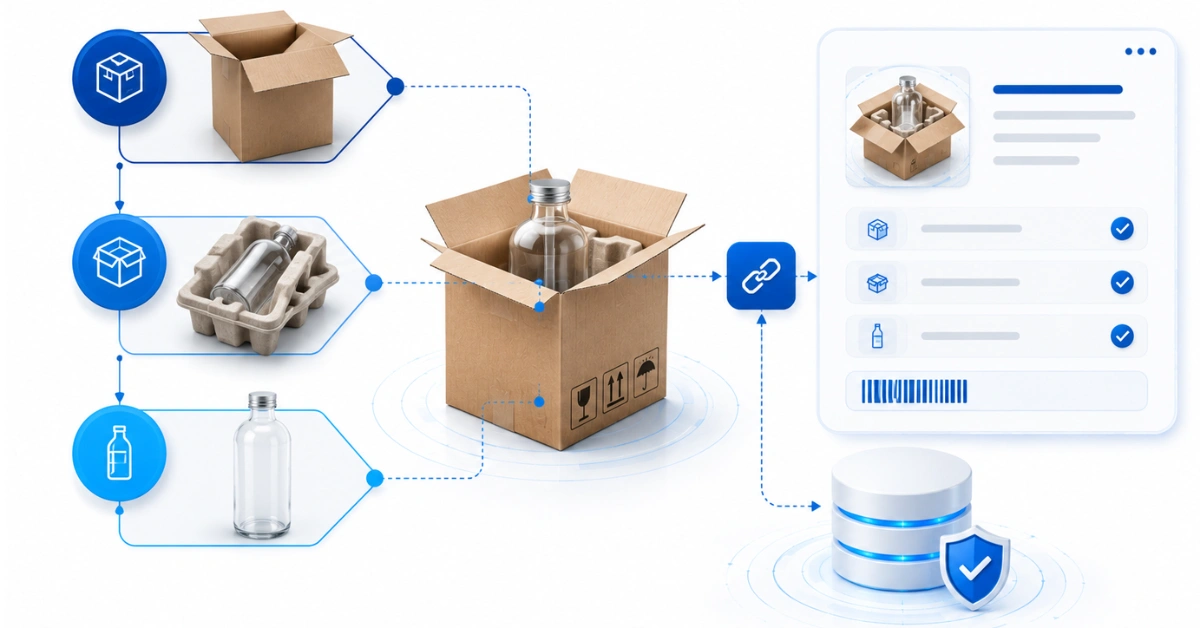
PPWR product and SKU mapping is the process of linking every packaging component primary, secondary, and tertiary to each individual product (SKU) a company places on the EU market, so that material composition, weight, recyclability grade, recycled content, and supplier evidence can be reported per packaging unit under the EU Packaging and Packaging Waste Regulation (Regulation (EU) 2025/40). Manufacturers, importers, and ecommerce sellers need SKU-level packaging records to produce declarations of conformity, technical documentation, and EPR reporting. Compliance platforms from TraceX automate this mapping by pulling product masters from ERP systems, classifying packaging components with AI, and maintaining an audit-ready packaging-to-SKU register.
PPWR product and SKU mapping is where most packaging compliance programmes quietly fail. Teams read the regulation, brief their suppliers, and even collect material declarations then discover that none of that data is connected to the actual products they sell. The EU Packaging and Packaging Waste Regulation doesn’t regulate your company in the abstract. It regulates every packaging unit you place on the market, which means every SKU in your catalogue needs its own defensible packaging record.
In plain language: PPWR product and SKU mapping means building a register that answers, for any product you sell into the EU, exactly what packaging it ships in, what that packaging is made of, how much it weighs, whether it meets recyclability and recycled-content requirements, and which supplier documents prove it.
If you’re a compliance, procurement, or operations lead staring at a catalogue of 500, 5,000, or 50,000 SKUs and wondering how you’ll get there before enforcement begins, this guide walks through what the regulation requires at SKU level, why manual approaches break, and how to build a mapping process that survives an audit.
Stop Chasing Packaging Data Across Spreadsheets
Specs, supplier docs, and compliance evidence live in one platform instead of scattered inboxes and files. See exactly how TraceX becomes your single source of truth for PPWR.
PPWR compliance is assessed per packaging unit which means your obligations attach at SKU level, not at company or category level.
Every SKU needs a complete packaging record: components, materials, weights, recyclability performance, recycled content, and supplier evidence.
Spreadsheet-based mapping collapses at scale: multi-component packs, seasonal variants, and supplier substitutions create silent data gaps auditors will find.
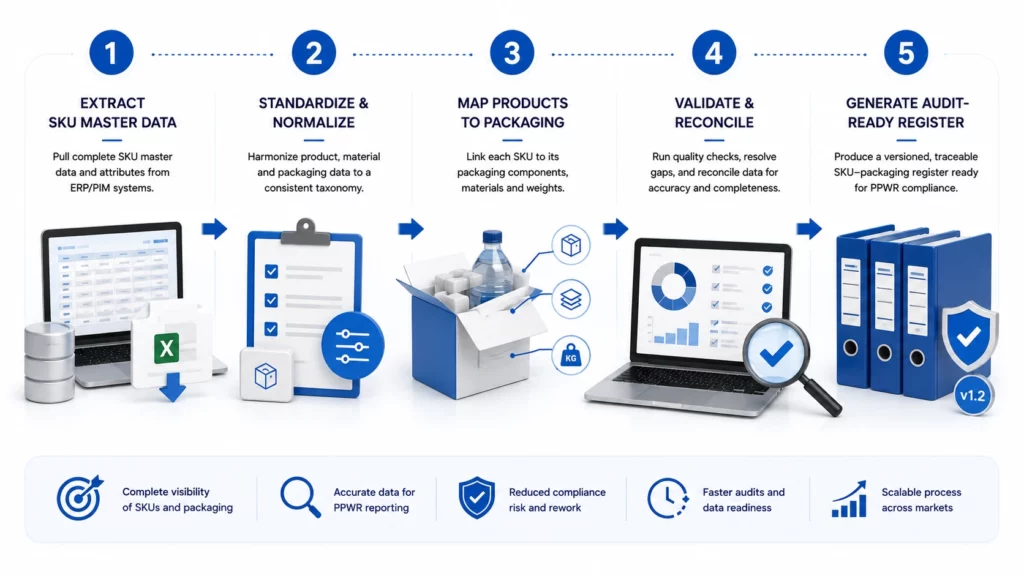
A defensible mapping process has five steps: extract the SKU master, decompose packaging into components, attach supplier evidence, classify against PPWR criteria, and version-control every change.
Automated packaging-to-SKU registers cut mapping effort from months to weeks and keep declarations of conformity continuously audit-ready.
PPWR Product and SKU Mapping: What It Is and Why It Decides Your Compliance Readiness
PPWR obligations attach to individual packaging units, so your compliance posture is only as strong as your weakest SKU record. Here’s what that means in practice:
PPWR (Regulation (EU) 2025/40) entered into force on 11 February 2025, with the majority of obligations applying from 12 August 2026 .
Requirements — recyclability design criteria, recycled-content minimums, labelling, minimisation, and empty-space limits are evaluated per packaging unit, not per company.
A “packaging unit” includes primary packaging (the pouch, jar, or bottle), secondary packaging (the retail carton or multipack sleeve), and tertiary packaging (the shipper, pallet wrap, and void fill).
This is the structural point most teams miss. Two SKUs that look identical on a shelf can have completely different compliance profiles: one uses a mono-material film from Supplier A, the other a laminate from Supplier B introduced during a supply shortage. Without SKU-level mapping, both sit in your system as “coffee pouch, 250g” and one of them is a non-conformity waiting to be discovered.
The economic obligation follows the same logic. Extended producer responsibility fees are increasingly eco-modulated: what you pay per unit depends on the recyclability performance of that unit’s packaging. Poor mapping doesn’t just create audit risk it means you can’t even calculate what compliance will cost you.
PPWR introduces new requirements for packaging design, recyclability, technical documentation, conformity assessments, and economic operators. Understanding these requirements today is the first step toward building a compliant packaging strategy.
PPWR Product and SKU Mapping Obligations: The Data the Regulation Actually Requires
Every SKU-level packaging record needs a defined set of fields to support conformity assessment and reporting. The core data model looks like this:
Component inventory — every separable packaging element per SKU: body, closure, label, liner, sleeve, insert, void fill, shipper.
Material composition per component — polymer or fibre type, coatings, adhesives, inks, and any substances of concern.
Weight per component — the basis for EPR fee calculation, minimisation assessment, and recycled-content percentages.
Recyclability performance grade — from 1 January 2030, packaging must meet design-for-recycling criteria and will be graded on recyclability performance .
Recycled content share — plastic packaging faces minimum recycled-content percentages from 2030, calculated per unit of packaging
Supplier evidence — material declarations, test reports, and certificates tied to the specific component and supplier, not filed loosely at company level.
Declaration of conformity and technical documentation — the assembled proof pack you must be able to produce for market surveillance authorities per packaging type.
You can’t manage what you haven’t mapped. A comprehensive packaging inventory is the foundation for identifying packaging materials, collecting supplier documentation, assessing compliance, and preparing for PPWR.
Read our Complete Guide to Building a PPWR Packaging Inventory
PPWR mapping requirements differ by role in the chain
Brand manufacturers own the deepest obligation: full technical documentation for packaging they specify. Importers must verify that documentation exists before placing products on the EU market. Ecommerce sellers and fulfilment-driven brands carry a distinctive extra burden the shipping packaging they add (mailers, void fill, boxes) is packaging they “place on the market” too, and the empty-space ratio limits for grouped, transport, and e-commerce packaging apply to their pack-out choices, not just to what arrives from suppliers.
Why PPWR Product and SKU Mapping Breaks Down in Spreadsheets
Manual mapping fails predictably at four points. If any of these describe your current setup, you have gaps you can’t see:
The combinatorial explosion. A 2,000-SKU catalogue with an average of six packaging components per SKU is a 12,000-row mapping problem before variants, bundles, seasonal packs, and market-specific formats multiply it further.
Silent supplier substitutions. Procurement swaps a film supplier to protect margin; the spreadsheet still shows last year’s material spec. Your declaration of conformity is now wrong, and nobody knows.
Evidence divorced from records. Supplier certificates live in email threads and shared drives. When an authority asks you to substantiate the recyclability grade of one specific SKU’s closure, assembling the proof takes days — per request.
No version history. PPWR compliance is continuous, not a one-off certification. When packaging changes, you must show what was true when. Spreadsheets overwrite; audits require history.
The pattern we see across compliance teams is consistent: the first 60% of the catalogue maps quickly, and the remaining 40% the multi-component packs, the co-manufactured lines, the SKUs with three possible shippers depending on the fulfilment centre consumes months and still ends up incomplete.
PPWR compliance depends on more than packaging it depends on knowing where your packaging materials come from, who supplies them, and how information flows across your value chain. Build visibility before compliance deadlines arrive.
Read our Complete Guide to PPWR Supply Chain Mapping
How to Build a PPWR Product and SKU Mapping Process: Five Steps
A defensible mapping process moves from your existing product data outward to supplier evidence, in this order:
Step 1: Extract and clean the SKU master
Start from your ERP or PIM, not from packaging specs. Pull every active SKU sold into the EU, including bundles, variants, and marketplace-only listings. Deduplicate, retire dead SKUs, and flag products with multiple packaging configurations (different co-packers, different markets). This is your denominator every compliance percentage you report later is measured against it.
Step 2: Decompose each SKU into packaging components
For every SKU, list each separable packaging element across all three layers. Use a consistent component taxonomy (body / closure / label / liner / secondary / tertiary) so records are comparable across the catalogue. Where identical components are shared across SKUs the same jar across twelve flavours model the component once and link it to many SKUs, so a spec change propagates everywhere automatically.
Step 3: Attach supplier evidence at component level
Request material declarations, weights, recycled-content certificates, and recyclability test data from suppliers per component, and store each document linked to the component record it substantiates. An unlinked certificate is administratively invisible: if you can’t trace it to a SKU in under a minute, it won’t help you in an audit.
Step 4: Classify components against PPWR criteria
With composition and weight data in place, assess each packaging unit against the applicable requirements: recyclability design criteria, recycled-content minimums, minimisation, empty-space ratios for shipping formats, and labelling. The output is a compliance status per SKU conformant, at risk, or non-conformant with the specific failing component identified.
Step 5: Version-control the register and generate documentation
Lock the register under change control. Every supplier substitution, spec revision, or new SKU triggers a re-assessment and a new version, with the old record preserved. From this living register, generate declarations of conformity and technical documentation on demand rather than assembling them by hand per request.
PPWR Product and SKU Mapping with TraceX : From ERP Extract to Audit-Ready Register
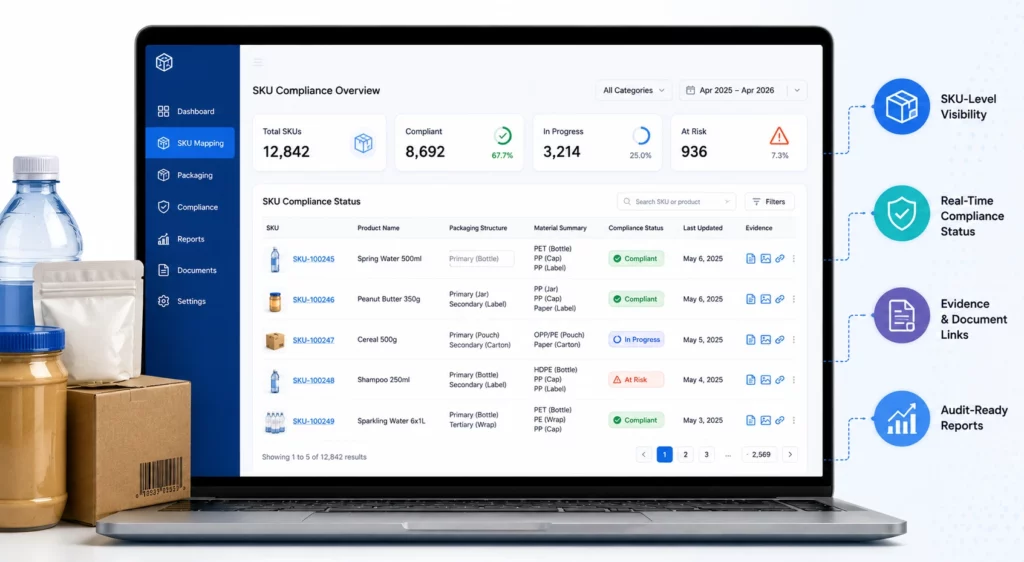
The five steps above are exactly what TraceX PPWR Solution operationalises replacing the spreadsheet layer with a structured packaging-to-SKU register that stays current as your catalogue changes.
Automated SKU ingestion from your existing systems
Cleara AI connects to your ERP and product data sources [verify current connector list — e.g., SAP, Oracle NetSuite, Microsoft Dynamics, Odoo] and pulls the SKU master directly, so mapping starts from live product data instead of a stale export. New SKUs and delisted products sync automatically, keeping the compliance denominator accurate.
AI-assisted packaging component classification
Instead of manually decomposing thousands of SKUs, Cleara AI’s classification engine reads packaging specifications and supplier declarations including unstructured PDFs and proposes the component breakdown, material assignments, and weights for review. Your team validates exceptions rather than keying every row, which is where the months-to-weeks compression happens.
Evidence vault linked at component level
Supplier certificates, test reports, and declarations are stored against the exact components they substantiate. When a document expires or a supplier changes, the affected SKUs are flagged instantly closing the silent-substitution gap that breaks manual registers.
Continuous compliance status and documentation on demand
Each SKU carries a live PPWR status against recyclability, recycled-content, and labelling requirements, and declarations of conformity are generated from the register rather than drafted by hand. When market surveillance asks for the technical documentation behind one SKU, the answer is an export, not a project.
Everything You Need to Understand PPWR — in One Guide
Skip the scattered articles and regulatory PDFs. Our handbook breaks down PPWR obligations, timelines, and requirements into one clear resource.
PPWR Product and SKU Mapping: Manual Spreadsheets vs. Automated Register
Dimension
Manual spreadsheet mapping
Automated register (TraceX )
Initial mapping effort
Months of manual data entry; long tail of complex SKUs often left incomplete
AI-assisted classification from ERP data and supplier docs; weeks, with exceptions routed for review
Supplier substitutions
Invisible until someone remembers to update the sheet
Flagged automatically; affected SKUs re-assessed
Evidence traceability
Certificates scattered across drives and inboxes
Documents linked to the exact component and SKU they prove
Version history
Overwritten cells; no defensible audit trail
Full change history per SKU and component
Declarations of conformity
Assembled by hand per request, over days
Generated from the register on demand
Scaling to new SKUs
Every launch adds manual rows and risk
New SKUs sync from ERP and enter the classification queue automatically
PPWR Product and SKU Mapping Readiness: A Buyer’s Checklist
Use this checklist to assess your current state or to evaluate any platform you’re considering:
Can you produce a complete packaging component list for any SKU in under one minute?
Is every supplier certificate linked to the specific component it substantiates?
Do supplier substitutions automatically trigger a compliance re-assessment?
Can you calculate eco-modulated EPR fee exposure per SKU from your current data?
Is there a version history showing what your packaging data said at any past date?
Can declarations of conformity and technical documentation be generated from the register rather than assembled manually?
Does your SKU master sync from ERP, or does someone maintain a parallel export?
Are e-commerce shipping formats (mailers, void fill, shippers) mapped as packaging you place on the market?
If you answered “no” to three or more, your mapping gap is large enough that manual remediation is unlikely to close it before enforcement — and automation moves from nice-to-have to necessary.
Frequently Asked Questions (FAQ’s)
What is PPWR product and SKU mapping?
It’s the process of linking every packaging component primary, secondary, and tertiary to each individual product (SKU) you place on the EU market, with material, weight, recyclability, recycled-content, and evidence data attached, so PPWR conformity can be demonstrated per packaging unit.
Does PPWR really apply at SKU level rather than company level?
Yes. PPWR requirements recyclability criteria, recycled-content minimums, labelling, and minimisation are assessed per packaging unit. Reporting and EPR fees are calculated from unit-level data aggregated across what you place on the market, which is only possible with SKU-level records.
Which teams should own the packaging-to-SKU register?
Compliance typically owns the register’s integrity, but procurement (supplier evidence), packaging engineering (specifications), and operations (ERP master data) all feed it. The structural mistake is letting each function keep its own partial copy the register must be single-source.
How long does PPWR product and SKU mapping take for a typical catalogue?
Manually, mid-size catalogues (1,000–5,000 SKUs) commonly take months , with the complex long tail unfinished. With automated ingestion and AI-assisted classification, comparable catalogues reach audit-ready state in weeks
Do ecommerce sellers need SKU mapping if suppliers handle product packaging?
Yes. The shipping packaging you add at fulfilment mailers, boxes, void fill is packaging you place on the market, subject to empty-space limits and reporting. You also carry verification duties for the product packaging of goods you import.
How does TraceX handle packaging shared across many SKUs?
Shared components are modelled once and linked to every SKU that uses them. When the component’s spec or supplier changes, all linked SKUs are re-assessed in one pass the register stays consistent without duplicate maintenance.
Start using TraceX
Transparency, Trust, & Success for your Climate Journey.
We use cookies on our website to give you the most relevant experience by remembering your preferences and repeat visits. By clicking “Accept All”, you consent to the use of ALL the cookies. However, you may visit "Cookie Settings" to provide a controlled consent.
This website uses cookies to improve your experience while you navigate through the website. Out of these, the cookies that are categorized as necessary are stored on your browser as they are essential for the working of basic functionalities of the website. We also use third-party cookies that help us analyze and understand how you use this website. These cookies will be stored in your browser only with your consent. You also have the option to opt-out of these cookies. But opting out of some of these cookies may affect your browsing experience.
Necessary cookies are absolutely essential for the website to function properly. These cookies ensure basic functionalities and security features of the website, anonymously.
Cookie
Duration
Description
cookielawinfo-checkbox-analytics
11 months
This cookie is set by GDPR Cookie Consent plugin. The cookie is used to store the user consent for the cookies in the category "Analytics".
cookielawinfo-checkbox-functional
11 months
The cookie is set by GDPR cookie consent to record the user consent for the cookies in the category "Functional".
cookielawinfo-checkbox-necessary
11 months
This cookie is set by GDPR Cookie Consent plugin. The cookies is used to store the user consent for the cookies in the category "Necessary".
cookielawinfo-checkbox-others
11 months
This cookie is set by GDPR Cookie Consent plugin. The cookie is used to store the user consent for the cookies in the category "Other.
cookielawinfo-checkbox-performance
11 months
This cookie is set by GDPR Cookie Consent plugin. The cookie is used to store the user consent for the cookies in the category "Performance".
viewed_cookie_policy
11 months
The cookie is set by the GDPR Cookie Consent plugin and is used to store whether or not user has consented to the use of cookies. It does not store any personal data.
Functional cookies help to perform certain functionalities like sharing the content of the website on social media platforms, collect feedbacks, and other third-party features.
Performance cookies are used to understand and analyze the key performance indexes of the website which helps in delivering a better user experience for the visitors.
Analytical cookies are used to understand how visitors interact with the website. These cookies help provide information on metrics the number of visitors, bounce rate, traffic source, etc.
Advertisement cookies are used to provide visitors with relevant ads and marketing campaigns. These cookies track visitors across websites and collect information to provide customized ads.
Download the 2026 Traceability Scorecard and Benchmark Your Supply Chain Across 10 Critical Capabilities.
Download our eBook
Don’t Wait for an Audit to Find Your EUDR Gaps
The 2026 Simplification Package changes how HS codes, DDS pass-through and geolocation rules apply to you. Get the free guide and 20-point readiness checklist before enforcement catches you unprepared.