EUDR Information System Updates: What Businesses Need to Know From the Latest User Guide
Published
, 10 minute read
Share this article
Quick summary: EUDR Information System updates explain DDS workflows, Simplified Declarations, geolocation data, reference numbers, and downstream verification.
A simple, practical guide to the September 2026 update, DDS, Simplified Declarations, downstream roles and what businesses should prepare.
EUDR Information System Updates introduce important changes to how businesses manage Due Diligence Statements, Simplified Declarations, geolocation data, downstream verification and other compliance activities. The latest User Guide provides clearer, role-based workflows and new functionality as businesses prepare for EUDR application. If you are preparing for EUDR, you may be spending most of your time collecting geolocation, supplier and due-diligence information. But there is another part of the process that is becoming increasingly important: understanding how the EUDR Information System actually works.
The European Commission’s EUDR User Guide was updated on 16 September 2026. The guide explains how businesses can register, create and manage Due Diligence Statements (DDS), submit Simplified Declarations (SD), manage statement records, group their own declarations and verify upstream statements. It also explains how different economic operator roles interact with the system.
For businesses, the key message is simple: EUDR compliance is not just about preparing a DDS. You also need to understand the digital workflow around registration, references, verification, geolocation and downstream traceability.
Key Takeaways
The User Guide was updated on 16 September 2026.
The system supports DDS and Simplified Declaration workflows and different EUDR activity types.
DDS reference numbers and SD identifiers are important downstream and customs data points.
Geolocation is a core part of the declaration workflow.
Downstream businesses can verify upstream declarations using the relevant reference and verification information.
DDS grouping can help manage large geolocation volumes, but the Group Head becomes the legally relevant statement.
The practical challenge is connecting the Information System with the underlying supply-chain data and evidence.
December 2026 is approaching. Is your supply chain actually ready?
Move from spreadsheets and fragmented supplier data to a traceable, audit-ready EUDR workflow with TraceX.
EUDR Information System Updates : What Changed in the September 2026?
The EUDR Information System is the European Commission’s digital system for managing the EUDR statement lifecycle. The updated User Guide explains that the system supports the creation, submission and management of DDS and Simplified Declarations and is part of the TRACES platform.
Think of it as the place where the formal EUDR declaration is submitted and managed. But the system does not replace the work businesses need to do before submission. Companies still need to collect the underlying supplier, product, production-location, geolocation and due-diligence information needed for their role.
Role-Based Workflows Matter
The guide distinguishes between EUDR Operators, Micro or Small Primary Operators, SME Downstream Operators or Traders, non-SME Downstream Operators or Traders, and Authorised Representatives.
This matters because not every company uses the system in the same way. An upstream operator uses it to submit a DDS. A qualifying Micro or Small Primary Operator uses it for a Simplified Declaration. Downstream businesses have different access and verification functions.
For large businesses that previously used a general Trader activity type, the guide says they need to actively take on the new EUDR Non-SME Downstream Operator or Trader activity type to fulfil the relevant Article 5(2) obligations.
Understand how EUDR obligations change depending on whether you are an upstream operator, downstream operator, trader, or micro/small primary operator and what each role needs to do across due diligence, traceability, DDS references, and record keeping.
Once a DDS is processed and becomes AVAILABLE, the system assigns a unique reference number and verification number. The User Guide explains that the DDS reference number is the number shared with the next actor in the supply chain or entered in the customs declaration.
This creates a practical requirement for companies: the DDS reference cannot be treated as an isolated number sitting in an email or spreadsheet. It needs to remain connected to the relevant supplier, product, shipment or transaction.
For example, if a European importer receives coffee covered by a DDS, the importer should be able to connect the incoming product with the relevant EUDR reference and the underlying supply-chain records.
EUDR reference management is essential for connecting Due Diligence Statements, products, suppliers, shipments and customs declarations. Understand how DDS reference numbers and declaration identifiers should be managed across your supply chain and how to maintain a clear compliance trail.
The updated guide provides specific instructions for entering production locations, including manual entry and GeoJSON import. The DDS workflow also requires product information, quantities and geolocation as part of the relevant declaration data.
This is important because a company cannot treat geolocation as a separate compliance file that is prepared only when the DDS is submitted. Production locations need to be organized so they can be accurately associated with the relevant products and declarations.
In practice, businesses dealing with hundreds or thousands of plots will benefit from having a structured geospatial data layer before they reach the final submission stage.
Simplified Declarations for Micro and Small Primary Operators
The User Guide provides a dedicated workflow for Micro or Small Primary Operators (MSPOs). Instead of using the standard DDS workflow, qualifying MSPOs can create, submit and update a Simplified Declaration.
Once the Simplified Declaration becomes AVAILABLE, the system assigns a unique declaration identifier. The guide states that this identifier is used in the customs declaration or shared with the next actor in the supply chain.
This creates another important data point for downstream traceability. Buyers and downstream businesses need a reliable way to connect the declaration identifier with the products they receive.
Understand how EUDR Simplified Declarations work for micro and small primary operators, including the information they need to provide, how plot locations are captured, and how declarations are submitted through the EUDR Information System.
Downstream Businesses Can Verify Upstream Declarations
The updated system provides functionality for verifying an upstream DDS or Simplified Declaration. Users need the relevant DDS reference number or SD declaration identifier together with the associated verification number to perform the verification.
For non-SME downstream operators and traders, the guide also describes the ability to consult the contents of an upstream statement when there is a substantiated concern. This means downstream compliance is not simply about receiving a reference number and filing it away.
For a downstream business, a practical process should connect the incoming product, supplier, DDS or SD reference, verification status and internal transaction records.
DDS Grouping Can Help With Large Volumes
Another useful function is the ability for upstream operators, including MSPOs, to group their own DDS or Simplified Declarations into a single Group Head. The guide explains that this can be useful when a large number of geolocations exceeds the 25 MB file-size limit. Up to 1,000 individual DDS or SD can be grouped into one Group Head.
However, this feature needs to be used carefully. The Group Head becomes the statement with legal value, while the individual statements become grouped and are no longer independently available for use or customs presentation. The quantities and products in the Group Head therefore need to be correct.
Managing multiple Due Diligence Statements can become complex, especially when dealing with large volumes of products and geolocations. EUDR DDS grouping allows businesses to combine multiple DDSs into a Group Head, helping simplify compliance management while maintaining the required references and traceability.
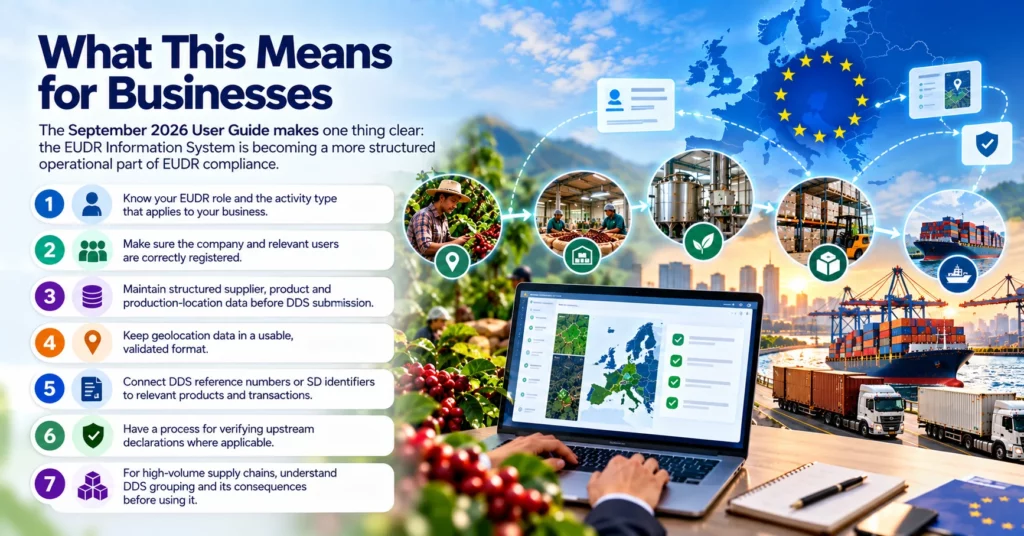
The September 2026 User Guide makes one thing clear: the EUDR Information System is becoming a more structured operational part of EUDR compliance.
Businesses should therefore prepare for more than the final DDS submission.
Know your EUDR role and the activity type that applies to your business.
Make sure the company and relevant users are correctly registered.
Maintain structured supplier, product and production-location data before DDS submission.
Keep geolocation data in a usable, validated format.
Connect DDS reference numbers or SD identifiers to relevant products and transactions.
Have a process for verifying upstream declarations where applicable.
For high-volume supply chains, understand DDS grouping and its consequences before using it.
Why This Matters Beyond TRACES
The EUDR Information System is where the formal declaration is submitted, but it is not where the entire supply-chain data journey begins. The hard work often happens before the declaration: onboarding suppliers, collecting farm and production information, validating geolocation, checking deforestation risk, gathering legality evidence, linking procurement to lots and preparing the right information for each shipment.
That is why businesses should think of the EUDR Information System as the final digital submission point within a much larger compliance workflow.
How TraceX Can Help
TraceX EUDR Solutions can help businesses prepare for the EUDR Information System by organizing the data that sits behind the DDS or Simplified Declaration. It can connect supplier onboarding, farmer and farm records, plot-level geolocation, satellite-based checks, procurement, lots, batches, shipments and supporting evidence in one traceability workflow.
For upstream operators, this creates a structured path from supplier and production data to DDS preparation. For downstream businesses, it can help connect incoming products with supplier records, DDS references or declaration identifiers and internal transactions.
The goal is simple: when it is time to work with the EUDR Information System, the required information is already structured, connected and easier to retrieve.
See how TraceX can help you manage EUDR compliance from source to shipment in one workflow.
The latest EUDR Information System update makes the digital side of EUDR more practical but it also highlights the importance of being organized before submission. Businesses that treat the DDS as the end of the process may still struggle with the data behind it.
A better approach is to build the traceability foundation first: connect suppliers, farms, geolocation, procurement, products, evidence and shipments. Then the EUDR Information System becomes the place where that prepared information is formally submitted and managed.
Frequently Asked Questions (FAQ’s)
What is the EUDR Information System?
The EUDR Information System is the European Commission’s digital platform for submitting and managing Due Diligence Statements (DDS) and Simplified Declarations (SD). It also supports related workflows such as registration, verification and management of submitted declarations.
What are the key updates in the latest EUDR Information System?
The latest updates introduce Simplified Declarations for micro and small primary operators, new role-based workflows, updated technical specifications for APIs, and additional functionality for managing EUDR declarations. The Commission has also introduced voluntary grouping functionality to help businesses manage multiple declarations.
What is an EUDR Simplified Declaration?
A Simplified Declaration (SD) is a declaration available to qualifying micro and small primary operators under the updated EUDR framework. It provides a simplified route for these operators to fulfil their applicable obligations through the Information System.
Can businesses group multiple DDSs in the EUDR Information System?
Yes. The updated Information System includes grouping functionality that allows businesses to manage multiple DDSs or Simplified Declarations together. This can be useful when businesses are handling large numbers of declarations or geolocations and need a more manageable way to organize them.
Why do these EUDR Information System updates matter for businesses?
The updates make the Information System more closely aligned with the different roles and compliance workflows under EUDR. Businesses should therefore review their role, supplier data, geolocation information, DDS/SD references and internal processes to ensure they are ready to use the system effectively as EUDR application approaches.
Start using TraceX
Transparency, Trust, & Success for your Climate Journey.
We use cookies on our website to give you the most relevant experience by remembering your preferences and repeat visits. By clicking “Accept All”, you consent to the use of ALL the cookies. However, you may visit "Cookie Settings" to provide a controlled consent.
This website uses cookies to improve your experience while you navigate through the website. Out of these, the cookies that are categorized as necessary are stored on your browser as they are essential for the working of basic functionalities of the website. We also use third-party cookies that help us analyze and understand how you use this website. These cookies will be stored in your browser only with your consent. You also have the option to opt-out of these cookies. But opting out of some of these cookies may affect your browsing experience.
Necessary cookies are absolutely essential for the website to function properly. These cookies ensure basic functionalities and security features of the website, anonymously.
Cookie
Duration
Description
cookielawinfo-checkbox-analytics
11 months
This cookie is set by GDPR Cookie Consent plugin. The cookie is used to store the user consent for the cookies in the category "Analytics".
cookielawinfo-checkbox-functional
11 months
The cookie is set by GDPR cookie consent to record the user consent for the cookies in the category "Functional".
cookielawinfo-checkbox-necessary
11 months
This cookie is set by GDPR Cookie Consent plugin. The cookies is used to store the user consent for the cookies in the category "Necessary".
cookielawinfo-checkbox-others
11 months
This cookie is set by GDPR Cookie Consent plugin. The cookie is used to store the user consent for the cookies in the category "Other.
cookielawinfo-checkbox-performance
11 months
This cookie is set by GDPR Cookie Consent plugin. The cookie is used to store the user consent for the cookies in the category "Performance".
viewed_cookie_policy
11 months
The cookie is set by the GDPR Cookie Consent plugin and is used to store whether or not user has consented to the use of cookies. It does not store any personal data.
Functional cookies help to perform certain functionalities like sharing the content of the website on social media platforms, collect feedbacks, and other third-party features.
Performance cookies are used to understand and analyze the key performance indexes of the website which helps in delivering a better user experience for the visitors.
Analytical cookies are used to understand how visitors interact with the website. These cookies help provide information on metrics the number of visitors, bounce rate, traffic source, etc.
Advertisement cookies are used to provide visitors with relevant ads and marketing campaigns. These cookies track visitors across websites and collect information to provide customized ads.
Download the 2026 Traceability Scorecard and Benchmark Your Supply Chain Across 10 Critical Capabilities.
Download our eBook
Don’t Wait for an Audit to Find Your EUDR Gaps
The 2026 Simplification Package changes how HS codes, DDS pass-through and geolocation rules apply to you. Get the free guide and 20-point readiness checklist before enforcement catches you unprepared.