EUDR Coffee Compliance in Brazil: The 2026 Exporter and Importer Guide
Published
, 8 minute read
Share this article
Quick summary: EUDR coffee compliance in Brazil demands deforestation-free proof, plot-level geolocation and a filed DDS before the 30 December 2026 deadline. Get ready.
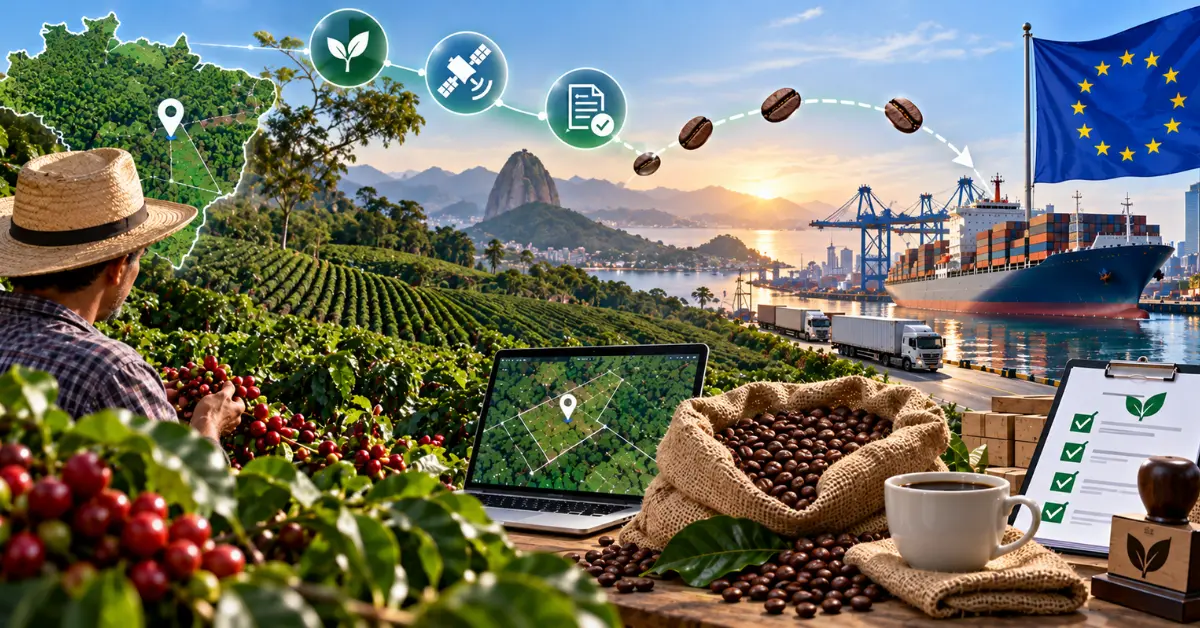
EUDR coffee compliance in Brazil means proving that coffee placed on or exported to the EU market is deforestation-free after 31 December 2020, legally produced under Brazilian law, and covered by a Due Diligence Statement (DDS) filed in the EU Information System with plot-level geolocation for every farm. Coffee falls under customs heading 0901. Large and medium operators and traders must comply from 30 December 2026; micro and small operators from 30 June 2027.
Key takeaways
Brazil is rated standard risk under Commission Implementing Regulation (EU) 2025/1093, not low risk, so full due diligence applies.
Legality and deforestation-free status are two separate tests. CAR proves legality; it does not prove the 31 December 2020 cut-off was met.
Coffee is in scope under heading 0901 (green, roasted, decaffeinated, husks and skins). Soluble coffee and extracts under 2101 are outside scope for now.
Plots under 4 hectares need a single GPS point; plots of 4 hectares or more need a boundary polygon, with no sampling.
The operator, usually the EU importer or exporter, files the DDS and holds the liability. Brazilian producers supply the data.
US tariffs are redirecting Brazilian coffee toward Europe, raising EU exposure and making readiness urgent.
What EUDR Coffee Compliance in Brazil Actually Requires
EUDR coffee compliance in Brazil requires proof that coffee is deforestation-free after 31 December 2020, legally produced, and covered by a filed DDS with plot-level geolocation for every farm.
EUDR coffee compliance in Brazil rests on three tests that a shipment must pass before it reaches an EU buyer. The coffee must be deforestation-free, meaning no farm plot behind it was cleared after 31 December 2020. It must be legally produced under Brazilian law. And a Due Diligence Statement, or DDS, must be filed in the EU Information System, with satellite-checkable geolocation for every plot that grew it. Coffee sits under customs heading 0901, which covers green, roasted and decaffeinated beans plus husks and skins. Miss any one test and the beans are not sellable into the EU, whatever the cup score or the price.
The clock is now fixed. Large and medium operators and traders must comply from 30 December 2026, and micro and small operators from 30 June 2027, under Regulation (EU) 2023/1115 as amended by Regulation (EU) 2025/2650. For Brazilian exporters, that first date governs almost every green-coffee contract into Europe, and it is the anchor for any EUDR coffee compliance in Brazil roadmap.
Learn how coffee exporters, traders, roasters, and importers can build a structured, traceable EUDR compliance process from farm to EU shipment.
Coffee is grown across roughly twenty states through cooperatives and intermediaries, so lots are blended from many farms and mixing compliant with unknown-origin beans is prohibited.
Brazil grows coffee across roughly twenty states, and that geography is exactly what makes EUDR coffee compliance in Brazil hard to execute at volume. Arabica concentrates in Minas Gerais, Sao Paulo and the mountain regions of Espirito Santo, while robusta and conilon come from Espirito Santo, Bahia and Rondonia. A single export lot is often blended from hundreds of farms, aggregated through cooperatives and intermediaries who have never captured a GPS coordinate in their lives.
The regulation closes the easy workaround. The European Commission is explicit that custody chains mixing compliant coffee with beans of unknown origin are not allowed, and lots must stay segregated at every stage of the supply chain. For a Brazilian exporter that turns traceability from a paperwork task into a physical warehousing and lot-management problem, and it is one of the largest operational costs in EUDR coffee compliance in Brazil.
Learn how aggregated traceability in EUDR can help businesses connect source-level data, quantities, suppliers, batches, and EU shipments while maintaining a structured and audit-ready compliance record.
CAR settles legality and supplies farm polygons, but it does not prove the absence of deforestation after 31 December 2020, which is a separate and mandatory test.
Here is the mistake that will cost suppliers the most. Legality and deforestation-free status are two independent tests, and passing one does not pass the other. Brazil’s Rural Environmental Registry, the Cadastro Ambiental Rural or CAR, is a genuine advantage: it supplies farm polygons and answers the legality question. But CAR does not prove that no clearing happened after the 31 December 2020 cut-off.
Vegetation clearance that Brazilian law authorised can still fail EUDR coffee compliance in Brazil if it took place after that date. National legality never overrides the European cut-off. This is why Brazil’s standard-risk classification, set in Commission Implementing Regulation (EU) 2025/1093, matters: standard risk, not low risk, means buyers must run full due diligence rather than the reduced checks reserved for low-risk origins.
Who Files the DDS for Brazilian Coffee
The operator, defined as the first party to place coffee on the EU market and usually the EU importer or exporter, files the DDS. Producers supply the data.
Responsibility does not sit where most producers assume. The operator, defined as the first party to place coffee on the EU market, files the DDS and carries the legal liability. In most Brazilian export chains that is the EU importer or the EU-based exporter, not the farm. Producers and cooperatives supply the underlying data, and downstream operators and traders further along simply reference the upstream DDS number.
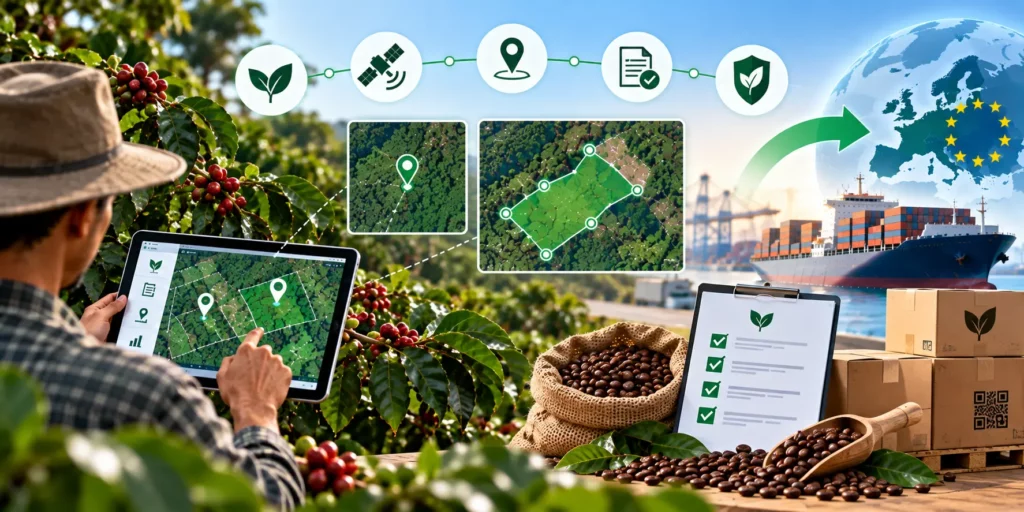
The data itself is precise. Article 9 requires geolocation for every plot with no sampling: a plot under four hectares can be a single six-decimal coordinate, while a plot of four hectares or more must be a polygon tracing the real boundary. For a smallholder-heavy origin that is potentially tens of thousands of coordinates behind one container, which is where EUDR coffee compliance in Brazil stops being a spreadsheet exercise.
Certifications such as Rainforest Alliance or Fairtrade support risk mitigation, but under EUDR they do not replace the Due Diligence Statement, plot-level geolocation, or a deforestation check against the 31 December 2020 cut-off. TraceX EUDR Solutions is built to capture farm coordinates at source, screen plots against the cut-off, and structure the data for the DDS and the EU Information System .The point is to make origin provable, not just documented.
See how TraceX captures farm geolocation, screens plots against the deforestation cut-off, and structures your DDS for Brazilian coffee.
EUDR Coffee Compliance in Brazil: Manual vs Platform
Manual tracking with email and spreadsheets holds until the first audit query or contested plot; a purpose-built system keeps geolocation, deforestation checks and DDS data audit-ready.
Some exporters still try to manage EUDR coffee compliance in Brazil with email, PDFs and shared spreadsheets. It works until the first audit query or the first contested plot. The comparison below shows where a manual approach breaks and where a purpose-built system holds.
Compliance task
Manual approach
TraceX Cleara AI
Plot geolocation
Coordinates chased by email, often missing or duplicated
Points and polygons captured and validated at source
Deforestation check
Manual map cross-referencing, no audit trail
Automated satellite screening against the 31 Dec 2020 cut-off
DDS filing
Re-keyed into TRACES, error-prone
Collected data mapped to the DDS and Information System
Segregation
Hard to prove lots stayed separate
Lot-level chain-of-custody records
Audit response
Days of document hunting
Records retrievable on demand across the 5-year retention window
How to Get EUDR-Ready for Brazilian Coffee
Treat readiness as a farm-to-DDS data programme: collect geolocation, separate the legality and deforestation tests, then map everything to a filed statement well ahead of the deadline.
Readiness comes down to a short, testable checklist. Treat EUDR coffee compliance in Brazil as a data-collection programme that starts at the farm and ends with a filed statement, and sequence it now rather than in the final quarter before the deadline.
Use this checklist to evaluate any solution or internal process:
Captures both GPS points (under 4 ha) and boundary polygons (4 ha and over) with no sampling
Screens every plot against the 31 December 2020 deforestation cut-off, not just national legality
Separates the legality test (CAR, land rights, labour law) from the deforestation test
Maps collected data straight to the DDS and the EU Information System
Maintains lot-level segregation and five-year record retention
Scales to the smallholder volumes typical of Minas Gerais and the conilon regions
The exporters who move early will keep their European contracts. Those who wait will watch buyers quietly shift to suppliers who can already prove origin. With United States tariffs pushing more Brazilian coffee toward Europe, EUDR coffee compliance in Brazil is fast becoming the condition for keeping market access, not a box to tick later.
Frequently Asked Questions
Is coffee covered by EUDR in Brazil?
Yes. Coffee falls under customs heading 0901, which covers green, roasted and decaffeinated beans plus husks and skins. Soluble coffee and extracts under heading 2101 remain outside scope for now, pending a separate Commission act.
When is the EUDR deadline for Brazilian coffee?
30 December 2026 for large and medium operators and traders, and 30 June 2027 for micro and small operators, under Regulation (EU) 2025/2650.
Does CAR registration make my coffee EUDR compliant?
No. CAR settles the legality question and supplies farm polygons, but you must separately prove that no deforestation occurred after 31 December 2020.
What geolocation does Brazilian coffee need?
Every plot, with no sampling. A plot under four hectares can be a single six-decimal point; a plot of four hectares or more must be a boundary polygon.
Who files the DDS, the farm or the importer?
The operator, usually the EU importer or exporter that places the coffee on the market first. Producers supply the data, and downstream traders reuse the reference number.
Is Brazil a low-risk origin under EUDR?
No. Brazil is classified as standard risk under Commission Implementing Regulation (EU) 2025/1093, so full due diligence applies to every shipment.
What are the penalties for non-compliance?
Fines of up to 4% of EU-wide annual turnover, confiscation of the products and the revenue from them, and temporary exclusion from the EU market.
Start using TraceX
Transparency, Trust, & Success for your Climate Journey.
We use cookies on our website to give you the most relevant experience by remembering your preferences and repeat visits. By clicking “Accept All”, you consent to the use of ALL the cookies. However, you may visit "Cookie Settings" to provide a controlled consent.
This website uses cookies to improve your experience while you navigate through the website. Out of these, the cookies that are categorized as necessary are stored on your browser as they are essential for the working of basic functionalities of the website. We also use third-party cookies that help us analyze and understand how you use this website. These cookies will be stored in your browser only with your consent. You also have the option to opt-out of these cookies. But opting out of some of these cookies may affect your browsing experience.
Necessary cookies are absolutely essential for the website to function properly. These cookies ensure basic functionalities and security features of the website, anonymously.
Cookie
Duration
Description
cookielawinfo-checkbox-analytics
11 months
This cookie is set by GDPR Cookie Consent plugin. The cookie is used to store the user consent for the cookies in the category "Analytics".
cookielawinfo-checkbox-functional
11 months
The cookie is set by GDPR cookie consent to record the user consent for the cookies in the category "Functional".
cookielawinfo-checkbox-necessary
11 months
This cookie is set by GDPR Cookie Consent plugin. The cookies is used to store the user consent for the cookies in the category "Necessary".
cookielawinfo-checkbox-others
11 months
This cookie is set by GDPR Cookie Consent plugin. The cookie is used to store the user consent for the cookies in the category "Other.
cookielawinfo-checkbox-performance
11 months
This cookie is set by GDPR Cookie Consent plugin. The cookie is used to store the user consent for the cookies in the category "Performance".
viewed_cookie_policy
11 months
The cookie is set by the GDPR Cookie Consent plugin and is used to store whether or not user has consented to the use of cookies. It does not store any personal data.
Functional cookies help to perform certain functionalities like sharing the content of the website on social media platforms, collect feedbacks, and other third-party features.
Performance cookies are used to understand and analyze the key performance indexes of the website which helps in delivering a better user experience for the visitors.
Analytical cookies are used to understand how visitors interact with the website. These cookies help provide information on metrics the number of visitors, bounce rate, traffic source, etc.
Advertisement cookies are used to provide visitors with relevant ads and marketing campaigns. These cookies track visitors across websites and collect information to provide customized ads.
Download the 2026 Traceability Scorecard and Benchmark Your Supply Chain Across 10 Critical Capabilities.
Download our eBook
Don’t Wait for an Audit to Find Your EUDR Gaps
The 2026 Simplification Package changes how HS codes, DDS pass-through and geolocation rules apply to you. Get the free guide and 20-point readiness checklist before enforcement catches you unprepared.