EUDR Article 9: Understanding the Information Requirements for EUDR Compliance
Published
, 10 minute read
Share this article
Quick summary: EUDR Article 9 explains the information, supplier data, geolocation, legality evidence, and deforestation-free records needed for EUDR compliance.
EUDR Article 9 sets out the information requirements operators must meet as part of their due diligence process. The requirement is broader than simply submitting a Due Diligence Statement (DDS). Operators must collect, organise and keep information, documents and data that demonstrate the relevant products comply with Article 3.
For each relevant product, Article 9 requires information covering the product itself, quantity, country of production, source geolocation, suppliers, customers, deforestation-free status and legality. Operators must also retain this information and its supporting evidence for five years from the date the relevant products are placed on the market or exported.
In practical terms, EUDR Article 9 creates the data foundation for due diligence, risk assessment, traceability and declaration workflows. If the underlying information is incomplete, inconsistent or difficult to verify, preparing an accurate EUDR compliance record becomes significantly harder.
Key Takeaways
Article 9 defines the information operators must collect for each relevant product.
Operators must collect supporting evidence, not just basic data fields.
Geolocation must cover all relevant production plots, with the production date or time range.
Supplier and downstream recipient information must be maintained.
Deforestation-free and legality evidence are separate but essential information requirements.
Relevant information must be retained for five years from placing on the market or export.
The information must be available to competent authorities upon request.
Connecting source, procurement, product and shipment data is critical for operational EUDR compliance.
December 2026 is approaching. Is your supply chain actually ready?
Move from spreadsheets and fragmented supplier data to a traceable, audit-ready EUDR workflow with TraceX.
Article 9 identifies eight core categories of information. Businesses should treat these as connected data requirements rather than isolated fields because the information must ultimately relate to the specific relevant product being placed on the market or exported.
1. Product Description and Wood Species Information
Operators must collect a description of each relevant product, including its trade name and type. Where the relevant product contains or has been made using wood, the description must also include the common name of the species and its full scientific name.
The product description must include the relevant commodities or relevant products contained in or used to make the product. For wood-based supply chains, this means product master data and species information need to be captured accurately and connected to the relevant material and finished product.
2. Quantity of the Relevant Product
Article 9 requires operators to collect the quantity of relevant products. For products entering or leaving the market, quantity is expressed in kilograms of net mass and, where applicable, the supplementary unit specified against the relevant Harmonised System code in Annex I to Council Regulation (EEC) No 2658/87.
For other relevant products, quantity is expressed as net mass or, where applicable, volume or number of items. This makes quantity a critical part of EUDR data management because compliance information must be connected to the actual quantities represented by the relevant product and declaration.
3. Country of Production
Operators must collect the country of production and, where relevant, the relevant parts of that country. Country information therefore needs to be connected to the source of the relevant commodity rather than treated simply as a generic supplier-country field.
For businesses sourcing from multiple countries or regions, maintaining clear country-of-production records helps establish the correct context for subsequent due diligence and risk assessment.
4. Geolocation of All Production Plots
Geolocation is one of the most significant requirements under EUDR Article 9. Operators must collect the geolocation of all plots of land where the relevant commodities contained in, or used to make, the relevant product were produced, together with the date or time range of production.
Where a relevant product contains commodities produced on different plots, the geolocation of all different plots must be included. The requirement is therefore not satisfied simply by identifying a supplier, region or general production area.
Understand the requirements for coordinates and polygons, common geolocation data gaps, and how businesses can validate source locations before compliance and DDS workflows.
Article 9 also states that deforestation or forest degradation on a given plot automatically disqualifies the relevant commodities and products from that plot from being placed or made available on the market or exported.
For cattle and relevant products containing cattle, the geolocation refers to all establishments where the cattle were kept. For other relevant products covered by Annex I, the geolocation refers to the plots of land.
This is why an EUDR data model needs to connect geolocation with the actual source material and downstream product. A standalone map or collection of coordinates is not enough if the business cannot establish which material, product or shipment those locations relate to.
5. Supplier Information
Operators must collect the name, postal address and email address of any business or person from whom they have been supplied with the relevant products.
This creates a direct requirement for supplier-level information within the EUDR compliance record. Supplier master data should therefore be complete and consistently linked to the relevant purchases, materials or products to which the due diligence information applies.
Supplier assessment is a critical part of EUDR due diligence, helping businesses evaluate supplier information, source locations, legality, deforestation risk, and the reliability of supporting evidence. Learn how a structured supplier assessment process can improve data quality, identify compliance gaps, and strengthen EUDR readiness.
Article 9 also requires the name, postal address and email address of any business, operator or trader to whom the relevant products have been supplied.
This extends the information chain beyond the source. An EUDR-ready record should therefore connect upstream supplier information with downstream recipients and the relevant products or transactions.
7. Evidence That Products Are Deforestation-Free
Operators must collect adequately conclusive and verifiable information demonstrating that the relevant products are deforestation-free.
The important operational point is that this is an evidence requirement. Businesses need to organise the information supporting their conclusion and connect it to the relevant source plots and products. A compliance workflow should make it possible to identify what evidence was considered and which products or source locations it supports.
Businesses need a structured workflow to collect supplier and geolocation data, assess deforestation and legality risks, verify evidence, address gaps, and maintain an audit-ready record.
Article 9 requires adequately conclusive and verifiable information showing that the relevant commodities were produced in accordance with the relevant legislation of the country of production. This includes any arrangement conferring the right to use the respective area for production.
Legality evidence therefore forms a distinct part of the Article 9 information set. Businesses need a structured way to collect, associate and retain relevant documentation rather than treating legality as a one-time supplier declaration.
Understand the key legality requirements, supporting documentation, and how businesses can organize and verify legal compliance evidence across suppliers and source locations.
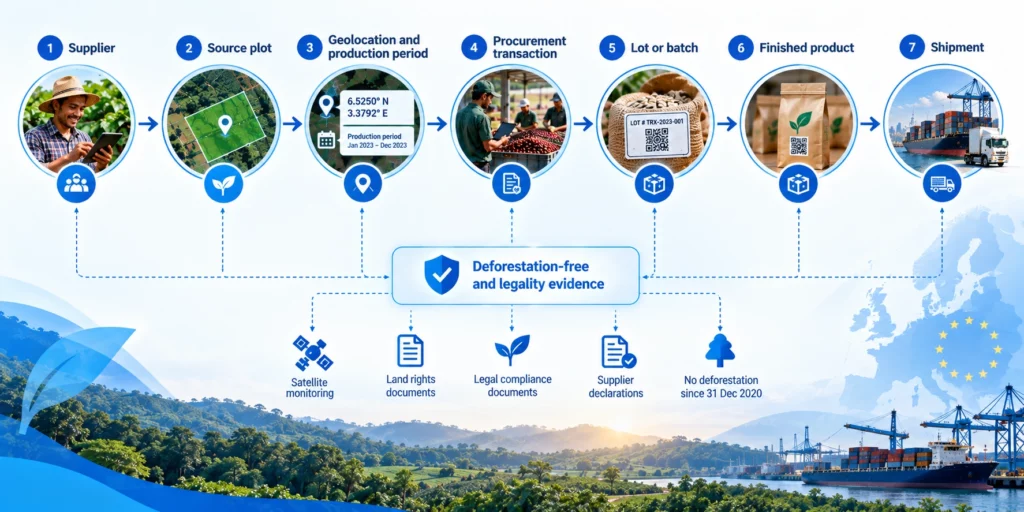
At first glance, Article 9 can look like a list of information fields. In practice, the challenge is connecting those fields into one traceable record.
Consider a company sourcing a commodity from several suppliers. It may have supplier information in an ERP, plot coordinates in spreadsheets, procurement quantities in another system, supporting documents in email folders and finished-product shipments in a logistics system. Each individual data set may exist, but the business still needs to establish the relationship between them.
An operational EUDR workflow therefore needs to connect:
Supplier → Source plot Source plot → Geolocation and production period Supplier → Procurement transaction Procurement → Lot or batch Lot or batch → Finished product Finished product → Shipment Product/source → Deforestation-free and legality evidence
This connected structure makes Article 9 information usable for due diligence instead of leaving it as disconnected records.
Common EUDR Article 9 Data Challenges
Missing or incomplete plot geolocation from suppliers.
Supplier information that is inconsistent across procurement and compliance records.
Multiple source plots contributing to a single product without a clear linkage.
Quantity mismatches between procurement, production and shipment records.
Wood species information missing from relevant product records.
Supporting legality or deforestation-free evidence stored separately from the relevant product or source.
Difficulty retrieving the complete information set when an authority requests it.
These challenges become more significant as supplier and product volumes increase. Manual processes can make it difficult to identify missing information early and establish a consistent audit trail.
How TraceX Can Operationalise EUDR Article 9
A digital EUDR platform can turn Article 9 from a static checklist into a connected workflow. TraceX’s EUDR solution is designed to connect supplier and source information with procurement, traceability, evidence and shipment workflows.
Through structured supplier engagement, businesses can collect source-level information such as farmer or producer records, plot geolocation and supporting documents. That information can then be connected to procurement and material records and carried forward into batch, finished-product and shipment traceability.
This approach also supports controlled collaboration across supply-chain participants. Suppliers can contribute the information they own, while operators retain oversight of the broader compliance record. Customers or authorised representatives can be given appropriate access to relevant records without exposing unrelated information.
The objective is not to replace the operator’s due diligence responsibility. It is to provide the digital infrastructure needed to organise, connect, validate and retrieve the information required by the EUDR process.
TraceX helps businesses digitize source data, connect procurement and product traceability, organise EUDR evidence, and build a connected compliance workflow from source plot to shipment.
Article 9 requires operators to make the collected information, documents and data available to competent authorities upon request. This makes retrieval as important as collection.
An EUDR-ready organisation should be able to move from a relevant product or shipment back through the compliance chain to the underlying source information and evidence. This becomes particularly important when multiple suppliers, plots, batches or products are involved.
A centralised compliance record with traceability and documented evidence can reduce dependency on manual searches across spreadsheets, emails and folders.
Frequently Asked Questions (FAQ’s)
What is EUDR Article 9?
EUDR Article 9 defines the information, documents and data that operators must collect, organise and retain to demonstrate that relevant products comply with Article 3.
How long must Article 9 information be kept?
The Article 9 text requires operators to keep the information, documents and data for five years from the date the relevant products are placed on the market or exported.
Does EUDR Article 9 require plot geolocation?
Yes. Operators must collect the geolocation of all plots where the relevant commodities were produced, along with the date or time range of production. For cattle-related products, the geolocation refers to all establishments where the cattle were kept.
What supplier information is required under Article 9?
The operator must collect the supplier’s name, postal address and email address for businesses or persons from whom the relevant products were supplied.
Does Article 9 require legality evidence?
Yes. Operators must collect adequately conclusive and verifiable information showing that the relevant commodities were produced in accordance with the relevant legislation of the country of production.
Does Article 9 require deforestation-free evidence?
Yes. Operators must collect adequately conclusive and verifiable information demonstrating that the relevant products are deforestation-free.
Why is EUDR Article 9 important for digital traceability?
Because the required information must relate to specific relevant products and their source. Digital traceability can connect supplier, plot, geolocation, procurement, quantity, batch, product, shipment and evidence into a retrievable compliance record.
Start using TraceX
Transparency, Trust, & Success for your Climate Journey.
We use cookies on our website to give you the most relevant experience by remembering your preferences and repeat visits. By clicking “Accept All”, you consent to the use of ALL the cookies. However, you may visit "Cookie Settings" to provide a controlled consent.
This website uses cookies to improve your experience while you navigate through the website. Out of these, the cookies that are categorized as necessary are stored on your browser as they are essential for the working of basic functionalities of the website. We also use third-party cookies that help us analyze and understand how you use this website. These cookies will be stored in your browser only with your consent. You also have the option to opt-out of these cookies. But opting out of some of these cookies may affect your browsing experience.
Necessary cookies are absolutely essential for the website to function properly. These cookies ensure basic functionalities and security features of the website, anonymously.
Cookie
Duration
Description
cookielawinfo-checkbox-analytics
11 months
This cookie is set by GDPR Cookie Consent plugin. The cookie is used to store the user consent for the cookies in the category "Analytics".
cookielawinfo-checkbox-functional
11 months
The cookie is set by GDPR cookie consent to record the user consent for the cookies in the category "Functional".
cookielawinfo-checkbox-necessary
11 months
This cookie is set by GDPR Cookie Consent plugin. The cookies is used to store the user consent for the cookies in the category "Necessary".
cookielawinfo-checkbox-others
11 months
This cookie is set by GDPR Cookie Consent plugin. The cookie is used to store the user consent for the cookies in the category "Other.
cookielawinfo-checkbox-performance
11 months
This cookie is set by GDPR Cookie Consent plugin. The cookie is used to store the user consent for the cookies in the category "Performance".
viewed_cookie_policy
11 months
The cookie is set by the GDPR Cookie Consent plugin and is used to store whether or not user has consented to the use of cookies. It does not store any personal data.
Functional cookies help to perform certain functionalities like sharing the content of the website on social media platforms, collect feedbacks, and other third-party features.
Performance cookies are used to understand and analyze the key performance indexes of the website which helps in delivering a better user experience for the visitors.
Analytical cookies are used to understand how visitors interact with the website. These cookies help provide information on metrics the number of visitors, bounce rate, traffic source, etc.
Advertisement cookies are used to provide visitors with relevant ads and marketing campaigns. These cookies track visitors across websites and collect information to provide customized ads.
Download the 2026 Traceability Scorecard and Benchmark Your Supply Chain Across 10 Critical Capabilities.
Download our eBook
Don’t Wait for an Audit to Find Your EUDR Gaps
The 2026 Simplification Package changes how HS codes, DDS pass-through and geolocation rules apply to you. Get the free guide and 20-point readiness checklist before enforcement catches you unprepared.