Fulfilment Service Provider in PPWR: Who Qualifies, What You Must Do, and How to Prove It
Published
, 12 minute read
Share this article
Quick summary: Fulfilment service provider in PPWR explained who qualifies, what obligations apply from 12 Aug 2026, and how to keep packaging compliance intact across your warehouse.
Who is a fulfilment service provider in PPWR? A fulfilment service provider in PPWR is any company that, in the course of business, offers at least two of these four services warehousing, packaging, addressing, and dispatching without owning the products it handles. PPWR (Regulation (EU) 2025/40) borrows this definition directly from Article 3(11) of the EU Market Surveillance Regulation (EU) 2019/1020. Postal, parcel-delivery, and freight-transport services are excluded. As a named economic operator, a fulfilment service provider in PPWR must ensure that the way it stores, handles, packs, addresses, and dispatches packaging does not jeopardise that packaging’s compliance with PPWR. These duties apply from 12 August 2026.
Key takeaways
A fulfilment service provider in PPWR is defined by activity, not job title the “two-of-four services + no ownership” test decides whether you qualify.
The definition is inherited from Article 3(11) of Regulation (EU) 2019/1020, so existing market-surveillance guidance applies.
The core duty is a “do-no-harm” obligation: your warehousing, handling, packing, addressing, and dispatching must not compromise packaging compliance.
You can be a fulfilment service provider in PPWR and another economic operator at the same time each role carries its own obligations.
Obligations bite from 12 August 2026, and PPWR applies directly in all 27 Member States with no national transposition.
Proving compliance means traceable records linking each packaging unit to storage conditions, handling steps, and conformity documentation.
Fulfilment Service Provider in PPWR: The Legal Definition
A fulfilment service provider in PPWR is one of the economic operators that the EU Packaging and Packaging Waste Regulation (PPWR, Regulation (EU) 2025/40) holds directly accountable for keeping packaging compliant across the supply chain. Rather than write a fresh definition, PPWR imports the established one from Article 3(11) of the Market Surveillance Regulation (EU) 2019/1020 which means the guidance market-surveillance authorities already use carries straight over.
In plain language, a fulfilment service provider is any natural or legal person who, in the course of commercial activity, offers at least two of the following four services without taking ownership of the products involved:
Warehousing — storing goods until they are ordered
Packaging — packing or repacking products for shipment
Addressing — applying the delivery address to the parcel
Dispatching — handing the order to a carrier or shipping it out
Two thresholds matter most. First, the two-of-four test: offer any two of those services and you are in scope. Second, the no-ownership condition: the moment you take title to the goods you become a distributor or importer instead. The definition deliberately excludes pure postal services (Directive 97/67/EC), parcel-delivery services (Regulation (EU) 2018/644), and other freight-transport services a courier that only moves parcels is not a fulfilment service provider in PPWR.
Whether you brand yourself a 3PL, an e-commerce fulfilment house, a pick-and-pack operation, or an on-demand warehouse, the label is irrelevant. If your activity matches the test, you are a fulfilment service provider in PPWR and the regulation’s duties attach to you.
Read our guide on PPWR Rolesto understand who is responsible for packaging compliance, documentation, conformity assessment, labelling and market obligations and how these responsibilities can apply across different supply-chain scenarios.
How the PPWR Fulfilment Service Provider Fits the Economic Operator Roles
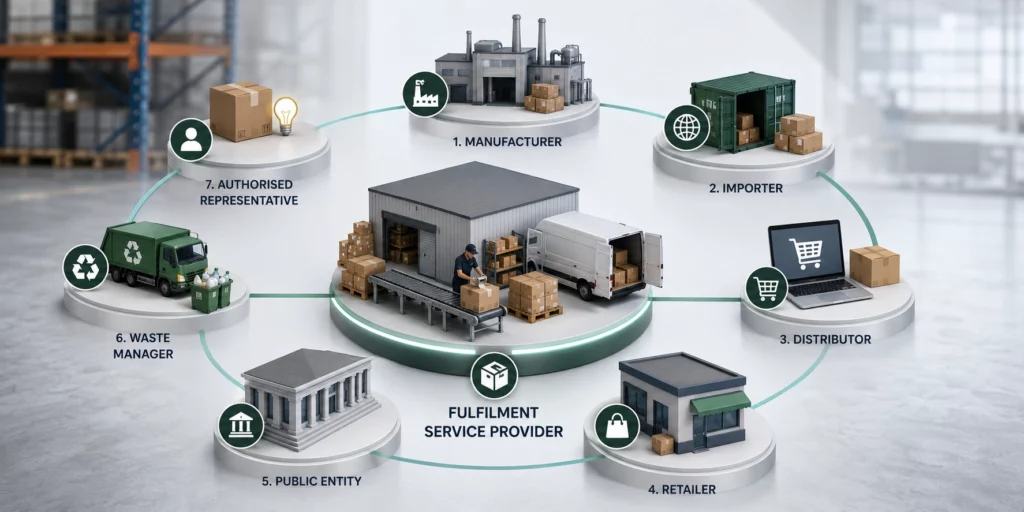
PPWR spreads responsibility across every link in the chain. The regulation’s definition of “economic operator” covers the manufacturer, the supplier, the importer, the distributor, the authorised representative, the final distributor, and the fulfilment service provider. Each role inherits obligations proportionate to the control it has over packaging.
The fulfilment service provider in PPWR was added to close a specific gap. In cross-border e-commerce, the manufacturer or seller often sits outside the EU, leaving no obviously accountable party inside the Union. By naming fulfilment providers as economic operators, the EU ensures there is almost always an operator physically established in the market who can be held responsible for the goods flowing through it. This is the same “backstop” logic that first introduced the role under Regulation (EU) 2019/1020.
Crucially, being a fulfilment service provider in PPWR does not transfer product-conformity liability onto you. The manufacturer and upstream supply-chain parties remain responsible for whether the packaging itself meets PPWR’s design, recyclability, recycled-content, and labelling rules. Your duty is narrower but real: don’t break that compliance while the packaging is in your hands. Where a single company plays several roles for example, packing goods it also imports it must satisfy the obligations of each role it occupies.
What a PPWR Fulfilment Service Provider Must Actually Do
The obligation is easy to state and hard to prove. A fulfilment service provider in PPWR must ensure that, for any packaging it handles whether empty or already containing a product the conditions during warehousing, handling, packing, addressing, and dispatching do not jeopardise that packaging’s compliance with the applicable PPWR requirements.
The pain: an obligation with no obvious paper trail
Most fulfilment operations were never built to evidence packaging compliance. Goods arrive, sit on a shelf, get picked, packed, and shipped and no record ties a specific outbound parcel back to the conformity status of the packaging used or the conditions it was stored under. When a market-surveillance authority asks a fulfilment service provider in PPWR to demonstrate that its handling did not compromise compliance, “we’re careful” is not an answer. The gap is not intent; it is traceability.
The capability: traceability from inbound to dispatch
This is where a purpose-built platform such as TraceXPPWR Solutions changes the picture. Instead of leaving compliance to memory, a fulfilment service provider in PPWR can link every packaging SKU to its declaration of conformity and technical documentation, log storage conditions against the units they affect, and capture a timestamped chain of handling events from receipt to dispatch. The workflows that power this packaging inventory mapping, conformity-document linkage, storage-condition logging, and dispatch audit trails turn an abstract legal duty into a set of records you can actually produce.
Read our guide on PPWR Supply Chain Mapping to learn how to map your packaging supply chain, identify data gaps and build a clearer view of the information needed for compliance.
The benefit: audit-readiness instead of scramble
The payoff is that compliance becomes a byproduct of normal operations rather than a fire drill. A provider that can answer an authority’s request in minutes with records showing which packaging was used, in what condition, and handled how protects its client relationships, avoids goods being pulled from sale, and turns PPWR readiness into a commercial differentiator when winning new e-commerce accounts.
The proof: records that stand up to scrutiny
Proof is the whole game. The measure of a compliant fulfilment service provider in PPWR is not a policy document but the ability to reconstruct, for any parcel, the compliance story behind it. That means immutable, queryable records the kind an automated traceability system produces by default and a spreadsheet almost never does.
Are You a Fulfilment Service Provider in PPWR? A Quick Self-Assessment
Run your operation through the test. If both statements below are true, you are almost certainly a fulfilment service provider in PPWR:
You offer at least two of warehousing, packaging, addressing, and dispatching as a commercial service.
You do not own the products you handle you act for another party.
Common operations that qualify as a fulfilment service provider in PPWR include:
Third-party logistics (3PL) providers that store and ship on behalf of merchants
E-commerce fulfilment houses running pick, pack, and dispatch for online sellers
Marketplace-adjacent fulfilment networks that warehouse and ship seller inventory
Cross-border fulfilment centres holding non-EU sellers’ stock inside the Union
Operations that are usually not caught: pure couriers and postal operators (delivery only), freight forwarders moving goods between businesses without warehousing plus a second qualifying service, and any party that takes ownership of the goods that party is a distributor or importer with its own, heavier obligations.
Read our guide on PPWR for E-commerce Sellersto understand how product packaging, packaging data, supplier information, labelling, documentation and compliance responsibilities can affect your EU sales.
Fulfilment Service Provider in PPWR vs Distributor vs Importer
Because roles overlap in practice, it helps to see how a fulfilment service provider in PPWR differs from the two roles it is most often confused with. The dividing lines are ownership and where the goods enter the market.
Aspect
Fulfilment service provider
Distributor
Importer
Owns the goods?
No
Yes / makes available
Yes / first to bring in
Defining activity
2+ of warehouse, pack, address, dispatch
Makes packaging available on the market
Places non-EU packaging on the EU market first
Core PPWR duty
Don’t jeopardise compliance while handling
Verify conformity before selling on
Ensure conformity + documentation on entry
Typical example
3PL / e-commerce fulfilment centre
Wholesaler, retailer reselling
EU company sourcing from outside the EU
The takeaway: a fulfilment service provider in PPWR carries the lightest ownership footprint but a very specific custodial duty. If you find you also take title or import, you layer those obligations on top.
How to Operationalise PPWR Fulfilment Service Provider Compliance
Meeting the standard as a fulfilment service provider in PPWR comes down to one question your systems must answer on demand: for any parcel that left your warehouse, can you show that the packaging was compliant and that you didn’t compromise it? Doing that manually is possible but brittle. The table below contrasts the two approaches.
Capability
Manual/spreadsheet
TraceX
Packaging inventory mapping
SKUs tracked in disconnected sheets; gaps go unnoticed
Every packaging SKU mapped and linked to its client and conformity status
Conformity document linkage
DoCs emailed, filed, and often unfindable at audit time
Declaration of conformity + technical docs attached to each packaging unit
Storage-condition records
Rarely logged against affected units
Conditions logged and tied to the exact units handled
Dispatch audit trail
Reconstructed after the fact, if at all
Timestamped chain from inbound to dispatch, queryable on demand
Authority request response
Days of manual digging
Records exported in minutes
For a PPWR fulfilment service provider, the difference is not cosmetic. Manual methods leave you hoping the records exist; an automated traceability platform makes the records a guaranteed output of the work you already do.
How TraceX Helps Fulfilment Service Providers with PPWR Compliance
Fulfilment service providers can sit between manufacturers, importers and EU customers, making it important to maintain clear packaging and compliance information across the products they handle. TraceX PPWR Solutions helps create a structured digital record connecting products and SKUs, packaging components, materials, suppliers and supporting documentation. Teams can centralize packaging data, identify missing information, manage supplier evidence and maintain compliance records across multiple products and clients. Where documentation such as technical files or Declarations of Conformity needs to be collected and verified, TraceX helps keep the relevant evidence linked to the appropriate packaging and product. This creates a single, traceable packaging compliance record that can support PPWR workflows and make it easier to retrieve the right information when customers, business partners or authorities require it.
See how a fulfilment service provider in PPWR can link every packaging unit to its conformity records and produce audit-ready evidence on demand.
PPWR Fulfilment Service Provider: Buyer Evaluation Checklist
If you are evaluating tooling to support your obligations as a PPWR fulfilment service provider, score any platform against these criteria:
Links each packaging SKU to its declaration of conformity and technical documentation
Captures a timestamped, immutable handling trail from inbound receipt to dispatch
Logs storage and handling conditions against the specific units they affect
Separates records by client so you can respond per-merchant to authority requests
Exports audit-ready evidence in minutes, in a format authorities accept
Supports the other economic-operator roles you may also occupy (importer, distributor)
Scales across multiple warehouses and Member States under one system of record
Frequently Asked Questions (FAQ’s)
Who is a fulfilment service provider in PPWR?
A fulfilment service provider in PPWR is any business offering at least two of warehousing, packaging, addressing, and dispatching, in the course of commercial activity, without owning the products it handles. PPWR takes this definition from Article 3(11) of Regulation (EU) 2019/1020.
When do fulfilment service provider obligations under PPWR start?
PPWR (Regulation (EU) 2025/40) entered into force on 11 February 2025, and its general obligations including those on fulfilment service providers apply from 12 August 2026 across all 27 EU Member States.
Is a courier or postal service a fulfilment service provider in PPWR?
No. The definition explicitly excludes postal services (Directive 97/67/EC), parcel-delivery services (Regulation (EU) 2018/644), and other freight-transport services. A party that only delivers parcels is not a fulfilment service provider in PPWR.
What is the core duty of a fulfilment service provider in PPWR?
To ensure that the conditions during warehousing, handling, packing, addressing, and dispatching of packaging empty or with a product do not jeopardise that packaging’s compliance with PPWR requirements.
Does being a PPWR fulfilment service provider make me liable for packaging conformity?
Not for the packaging’s design conformity itself that stays with the manufacturer and upstream parties. Your duty is custodial: don’t compromise compliance while the packaging is in your care.
Can I be a fulfilment service provider and another economic operator at once?
Yes. If you also import or take ownership of goods, you occupy those roles too and must meet each role’s obligations in addition to the fulfilment service provider duties.
How does a fulfilment service provider in PPWR prove compliance?
By maintaining traceable records that link each packaging unit to its conformity documentation, storage conditions, and handling history evidence you can produce quickly when a market-surveillance authority asks.
Start using TraceX
Transparency, Trust, & Success for your Climate Journey.
We use cookies on our website to give you the most relevant experience by remembering your preferences and repeat visits. By clicking “Accept All”, you consent to the use of ALL the cookies. However, you may visit "Cookie Settings" to provide a controlled consent.
This website uses cookies to improve your experience while you navigate through the website. Out of these, the cookies that are categorized as necessary are stored on your browser as they are essential for the working of basic functionalities of the website. We also use third-party cookies that help us analyze and understand how you use this website. These cookies will be stored in your browser only with your consent. You also have the option to opt-out of these cookies. But opting out of some of these cookies may affect your browsing experience.
Necessary cookies are absolutely essential for the website to function properly. These cookies ensure basic functionalities and security features of the website, anonymously.
Cookie
Duration
Description
cookielawinfo-checkbox-analytics
11 months
This cookie is set by GDPR Cookie Consent plugin. The cookie is used to store the user consent for the cookies in the category "Analytics".
cookielawinfo-checkbox-functional
11 months
The cookie is set by GDPR cookie consent to record the user consent for the cookies in the category "Functional".
cookielawinfo-checkbox-necessary
11 months
This cookie is set by GDPR Cookie Consent plugin. The cookies is used to store the user consent for the cookies in the category "Necessary".
cookielawinfo-checkbox-others
11 months
This cookie is set by GDPR Cookie Consent plugin. The cookie is used to store the user consent for the cookies in the category "Other.
cookielawinfo-checkbox-performance
11 months
This cookie is set by GDPR Cookie Consent plugin. The cookie is used to store the user consent for the cookies in the category "Performance".
viewed_cookie_policy
11 months
The cookie is set by the GDPR Cookie Consent plugin and is used to store whether or not user has consented to the use of cookies. It does not store any personal data.
Functional cookies help to perform certain functionalities like sharing the content of the website on social media platforms, collect feedbacks, and other third-party features.
Performance cookies are used to understand and analyze the key performance indexes of the website which helps in delivering a better user experience for the visitors.
Analytical cookies are used to understand how visitors interact with the website. These cookies help provide information on metrics the number of visitors, bounce rate, traffic source, etc.
Advertisement cookies are used to provide visitors with relevant ads and marketing campaigns. These cookies track visitors across websites and collect information to provide customized ads.
Download the 2026 Traceability Scorecard and Benchmark Your Supply Chain Across 10 Critical Capabilities.
Download our eBook
Don’t Wait for an Audit to Find Your EUDR Gaps
The 2026 Simplification Package changes how HS codes, DDS pass-through and geolocation rules apply to you. Get the free guide and 20-point readiness checklist before enforcement catches you unprepared.