PPWR Supplier Compliance: How to Collect and Verify Packaging Evidence at Scale
Published
, 10 minute read
Share this article
Quick summary: PPWR supplier compliance made auditable collect and verify DoCs, PFAS, recycled-content and recyclability evidence from every packaging supplier at scale.
PPWR supplier compliance is the process of collecting and verifying the packaging evidence you need from your suppliers Declarations of Conformity, substance test reports, recycled-content data and recyclability assessments so you can legally place packaging on the EU market under Regulation (EU) 2025/40. Since 12 August 2026, no packaging can be placed on the EU market without a valid Declaration of Conformity and technical documentation behind it. The catch: most of that evidence does not live inside your business. It lives with the converters, printers and material suppliers in your chain. Getting PPWR supplier compliance right means building a repeatable way to request, verify and store that evidence at scale not chasing PDFs by email before every audit.
Key takeaways
PPWR (Regulation (EU) 2025/40) applies from 12 August 2026 every packaging type needs a Declaration of Conformity (DoC) backed by technical documentation.
The manufacturer or brand owner signs the DoC, but the underlying evidence must be collected from suppliers you cannot self-certify it into existence.
Core evidence to gather: material composition, PFAS and heavy-metals test reports, recycled-content percentages, recyclability grade and minimisation data.
PFAS in food-contact packaging is restricted from 12 August 2026 (25 ppb single substance, 250 ppb sum, 50 ppm total fluorine); heavy metals capped at 100 mg/kg combined.
Recyclability performance grades tighten from 1 January 2030 collecting the data now avoids restarting supplier outreach later.
Evidence collection is recurring, not a one-off a centralised, auditable process beats scattered inbox threads.
PPWR supplier compliance rests on evidence you don’t own
The legal responsibility sits with you, the data sits with your suppliers.
For most brand owners and importers, PPWR supplier compliance is uncomfortable because the responsibility and the data sit in two different places. Under Regulation (EU) 2025/40, if your name or brand appears on the packaging, you are the manufacturer in the eyes of the regulation and you sign the EU Declaration of Conformity. But the facts that make that declaration true what the film is made of, how much recycled content the board contains, whether the ink is PFAS-free are generated by the converter, the printer and the mill. PPWR supplier compliance is therefore, at its core, a supplier data-collection problem. You cannot self-certify your way out of it, and authorities can request the supporting file at any time.
Are Your Suppliers Ready for PPWR?Learn how to engage suppliers, collect the right packaging data and evidence, and build stronger supply-chain readiness for PPWR compliance.
Manual collection fails in three predictable ways as SKU and supplier counts grow.
A single SKU can involve half a dozen packaging components, each from a different supplier, each requiring its own evidence. Multiply that across a portfolio of hundreds of SKUs and PPWR supplier compliance quickly becomes unmanageable in spreadsheets and email. Teams running manual collection routinely hit the same failure modes:
Incomplete or outdated declarations — supplier statements arrive missing signatures, dates or the right article references.
Missing test reports at audit time — the PFAS or heavy-metals evidence can’t be found when an inspector or customer asks.
Specifications that no longer match reality — materials and suppliers change, but the documentation doesn’t keep pace, so last year’s compliant file is today’s liability.
The regulation raises the bar further: you must document how compliance was assessed, not simply assert that it was achieved. That turns evidence quality not just evidence existence into the deciding factor in PPWR supplier compliance.
Are You Ready for PPWR Compliance?Understand the key requirements, responsibilities and deadlines businesses need to address across packaging data, EPR, labelling, recyclability and technical documentation.
What PPWR supplier compliance evidence to request from every supplier
A defined evidence set, requested from every supplier tier not only your direct contracts.
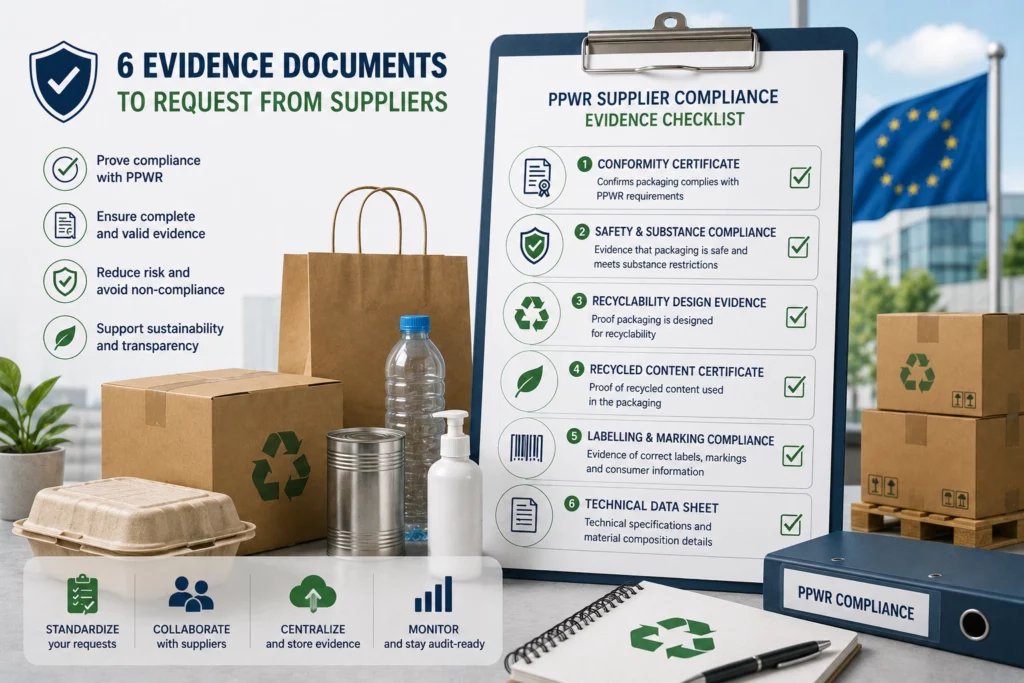
Effective PPWR supplier compliance depends on collecting a defined evidence set from every supplier that touches the packaging, not only the ones you contract with directly. Annex VII sets out what technical documentation must contain and Annex VIII sets out the Declaration of Conformity. In practice, the evidence you need to request breaks down into:
Declaration of Conformity / supplier declaration — referencing Regulation (EU) 2025/40 and Articles 5–12, signed, dated and traceable to a specific packaging format.
Material composition — for each component, listing the substances and concentrations used.
Substances-of-concern evidence — a PFAS attestation and heavy-metals statement. PFAS in food-contact packaging is restricted from 12 August 2026 at 25 ppb (single substance), 250 ppb (sum of PFAS) and 50 ppm (total fluorine); lead, cadmium, mercury and hexavalent chromium are capped at 100 mg/kg combined.
Recycled-content percentages — for each plastic component (Article 7 calculations).
Recyclability assessment / design-for-recycling grade — under Article 6, plus minimisation and, where relevant, reusability data (Articles 10 and 11).
Unique traceability identifiers — linking each piece of evidence to the packaging format it describes.
Are Your Supplier Declarations PPWR-Ready?Learn what supplier declarations should contain, how to manage supporting evidence, and how to connect supplier data with your packaging compliance records.
What PPWR Article 16 Means for Packaging Suppliers
Article 16 changes the role of supplier data in PPWR compliance. Suppliers are expected to provide manufacturers with the information and documentation needed to demonstrate packaging conformity, including relevant technical documentation under Annex VII and requirements arising from Articles 5 to 11. For contact-sensitive packaging, applicable supporting documentation under other EU legislation may also need to form part of the evidence package.
The practical challenge is scale. A manufacturer may work with hundreds of suppliers across packaging formats, materials and SKUs. Collecting a PDF from each supplier is not enough if teams cannot verify whether the evidence is complete, current and linked to the correct packaging component. When the DoC becomes due, the question is not simply “Do we have a supplier document?” but “Can we prove which packaging, material and requirement that document supports?” This is why Article 16 should be treated as a supplier-data workflow not just a documentation request.
How to collect and verify PPWR supplier compliance evidence at scale
Four moving parts turn scattered attachments into an audit-ready, always-current file.
Turning that list into an audit-ready file is where PPWR supplier compliance is won or lost. A repeatable process has four moving parts:
Structured request — send every supplier a standardised evidence template so responses come back in a consistent, comparable format instead of scattered PDFs.
Verification — check that each declaration references the correct regulation and articles, is signed and dated, and is backed by an actual test report rather than an unsupported claim.
Centralised storage — keep every document in one place, versioned and linked to the packaging format and SKU it belongs to, so it can be produced instantly on a customer request or regulatory inspection.
Monitoring — flag declarations that are expiring, suppliers that haven’t responded and specifications that have changed, because PPWR supplier compliance is a living obligation, not a one-time project.
Done well, this converts a reactive scramble before every audit into a defensible, always-current PPWR supplier compliance file and it is the difference between signing a Declaration of Conformity you can defend and one you merely hope holds up.
“PPWR supplier compliance is only as strong as the weakest evidence link in your supply chain. Treat supplier evidence as structured, verifiable data not attachments in an inbox and the Declaration of Conformity you sign becomes something you can defend, not just something you hope holds up.”
PPWR supplier compliance, made systematic with the TraceX platform
Standardised requests, automated verification, and a centralised evidence repository one system for the whole obligation.
The TraceX PPWR platform is built to make PPWR supplier compliance systematic rather than manual. It provides structured supplier onboarding and evidence-request workflows so every supplier submits the same defined data set, validation checks that flag missing signatures, wrong article references or absent test reports before they reach your Declaration of Conformity, and a centralised, versioned evidence repository that links each document to the packaging format, component and SKU it supports.
Automated reminders and expiry tracking keep the file current as suppliers and materials change, so when an authority or customer asks for proof, you can produce a complete, traceable record in minutes rather than weeks.
See how structured evidence collection, automated verification and audit-ready storage keep your Declaration of Conformity defensible across every SKU.
When evaluating a solution, confirm it can do all seven of the following.
Send standardised evidence requests to every supplier tier, not just direct suppliers
Capture DoCs, material composition, PFAS and heavy-metals evidence, recycled content and recyclability grades in one place
Validate that each declaration references Regulation (EU) 2025/40 and Articles 5–12
Link every piece of evidence to a specific packaging format, component and SKU
Track expiry dates and flag outdated or missing declarations automatically
Produce a complete, audit-ready file on demand for authorities or customers
Scale across hundreds of SKUs without adding headcount
Frequently Asked Questions (FAQ’s)
What is PPWR supplier compliance?
PPWR supplier compliance is the process of collecting and verifying packaging evidence from suppliers so a brand owner or importer can legally place packaging on the EU market under Regulation (EU) 2025/40. It covers Declarations of Conformity, material composition, substance test reports, recycled content and recyclability data.
Who is responsible for the Declaration of Conformity under PPWR?
The manufacturer typically the party whose name or brand appears on the packaging prepares and signs the EU Declaration of Conformity for each packaging type. Importers must collect and retain the DoC and technical documentation from their suppliers before placing packaging on the market.
What evidence do I need to collect from packaging suppliers?
Request material composition, a PFAS attestation and heavy-metals statement, recycled-content percentages, a recyclability or design-for-recycling grade, minimisation data and unique traceability identifiers each signed, dated and tied to a specific packaging format.
When did PPWR supplier compliance obligations start?
PPWR supplier compliance obligations took effect on 12 August 2026, when Regulation (EU) 2025/40 became applicable. From that date, no packaging can be placed on the EU market without a valid Declaration of Conformity and supporting technical documentation available for authorities on request.
Is a supplier declaration the same as a Declaration of Conformity?
No. Supplier declarations are the evidence you collect from converters, printers and material suppliers. Your Declaration of Conformity is your own self-certification, built on that supplier evidence, that the packaging meets Articles 5–12 of Regulation (EU) 2025/40.
What are the PFAS and heavy-metals limits under PPWR?
For food-contact packaging from 12 August 2026, PFAS limits are 25 ppb for any single substance, 250 ppb for the sum of PFAS and 50 ppm for total fluorine. Lead, cadmium, mercury and hexavalent chromium are capped at 100 mg/kg combined across all packaging.
How do I manage PPWR supplier compliance across hundreds of SKUs?
Manage PPWR supplier compliance at scale with a centralised, structured process: standardised evidence requests, automated verification, versioned storage linked to each SKU, and expiry tracking. A platform such as the TraceX platform is designed to run this end to end
Start using TraceX
Transparency, Trust, & Success for your Climate Journey.
We use cookies on our website to give you the most relevant experience by remembering your preferences and repeat visits. By clicking “Accept All”, you consent to the use of ALL the cookies. However, you may visit "Cookie Settings" to provide a controlled consent.
This website uses cookies to improve your experience while you navigate through the website. Out of these, the cookies that are categorized as necessary are stored on your browser as they are essential for the working of basic functionalities of the website. We also use third-party cookies that help us analyze and understand how you use this website. These cookies will be stored in your browser only with your consent. You also have the option to opt-out of these cookies. But opting out of some of these cookies may affect your browsing experience.
Necessary cookies are absolutely essential for the website to function properly. These cookies ensure basic functionalities and security features of the website, anonymously.
Cookie
Duration
Description
cookielawinfo-checkbox-analytics
11 months
This cookie is set by GDPR Cookie Consent plugin. The cookie is used to store the user consent for the cookies in the category "Analytics".
cookielawinfo-checkbox-functional
11 months
The cookie is set by GDPR cookie consent to record the user consent for the cookies in the category "Functional".
cookielawinfo-checkbox-necessary
11 months
This cookie is set by GDPR Cookie Consent plugin. The cookies is used to store the user consent for the cookies in the category "Necessary".
cookielawinfo-checkbox-others
11 months
This cookie is set by GDPR Cookie Consent plugin. The cookie is used to store the user consent for the cookies in the category "Other.
cookielawinfo-checkbox-performance
11 months
This cookie is set by GDPR Cookie Consent plugin. The cookie is used to store the user consent for the cookies in the category "Performance".
viewed_cookie_policy
11 months
The cookie is set by the GDPR Cookie Consent plugin and is used to store whether or not user has consented to the use of cookies. It does not store any personal data.
Functional cookies help to perform certain functionalities like sharing the content of the website on social media platforms, collect feedbacks, and other third-party features.
Performance cookies are used to understand and analyze the key performance indexes of the website which helps in delivering a better user experience for the visitors.
Analytical cookies are used to understand how visitors interact with the website. These cookies help provide information on metrics the number of visitors, bounce rate, traffic source, etc.
Advertisement cookies are used to provide visitors with relevant ads and marketing campaigns. These cookies track visitors across websites and collect information to provide customized ads.
Download the 2026 Traceability Scorecard and Benchmark Your Supply Chain Across 10 Critical Capabilities.
Download our eBook
Don’t Wait for an Audit to Find Your EUDR Gaps
The 2026 Simplification Package changes how HS codes, DDS pass-through and geolocation rules apply to you. Get the free guide and 20-point readiness checklist before enforcement catches you unprepared.