PPWR Article 3 Explained: What “Placing on the Market” Means for Packaging Compliance
Published
, 10 minute read
Share this article
Quick summary: PPWR Article 3 explains placing on the market, making available, and packaging scope to help businesses identify EU packaging compliance roles.
A practical guide to understanding PPWR market-availability definitions and their compliance implications
Under PPWR, compliance responsibility can start with a simple question: When did your packaging enter the EU market? PPWR Article 3 distinguishes between “making available on the market,” “placing on the market,” and “making available on the territory of a Member State.” These definitions cover both empty packaging and packaging containing a product.
Companies often focus on what packaging they use, but the Packaging and Packaging Waste Regulation (PPWR) also requires businesses to understand how and where packaging is being made available or placed on the market.
The practical takeaway is simple: before determining your PPWR obligations, establish what “placing on the market” means for your business.
Key Takeaways
“Placing on the market” is a specific PPWR concept and should not be treated as interchangeable with simply selling or distributing packaging.
The economic operator and the point at which packaging enters the EU market matter when determining applicable PPWR responsibilities.
Packaging responsibility can extend beyond the final consumer package, making it important to understand sales, grouped and transport packaging within the relevant scope.
Packaging flows should be mapped across EU markets to understand where obligations such as EPR and other requirements may arise.
A central packaging inventory is essential for determining responsibility, connecting packaging types and components with suppliers, markets, evidence and compliance obligations.
Supplier-provided declarations do not automatically transfer all PPWR responsibilities to the packaging supplier; businesses need to assess their own role and obligations.
What Is PPWR Article 3?
Article 3 provides important definitions used throughout the PPWR. Understanding these terms is essential because they help determine how packaging enters the EU market and how subsequent supply is treated.
1. Making available on the market
Making available on the market refers to any supply of packaging, whether empty or containing a product, for distribution, consumption or use on the Union market in a commercial activity, with or without payment.
2. Placing on the market
Placing on the market means the first making available of packaging, whether empty or containing a product, on the Union market.
3. Making available on the territory of a Member State
This refers to any supply of packaging, whether empty or containing a product, for distribution, consumption or use within the territory of a Member State in a commercial activity, with or without payment.
Making Available vs Placing on the Market: What’s the Difference?
Term
Simple explanation
Example
Making available
Supplying packaging on the EU market.
A distributor supplies packaged goods to a customer.
Placing on the market
The first time packaging is made available on the Union market.
An importer brings packaged products into the EU for the first time.
Making available in a Member State
Supplying packaging for distribution, consumption or use in a specific EU country.
A company supplies packaged products to customers in Germany.
Simple takeaway: “Placing on the market” focuses on the first availability of packaging, while “making available” covers supply on the market more generally.
Is Your Business Ready for PPWR Compliance?Understand the key requirements, responsibilities and deadlines businesses need to address across packaging data, labelling, EPR, recyclability and technical documentation.
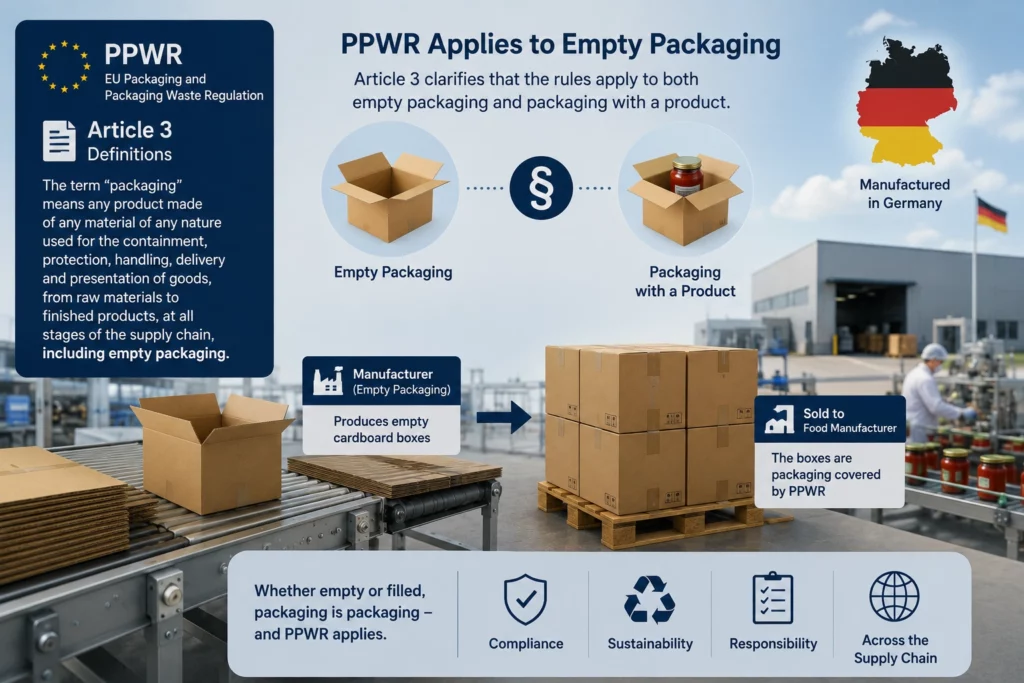
A common misunderstanding is that packaging requirements only become relevant when packaging contains a finished consumer product. Article 3’s definitions clarify that the reference to packaging includes both empty packaging and packaging with a product.
For example, if a company manufactures empty cardboard boxes in Germany and sells them to a food manufacturer, the boxes themselves are packaging covered by the relevant PPWR framework.
Real-World Examples: How Article 3 Works
Scenario 1: EU Packaging Manufacturer
A German company manufactures food packaging and sells it to an EU customer. The business needs to understand whether its activity represents the first making available of that packaging on the Union market and how its economic-operator role affects its obligations.
Scenario 2: Importer
A company imports packaging from outside the EU and makes it available in the Union. The business should determine whether it is involved in the first placing of that packaging on the EU market and what responsibilities follow from its role.
Scenario 3: Distributor
A distributor purchases packaging that has already been placed on the EU market and resells it. This illustrates why “making available” and “placing on the market” should not be treated as interchangeable concepts.
Scenario 4: Brand Owner
A brand owner purchases packaging from a supplier and sells packaged products under its own brand. The business should establish which economic operator is responsible for the relevant market activity and compliance requirements.
Who Is Responsible for PPWR Compliance?Understand the roles and responsibilities of manufacturers, importers, distributors and other economic operators under PPWR and what each needs to get right.
Article 3 should not be read in isolation. PPWR Article 3 provides definitions for economic operators including manufacturers, suppliers, importers and distributors. These roles are then used in the provisions covering economic-operator obligations.
Understanding where packaging first enters the EU market can therefore be an important starting point for identifying the relevant responsibilities across the packaging value chain.
Who Carries PPWR Responsibilities Across the Supply Chain?Understand how PPWR obligations apply to manufacturers, importers, distributors and other economic operators—and what businesses need to manage.
Once the relevant economic-operator role and market activity have been established, businesses need a reliable way to demonstrate packaging compliance.
The economic operators placing packaging on the EU market need to carry out a conformity assessment procedure and draw up technical documentation. The documentation must be retained and presented to market-surveillance authorities when requested.
Article 3 and Your Packaging Data
Determining the correct PPWR role requires visibility into packaging flows. A structured data model can connect packaging information with the organizations, products and markets involved in the packaging lifecycle.
Packaging Inventory → Supplier & Manufacturer Data → Economic Operator Mapping → EU Market / Member State → Compliance Requirements → Evidence & Documentation
Common Mistakes Businesses Make
1. Treating “making available” and “placing on the market” as the same thingThese terms can have different implications under PPWR, and confusing them can lead businesses to assign responsibilities incorrectly. A company needs to understand when packaging or a packaged product is first made available on the EU market and which economic operator is responsible at that point. This becomes particularly important when products move through manufacturers, importers, distributors and other supply-chain participants. Mapping the transaction and supply-chain flow helps determine where specific obligations arise.
2. Assuming only filled consumer packaging is relevantPPWR obligations are not limited to the final consumer package sitting on a retail shelf. Businesses also need to consider packaging used across the supply chain, including sales packaging, grouped packaging and transport packaging, depending on the specific requirement and packaging flow. Ignoring secondary or transport packaging can leave gaps in packaging inventories, material data, labelling assessments and EPR-related obligations.
3. Assuming the packaging supplier automatically carries every compliance responsibilityA packaging supplier may provide specifications, declarations, certificates or other supporting information, but that does not necessarily transfer every PPWR obligation away from the business placing products on the market. Responsibilities can depend on the role of the economic operator, the packaging involved and the specific PPWR requirement. Businesses therefore need to distinguish between information supplied by a packaging manufacturer and the compliance responsibilities that remain with their own organisation.
4. Not mapping packaging flows across different EU marketsPackaging compliance cannot always be managed as a single EU-wide checklist. Businesses selling across multiple Member States may encounter different EPR registration, reporting, producer-responsibility and operational requirements. Without mapping which packaging and products enter which market, companies can struggle to determine the applicable obligations and maintain the right evidence. A market-by-market packaging flow can make these differences visible and easier to manage.
5. Trying to determine PPWR responsibility without a central packaging inventory and supporting evidenceResponsibility becomes difficult to determine when businesses do not have a reliable view of what packaging they use, who supplies it, where it is placed on the market and what evidence supports its characteristics. A central packaging inventory should connect packaging SKUs and components with material composition, suppliers, specifications, declarations, relevant assessments, markets and compliance status. This gives compliance teams a traceable basis for determining obligations instead of relying on disconnected spreadsheets, emails and supplier documents.
How TraceX Can Help
TraceX PPWR Solutions can serve as an operational layer for connecting packaging data with suppliers, economic operators, products and markets involved in the packaging lifecycle.
A structured packaging compliance workflow can help teams maintain a packaging inventory, connect supplier information and supporting evidence, and improve visibility into where packaging enters the EU market.
This creates a stronger foundation for managing downstream activities such as technical documentation, conformity evidence, EPR reporting and broader PPWR readiness.
Not sure which PPWR obligations apply to your business?
TraceX can help you map your packaging portfolio, economic operators, suppliers and EU markets to build a clearer PPWR compliance workflow.
Use these questions as a starting point for reviewing your packaging data and market flows:
What packaging do we place or make available on the EU market?
Are we dealing with empty packaging, filled packaging, or both?
Which entity first makes the packaging available in the EU?
Which entity subsequently makes it available?
In which Member States is the packaging being made available?
Can we connect each packaging type to the responsible economic operator and supporting compliance data?
Conclusion
PPWR compliance does not start with a Declaration of Conformity. It starts with understanding what packaging you are putting on the EU market and who is responsible for it.
Article 3 provides the terminology businesses need to understand how packaging enters the market and how subsequent supply is treated. Once those flows are mapped, businesses can begin determining the appropriate compliance responsibilities and evidence requirements.
For organizations managing large packaging portfolios, a structured digital approach can make it easier to connect packaging records, suppliers, economic operators, markets and supporting compliance evidence.
Frequently Asked Questions (FAQ’s)
What does “placing on the market” mean under PPWR?
“Placing on the market” refers to the first making available of a product on the EU market. Understanding when and where this occurs is important for determining which economic operator has the relevant PPWR responsibilities.
What is the difference between “placing on the market” and “making available” under PPWR?
The concepts are related but not identical. “Placing on the market” generally concerns the first making available of a product on the EU market, while “making available” can refer to subsequent supply or availability within the market.
Does PPWR apply only to consumer packaging?
No. Businesses should assess the packaging used throughout their relevant supply-chain flows, including sales, grouped and transport packaging, depending on the specific PPWR requirement and scope.
Is the packaging supplier responsible for PPWR compliance?
Not necessarily. A packaging supplier may provide specifications, declarations and supporting evidence, but PPWR responsibilities depend on the role of the economic operator and the specific obligation. Businesses should not assume that supplier documentation transfers their own responsibilities.
Why do businesses need a packaging inventory for PPWR?
A central packaging inventory helps businesses identify what packaging they use, its components and materials, who supplies it, where it is placed on the market and what evidence supports it. This provides a clearer basis for determining PPWR responsibilities and managing compliance.
Start using TraceX
Transparency, Trust, & Success for your Climate Journey.
We use cookies on our website to give you the most relevant experience by remembering your preferences and repeat visits. By clicking “Accept All”, you consent to the use of ALL the cookies. However, you may visit "Cookie Settings" to provide a controlled consent.
This website uses cookies to improve your experience while you navigate through the website. Out of these, the cookies that are categorized as necessary are stored on your browser as they are essential for the working of basic functionalities of the website. We also use third-party cookies that help us analyze and understand how you use this website. These cookies will be stored in your browser only with your consent. You also have the option to opt-out of these cookies. But opting out of some of these cookies may affect your browsing experience.
Necessary cookies are absolutely essential for the website to function properly. These cookies ensure basic functionalities and security features of the website, anonymously.
Cookie
Duration
Description
cookielawinfo-checkbox-analytics
11 months
This cookie is set by GDPR Cookie Consent plugin. The cookie is used to store the user consent for the cookies in the category "Analytics".
cookielawinfo-checkbox-functional
11 months
The cookie is set by GDPR cookie consent to record the user consent for the cookies in the category "Functional".
cookielawinfo-checkbox-necessary
11 months
This cookie is set by GDPR Cookie Consent plugin. The cookies is used to store the user consent for the cookies in the category "Necessary".
cookielawinfo-checkbox-others
11 months
This cookie is set by GDPR Cookie Consent plugin. The cookie is used to store the user consent for the cookies in the category "Other.
cookielawinfo-checkbox-performance
11 months
This cookie is set by GDPR Cookie Consent plugin. The cookie is used to store the user consent for the cookies in the category "Performance".
viewed_cookie_policy
11 months
The cookie is set by the GDPR Cookie Consent plugin and is used to store whether or not user has consented to the use of cookies. It does not store any personal data.
Functional cookies help to perform certain functionalities like sharing the content of the website on social media platforms, collect feedbacks, and other third-party features.
Performance cookies are used to understand and analyze the key performance indexes of the website which helps in delivering a better user experience for the visitors.
Analytical cookies are used to understand how visitors interact with the website. These cookies help provide information on metrics the number of visitors, bounce rate, traffic source, etc.
Advertisement cookies are used to provide visitors with relevant ads and marketing campaigns. These cookies track visitors across websites and collect information to provide customized ads.
Download the 2026 Traceability Scorecard and Benchmark Your Supply Chain Across 10 Critical Capabilities.
Download our eBook
Don’t Wait for an Audit to Find Your EUDR Gaps
The 2026 Simplification Package changes how HS codes, DDS pass-through and geolocation rules apply to you. Get the free guide and 20-point readiness checklist before enforcement catches you unprepared.