Battery DPP Compliance Requirements: What the EU Battery Regulation Demands Before 18 February 2027
Published
, 10 minute read
Share this article
Quick summary: Battery DPP compliance requirements explained: who must comply, the Annex XIII data set, and the 18 Feb 2027 deadline under the EU Battery Regulation.
Battery DPP compliance requirements are the data, access, and traceability obligations that every EV battery, light-means-of-transport (LMT) battery, and industrial battery above 2 kWh must satisfy under Article 77 of the EU Battery Regulation (Regulation (EU) 2023/1542) before it can be placed on the EU market from 18 February 2027. In practice, that means a machine-readable digital product passport, linked to each battery by a QR code, populated with the roughly 90 attributes set out in Annex XIII and kept accurate for the life of the battery.
Key Takeaways
• The deadline is fixed. 18 February 2027 is a directly applicable statutory date across all 27 member states no national transposition, no soft grace period.
• Scope is category-specific. EV batteries, LMT batteries, and industrial batteries above 2 kWh are in scope. Portable, SLI, and sub-2 kWh industrial batteries are not (though other Battery Regulation duties still apply).
• The economic operator placing the battery on the market owns the passport whether that is the manufacturer or the importer.
• Annex XIII defines the content: ~90 mandatory attributes across seven lifecycle clusters, split into static/dynamic and model-level/unit-level data, with tiered access.
• No compliant passport, no market access. In-scope batteries without a registered passport cannot lawfully clear EU customs.
The Battery DPP introduces new expectations around battery data, traceability, sustainability information and digital access across the battery lifecycle.
Our eBook breaks down the key requirements and practical considerations businesses need to understand as they prepare for implementation.
What Battery DPP Compliance Requirements Actually Cover
Battery DPP compliance requirements are the obligation to attach a structured, machine-readable digital passport to each in-scope battery and keep its data complete, correct, and accessible.
A digital product passport (DPP) is a data record, not a PDF linked to the physical battery through a QR code and a unique identifier.
The battery passport is the first live application of the EU’s DPP concept, and the template later product categories (textiles, electronics) will follow.
The regulation is the law; the passport is the instrument it mandates. Conflating the two is the most common early mistake compliance teams make.
The pain most teams hit is definitional before it is operational. Battery DPP compliance requirements are not the same as your Extended Producer Responsibility (EPR) registration, and they are not the same as your supply-chain due-diligence policy. Those are distinct instruments under the same regulation. The passport is specifically the Article 77 data record and getting its boundaries right up front saves weeks of mis-scoped effort when you start mapping obligations against your internal systems.
Preparing for the Battery Digital Product Passport?
Our complete guide to the Battery DPP explains what battery manufacturers and supply chain teams need to knowfrom data requirements and traceability to QR codes, lifecycle information and compliance readiness.
Battery DPP Compliance Requirements: Who Must Comply and When
Battery DPP compliance requirements split into three practical questions which batteries, by when, and whose responsibility. In short: three categories, one hard date, one responsible operator.
Which batteries are in scope
Under Article 77(1), the passport applies to each LMT battery, each industrial battery with a capacity above 2 kWh, and each EV battery placed on the market or put into service. Portable batteries, SLI (starting, lighting, ignition) batteries, and industrial batteries at or below 2 kWh are outside the passport requirement a distinction worth checking at the individual-battery level, not the system level, because many stationary-storage and UPS systems cross the 2 kWh threshold per battery.
Is your business prepared for the EU Battery Regulation?
Our guide to the EU Battery Regulation breaks down the key requirements businesses need to understand, from battery sustainability and carbon footprint to due diligence, recycled content, traceability, labelling and the Battery Digital Product Passport.
The deadline that governs everything
Meeting battery DPP compliance requirements becomes mandatory on 18 February 2027. Because Regulation (EU) 2023/1542 is directly applicable, there is no member-state transposition to soften or delay it. For manufacturers and importers, 2026 is the data-readiness year: lifecycle data collection, QR/data-carrier workflows, and supplier integration all have to be in place before the passport can be generated and registered.
Who carries the obligation
The economic operator placing the battery on the EU market the manufacturer or, for imported batteries, the importer is responsible for ensuring the passport exists, is linked to the battery, and stays accurate and up to date. That operator may authorise another party in writing to act on its behalf, but the accountability does not move. When a battery is repurposed or given a second life, the operator placing it back on the market must generate a new passport linked to the original.
Battery DPP Compliance Requirements Under Annex XIII
The hardest part of battery DPP compliance requirements is the data itself. Annex XIII defines the mandatory content the Battery Pass Consortium counts roughly 90 attributes for EV batteries organised into seven lifecycle clusters:
General battery and manufacturer information (identity, model, GTIN, manufacturing date and location).
Compliance, labels, and certifications.
Battery carbon footprint (declaration and performance class, in kg CO2e per kWh over service life).
Supply-chain due-diligence information (aligned with OECD guidance).
Battery materials and composition (including recycled content of cobalt, lithium, nickel, and lead).
Circularity and resource efficiency (removability, repairability, dismantling and safety information).
Performance and durability (rated capacity, state of health, cycle count, expected service life).
Two structural distinctions shape how you store and update this data. First, static attributes (carbon footprint, sourcing) are set at market entry and rarely change, while dynamic attributes (state of health, cycle count) evolve across the battery’s life and must be kept current. Second, some data is model-level and some is unit-level. On top of that, access is tiered: some fields are public, some visible only to parties with a legitimate interest and the Commission, and some restricted to notified bodies and market-surveillance authorities. Getting these distinctions right is what separates battery DPP compliance requirements that survive an audit from a static form that does not.
Preparing for the EU’s Digital Product Passport requirements under ESPR?
Our guide to DPP for ESPR explains how the Digital Product Passport is shaping product transparency, sustainability and circularity across EU supply chainsfrom product data and traceability to recyclability, repairability and compliance information.
On paper, a passport looks like a form to fill in. In practice, battery DPP compliance requirements are a retrieval problem, not a documentation problem and that is where manual systems fail.
The data does not live in one place. Carbon-footprint figures come from LCA models, recycled-content percentages from cell and material suppliers, due-diligence evidence from procurement, and state-of-health telemetry from the field. A spreadsheet can hold a snapshot, but it cannot keep ~90 attributes per battery model reconciled across suppliers, versioned for audit, and updated as dynamic fields change at the volume a real product line generates. This is the same reason the “one data layer, many regulations” approach wins: the carbon, sourcing, and material data you assemble for the battery passport is the same data your EPR, due-diligence, and CSRD reporting draw on. Capturing it once, in a structured system, is the difference between passing an audit and scrambling for it.
Battery DPP compliance requirements are not a labelling task bolted on at the end of a production line they are a data-architecture decision made at the start. The TraceX platform is built to capture supply-chain, material, carbon, and lifecycle data in a single traceable layer, so the Annex XIII attributes needed for the battery passport are a query against data you already hold rather than a fresh scramble per SKU.
The organisations that will clear the 18 February 2027 deadline comfortably are the ones treating 2026 as a data-readiness year mapping every Annex XIII field to a source system now, while there is still time to fix the gaps.
TraceX Battery DPP Solutions helps battery manufacturers prepare for Battery Digital Product Passport (DPP) compliance by creating a connected digital record of the battery’s lifecycle and supply chain. It brings together supplier information, raw-material provenance, component data, manufacturing events, batch and serial-level traceability, carbon footprint, recycled content and sustainability data in one structured workflow. TraceX can also connect data from existing enterprise systems and support supplier data collection, validation and audit-ready reporting. This helps manufacturers move from fragmented spreadsheets and disconnected systems to a verifiable, DPP-ready data foundation that can support the information required throughout the battery lifecycle from raw materials and manufacturing to use, reuse and recycling.
Preparing your Battery DPP strategy?
Talk to TraceX about building a connected, DPP-ready data and traceability foundation.
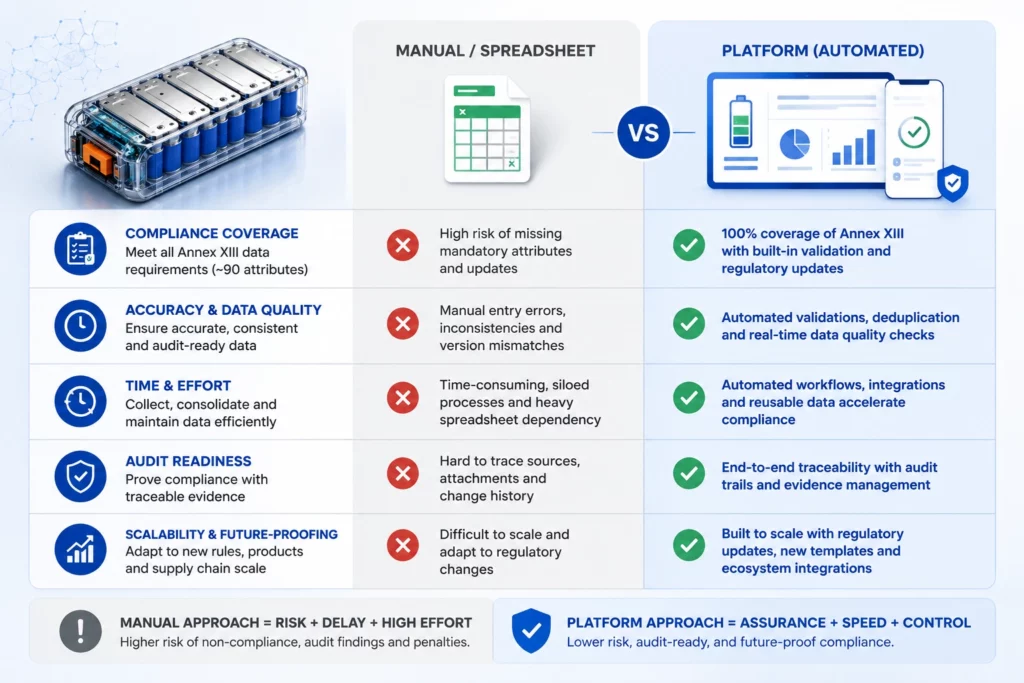
Manual vs Platform: Meeting Battery DPP Compliance Requirements
The same battery DPP compliance requirements can be met two ways. The gap shows up under audit and at scale.
Requirement
Manual / spreadsheet approach
TraceX platform approach [pending sign-off]
Annex XIII data capture
Re-keyed per SKU from scattered supplier emails and PDFs.
Structured capture into one traceable data layer, reused across regulations.
Dynamic data (state of health, cycle count)
Static snapshot; goes stale after market entry.
Field/telemetry updates flow into the unit-level record over the battery’s life.
Supplier evidence
Chased ad hoc; hard to verify or version.
Requested, collected, and version-controlled against each attribute.
QR + unique identifier
Generated manually, linkage error-prone.
Identifier and QR issued and linked to the passport record automatically.
Audit & market surveillance
Retrieval scramble across files and inboxes.
Tiered-access record produced on demand for the right authority.
A Buyer’s Checklist for Battery DPP Compliance Requirements
Use this to evaluate any passport solution against real battery DPP compliance requirements not just a QR generator:
Maps every Annex XIII attribute to a named source system, not a blank field.
Handles both static and dynamic data, and both model-level and unit-level records.
Issues and links the QR code and unique identifier to ISO/IEC 15459 standards.
Enforces tiered access (public / legitimate interest / authorities) out of the box.
Supports passport re-issue for repurposed and second-life batteries.
Reuses the same data for EPR, due diligence, and CSRD not a siloed point tool.
Registers passports to the EU registry infrastructure as it comes online.
Frequently Asked Questions (FAQ’s)
What are the battery DPP compliance requirements in one sentence?
They are the obligation, under Article 77 of Regulation (EU) 2023/1542, to attach a machine-readable digital product passport populated with the Annex XIII data set and linked by QR code to each in-scope battery before it is placed on the EU market from 18 February 2027.
When do battery passport requirements start?
18 February 2027. The date is directly applicable across all 27 EU member states, so there is no national grace period.
Which batteries need a digital product passport?
EV batteries, LMT batteries, and industrial batteries with a capacity above 2 kWh. Portable, SLI, and sub-2 kWh industrial batteries are outside the passport requirement but remain subject to other Battery Regulation obligations.
Who is responsible for creating the battery passport?
The economic operator placing the battery on the EU market the manufacturer or the importer. That operator may authorise another party in writing to act for it, but the accountability stays with the operator.
What data goes into the battery passport?
The Annex XIII data set roughly 90 mandatory attributes across seven clusters: general/manufacturer information, compliance and certifications, carbon footprint, due diligence, materials and composition, circularity, and performance and durability.
Is the battery passport the same as EPR registration or due diligence?
No. They are distinct instruments under the same regulation. EPR registration and the supply-chain due-diligence policy are separate obligations from the Article 77 passport, even though they draw on overlapping data.
Can a spreadsheet meet battery DPP compliance requirements?
For a handful of models, briefly. At production volume it fails on auditability, dynamic-data updates, and supplier reconciliation which is why manufacturers move to a structured traceability platform ahead of the deadline.
Start using TraceX
Transparency, Trust, & Success for your Climate Journey.
We use cookies on our website to give you the most relevant experience by remembering your preferences and repeat visits. By clicking “Accept All”, you consent to the use of ALL the cookies. However, you may visit "Cookie Settings" to provide a controlled consent.
This website uses cookies to improve your experience while you navigate through the website. Out of these, the cookies that are categorized as necessary are stored on your browser as they are essential for the working of basic functionalities of the website. We also use third-party cookies that help us analyze and understand how you use this website. These cookies will be stored in your browser only with your consent. You also have the option to opt-out of these cookies. But opting out of some of these cookies may affect your browsing experience.
Necessary cookies are absolutely essential for the website to function properly. These cookies ensure basic functionalities and security features of the website, anonymously.
Cookie
Duration
Description
cookielawinfo-checkbox-analytics
11 months
This cookie is set by GDPR Cookie Consent plugin. The cookie is used to store the user consent for the cookies in the category "Analytics".
cookielawinfo-checkbox-functional
11 months
The cookie is set by GDPR cookie consent to record the user consent for the cookies in the category "Functional".
cookielawinfo-checkbox-necessary
11 months
This cookie is set by GDPR Cookie Consent plugin. The cookies is used to store the user consent for the cookies in the category "Necessary".
cookielawinfo-checkbox-others
11 months
This cookie is set by GDPR Cookie Consent plugin. The cookie is used to store the user consent for the cookies in the category "Other.
cookielawinfo-checkbox-performance
11 months
This cookie is set by GDPR Cookie Consent plugin. The cookie is used to store the user consent for the cookies in the category "Performance".
viewed_cookie_policy
11 months
The cookie is set by the GDPR Cookie Consent plugin and is used to store whether or not user has consented to the use of cookies. It does not store any personal data.
Functional cookies help to perform certain functionalities like sharing the content of the website on social media platforms, collect feedbacks, and other third-party features.
Performance cookies are used to understand and analyze the key performance indexes of the website which helps in delivering a better user experience for the visitors.
Analytical cookies are used to understand how visitors interact with the website. These cookies help provide information on metrics the number of visitors, bounce rate, traffic source, etc.
Advertisement cookies are used to provide visitors with relevant ads and marketing campaigns. These cookies track visitors across websites and collect information to provide customized ads.
Download the 2026 Traceability Scorecard and Benchmark Your Supply Chain Across 10 Critical Capabilities.
Download our eBook
Don’t Wait for an Audit to Find Your EUDR Gaps
The 2026 Simplification Package changes how HS codes, DDS pass-through and geolocation rules apply to you. Get the free guide and 20-point readiness checklist before enforcement catches you unprepared.