PPWR Compliance for Tire Manufacturers in Belgium: What Changes by 12 August 2026
Published
, 12 minute read
Share this article
Quick summary: PPWR Compliance for Tire Manufacturers in Belgium: what Reg. (EU) 2025/40 requires by 12 Aug 2026 and how it stacks with Fost Plus, Valipac and three regional registers.
PPWR Compliance for Tire Manufacturers in Belgium means aligning every packaging component you place on the Belgian market with Regulation (EU) 2025/40 by 12 August 2026 while still meeting Belgium’s uniquely fragmented national obligations: a split between two producer responsibility organisations (Fost Plus for household packaging, Valipac for commercial and industrial packaging) and three regional registers coordinated by the Interregional Packaging Commission. Because tyres travel in both household and C&I packaging, the task is less an artwork exercise than a per-SKU, per-component data problem and Belgium is the most structurally complex EU market to get it right.
Key takeaways
PPWR (Regulation (EU) 2025/40) applies uniformly across the EU from 12 August 2026, with no transitional grace period for stock placed on the market on or after that date.
Belgium is the only EU country that splits packaging EPR across two PROs Fost Plus (household) and Valipac (commercial & industrial) and across three regional registers under the Interregional Packaging Commission (IVC/CIE).
Tyre makers usually touch both PRO streams: bulk pallets and shrink wrap shipped B2B to garages, fleets and distributors (Valipac) and consumer-boxed tyres sold via retail or e-commerce (Fost Plus).
From 12 August 2026 you must hold a Declaration of Conformity plus technical documentation for each packaging type; the take-back duty applies above 300 kg of packaging per year and attaches to the Belgian-side party placing goods on the market.
The 1997 Interregional Cooperation Agreement is being revised to align with PPWR through 2026–2027, so the Belgian legal base keeps moving another reason to manage PPWR Compliance for Tire Manufacturers in Belgium as structured data, not artwork.
Download the Free Declaration of Conformity (DoC) Template
Why PPWR Compliance for Tire Manufacturers in Belgium Is Structurally Different
PPWR Compliance for Tire Manufacturers in Belgium is uniquely demanding because the country layers more moving parts under the same EU rulebook than anywhere else. In short:
PPWR is a regulation, so it applies directly no Belgian transposition, no local carve-outs.
Belgium runs two PROs and three regional registers, and none of that goes away on 12 August 2026.
Tyres and their packaging cross both the household and C&I streams, so most tyre makers report into both.
Regulation (EU) 2025/40 entered into force on 11 February 2025 and applies generally from 12 August 2026, repealing the 1994 Packaging Directive. It is one harmonised rulebook that binds every economic operator placing packaging on the EU market. Belgium, however, is the only member state that maintains a dedicated system for commercial and industrial packaging (Valipac) alongside its household scheme (Fost Plus), with both coordinated across Flanders, Wallonia and Brussels-Capital by the Interregional Packaging Commission. The PPWR adds a conformity layer above all of it without simplifying any of it which is why packaging compliance in Belgium is deceptively hard.
What PPWR Compliance for Tire Manufacturers in Belgium Actually Requires
PPWR Compliance for Tire Manufacturers in Belgium breaks into three obligations that must be demonstrable from day one:
Substances of concern and PFAS minimisation on all packaging
A Declaration of Conformity and technical documentation per packaging type
Correct registration and reporting across Fost Plus, Valipac and the three regions
Substances of concern, PFAS and recyclability
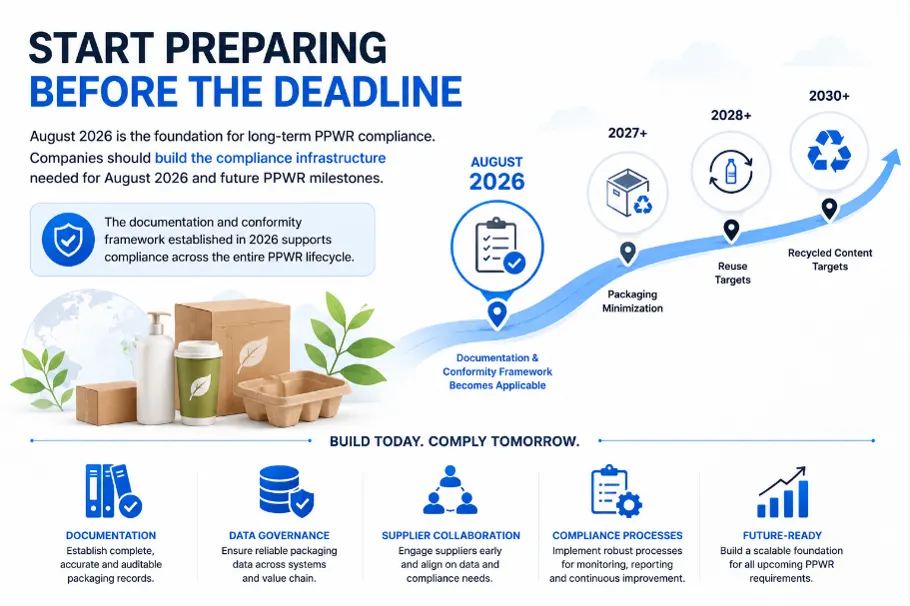
From 12 August 2026, packaging must be manufactured so that substances of concern are minimised, with PFAS limits (Article 5) for food-contact packaging. For a tyre maker this reaches beyond the tyre into inks, adhesives, shrink wrap and coated liners on every pallet, case and consumer box. Achieving PPWR Compliance for Tire Manufacturers in Belgium here means holding material-level evidence for every packaging component including secondary and tertiary transport packaging — not just the outer carton. Recyclability grading, recycled-content thresholds and the empty-space ratio cap phase in later (2028–2030), so build the data model to absorb them now.
Declaration of Conformity and technical documentation
Each packaging type placed on the market from 12 August 2026 needs an EU Declaration of Conformity backed by technical documentation and a conformity assessment. One statement covers one packaging type, so a tyre maker running 40 distinct formats needs 40 declarations. This is where the obligation turns into a document-control discipline: bills of materials, supplier attestations and test data must be mapped to each SKU and kept audit-ready. The TraceX platform can hold packaging BOMs, supplier evidence and Declaration-of-Conformity records against each SKU
The two-PRO and tri-regional registration split
Belgium’s take-back duty applies to companies placing more than 300 kg of household and commercial packaging on the Belgian market per year, and it attaches to the Belgian-side party who first places the goods on the market often an importer or distributor rather than the foreign seller. Household packaging is declared through Fost Plus (MyFost), commercial and industrial packaging through Valipac (Valipac Portal), with the Interregional Packaging Commission as the interregional authority and fallback. Fees are eco-modulated per kilogram by material. Getting PPWR Compliance for Tire Manufacturers in Belgium right therefore means classifying every packaging component by stream and region before a single declaration is filed.
Read our guide on PPWR Compliance Requirements to understand what businesses need to know about packaging design, recyclability, recycled content, labelling, EPR, reporting, and documentation.
The Belgian Fragmentation Behind PPWR Compliance for Tire Manufacturers in Belgium
Two PROs — bulk B2B pallets to garages, fleets and distributors sit with Valipac; consumer-boxed tyres sold at retail or online sit with Fost Plus.
Three regional registers — obligations and reporting rhythms differ across Flanders, Wallonia and Brussels-Capital under IVC/CIE.
A moving legal base — the 1997 Cooperation Agreement is being rewritten to align with PPWR through 2026–2027, so requirements will keep shifting.
Handled as separate projects one Fost Plus declaration, one Valipac declaration, three regional views and a new EU conformity file these collide, because the same packaging weights and materials get re-keyed into every system and drift out of sync. Non-compliance in Belgium can bring fines, sales bans and audits, and a mis-split between household and C&I can distort your fee base in both directions. Handled as one dataset, it becomes a single source of truth that feeds every scheme and survives the Cooperation Agreement revision which is the whole point of managing packaging as data rather than artwork.
How to Build a Defensible Program for PPWR Compliance for Tire Manufacturers in Belgium
A defensible approach to PPWR Compliance for Tire Manufacturers in Belgium runs on three moves:
Map packaging at component level — primary, secondary and tertiary to each SKU, with a household-vs-C&I flag and the region(s) it reaches.
Attach evidence to the component, not the document: material composition, weight, PFAS/substances-of-concern data, supplier attestations and Declaration-of-Conformity status.
Make every declaration a data output, so Fost Plus, Valipac, the regional registers and the PPWR conformity file are all generated from one validated dataset per SKU.
This is precisely where a traceability platform earns its place. [The TraceX platform is designed to link packaging BOMs, supplier evidence, substance data and conformity records to each SKU with a household/C&I stream flag so the same source feeds Fost Plus and Valipac declarations, regional reporting and PPWR documentation, pending product-team sign-off.] Framed this way, PPWR Compliance for Tire Manufacturers in Belgium stops being an annual scramble across two PROs and three regions and becomes a maintained system: when the Cooperation Agreement changes or a threshold shifts in 2028 or 2030, you update the data once and re-issue the affected declarations. Teams that reach this state report cutting packaging-compliance rework substantially and shortening time-to-evidence during audits
Belgium is the EU’s fragmentation test for packaging compliance. The PPWR rules are identical in Brussels and Berlin but only Belgium makes you satisfy two separate PROs and three regional registers underneath them, and only in Belgium do tyre makers routinely straddle the household and C&I streams at once. So the real differentiator in PPWR Compliance for Tire Manufacturers in Belgium is not who reads the regulation fastest; it’s who structures packaging as reusable, stream-tagged data. Treat it as separate declarations and you re-key the same numbers into four systems every year. Treat it as one dataset and you build it once.
Wondering what role Producer Responsibility Organisations (PROs) play under the PPWR?
Read the blog: PRO in PPWR: Understanding Producer Responsibility Organisations & EPR Compliance
Manual Spreadsheets vs. a Traceability Platform
How the two approaches to PPWR Compliance for Tire Manufacturers in Belgium compare across the obligations that actually get enforced:
Compliance task
Manual / spreadsheets
TraceX platform
Household vs C&I split
Judged ad hoc per shipment; drifts
Stream flag set per component, reused everywhere
Fost Plus + Valipac declarations
Numbers re-keyed into each portal
Both generated from one SKU dataset
Three regional registers
Tracked in separate sheets
One record, region tags applied
Declaration of Conformity
Rebuilt manually per packaging type
Generated from linked SKU evidence
Cooperation Agreement / 2028–2030 changes
Full re-audit each time
Update data once, re-issue affected records
For tire manufacturers in Belgium, TraceX’s PPWR solution can help centralize and manage packaging data across tire SKUs, packaging components, materials, weights, suppliers and supporting compliance documents. It can connect packaging information with the relevant product and shipment records, help teams identify missing supplier data or evidence, and create a structured compliance trail for PPWR requirements. This is particularly useful for tire manufacturers managing different packaging formats across products and EU markets, where packaging data may otherwise be spread across procurement systems, spreadsheets and supplier documents. TraceX can help bring this information into one connected workflow, making it easier for compliance and procurement teams to prepare the required documentation, manage EPR-related information and maintain an auditable record of packaging compliance.
See how the TraceX platform handles packaging compliance
Book a demo to see packaging BOMs, weights and Declaration-of-Conformity records mapped to each SKU with a household/C&I flag one dataset feeding Fost Plus, Valipac and PPWR
If you are scoping software to support PPWR Compliance for Tire Manufacturers in Belgium, confirm it can:
✓Hold packaging BOMs at primary, secondary and tertiary component level, per SKU and per market.
✓Tag each packaging component as household (Fost Plus) or commercial/industrial (Valipac), plus the Belgian region(s) it reaches.
✓Track the 300 kg/year threshold and identify the Belgian-side responsible party per supply route.
✓Generate and version an EU Declaration of Conformity per packaging type with linked technical documentation.
✓Output Fost Plus and Valipac declarations from the same validated dataset, with weights by material fraction.
✓Absorb the 2028–2030 thresholds and the revised Cooperation Agreement without a data re-build.
✓Produce an audit trail that maps every declared weight and claim back to source evidence.
Frequently Asked Questions
When does PPWR Compliance for Tire Manufacturers in Belgium take effect?
Regulation (EU) 2025/40 applies generally from 12 August 2026, with no transitional grace period for packaging placed on the market on or after that date. Substances-of-concern/PFAS rules and the Declaration of Conformity plus technical documentation apply from that date. Later thresholds (recyclability, recycled content, reuse, void ratio) phase in through 2028–2030.
Do tyre makers register with Fost Plus, Valipac, or both?
Usually both. Bulk pallets, shrink wrap and cases shipped B2B to garages, fleets and distributors are commercial/industrial packaging (Valipac), while consumer-boxed tyres sold at retail or via e-commerce are household packaging (Fost Plus). Belgium is the only EU country with a dedicated C&I packaging scheme, so this split is specific to the Belgian market.
Does PPWR replace Belgium’s Fost Plus and Valipac systems?
No. PPWR applies on top of Belgium’s national EPR structure. The 1997 Interregional Cooperation Agreement is being revised to align with the PPWR through 2026–2027, but Fost Plus, Valipac and the Interregional Packaging Commission remain the routes for registration, declaration and reporting.
Who is the responsible party when tyres are shipped into Belgium?
The duty attaches to the Belgian-side party that first places the packaged goods on the market frequently the importer or distributor rather than the foreign seller. Non-EU manufacturers selling into Belgium should confirm where responsibility sits in their supply chain and, where required, appoint a representative established in Belgium.
What is the 300 kg threshold?
Belgium’s take-back obligation applies to companies placing more than 300 kg of household and commercial packaging on the Belgian market per year. At or below 300 kg you fall outside the obligation. Because tyre transport packaging is heavy, most tyre makers clear this threshold quickly and should treat it as a formality rather than an exemption.
What documentation must be ready by 12 August 2026?
For each packaging type: an EU Declaration of Conformity supported by technical documentation and a conformity assessment, plus evidence that substances of concern are minimised. In Belgium, add correct Fost Plus and Valipac classification and the annual volume report broken down by material fraction and weight.
How does a traceability platform help with PPWR Compliance for Tire Manufacturers in Belgium?
It links packaging BOMs, weights, substance data, supplier evidence and conformity records to each SKU, with a household/C&I stream flag, so the same source feeds Fost Plus and Valipac declarations, regional reporting and PPWR documentation. [The TraceX platform is designed to output declarations and labels from one validated dataset and absorb future changes without a re-build
Start using TraceX
Transparency, Trust, & Success for your Climate Journey.
We use cookies on our website to give you the most relevant experience by remembering your preferences and repeat visits. By clicking “Accept All”, you consent to the use of ALL the cookies. However, you may visit "Cookie Settings" to provide a controlled consent.
This website uses cookies to improve your experience while you navigate through the website. Out of these, the cookies that are categorized as necessary are stored on your browser as they are essential for the working of basic functionalities of the website. We also use third-party cookies that help us analyze and understand how you use this website. These cookies will be stored in your browser only with your consent. You also have the option to opt-out of these cookies. But opting out of some of these cookies may affect your browsing experience.
Necessary cookies are absolutely essential for the website to function properly. These cookies ensure basic functionalities and security features of the website, anonymously.
Cookie
Duration
Description
cookielawinfo-checkbox-analytics
11 months
This cookie is set by GDPR Cookie Consent plugin. The cookie is used to store the user consent for the cookies in the category "Analytics".
cookielawinfo-checkbox-functional
11 months
The cookie is set by GDPR cookie consent to record the user consent for the cookies in the category "Functional".
cookielawinfo-checkbox-necessary
11 months
This cookie is set by GDPR Cookie Consent plugin. The cookies is used to store the user consent for the cookies in the category "Necessary".
cookielawinfo-checkbox-others
11 months
This cookie is set by GDPR Cookie Consent plugin. The cookie is used to store the user consent for the cookies in the category "Other.
cookielawinfo-checkbox-performance
11 months
This cookie is set by GDPR Cookie Consent plugin. The cookie is used to store the user consent for the cookies in the category "Performance".
viewed_cookie_policy
11 months
The cookie is set by the GDPR Cookie Consent plugin and is used to store whether or not user has consented to the use of cookies. It does not store any personal data.
Functional cookies help to perform certain functionalities like sharing the content of the website on social media platforms, collect feedbacks, and other third-party features.
Performance cookies are used to understand and analyze the key performance indexes of the website which helps in delivering a better user experience for the visitors.
Analytical cookies are used to understand how visitors interact with the website. These cookies help provide information on metrics the number of visitors, bounce rate, traffic source, etc.
Advertisement cookies are used to provide visitors with relevant ads and marketing campaigns. These cookies track visitors across websites and collect information to provide customized ads.
Download the 2026 Traceability Scorecard and Benchmark Your Supply Chain Across 10 Critical Capabilities.
Download our eBook
Don’t Wait for an Audit to Find Your EUDR Gaps
The 2026 Simplification Package changes how HS codes, DDS pass-through and geolocation rules apply to you. Get the free guide and 20-point readiness checklist before enforcement catches you unprepared.