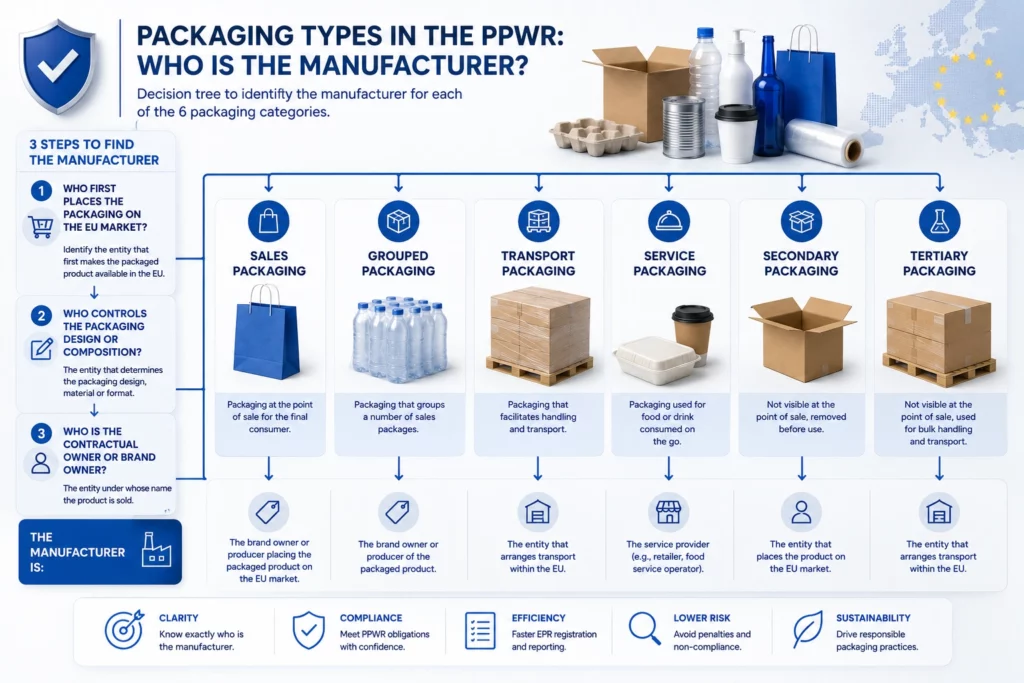
Packaging Types in the PPWR: Understanding the Different Categories with Real-World Examples
Published
, 13 minute read
Share this article
Quick summary: Packaging Types in the PPWR decide who is the manufacturer and producer. See each category with brand examples and a checklist to classify packaging fast.
Packaging Types in the PPWR are defined by function, not material. Article 3 of Regulation (EU) 2025/40 recognises sales packaging (primary), grouped packaging (secondary) and transport packaging (which replaces “tertiary”), plus service packaging, e-commerce packaging, take-away packaging, reusable packaging and primary production packaging. The category you assign decides who counts as the manufacturer, who becomes the producer for Extended Producer Responsibility (EPR), and which documentation you must hold. The PPWR applies from 12 August 2026.
Key Takeaways
The PPWR classifies packaging by its role in the supply chain sales, grouped, transport, service, reusable and unbranded scenarios not by the material it is made from.
Classification comes first: the packaging category usually determines the manufacturer, and the manufacturer feeds into who becomes the producer for EPR.
“Primary, secondary and tertiary” are retired terms the PPWR uses sales, grouped and transport packaging instead.
One packaging can have one manufacturer across the EU but a different producer in every Member State where it is first made available.
Branding is a shortcut, not the rule: whoever designs and specifies the packaging is the manufacturer, even when there is no logo on it.
Make Sense of PPWR — Without the Legal Jargon
PPWR spans recyclability, DoCs, recycled content, and more. Get a plain-English walkthrough of what applies to your business from someone who knows it cold.
Packaging Types in the PPWR are the functional categories that Regulation (EU) 2025/40 uses to classify every item of packaging placed on the EU market. In plain language, the regulation groups packaging by what it does in the supply chain whether it reaches the consumer, bundles products together, or protects goods in transit rather than by whether it is plastic, paper or glass.
This matters because your classification cascades into everything else. It determines who is legally the manufacturer, who becomes the producer responsible for EPR fees and registration, and which technical documentation and declaration of conformity you must hold when the rules apply from 12 August 2026.
Before you can answer “who is the manufacturer?”, you have to answer “what type of packaging is this?” The rest of this guide walks through each category with real-world brand examples, then shows how the packaging type flows through to the producer.
A quick orientation on the categories the regulation recognises:
Sales packaging (primary) — reaches the consumer with the product.
Grouped packaging (secondary) — bundles several sales units together.
Transport packaging (tertiary) — protects goods in shipping and storage, including e-commerce packaging as a defined subset.
Service packaging — filled at the point of sale, including take-away packaging.
Reusable packaging — designed for multiple trips inside a reuse system.
Unbranded packaging scenarios — where you must ask who designed and specified the item.
Manufacturers play a pivotal role in PPWR compliance. From ensuring packaging meets sustainability requirements to maintaining technical documentation and issuing the Declaration of Conformity, every step contributes to demonstrating compliance and maintaining access to the EU market.
Sales Packaging Under the PPWR (Primary Packaging)
Sales packaging is the packaging that reaches the final consumer together with the product and stays with it until purchase. It is the most familiar of the packaging types in the PPWR and the one most buyers think of first.
What it is: consumer-facing primary packaging (shampoo bottles, beverage cans, biscuit packets, milk cartons, cosmetic tubes).
Who is usually the manufacturer: the brand owner placing the packaged product on the market not the converter that physically makes the empty pack.
Why: the brand owner specifies design, materials, dimensions, graphics, labelling and sustainability requirements.
Example 1 — Shampoo bottle
ABC Plastics manufactures the empty HDPE bottle. The brand (illustratively, Dove) specifies the bottle design, recycled content, cap, label and artwork, then fills and sells it under its own name. Result: the manufacturer is the brand owner; ABC Plastics remains the packaging supplier.
Example 2 — Breakfast cereal box
A carton converter produces the folding cartons, but the brand (illustratively, Nestlé) designs the packaging, specifies the board and printing, and sells the cereal in its branded carton. Result: the manufacturer is the brand owner, because the packaging is designed specifically for that product and brand.
Grouped Packaging Under the PPWR (Secondary Packaging)
Grouped packaging bundles multiple sales units together while leaving the individual products unchanged. Under the PPWR the definition was expanded to include groupings created “to create a stock-keeping or distribution unit,” so it now catches more retail and warehouse formats than older national rules did.
What it is: six-pack drinks, twin-pack toothpaste, promotional bundles, shrink-wrapped canned food.
Who is usually the manufacturer: the company assembling and marketing the grouped pack normally the brand owner.
Why: the grouped format is created specifically by the brand owner for retail sale or shelf replenishment.
Example 1 — Beverage multipack
A converter supplies the shrink film; the brand (illustratively, Coca-Cola) bundles six bottles into one retail pack. Result: the manufacturer is the brand owner.
Example 2 — Toothpaste promotion
A supplier produces cardboard sleeves; the brand (illustratively, Colgate) packages two tubes into one promotional bundle. Result: the manufacturer is the brand owner.
Understanding who the manufacturer is under the PPWR isn’t always straightforward. As the examples in this blog demonstrate, the answer depends on factors such as packaging type, branding, design control, and who places the packaging on the EU market not simply who manufactures it.
Transport packaging protects goods during shipping and storage and is usually never seen by the consumer. It is where the manufacturer question flips most often, so it deserves extra care among the packaging types in the PPWR.
What it is: shipping cartons, stretch wrap, pallet hoods, wooden pallets, industrial crates.
E-commerce packaging: a defined subset of transport packaging used to deliver products through online or distance sales to the end user — parcel boxes, mailing bags and protective fill. Some obligations (such as the 50% empty-space limit) apply specifically to it.
Why it differs: transport packaging is frequently manufactured as a finished product before it reaches a customer, so the manufacturer is often the packaging maker — not the customer.
Example 1 — Standard shipping cartons
BoxCo manufactures plain corrugated cartons and a retailer (illustratively, Amazon) buys them from stock — no logo, no custom design. Result: the manufacturer is BoxCo.
Example 2 — Custom-specified cartons
The same retailer specifies dimensions, board strength, printing and logo, and BoxCo makes them to that brief. Result: the manufacturer is the retailer, because it controls the final packaging design and branding.
Service and Take-Away Packaging Under the PPWR
Service packaging is filled at the point of sale to make up a sales unit for the end user, and take-away packaging is the sub-type filled at attended points of sale with drinks or ready food. Among the packaging types in the PPWR, service packaging is the one where the manufacturer answer genuinely depends on branding.
What it is: coffee cups, takeaway containers, bakery bags, pizza boxes, carrier bags.
Who is the manufacturer: it depends on whether the item is branded and custom-designed, or a standard unbranded catalogue product.
Example 1 — Branded coffee cup
A paper manufacturer produces cups, but the chain (illustratively, Starbucks) specifies design, logo, printing and cup size. Result: the manufacturer is the chain.
Example 2 — Plain bakery bag
A converter makes generic paper bags and hundreds of bakeries buy the identical stock item. Result: the manufacturer is the bag manufacturer, because the bags are standard catalogue products.
Reusable Packaging Under the PPWR
Reusable packaging is designed for multiple trips inside a reuse system, and it carries its own reuse targets under the regulation which is why it is treated as a distinct entry among the packaging types in the PPWR rather than a variant of the others.
What it is: refillable bottles, reusable crates, reusable pallets, industrial containers.
Example 1 — Refillable glass bottles
A brand (illustratively, Coca-Cola) designs branded refillable bottles that circulate repeatedly. Result: the manufacturer is the brand owner.
Example 2 — Logistics pooling crates
A pooling company owns the reusable plastic crates used by supermarkets and designs, brands, maintains and manages the reuse system. Result: the manufacturer is the pooling system operator.
Packaging Types in the PPWR: Unbranded Packaging Scenarios
Unbranded packaging is where classification most often goes wrong. When there is no logo, do not assume the factory is the manufacturer — instead ask the decisive question: who designed and specified the packaging?
Example 1 — Custom food tray, no logo
A ready-meal company commissions a packaging firm to develop a unique tray with no logo on it. Result: the manufacturer is the ready-meal company, because it specified the design.
Example 2 — Standard plastic container
A packaging maker designs a generic food container and restaurants buy it straight from a catalogue. Result: the manufacturer is the packaging manufacturer.
A complete and accurate packaging inventory is the foundation of PPWR compliance. Without a clear understanding of your packaging materials, components, weights, suppliers, and markets, meeting technical documentation, reporting, and EPR obligations becomes significantly more challenging.
How Packaging Types in the PPWR Determine the Producer
Packaging type determines the manufacturer, but the producer is identified differently. The producer is the manufacturer, importer or distributor that first makes the packaging or packaged product available on the market of a given EU Member State the place where it ultimately becomes waste. The PPWR is built to point to one producer per packaging, per market.
Worked example: a brand (illustratively, Nestlé) manufactures the sales packaging for a cereal. Its German entity sells the cereal in Germany; its French entity imports and places the same cereal on the French market.
Manufacturer: the brand (the same across the EU).
Producer in Germany: the German entity.
Producer in France: the French entity.
One manufacturer, multiple producers. This is why an accurate packaging inventory and per-market mapping matters so much: the packaging types in the PPWR set the manufacturer once, but EPR registration and reporting obligations multiply across every Member State where the item is first made available.
Understanding your role under the PPWR is the foundation of compliance. Whether you’re a supplier, manufacturer, importer, distributor, or producer, each role carries distinct legal responsibilities that affect documentation, conformity, and Extended Producer Responsibility (EPR) obligations.
Common Mistakes When Classifying Packaging Types in the PPWR
Most misclassification happens long before the technical requirements it happens at the very first step of deciding what the item is. Watch for these:
Assuming the factory that physically makes the packaging is always the manufacturer.
Treating every packaging type the same when the packaging types in the PPWR each carry different obligations.
Confusing manufacturers with producers, and forgetting the producer role is per-Member-State.
Ignoring the role of branding and packaging design in deciding the manufacturer.
Assuming transport packaging follows the same rules as sales packaging.
Overlooking that unbranded packaging may still have the customer as the legal manufacturer when that customer specified the design.
TraceX PPWR Solutions helps businesses simplify PPWR compliance by providing a centralized platform to manage packaging data, supplier information, technical documentation, and regulatory workflows. From classifying packaging types and identifying legal roles such as manufacturer and producer to collecting supplier declarations, tracking material composition, maintaining audit-ready technical files, and supporting Declaration of Conformity requirements, TraceX streamlines the entire compliance lifecycle. With end-to-end visibility across packaging portfolios and supply chains, businesses can reduce manual effort, strengthen collaboration with suppliers, ensure data accuracy, and confidently meet evolving PPWR requirements across multiple EU markets.
Packaging Types in the PPWR: Manual Classification vs. TraceX
Classification task
Manual / spreadsheet
[TraceX Cleara AI]
Assigning packaging type per SKU
Manual judgement, inconsistent across reviewers
Rule-based classification against Article 3 categories
Manufacturer vs. producer logic
Tracked by hand, easy to conflate
Roles routed automatically to the correct owner
Per-Member-State producer mapping
Rebuilt market by market
One item mapped to every market of first availability
Technical documentation & DoC
Scattered files, hard to audit
Evidence kept beside the packaging record
Keeping up with phased 2026–2030 rules
Manual monitoring
Regulatory updates flagged against affected SKUs
Audit readiness
Reconstructed on request
Classification rationale retained and exportable
Find Out Which PPWR Rules Apply to Your Packaging
Recyclability, recycled content, labelling, DoCs — the handbook helps you identify what’s relevant to your products so you focus on what matters.
Packaging Types in the PPWR: Buyer Evaluation Checklist
Use this to pressure-test any packaging-compliance tool (or your own process) against how the packaging types in the PPWR actually work:
Does it classify each item against the PPWR Article 3 categories (sales, grouped, transport, service, reusable, e-commerce, take-away, primary production)?
Does it separate the manufacturer determination from the producer determination?
Can it map one manufacturer to multiple producers across Member States?
Does it flag e-commerce-specific obligations (e.g., empty-space limits) distinctly from general transport packaging?
Does it retain the rationale for each classification for audit, including the trigger when a classification changes?
Does it link technical documentation and the declaration of conformity to the packaging record?
Does it track the phased application dates (from 12 August 2026 onward) against the SKUs they affect?
Frequently Asked Question (FAQ’s)
How many packaging types are there in the PPWR?
The PPWR classifies packaging by function and recognises sales, grouped and transport packaging as the core categories, plus service, e-commerce, take-away, reusable and primary production packaging. The number you actually manage depends on your product range.
Are “primary, secondary and tertiary” still used in the PPWR?
No. The PPWR retires those terms and uses sales packaging (primary), grouped packaging (secondary) and transport packaging (tertiary) instead. The concepts map across, but the naming has changed.
What is the difference between the manufacturer and the producer?
The manufacturer is whoever designs and specifies the packaging. The producer is the manufacturer, importer or distributor that first makes the item available on a given Member State market. One packaging item can have one manufacturer but a different producer in each country.
Is e-commerce packaging a separate packaging type?
E-commerce packaging is a defined subset of transport packaging used for online or distance sales to the end user. It shares the transport definition but some obligations, such as the empty-space limit, apply specifically to it.
Who is the manufacturer of unbranded packaging?
Ask who designed and specified it. If a customer commissioned a custom design, that customer is usually the manufacturer even with no logo. If it is a generic catalogue product, the packaging maker is the manufacturer.
When do the packaging types in the PPWR obligations apply?
The PPWR applies from 12 August 2026, with further requirements phasing in through 2030 and beyond via implementing and delegated acts. Verify the specific date for each obligation you are scoping.
Why does packaging type classification matter for EPR?
Because the packaging type usually sets the manufacturer, and the manufacturer feeds into who becomes the producer responsible for EPR registration, fees and reporting in each Member State. Get the type wrong and every downstream obligation is misassigned.
Start using TraceX
Transparency, Trust, & Success for your Climate Journey.
We use cookies on our website to give you the most relevant experience by remembering your preferences and repeat visits. By clicking “Accept All”, you consent to the use of ALL the cookies. However, you may visit "Cookie Settings" to provide a controlled consent.
This website uses cookies to improve your experience while you navigate through the website. Out of these, the cookies that are categorized as necessary are stored on your browser as they are essential for the working of basic functionalities of the website. We also use third-party cookies that help us analyze and understand how you use this website. These cookies will be stored in your browser only with your consent. You also have the option to opt-out of these cookies. But opting out of some of these cookies may affect your browsing experience.
Necessary cookies are absolutely essential for the website to function properly. These cookies ensure basic functionalities and security features of the website, anonymously.
Cookie
Duration
Description
cookielawinfo-checkbox-analytics
11 months
This cookie is set by GDPR Cookie Consent plugin. The cookie is used to store the user consent for the cookies in the category "Analytics".
cookielawinfo-checkbox-functional
11 months
The cookie is set by GDPR cookie consent to record the user consent for the cookies in the category "Functional".
cookielawinfo-checkbox-necessary
11 months
This cookie is set by GDPR Cookie Consent plugin. The cookies is used to store the user consent for the cookies in the category "Necessary".
cookielawinfo-checkbox-others
11 months
This cookie is set by GDPR Cookie Consent plugin. The cookie is used to store the user consent for the cookies in the category "Other.
cookielawinfo-checkbox-performance
11 months
This cookie is set by GDPR Cookie Consent plugin. The cookie is used to store the user consent for the cookies in the category "Performance".
viewed_cookie_policy
11 months
The cookie is set by the GDPR Cookie Consent plugin and is used to store whether or not user has consented to the use of cookies. It does not store any personal data.
Functional cookies help to perform certain functionalities like sharing the content of the website on social media platforms, collect feedbacks, and other third-party features.
Performance cookies are used to understand and analyze the key performance indexes of the website which helps in delivering a better user experience for the visitors.
Analytical cookies are used to understand how visitors interact with the website. These cookies help provide information on metrics the number of visitors, bounce rate, traffic source, etc.
Advertisement cookies are used to provide visitors with relevant ads and marketing campaigns. These cookies track visitors across websites and collect information to provide customized ads.
Download the 2026 Traceability Scorecard and Benchmark Your Supply Chain Across 10 Critical Capabilities.
Download our eBook
Don’t Wait for an Audit to Find Your EUDR Gaps
The 2026 Simplification Package changes how HS codes, DDS pass-through and geolocation rules apply to you. Get the free guide and 20-point readiness checklist before enforcement catches you unprepared.