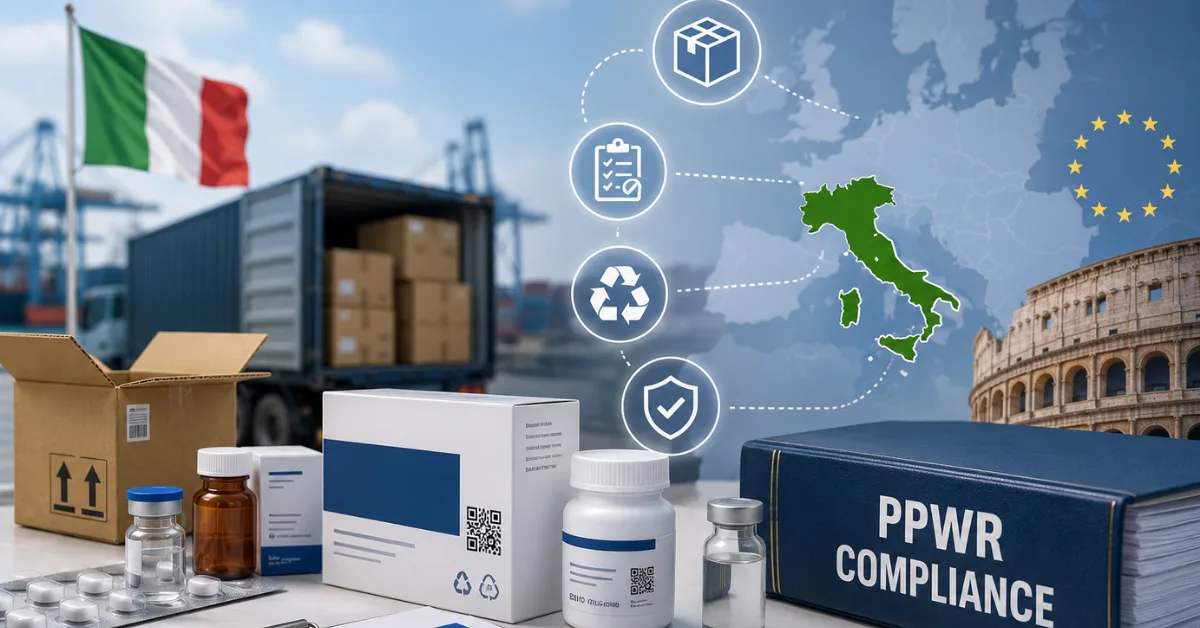
PPWR Compliance for Pharma Importers Italy: Your Readiness Guide
Published
, 9 minute read
Share this article
Quick summary: PPWR compliance for pharma importers Italy explained: Declaration of Conformity, technical documentation, pharma exemptions and CONAI duties before you ship.
PPWR compliance for pharma importers Italy means verifying that every packaged medicine you place on the Italian market is backed by a manufacturer’s Declaration of Conformity and supporting technical documentation under Regulation (EU) 2025/40 while continuing to meet Italy’s CONAI packaging obligations. Since 12 August 2026 both regimes apply in parallel, and the importer, not the overseas factory, holds the legal accountability.
Key takeaways
PPWR (Regulation (EU) 2025/40) applies directly across the EU from 12 August 2026 no national transposition and no grace period for placing non-compliant packaging on the market.
Pharma importers into Italy must collect and retain a Declaration of Conformity (Annex VIII) and be able to produce the manufacturer’s technical documentation (Annex VII) for every packaging type.
Pharmaceutical exemptions are narrow: primary packaging is relieved from minimum recycled-content rules on safety grounds, not from the wider PPWR framework.
CONAI registration and the Contributo Ambientale CONAI (CAC) remain mandatory and run alongside PPWR — the two systems are additive, not interchangeable.
Liability sits with the importer as the entity first placing packaging on the market; supplier contracts cannot transfer it.
PPWR compliance for pharma importers Italy: what changed on 12 August 2026
On 12 August 2026, Regulation (EU) 2025/40 the Packaging and Packaging Waste Regulation, or PPWR replaced the thirty-year-old Packaging Directive across all 27 member states. Because it is a regulation rather than a directive, it applies directly, uniformly and without the national transposition that used to give importers room to interpret. For companies bringing medicines into Italy, that means PPWR compliance for pharma importers Italy is no longer a future project on a roadmap; it is a live condition of market access. Packaging that cannot demonstrate conformity cannot lawfully be placed on the EU market, and there is no grace period for non-compliant packaging entering after the deadline.
The pain for pharma importers is specific. Your packaging blister foils, vials, ampoules, folding cartons, leaflet carriers and outer shippers was designed for product safety and Falsified Medicines Directive tamper-evidence, not for a packaging-waste regime. Yet each of those units now needs its own conformity evidence, and the authority that asks for it in Italy will look to you, the importer, first.
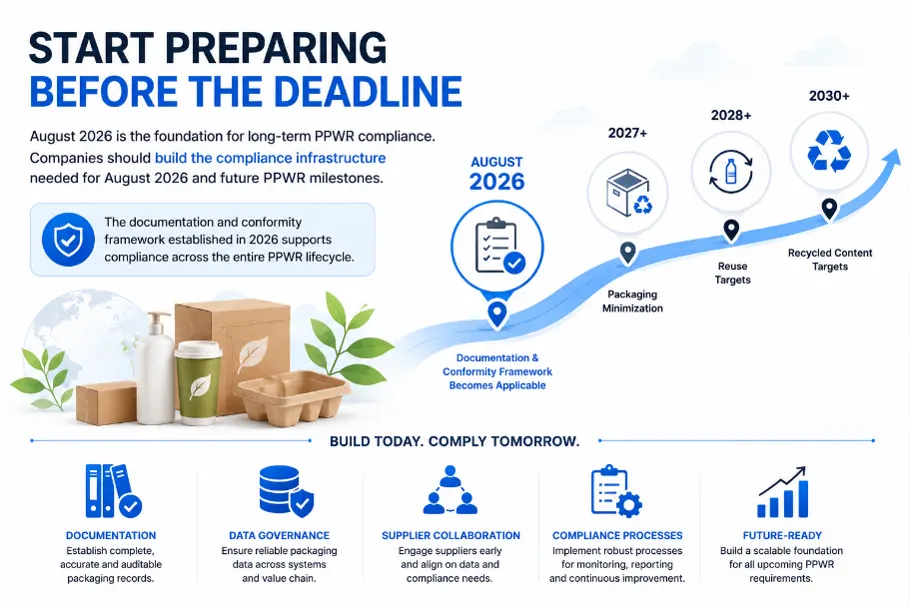
From packaging design and minimisation to recyclability, recycled content, reuse, labelling, substances of concern and EPR, PPWR introduces requirements across the packaging lifecycle.
Understand the key obligations, timelines and compliance considerations businesses need to prepare for.
PPWR importer obligations in Italy: Declaration of Conformity and technical documentation
The core of PPWR compliance for pharma importers Italy is documentary. Under the importer obligations in Article 18, you must verify that the manufacturer has carried out the conformity assessment (internal production control, Module A, set out in Annex VII), that a Declaration of Conformity exists for the packaging type, and that the technical documentation behind it is real and retrievable. You then collect and retain that Declaration five years for single-use packaging, ten for reusable and be ready to hand it to market-surveillance authorities on request.
The Declaration of Conformity follows the Annex VIII template and must identify the specific packaging, the manufacturer, and the requirements met. Getting the roles right matters: if a medicine reaches the Italian market under your name or brand, you may carry manufacturer-level duties, not merely importer ones. PPWR compliance for pharma importers Italy therefore starts with a role assessment per SKU, then a supplier-by-supplier programme to gather PFAS status, material composition and recyclability evidence the data most global pharma supply chains have never collected in one place.
The EU Declaration of Conformity is a key part of demonstrating packaging compliance under PPWR. Learn when it is required, what it should support, and how to connect it with your conformity assessment and technical documentation.
Pharmaceutical packaging exemptions under PPWR: narrow, not blanket
A common and costly misconception in PPWR compliance for pharma importers Italy is that medicines sit outside the regime. They do not. The exemptions the regulation grants pharmaceutical packaging are narrow and conditional. Primary packaging in direct contact with the medicine is relieved from the minimum recycled-content obligations where recycled material would compromise product safety but that relief does not extend to the rest of the framework, and it must be evidenced product by product, not assumed.
Everything else still applies: substance restrictions under Article 5, minimisation, the harmonised sorting label as it phases in, and documentation for every format. Where tamper-evident seals required by the Falsified Medicines Directive impair recyclability, the technical file must explain why those elements are indispensable for safety. In short, technical sensitivity narrows specific obligations; it does not remove compliance pressure.
CONAI registration and PPWR: the dual compliance burden in Italy
Italy adds a national layer that PPWR does not erase. PPWR compliance for pharma importers Italy runs on two parallel tracks: the EU-wide conformity duties above, and registration with CONAI (Consorzio Nazionale Imballaggi), Italy’s long-established packaging EPR consortium. As the party first placing packaged goods on the Italian market, an importer counts as a ‘producer’ for EPR purposes you register, declare packaging volumes by material and weight, and pay the Contributo Ambientale CONAI (CAC), routed through the six material consortia (COMIECO, COREPLA, COREVE, RICREA, CIAL and RILEGNO).
The two systems are additive, not interchangeable, and the harmonised EU sorting symbols may run alongside the existing CONAI environmental labelling until 11 August 2028. Treating PPWR compliance for pharma importers Italy as a single workflow is the most common planning error we see CONAI reporting proves you paid the environmental contribution; the Declaration of Conformity proves the packaging is legal. You need both, backed by the same SKU-level packaging data.
PPWR compliance starts with reliable, connected packaging data. Learn how to manage packaging materials, components, suppliers, SKUs, compliance evidence and market information in one structured framework.
How the TraceX platform helps pharma importers meet PPWR compliance in Italy
Both tracks depend on the same foundation: accurate, component-level packaging data linked to materials, weights, suppliers and market-placement logic. That is exactly where spreadsheets break down across thousands of pharmaceutical SKUs. The TraceX PPWR platform approaches PPWR compliance for pharma importers Italy as a data problem first centralising supplier declarations, material and PFAS evidence, and Declaration of Conformity records in one auditable system, with version control and retention timers built in
From that single source, the platform is designed to generate the packaging dataset that feeds both a defensible technical file and CONAI volume reporting, and to flag SKUs whose documentation is incomplete before a consignment ships . For importers scaling PPWR compliance for pharma importers Italy across many suppliers and formats, that shifts the work from chasing PDFs to managing exceptions and gives market-surveillance readiness that holds up under audit.
PPWR compliance for pharma importers Italy is won or lost at the data layer, not the legal one. Most importers already meet the physical packaging rules what they cannot yet do is prove it, per SKU, on demand. Fix the data model once and both PPWR conformity and CONAI reporting fall out of it. Chase documents deal-by-deal and every future PPWR deadline through 2040 becomes another fire drill.
See how a single packaging data model can serve both your PPWR Declaration of Conformity file and your CONAI reporting for the Italian market
Manual vs platform: managing PPWR compliance in Italy
How the two approaches compare across the tasks that matter most to a pharma import operation:
Compliance task
Manual / spreadsheet approach
TraceX platform [pending sign-off]
Declaration of Conformity collection
Emailed PDFs, ad-hoc folders, no retention timer
Central register with 5/10-year retention flags
Supplier PFAS & material evidence
Chased per consignment, often missing
Requested, stored and status-tracked per SKU
Importer vs manufacturer role check
Manual, easily missed on own-brand lines
Role assessment prompted at SKU onboarding
CONAI volume reporting
Re-keyed from separate systems
Generated from the same packaging dataset
Audit / market-surveillance response
Days of scrambling across inboxes
Retrieve current evidence on demand
Buyer’s checklist: evaluating PPWR compliance support for pharma imports
Use this when comparing internal processes or vendors for PPWR compliance for pharma importers Italy:
Can it hold a Declaration of Conformity per packaging type, with automatic 5- and 10-year retention?
Does it capture manufacturer conformity-assessment evidence (Annex VII / Module A), not just a signed form?
Does it prompt an importer-vs-manufacturer role check for own-brand and repackaged lines?
Can it store PFAS, recycled-content and material data at component level for each SKU?
Does it feed CONAI volume reporting from the same dataset, avoiding double data entry?
Does it flag incomplete documentation before a consignment ships, not after an audit?
Will it scale to your full SKU and supplier count without proportional headcount?
Frequently Asked Questions
Does PPWR apply to pharmaceutical packaging in Italy?
Yes. PPWR (Regulation (EU) 2025/40) applies to virtually all packaging placed on the EU market from 12 August 2026, including pharmaceutical packaging. The exemptions for medicines are narrow and conditional, so most pharma packaging remains in scope for documentation, substance and labelling duties.
Who is responsible for PPWR compliance the importer or the manufacturer?
The importer that first places the packaged medicine on the Italian market carries the accountability. You must verify the manufacturer’s conformity assessment and Declaration of Conformity, and if the product carries your brand you may hold manufacturer-level duties. Supplier contracts do not transfer this legal responsibility.
What is the pharmaceutical packaging exemption under PPWR?
Primary packaging in direct contact with the medicine is relieved from minimum recycled-content requirements where recycled material would compromise safety. It is not a blanket exemption it must be documented per product, and other PPWR obligations still apply.
Do I still need CONAI registration if I comply with PPWR?
Yes. CONAI registration and the Contributo Ambientale CONAI remain mandatory in Italy and run in parallel with PPWR. The two regimes are additive: CONAI covers the national EPR contribution, PPWR covers EU conformity. You must satisfy both.
What documentation must a pharma importer keep?
A Declaration of Conformity (Annex VIII) for each packaging type, plus access to the manufacturer’s technical documentation (Annex VII). Retain the Declaration for five years for single-use packaging and ten years for reusable packaging, and produce it on request.
Was there a grace period after 12 August 2026?
No grace period exists for placing non-compliant packaging on the market after 12 August 2026. Existing stock placed before the date may generally sell through, subject to national rules, but new consignments must meet the requirements in force.
Do I need a PPWR authorised representative in Italy?
Possibly. PPWR introduced an authorised-representative obligation from 12 August 2026, though its scope for EU-based firms is being revised at EU level. Third-country producers remain in scope. Confirm your obligation against the latest guidance before appointing one.
Start using TraceX
Transparency, Trust, & Success for your Climate Journey.
We use cookies on our website to give you the most relevant experience by remembering your preferences and repeat visits. By clicking “Accept All”, you consent to the use of ALL the cookies. However, you may visit "Cookie Settings" to provide a controlled consent.
This website uses cookies to improve your experience while you navigate through the website. Out of these, the cookies that are categorized as necessary are stored on your browser as they are essential for the working of basic functionalities of the website. We also use third-party cookies that help us analyze and understand how you use this website. These cookies will be stored in your browser only with your consent. You also have the option to opt-out of these cookies. But opting out of some of these cookies may affect your browsing experience.
Necessary cookies are absolutely essential for the website to function properly. These cookies ensure basic functionalities and security features of the website, anonymously.
Cookie
Duration
Description
cookielawinfo-checkbox-analytics
11 months
This cookie is set by GDPR Cookie Consent plugin. The cookie is used to store the user consent for the cookies in the category "Analytics".
cookielawinfo-checkbox-functional
11 months
The cookie is set by GDPR cookie consent to record the user consent for the cookies in the category "Functional".
cookielawinfo-checkbox-necessary
11 months
This cookie is set by GDPR Cookie Consent plugin. The cookies is used to store the user consent for the cookies in the category "Necessary".
cookielawinfo-checkbox-others
11 months
This cookie is set by GDPR Cookie Consent plugin. The cookie is used to store the user consent for the cookies in the category "Other.
cookielawinfo-checkbox-performance
11 months
This cookie is set by GDPR Cookie Consent plugin. The cookie is used to store the user consent for the cookies in the category "Performance".
viewed_cookie_policy
11 months
The cookie is set by the GDPR Cookie Consent plugin and is used to store whether or not user has consented to the use of cookies. It does not store any personal data.
Functional cookies help to perform certain functionalities like sharing the content of the website on social media platforms, collect feedbacks, and other third-party features.
Performance cookies are used to understand and analyze the key performance indexes of the website which helps in delivering a better user experience for the visitors.
Analytical cookies are used to understand how visitors interact with the website. These cookies help provide information on metrics the number of visitors, bounce rate, traffic source, etc.
Advertisement cookies are used to provide visitors with relevant ads and marketing campaigns. These cookies track visitors across websites and collect information to provide customized ads.
Download the 2026 Traceability Scorecard and Benchmark Your Supply Chain Across 10 Critical Capabilities.
Download our eBook
Don’t Wait for an Audit to Find Your EUDR Gaps
The 2026 Simplification Package changes how HS codes, DDS pass-through and geolocation rules apply to you. Get the free guide and 20-point readiness checklist before enforcement catches you unprepared.