Quick summary:
TraceX helps coffee companies in Hungary meet EUDR requirements with automated Due Diligence Statement (DDS) generation, farm-level traceability, and deforestation risk verification.
EUDR DDS for Coffee Supply Chain in Hungary requires operators to demonstrate that all coffee imported or placed on the Hungarian market is deforestation-free, legally sourced, and fully traceable to its farm of origin. Exporters and Hungarian importers must collect geolocation data for coffee plots, verify legality documents, assess deforestation risk, and maintain a transparent chain of custody across all intermediaries. A complete, accurate Due Diligence Statement (DDS) must be submitted via the EU Information System before market entry. Robust digital traceability, supplier onboarding, and documentation workflows are essential to meet Hungary’s EUDR compliance expectations.
Stay ahead of the 2025 regulation with our expert guide on Due Diligence Statements, traceability workflows, and category-specific obligations for operators, traders, and downstream entities.
Hungary, as an EU Member State, is fully subject to the EU Deforestation Regulation (EUDR), making compliance mandatory for all operators placing coffee or coffee-derived products on the Hungarian market. Coffee imported into Hungary whether green or roasted falls under HS Code 0901, bringing it directly into the EUDR scope. Operators must submit a complete Due Diligence Statement (DDS) confirming that all coffee is deforestation-free, legally produced, and fully traceable to its plantation of origin.
Under EUDR timelines, large and medium operators must comply by 30 December 2025, while small and micro enterprises must comply by 30 June 2026. From the cut-off date of 31 December 2020, no coffee placed on the Hungarian market may originate from land linked to deforestation or forest degradation. This requires precise geolocation of coffee plots, legality verification, satellite-supported deforestation checks, and transparent supply-chain mapping.
For Hungary’s coffee roasters, importers, traders, and re-exporters, the regulation demands deeper engagement with cooperatives, producers, and processors in origin countries across Latin America, Africa, and Asia. Companies must strengthen documentation workflows, digitize traceability systems, and ensure that every batch imported is backed by verified origin data. Non-compliance risks EU-level enforcement actions, shipment delays, and reputational damage.
Ultimately, EUDR is reshaping the competitiveness of Hungary’s coffee sector: traceability, data integrity, and verifiable sourcing are now essential requirements, not optional corporate sustainability measures.
What are the Key Challenges Faced by Hungarian Coffee Companies Under EUDR
1. Plantation-Level Traceability in Complex Global Supply Chains
Hungarian coffee companies source beans from multiple origins—Brazil, Vietnam, Colombia, Ethiopia, Uganda, and more. These supply chains involve thousands of smallholder farmers, cooperatives, intermediaries, dry mills, exporters, and traders. EUDR requires plot-level geolocation (polygon coordinates) for every coffee farm contributing to a batch, which is extremely difficult when supply originates from:
fragmented smallholder communities
regions with limited digital land records
multi-layer intermediary networks
blended bulk shipments This makes achieving reliable farm-to-port traceability one of the biggest compliance barriers.
2. Collecting, Verifying, and Standardizing Geolocation Data
Operators must submit complete and accurate polygon data for all supplying farms. Challenges include:
Lack of GPS-enabled mapping systems in origin countries
Inconsistent data formats across suppliers
Limited digital literacy among smallholders
Missing or outdated farm boundaries Incorrect geolocation data may lead to rejected DDS submissions or flagged risk profiles.
3. Legality Verification and Document Gaps
Hungarian coffee importers must prove that each supplying farm complies with national laws on:
land rights
forest use
environmental rules
agricultural licensing However, many producing regions lack:
formal land titles
consistent legal documentation
unified registries for ownership This makes legality verification slow, inconsistent, and resource intensive.
4. Deforestation Risk Assessment Across Diverse Origins
EUDR demands a negligible risk rating. Hungarian companies must conduct due diligence covering:
satellite deforestation checks
historical forest-cover change
risk scoring by origin country or sub-region
deforestation patterns post-31 December 2020 Countries like Brazil, Peru, Uganda, and Ethiopia present higher challenges due to active forest-conversion zones. Companies must develop or adopt analytical tools something many SMEs lack capacity for.
5. Blended Batches and Loss of Origin Identity
Coffee is often blended at:
cooperative level
washing/drying stations
mills
export warehouses Once mixed, it becomes nearly impossible to track which farms contributed to a specific shipment. This directly conflicts with EUDR’s requirement to map each batch back to its precise farm polygons.
6. Documentation Burden and Administrative Complexity
Hungarian coffee businesses must collect and store:
geolocation polygons
supplier declarations
legality evidence
deforestation-risk reports
chain-of-custody records
batch-level traceability data
multi-year documentation archives For smaller importers and roasters, this creates a heavy administrative load and risk of human error.
7. Need for Digital Transformation and Supplier Onboarding
Most suppliers in origin countries are not EUDR-ready. Hungarian companies must:
onboard farmers and cooperatives into digital platforms
train suppliers on GPS mapping
create digital data pipelines
enforce standardized formats Without a unified digital traceability framework, compliance becomes nearly impossible.
8. Increased Risk of Shipment Delays and Market Disruption
Incomplete or inaccurate DDS submissions can result in:
customs delays
shipment holds at EU borders
increased inspection frequency
financial penalties This creates operational uncertainty and threatens Hungary’s coffee trade flow.
9. Rising Costs of Compliance
Challenges add direct and indirect costs:
mapping and field data collection
digital traceability systems
satellite and risk assessment tools
onboarding and monitoring suppliers
internal compliance personnel For SMEs common in Hungary’s roasting and importing sector this is a significant financial strain.
10. Reputational and Commercial Risk with EU Buyers
Failure to meet EUDR requirements risks:
loss of retailer contracts
exclusion from sustainability-oriented buyers
reputational damage
inability to participate in ethical supply chains Large EU retailers and brands will demand proof of compliance from Hungarian suppliers, pushing accountability upstream.
Hungarian coffee companies face substantial challenges traceability, legality verification, data collection, supplier onboarding, and digital transformation due to the stringent nature of EUDR. Solving these requires integrated digital systems, supplier collaboration, and automated compliance workflows to ensure seamless EU market access.
How TraceX Simplifies EUDR DDS for Coffee in Hungary
As EUDR enforcement approaches, Hungarian coffee importers, roasters, traders, and distributors must comply with the EU’s deforestation-free sourcing requirements to ensure uninterrupted access to the EU market. TraceX’s EUDR Compliance Platform delivers a unified digital ecosystem that automates Due Diligence Statement (DDS) workflows, strengthens supply-chain transparency, and makes compliance scalable and audit-ready for Hungarian operators.
End-to-End Traceability Across Global Coffee Origins
TraceX provides full digital traceability from coffee farm to Hungarian importer, mapping each lot with unique identifiers, geolocation polygons, and supplier metadata. By linking farmer records, cooperative data, and shipment-level information, Hungarian companies achieve the plot-level traceability required under EUDR’s deforestation-free mandate.
Automated DDS Creation and EU Submission
The platform auto-generates EUDR-compliant DDS forms by validating farm geolocation, legality documents, supplier declarations, and risk assessments. Integrated with the EU Information System, TraceX enables one-click DDS submission reducing manual work, eliminating errors, and ensuring fast, compliant documentation for every batch imported into Hungary.
Blockchain-Based Proof of Origin and Data Integrity
With blockchain-secured chain-of-custody tracking, TraceX maintains an immutable record of every step in the coffee supply chain from origin country to Hungarian warehouse. This tamper-proof ledger enhances transparency, simplifies audits, and gives Hungarian importers confidence when demonstrating compliance to authorities and EU buyers.
Digital Onboarding for Farmers and Cooperatives
TraceX’s mobile-enabled tools allow for seamless onboarding of smallholder farmers and cooperatives across Africa, Latin America, and Asia. Suppliers can be GPS-mapped, verified, and digitally connected to Hungarian buyers, ensuring accurate upstream data capture and closing traceability gaps in regions with limited digital infrastructure.
Real-Time Dashboards and Compliance Risk Analytics
Hungarian coffee companies gain access to real-time dashboards that track compliance status, flag missing documents, and generate automated deforestation-risk scores. These analytics provide industry-specific insights that support proactive risk mitigation, audit preparation, and fully compliant batch formation.
Turning Compliance Into Competitive Advantage
By combining digital traceability, blockchain integrity, automated DDS workflows, and AI-powered risk scoring, TraceX transforms EUDR compliance from a regulatory hurdle into a strategic edge. Hungarian coffee businesses can safeguard EU market access, enhance brand trust, and lead in sustainable, deforestation-free sourcing.
Simplify EUDR DDS generation for coffee companies in Hungary.
[Request a Free Demo with TraceX] — Digitize compliance, protect your market access, and future-proof your Hungarian coffee supply chain.
Why EUDR Compliance Matters for the Hungarian Coffee Sector
EUDR compliance is critical for Hungary’s coffee sector because it directly affects the country’s ability to import, roast, distribute, and re-export coffee within the EU’s single market. As an EU Member State, Hungary must fully adhere to the regulation’s deforestation-free and legality requirements meaning that every coffee bean entering the supply chain must be traceable back to a mapped plantation and verified as compliant with laws in its country of origin.
For Hungary, which sources coffee from diverse and high-risk regions such as Brazil, Vietnam, Uganda, Colombia, and Ethiopia, this regulation significantly reshapes procurement frameworks. Coffee companies must overhaul traditional sourcing systems that relied on bulk shipments, blended lots, and limited farm-level visibility. Failing to comply could lead to shipment delays, costly inspections, or denial of entry, directly disrupting supply for roasters, retailers, and foodservice brands across the Hungarian market.
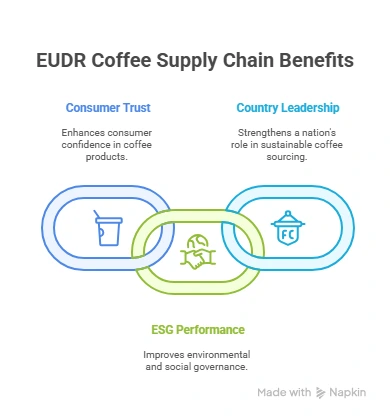
Beyond compliance risk, EUDR presents a strategic opportunity. Hungarian coffee processors and retailers that invest early in traceability, legality verification, and digital documentation will gain a competitive edge across Europe, where buyers increasingly prioritize transparent and sustainable sourcing. Enhanced supply-chain data also strengthens ESG reporting and builds trust among consumers, especially as demand for certified and traceable coffee continues to rise.
Ultimately, EUDR compliance is not simply a regulatory obligation it is a foundational requirement for Hungary’s long-term competitiveness in the European coffee ecosystem. Companies that modernize their sourcing systems and digitize their due-diligence processes will protect market access, strengthen brand reputation, and position themselves as leaders in responsible, future-ready coffee supply chains.
Strengthening Hungary’s Coffee Supply Chain Through EUDR-Ready DDS Systems
EUDR DDS for the Coffee Supply Chain in Hungary is now a foundational requirement for ensuring that all imported and distributed coffee is legally sourced, deforestation-free, and fully traceable to its plantation of origin. By adopting structured digital workflows for supplier onboarding, geolocation mapping, legality verification, and automated DDS submission, Hungarian coffee companies can reduce compliance risks, avoid market disruptions, and maintain seamless access to the EU’s high-value coffee market. A robust DDS framework not only ensures regulatory alignment but also enhances transparency, buyer trust, and long-term competitiveness in an increasingly sustainability-driven coffee economy.
The EUDR is a regulation by the European Union aimed at preventing deforestation-linked commodities like coffee from entering the EU market. It requires full supply chain traceability and submission of Due Diligence Statements (DDS) proving compliance.
What is a Due Diligence Statement (DDS) under EUDR?
A DDS is a formal declaration confirming that coffee imported or sold in Hungary is deforestation-free and legally sourced. It must include farm-level geolocation data and risk assessment documentation.
Who needs to comply with the EUDR for coffee in Hungary?
All Hungarian importers, traders, roasters, and retailers handling coffee are required to comply. Both large corporations and small operators must provide DDS documentation for their supply chains.
What challenges do coffee companies in Hungary face with EUDR DDS generation?
Common difficulties include gathering farm-level data, verifying deforestation-free claims, managing multiple smallholders, and preparing DDS documents manually.
How does TraceX help automate EUDR DDS generation?
TraceX digitizes the entire process mapping coffee farms, verifying deforestation risks via satellite data, and auto-generating compliant DDS reports ready for submission.
Start using TraceX
Transparency, Trust, & Success for your Climate Journey.
We use cookies on our website to give you the most relevant experience by remembering your preferences and repeat visits. By clicking “Accept All”, you consent to the use of ALL the cookies. However, you may visit "Cookie Settings" to provide a controlled consent.
This website uses cookies to improve your experience while you navigate through the website. Out of these, the cookies that are categorized as necessary are stored on your browser as they are essential for the working of basic functionalities of the website. We also use third-party cookies that help us analyze and understand how you use this website. These cookies will be stored in your browser only with your consent. You also have the option to opt-out of these cookies. But opting out of some of these cookies may affect your browsing experience.
Necessary cookies are absolutely essential for the website to function properly. These cookies ensure basic functionalities and security features of the website, anonymously.
Cookie
Duration
Description
cookielawinfo-checkbox-analytics
11 months
This cookie is set by GDPR Cookie Consent plugin. The cookie is used to store the user consent for the cookies in the category "Analytics".
cookielawinfo-checkbox-functional
11 months
The cookie is set by GDPR cookie consent to record the user consent for the cookies in the category "Functional".
cookielawinfo-checkbox-necessary
11 months
This cookie is set by GDPR Cookie Consent plugin. The cookies is used to store the user consent for the cookies in the category "Necessary".
cookielawinfo-checkbox-others
11 months
This cookie is set by GDPR Cookie Consent plugin. The cookie is used to store the user consent for the cookies in the category "Other.
cookielawinfo-checkbox-performance
11 months
This cookie is set by GDPR Cookie Consent plugin. The cookie is used to store the user consent for the cookies in the category "Performance".
viewed_cookie_policy
11 months
The cookie is set by the GDPR Cookie Consent plugin and is used to store whether or not user has consented to the use of cookies. It does not store any personal data.
Functional cookies help to perform certain functionalities like sharing the content of the website on social media platforms, collect feedbacks, and other third-party features.
Performance cookies are used to understand and analyze the key performance indexes of the website which helps in delivering a better user experience for the visitors.
Analytical cookies are used to understand how visitors interact with the website. These cookies help provide information on metrics the number of visitors, bounce rate, traffic source, etc.
Advertisement cookies are used to provide visitors with relevant ads and marketing campaigns. These cookies track visitors across websites and collect information to provide customized ads.
Download the 2026 Traceability Scorecard and Benchmark Your Supply Chain Across 10 Critical Capabilities.
Download our eBook
Don’t Wait for an Audit to Find Your EUDR Gaps
The 2026 Simplification Package changes how HS codes, DDS pass-through and geolocation rules apply to you. Get the free guide and 20-point readiness checklist before enforcement catches you unprepared.