Sustainable Cocoa Agroforestry in Ghana: The Forest a Satellite Can’t Tell Apart
Published
, 10 minute read
Share this article
Quick summary: Sustainable cocoa agroforestry in Ghana keeps forests standing and cocoa resilient — but a satellite can mistake it for forest. See why proof, not planting, is the barrier.
Sustainable cocoa agroforestry in Ghana is growing cocoa under a managed canopy of shade and economic trees typically a moderate 13 to 25 trees per hectare rather than as full-sun monoculture. It keeps forest cover on farmland, boosts biodiversity and climate resilience, and can be both low-emission and profitable while remaining deforestation-free. The catch is proof. Because a cocoa agroforest can look like natural forest from space, it is the land use most likely to be wrongly flagged under the EUDR, and Ghanaian farmers have historically not owned the timber trees on their land, so they had little reason to keep them. Making agroforestry work depends less on planting more trees than on proving tenure, deforestation-free status and value with farm-level, ground-truthed data.
Key Takeaways
It’s Ghana’s answer to a hard bind. Cocoa drives deforestation, yet EUDR demands deforestation-free beans. Agroforestry keeps forest cover on farms and cocoa resilient at the same time.
The satellite can’t tell agroforest from forest. The most sustainable, shaded farms are the most likely to be falsely flagged under EUDR without ground-truth evidence.
It’s a tenure problem, not just an agronomy one. Farmers who don’t own the trees on their land won’t protect them registering tree tenure is what makes agroforestry stick.
Proof turns shade trees into income. Deforestation-free status, carbon and biodiversity only pay when they’re measured, traceable and verifiable.
Can you prove your shaded cocoa isn’t deforestation?
See how TraceX maps farms and trees, layers agroforestry context onto satellite checks, and builds DDS-ready proof for Ghanaian cocoa.
What Sustainable Cocoa Agroforestry in Ghana Actually Is
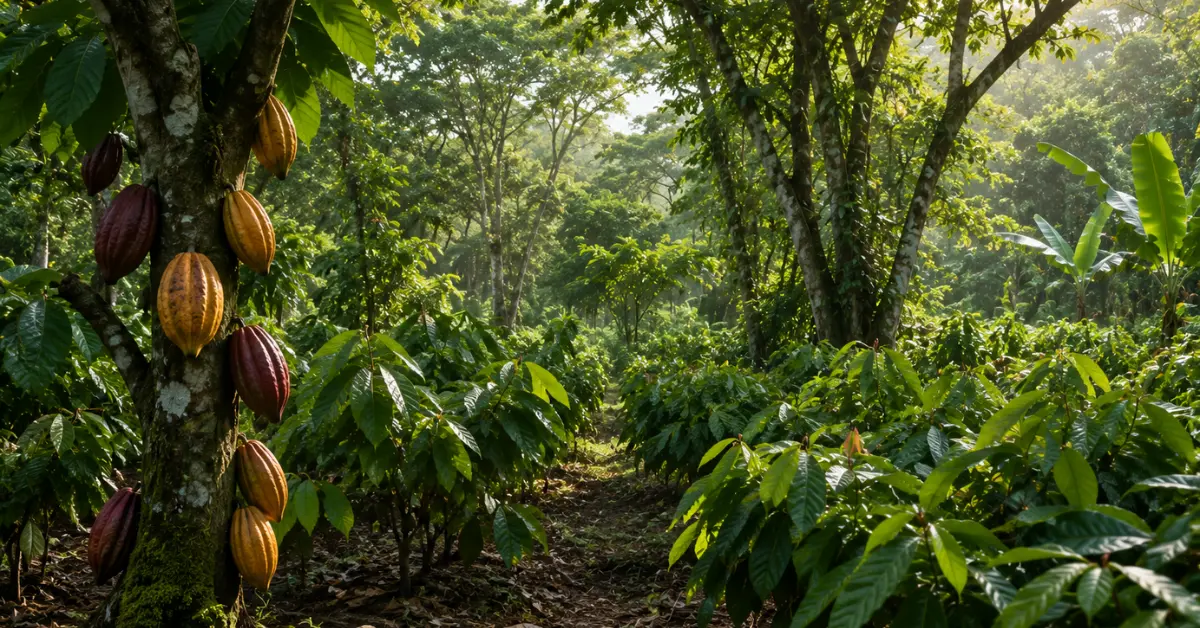
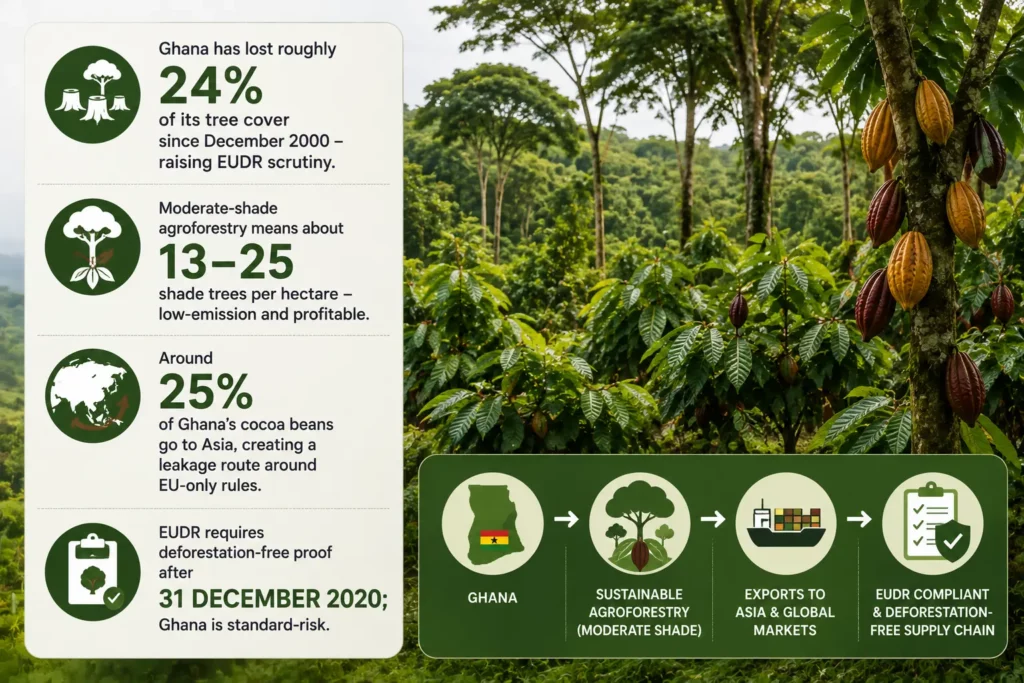
Sustainable cocoa agroforestry in Ghana means growing cocoa beneath a deliberate canopy of shade and economic trees instead of clearing land for full-sun monoculture. Research in Ghana points to a moderate-shade sweet spot roughly 13 to 25 shade trees per hectare that can be low in emissions and still profitable, countering the old assumption that shade always costs yield. Under COCOBOD’s forest-positive agenda, those trees do real work: they keep forest cover inside the farmed landscape, support biodiversity, buffer cocoa against rising heat and drought, and give farmers extra income from timber and fruit.
It matters because cocoa is a leading driver of deforestation in West Africa, and Ghana has lost roughly a quarter of its tree cover since 2000. With the EU Deforestation Regulation now requiring every bean placed on the EU market to be proven deforestation-free after 31 December 2020, agroforestry looks like the ideal reconciliation of productivity, climate and forests. On paper, it is. In practice, its biggest obstacle isn’t agronomy.
Why Sustainable Cocoa Agroforestry in Ghana Is a Proof Problem
The obstacle to sustainable cocoa agroforestry in Ghana isn’t planting trees it’s proving things about them. And there are two proofs that decide everything.
The first is deforestation-free status. A mature cocoa agroforest and a patch of natural forest look almost identical from orbit, and the EUDR’s definition of ‘forest’ doesn’t always match local land-use categories. So the very farms doing the most to protect Ghana’s forests the shaded, biodiverse ones are the most likely to trip a satellite deforestation flag. From space the difference between a cocoa agroforest and forest is invisible; it has to be proven on the ground, with farm-level geolocation and land-use evidence. Without that, sustainable practice becomes a compliance liability.
The second is tenure. For years, Ghanaian farmers did not own the commercial rights to naturally occurring timber trees on their own land the state did. A farmer who cannot benefit from a tree has every reason to let it be cut and none to nurture it, which is why so many cocoa farms lost their shade in the first place. Sustainable cocoa agroforestry in Ghana therefore depends on registering land and tree tenure so farmers actually own and profit from what they grow. The enabler isn’t seedlings; it’s a registry.
Put those together and the pattern is clear: agroforestry’s value deforestation-free beans, carbon, biodiversity, climate resilience only becomes income when it is measured, traceable and verifiable. Proof is the product.
Sustainable Cocoa Agroforestry in Ghana in the Real World
The shaded farm flagged as forest
In Ghana’s Western and Ashanti cocoa belts, shaded farms sit alongside active forest zones, and a dense agroforestry canopy can register as forest on satellite data. A routine agroforestry farm risks a false deforestation flag under EUDR penalising exactly the practice the regulation should reward. What unlocks it: farm-level geolocation plus ground-truthed land-use context that distinguishes agroforest from forest.
TraceX’s AI-powered Deforestation Risk Assessment helps businesses proactively identify and mitigate deforestation risks across their supply chains. By combining satellite imagery, geospatial analytics, farm geolocation, and risk intelligence, the platform assesses whether sourcing areas comply with EUDR requirements. It automatically classifies farms based on deforestation risk, highlights high-risk locations for further investigation, and provides audit-ready evidence to support due diligence. This enables organizations to make informed sourcing decisions, strengthen supply chain transparency, and simplify EUDR compliance with confidence.
The trees the farmer didn’t own
A deforestation-free cocoa project paired shade-tree planting with land and tree tenure registration TreeSeal and LandSeal and a payment-for-ecosystem-services model. Once farmers had documented ownership, they were markedly more likely to plant and keep shade trees. Tenure, not agronomy, was the unlock. What unlocks it: digital tree and land registration that gives farmers a provable, bankable stake in their canopy.
The beans that leak out the back
Because EUDR covers only the EU market and around a quarter of Ghana’s beans go to Asia, non-compliant cocoa can be sold elsewhere or blended through intermediaries while fragmented records across COCOBOD, licensed buyers and cooperatives make it hard to tell compliant from non-compliant flows. What unlocks it: a unified, farm-linked traceability system that keeps deforestation-free lots segregated and verifiable end to end.
See How TraceX Helped Build an EUDR-Ready Cocoa Supply Chain in Africa
Discover how blockchain, geospatial intelligence, and AI-powered traceability enabled end-to-end cocoa supply chain visibility while supporting EUDR compliance and smallholder inclusion.
Many farmers resist shade for fear of lower yields, yet Ghanaian plot research shows moderate-shade systems can be both low-emission and profitable, provided fungal diseases like black pod are managed with pruning and proper tree spacing. The barrier is belief, not biology. What unlocks it: measured, farm-level agronomy data that lets farmers adopt shade with confidence.
Making Sustainable Cocoa Agroforestry in Ghana Provable and Profitable
If proof is the product, the job is to instrument the agroforest. A platform built for sustainable cocoa agroforestry in Ghana should do six things.
Map every farm and register tenure. Capture GPS plot boundaries and record land and tree ownership, so farmers have a provable, bankable stake in their canopy.
Add agroforestry context to satellite checks. Layer land-use and ground-truth data over deforestation screening so shaded farms aren’t lost to false positives.
Generate EUDR-ready DDS. Compile geolocation, legality and risk evidence into Due Diligence Statements for the EU Information System.
Measure carbon and biodiversity. Quantify the shade canopy’s carbon and ecosystem value so it can earn payments, credits or a premium.
Unify fragmented records to stop leakage. Connect COCOBOD, licensed buyers and cooperatives so compliant, deforestation-free lots stay segregated and traceable.
Capture the first mile offline. Register smallholders and record data in low-connectivity cocoa districts, syncing when signal returns.
Cocoa Systems in Ghana: Shade, Resilience and the EUDR Look
Match each farm to a system — and see where proof matters most.
Cocoa system
Shade & resilience
EUDR / proof consideration
Full-sun monoculture
Little/no shade; high short-term yield but low climate resilience
Clearly not forest, but most exposed to heat, drought and disease
Moderate-shade agroforestry
13–25 trees/ha; resilient, low-emission, can be profitable
The forest-positive sweet spot deforestation-free and defensible with data
Dense-shade / forest-edge
Heavy canopy; most biodiverse
Hardest to tell from forest on satellite highest false-flag risk without ground proof
How TraceX EUDR Solution Enables Sustainable Cocoa Agroforestry in Ghana
Ghana’s cocoa sector depends on millions of smallholder farmers who often cultivate cocoa within agroforestry systems that integrate shade trees to improve biodiversity, soil health, and climate resilience. As EUDR introduces stringent requirements for deforestation-free sourcing and traceability, TraceX helps cocoa businesses protect these sustainable farming systems while demonstrating compliance with confidence.
TraceX EUDR Solutions enables digital onboarding of farmers and farm plots, capturing precise GPS polygons, land ownership details, and farm attributes through offline-first mobile applications designed for remote farming communities. The platform combines satellite-based deforestation monitoring, geospatial intelligence, and AI-powered risk assessment to distinguish sustainable cocoa agroforestry from illegal forest conversion, reducing false positives and strengthening compliance decisions.
Beyond deforestation monitoring, TraceX establishes end-to-end traceability from farm to exporter, linking farmer records, procurement transactions, processing, and shipments into a verifiable chain of custody. The platform also centralizes legality documents, supplier declarations, geospatial evidence, and due diligence records to create audit-ready documentation for EUDR.
By digitizing fragmented smallholder supply chains and providing continuous monitoring, TraceX helps Ghanaian cocoa exporters preserve agroforestry systems, improve market access to the European Union, strengthen buyer confidence, and support sustainable livelihoods for cocoa-growing communities while protecting forests and biodiversity.
Make sustainable cocoa agroforestry in Ghana provable and profitable.
TraceX maps farms and trees, registers tenure, layers agroforestry context onto satellite checks, and builds DDS-ready proof that turns Ghana’s shaded cocoa into verified, market-ready value.
Sustainable Cocoa Agroforestry in Ghana: Readiness Checklist
Before agroforestry can pay, confirm you can prove it.
✓Every farm is GPS-mapped and linked to a registered farmer.
✓Land and tree tenure are documented so farmers own their canopy.
✓Satellite screening is combined with ground-truth agroforestry context.
✓Deforestation-free status is evidenced against the 2020 cut-off.
✓Carbon and biodiversity value are measured, not assumed.
✓Records across COCOBOD, buyers and cooperatives are unified — no silos.
✓A DDS can be generated per consignment and kept for five years.
Frequently Asked Questions
Does cocoa agroforestry count as deforestation under EUDR?
No agroforestry is not deforestation. But a shaded cocoa farm can resemble forest on satellite imagery, so farm-level geolocation and ground-truth land-use evidence are needed to prove it is a deforestation-free agroforest, not cleared or natural forest.
Why don’t Ghanaian farmers plant more shade trees?
A major reason is tenure. The state has historically held commercial rights to naturally occurring timber trees, even on private farms, so farmers had little incentive to keep them. Registering tree tenure changes that.
Does shade reduce cocoa yields?
Not necessarily. Ghanaian research shows moderate shade (about 13–25 trees per hectare) can be low-emission and profitable, as long as fungal diseases like black pod are managed with pruning and proper spacing.
Is cocoa covered by the EUDR?
Yes. Cocoa is one of the seven EUDR commodities, so Ghanaian cocoa placed on the EU market must be traceable to geolocated plots and proven deforestation-free after 31 December 2020.
How does traceability help agroforestry farmers?
It converts sustainable practice into value proving deforestation-free status for EU access, documenting tenure, and quantifying carbon and biodiversity so shade trees generate income rather than cost.
We use cookies on our website to give you the most relevant experience by remembering your preferences and repeat visits. By clicking “Accept All”, you consent to the use of ALL the cookies. However, you may visit "Cookie Settings" to provide a controlled consent.
This website uses cookies to improve your experience while you navigate through the website. Out of these, the cookies that are categorized as necessary are stored on your browser as they are essential for the working of basic functionalities of the website. We also use third-party cookies that help us analyze and understand how you use this website. These cookies will be stored in your browser only with your consent. You also have the option to opt-out of these cookies. But opting out of some of these cookies may affect your browsing experience.
Necessary cookies are absolutely essential for the website to function properly. These cookies ensure basic functionalities and security features of the website, anonymously.
Cookie
Duration
Description
cookielawinfo-checkbox-analytics
11 months
This cookie is set by GDPR Cookie Consent plugin. The cookie is used to store the user consent for the cookies in the category "Analytics".
cookielawinfo-checkbox-functional
11 months
The cookie is set by GDPR cookie consent to record the user consent for the cookies in the category "Functional".
cookielawinfo-checkbox-necessary
11 months
This cookie is set by GDPR Cookie Consent plugin. The cookies is used to store the user consent for the cookies in the category "Necessary".
cookielawinfo-checkbox-others
11 months
This cookie is set by GDPR Cookie Consent plugin. The cookie is used to store the user consent for the cookies in the category "Other.
cookielawinfo-checkbox-performance
11 months
This cookie is set by GDPR Cookie Consent plugin. The cookie is used to store the user consent for the cookies in the category "Performance".
viewed_cookie_policy
11 months
The cookie is set by the GDPR Cookie Consent plugin and is used to store whether or not user has consented to the use of cookies. It does not store any personal data.
Functional cookies help to perform certain functionalities like sharing the content of the website on social media platforms, collect feedbacks, and other third-party features.
Performance cookies are used to understand and analyze the key performance indexes of the website which helps in delivering a better user experience for the visitors.
Analytical cookies are used to understand how visitors interact with the website. These cookies help provide information on metrics the number of visitors, bounce rate, traffic source, etc.
Advertisement cookies are used to provide visitors with relevant ads and marketing campaigns. These cookies track visitors across websites and collect information to provide customized ads.
Download the 2026 Traceability Scorecard and Benchmark Your Supply Chain Across 10 Critical Capabilities.
Download our eBook
Don’t Wait for an Audit to Find Your EUDR Gaps
The 2026 Simplification Package changes how HS codes, DDS pass-through and geolocation rules apply to you. Get the free guide and 20-point readiness checklist before enforcement catches you unprepared.