Packaging Changes Under PPWR: Why Every Design Update Matters
Published
, 11 minute read
Share this article
Quick summary: Packaging changes under PPWR start 12 Aug 2026. Learn the five design rules, key 2030 deadlines, and how to map and document every packaging unit.
Packaging changes under PPWR (Regulation (EU) 2025/40) require every package placed on the EU market to be recyclable, reduced to its minimum weight and volume, free of restricted substances, and backed by a Declaration of Conformity. The regulation applies from 12 August 2026, with the most demanding design targets recyclability grades, minimum recycled content, and packaging minimization taking effect in 2030. To comply, companies must map every SKU, collect supplier-backed evidence for each packaging unit, and keep conformity documentation audit-ready.
Packaging changes under PPWR are no longer a future planning exercise they are a live compliance requirement for any business that puts packaged goods on the EU market. The Packaging and Packaging Waste Regulation (Regulation (EU) 2025/40) replaced the old Packaging Directive and, as a regulation, applies directly and identically in all 27 member states with no national transposition. In plain terms: a single, harmonized rulebook now governs how your packaging is designed, what it is made of, how little of it you may use, and how you prove all of that to authorities.
That shift is why every design update matters. Under the old directive, packaging tweaks were largely a cost-and-branding decision. Under PPWR, each change to a material, a layer, a coating, or a supplier can move a SKU in or out of compliance and an out-of-compliance package cannot legally be placed on the EU market. This guide breaks down exactly what the packaging changes under PPWR require, when each obligation applies, and how to manage them across a large product catalogue without drowning in spreadsheets.
KEY TAKEAWAYS
Packaging changes under PPWR apply from 12 August 2026; the toughest design rules (recyclability, recycled content, minimization) land in 2030.
Five design levers change at once: recyclability, recycled content, minimization/empty-space, restricted substances, and labelling.
Every packaging unit needs a Declaration of Conformity supported by verifiable supplier data not estimates.
Spreadsheet-based tracking cannot scale across a full SKU catalogue with shifting supplier inputs.
Mapping your packaging portfolio early lowers redesign risk, avoids market-access gaps, and can reduce modulated EPR fees.
What Packaging Changes Under PPWR Actually Require
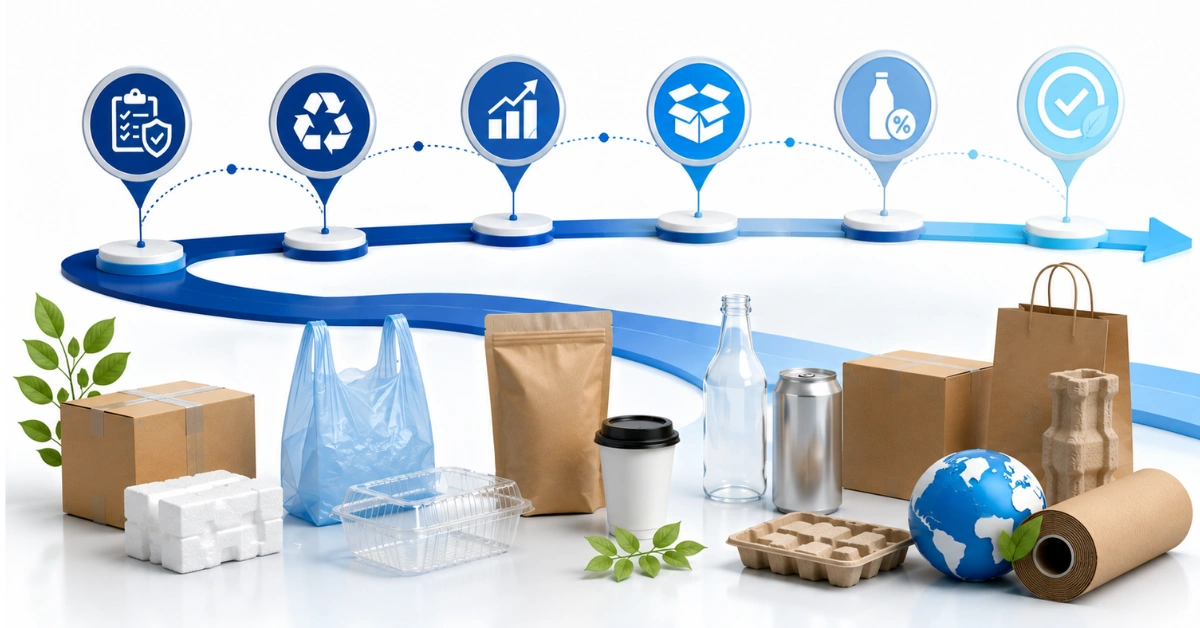
The packaging changes under PPWR reach across the entire lifecycle of a package from the moment it is designed to the moment it becomes waste. Most core obligations become applicable on 12 August 2026, the general application date, while the heaviest design targets phase in through 2030 and beyond. Understanding the sequence is the difference between a controlled redesign roadmap and a last-minute scramble.
Here is the timeline that governs the packaging changes under PPWR:
11 February 2025 — Regulation (EU) 2025/40 enters into force; the 18-month transition begins.
12 August 2026 — general application. Substance restrictions, the Declaration of Conformity requirement, and empty-space rules for e-commerce and grouped packaging take effect. Only conforming packaging may be placed on the market.
12 August 2028 — harmonized labelling and material-composition marking obligations begin (following the relevant implementing acts).
2030 — the defining design targets: all packaging must be recyclable to defined grades, minimum recycled-content thresholds apply to plastic packaging, and packaging minimization becomes mandatory.
Because a package designed today may still be on shelves in 2030, the practical deadline for many of these packaging changes under PPWR is much closer than the headline date suggests. Material and supplier decisions made now determine whether a SKU can meet the 2030 targets without a costly re-tool.
A complete packaging inventory is the foundation of PPWR compliance.
Learn how to build, organize, and manage packaging data across products, suppliers, and manufacturing sites.
Packaging Changes Under PPWR: The Five Design Rules Reshaping Your SKUs
Every packaging change under PPWR traces back to five design levers. A single SKU can be affected by all five at once, which is why they must be tracked together rather than in isolation:
Recyclability by Design
By 2030, all packaging placed on the EU market must be recyclable in an economically viable way, assessed against recyclability performance grades (A, B, C) tied to how much of the unit can actually be recycled. Grade C packaging is expected to be phased out by 2038, leaving only grades A and B on the market. The detailed criteria arrive through delegated acts, so design-for-recycling mono-materials, compatible inks and adhesives, easy separability becomes a core specification, not a nice-to-have.
Recycled Content Minimums
From 2030, plastic packaging must contain a minimum share of post-consumer recycled (PCR) content, calculated as an average per packaging type, per manufacturing plant, per year. Indicative thresholds discussed in guidance sit around [30%] for contact-sensitive PET and [10%] for contact-sensitive other plastics, with higher figures for non-contact formats but the exact percentages are being confirmed through implementing acts and should be treated as placeholders pending legal sign-off. The practical challenge is proving PCR content with supplier documentation, not just specifying it.
Packaging Minimization and Empty Space
PPWR requires packaging to be reduced to the minimum weight and volume needed for function and safety. From 12 August 2026, e-commerce, transport, and grouped packaging must keep the empty-space ratio below 40% unless technically unavoidable. From 2030, minimization becomes a broader design obligation double walls, false bottoms, and unnecessary layers used to inflate perceived size are effectively banned. Every gram and every void now needs a justification you can document.
Is your packaging optimized for PPWR compliance? Learn how packaging minimization can reduce costs, improve sustainability, and help meet upcoming EU requirements.
→ Read the Complete Guide to Packaging Minimization
Restricted Substances
PPWR tightens limits on substances of concern. Heavy-metal limits apply from entry into force, and restrictions on [non-polymeric PFAS] in food-contact packaging phase in (indicatively from 2026/2028, pending confirmation). A change of coating, ink, or barrier film that reintroduces a restricted substance can invalidate a SKU’s compliance which is exactly why substance data has to travel with every packaging change.
Labelling and the Declaration of Conformity
From 12 August 2026, only packaging for which a Declaration of Conformity exists may be placed on the market, with harmonized labelling and material-composition marking following from 12 August 2028. The Declaration is the linchpin: it ties every other requirement recyclability, recycled content, minimization, substances — to a documented, defensible claim per packaging unit. No documentation, no market access.
Effective PPWR compliance starts with accurate product and packaging mapping. Learn how to map products to SKUs, packaging components, and suppliers to build a scalable compliance framework.
How Packaging Changes Under PPWR Affect the Declaration of Conformity (DoC)
Under the Packaging and Packaging Waste Regulation (PPWR), the Declaration of Conformity (DoC) is not a one-time document. It must accurately reflect the packaging placed on the EU market and be supported by up-to-date technical documentation. Any significant change to a packaging system can trigger a review—and potentially an update of the DoC to ensure continued compliance.
Common packaging changes that may require a DoC review include:
Switching to a new packaging supplier
Changing the material or material grade
Modifying recycled content percentages
Introducing new coatings, inks, adhesives, or barrier layers
Redesigning packaging to improve recyclability or reduce material usage
Changing labels, sleeves, caps, closures, or other packaging components
Updating packaging dimensions or weight
These changes can affect compliance with PPWR requirements related to recyclability, packaging minimization, recycled content, substance restrictions, and labeling. Manufacturers are therefore expected to maintain current technical documentation and update the supporting evidence behind the Declaration of Conformity whenever packaging changes impact compliance
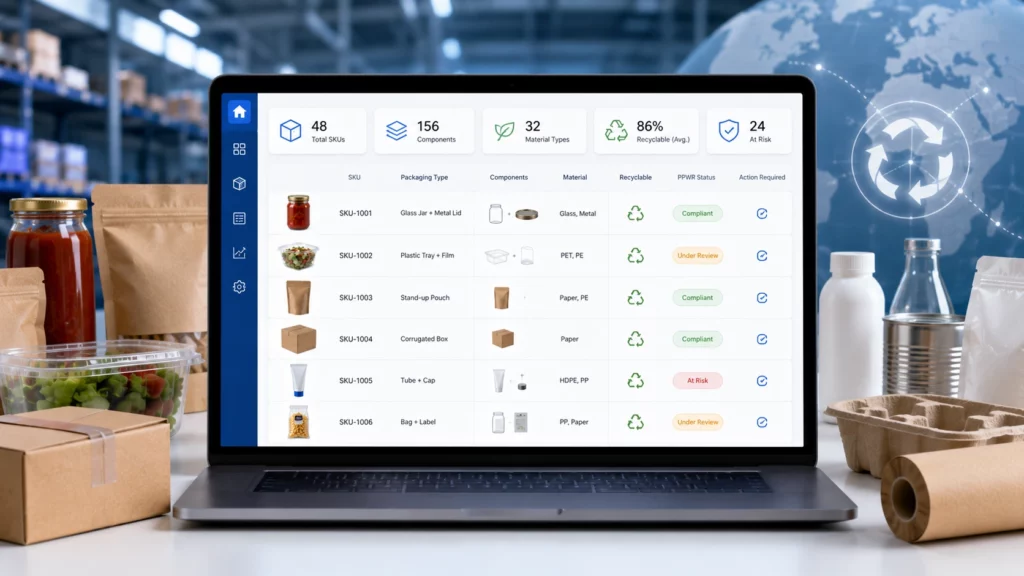
For businesses managing hundreds or thousands of SKUs, manually tracking packaging revisions and their impact on compliance can quickly become challenging. A centralized packaging compliance platform helps maintain version-controlled packaging records, supplier documentation, technical files, and audit-ready evidence, making it easier to keep Declarations of Conformity accurate throughout the packaging lifecycle.
Manual Tracking vs. Automated Compliance: A Side-by-Side
How the two approaches compare against the demands of the packaging changes under PPWR:
Requirement
Manual (spreadsheets + email)
Automated (TraceX Cleara AI*)
SKU / packaging mapping
Static sheets, quickly outdated
Live packaging inventory linked to every SKU
Supplier evidence
Chased by email, inconsistent formats
Structured supplier data requests, validated on intake
Recycled-content & substance data
Manually re-keyed, error-prone
Captured per component, versioned automatically
Declaration of Conformity
Rebuilt by hand per SKU
Generated from current, verified data
Change management
Breaks silently when materials change
Flags affected SKUs when an input changes
EPR / reporting
Reassembled each cycle
Reporting-ready from a single source of truth
Audit readiness
Best-effort, hard to prove
Traceable evidence trail on demand
How to Manage Packaging Changes Under PPWR at Scale
Managing the packaging changes under PPWR at scale means turning a scattered, manual process into a single connected system: one place where every SKU, component, supplier, and document lives and stays current as designs evolve. This is where a traceability and compliance platform such as TraceX PPWR Solutions is built to help.
A defensible PPWR program follows four steps:
Map your packaging portfolio. Build a live inventory of every packaging unit and component, linked to the SKUs it protects. You cannot comply with what you cannot see.
Collect supplier-backed evidence. Request recyclability, recycled-content, and substance data through structured, trackable requests instead of email — and validate it on intake.
Generate conformity documentation. Produce a Declaration of Conformity per packaging unit from current, verified data, ready for authorities on request.
Manage change continuously. When a supplier or material changes, automatically flag every affected SKU so documentation never falls out of sync with the physical package.
The benefit is not just avoiding fines or market-access blocks. A connected system for the packaging changes under PPWR gives sustainability, procurement, and compliance teams a shared source of truth which shortens redesign cycles, supports lower modulated EPR fees through better data, and turns a reactive scramble into a controlled roadmap toward the 2030 targets.
Buyer’s Checklist: Evaluating a PPWR Compliance Solution
If you are evaluating software to manage the packaging changes under PPWR, use this checklist. The right platform should let you:
Build a live packaging inventory that links every component to its SKUs.
Collect and validate supplier evidence for recyclability, recycled content, and substances.
Track recycled-content percentages per packaging type, plant, and year.
Generate and store a Declaration of Conformity per packaging unit.
Flag affected SKUs automatically when a material or supplier changes.
Produce EPR and reporting outputs from a single source of truth.
Integrate with your ERP / PLM so packaging data is not re-keyed.
Keep a traceable, audit-ready evidence trail available on demand.
Frequently Asked Questions (FAQ’s)
When do the packaging changes under PPWR take effect?
PPWR (Regulation (EU) 2025/40) entered into force on 11 February 2025 and applies generally from 12 August 2026. Core obligations substance restrictions, the Declaration of Conformity, and empty-space rules start on that date, while recyclability grades, recycled-content minimums, and minimization apply from 2030.
Do the packaging changes under PPWR apply to my business if I am outside the EU?
Yes. PPWR applies to any packaging placed on the EU market, regardless of where it is produced. Importers and non-EU sellers must comply, and non-conforming packaging can be rejected at the EU border.
What is a Declaration of Conformity under PPWR?
It is a documented, defensible claim that a packaging unit meets PPWR’s requirements recyclability, recycled content, minimization, and substance limits. From 12 August 2026, only packaging with a valid Declaration of Conformity may be placed on the market.
Which packaging changes under PPWR are hardest to meet?
The 2030 design targets are the most demanding: achieving recyclability grades, hitting minimum recycled-content thresholds, and minimizing weight, volume, and empty space all backed by supplier-verified data rather than estimates.
How much recycled content will plastic packaging need?
From 2030, plastic packaging must contain minimum post-consumer recycled content, averaged per type, plant, and year. Indicative figures around [30%] for contact-sensitive PET and [10%] for other contact-sensitive plastics have been discussed, but exact percentages depend on implementing acts and should be confirmed with legal counsel.
Do certifications replace PPWR obligations?
No. Certifications and supplier claims can support your evidence base, but PPWR requires per-unit conformity documentation. You still need traceable data for recyclability, recycled content, substances, and minimization for each packaging unit.
What is the fastest way to prepare for the packaging changes under PPWR?
Start by mapping your full packaging portfolio and identifying which SKUs need design or supplier changes. Then centralize supplier evidence and conformity documentation in one system so it stays current as designs evolve toward the 2030 deadlines.
Start using TraceX
Transparency, Trust, & Success for your Climate Journey.
We use cookies on our website to give you the most relevant experience by remembering your preferences and repeat visits. By clicking “Accept All”, you consent to the use of ALL the cookies. However, you may visit "Cookie Settings" to provide a controlled consent.
This website uses cookies to improve your experience while you navigate through the website. Out of these, the cookies that are categorized as necessary are stored on your browser as they are essential for the working of basic functionalities of the website. We also use third-party cookies that help us analyze and understand how you use this website. These cookies will be stored in your browser only with your consent. You also have the option to opt-out of these cookies. But opting out of some of these cookies may affect your browsing experience.
Necessary cookies are absolutely essential for the website to function properly. These cookies ensure basic functionalities and security features of the website, anonymously.
Cookie
Duration
Description
cookielawinfo-checkbox-analytics
11 months
This cookie is set by GDPR Cookie Consent plugin. The cookie is used to store the user consent for the cookies in the category "Analytics".
cookielawinfo-checkbox-functional
11 months
The cookie is set by GDPR cookie consent to record the user consent for the cookies in the category "Functional".
cookielawinfo-checkbox-necessary
11 months
This cookie is set by GDPR Cookie Consent plugin. The cookies is used to store the user consent for the cookies in the category "Necessary".
cookielawinfo-checkbox-others
11 months
This cookie is set by GDPR Cookie Consent plugin. The cookie is used to store the user consent for the cookies in the category "Other.
cookielawinfo-checkbox-performance
11 months
This cookie is set by GDPR Cookie Consent plugin. The cookie is used to store the user consent for the cookies in the category "Performance".
viewed_cookie_policy
11 months
The cookie is set by the GDPR Cookie Consent plugin and is used to store whether or not user has consented to the use of cookies. It does not store any personal data.
Functional cookies help to perform certain functionalities like sharing the content of the website on social media platforms, collect feedbacks, and other third-party features.
Performance cookies are used to understand and analyze the key performance indexes of the website which helps in delivering a better user experience for the visitors.
Analytical cookies are used to understand how visitors interact with the website. These cookies help provide information on metrics the number of visitors, bounce rate, traffic source, etc.
Advertisement cookies are used to provide visitors with relevant ads and marketing campaigns. These cookies track visitors across websites and collect information to provide customized ads.
Download the 2026 Traceability Scorecard and Benchmark Your Supply Chain Across 10 Critical Capabilities.
Download our eBook
Don’t Wait for an Audit to Find Your EUDR Gaps
The 2026 Simplification Package changes how HS codes, DDS pass-through and geolocation rules apply to you. Get the free guide and 20-point readiness checklist before enforcement catches you unprepared.