MRLs for Food Exports: How Residue Limits Decide Whether Your Shipment Clears the Border
Published
, 10 minute read
Share this article
Quick summary: MRLs for food exports decide whether a shipment clears customs or is rejected. See how residue limits work across the EU, US and Codex — and how to comply.
MRLs for food exports are the maximum residue levels the highest legally permitted concentrations of pesticide residues allowed on a food product when it crosses a border. Whether a container of coffee, spices, tea, fresh produce or processed food clears customs or is turned away often comes down to a single number measured in milligrams per kilogram. Get it right and the shipment moves; get it wrong and the whole consignment can be rejected, flagged across every EU member state, and every future shipment placed under heightened inspection.
Key takeaways
MRLs for food exports are set by the destination market, not the country of origin the EU, US, Japan and Codex each maintain different limits.
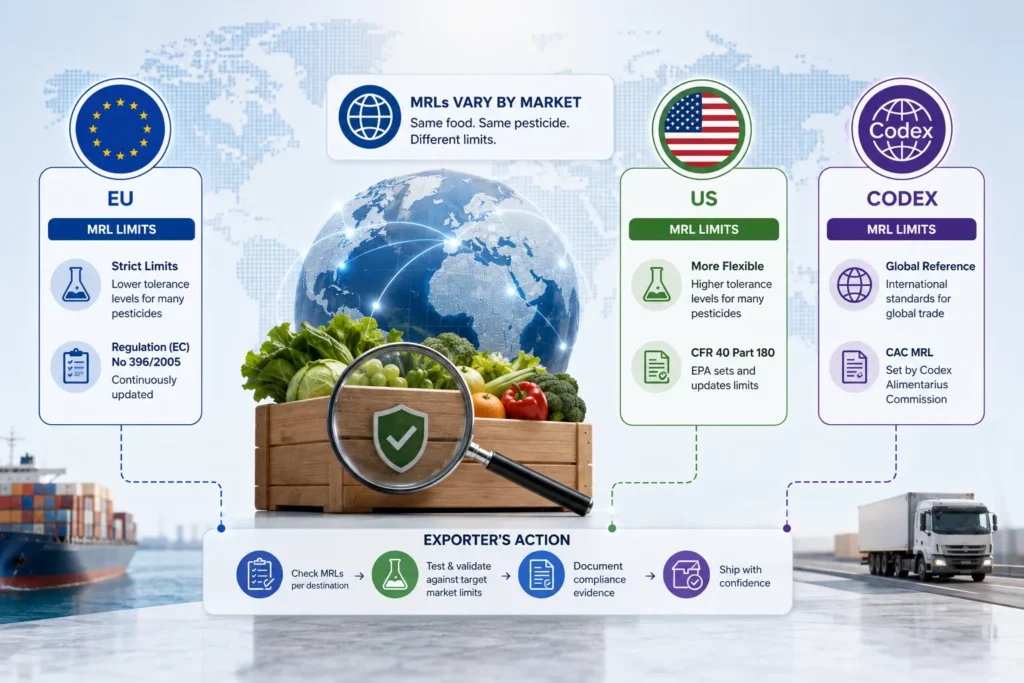
The EU’s Regulation (EC) No 396/2005 is often the strictest, applying a default limit of 0.01 mg/kg where no specific MRL exists.
A single exceedance can trigger a RASFF alert, full-consignment rejection, and elevated inspection rates on every future shipment.
Compliance is a data and traceability problem: you need plot- and batch-level evidence of what was applied, where, and when.
The TraceX platform links farm-level input records to export batches so residue risk surfaces before the shipment leaves.
MRLs for food exports define the ceiling for pesticide (and veterinary drug) residues a food product may legally carry into a destination market. In short:
An MRL is the highest residue concentration legally tolerated when a pesticide is applied per good agricultural practice (GAP).
MRLs are pesticide-, commodity- and country-specific the same fungicide on the same grapes can carry different limits in the EU, the US and Japan.
Where no specific limit exists, many markets apply a default of 0.01 mg/kg effectively the limit of detection.
Because MRLs for food exports are pesticide-, commodity- and country-specific, the reference point that ties them together is Codex Alimentarius the FAO/WHO body that has established over 4,300 MRLs across nearly 200 pesticides, forming the basis for many national limits. But the big markets legislate their own. The EU sets MRLs under Regulation (EC) No 396/2005, harmonised across all member states and enforced at the border. The US works through EPA tolerances enforced by the FDA. The UK, post-Brexit, is aligned with the EU for now but gradually diverging. Crucially, MRLs are regulatory thresholds tied to GAP, not toxicity cliffs a marginal exceedance is a compliance failure treated as a legal breach, even where it poses no direct health risk.
Why MRLs for Food Exports Trip Up Even Careful Producers
The problem is not that these limits exist. It is that they move and that a compliant crop can become a non-compliant shipment while the container is still at sea.
Limits change constantly: the EU amends the annexes to Regulation (EC) No 396/2005 almost monthly.
Banned substances persist: chlorpyrifos and chlorpyrifos-methyl still show up in rejected loads years after their EU approval lapsed.
One SKU, many rulebooks: shipping the same product to five markets means tracking five limit tables that each update on their own schedule.
The difficulty with MRLs for food exports is one of moving targets. Through 2025 and 2026 the European Commission issued a near-continuous stream of regulations revising limits for individual substances. A pesticide that was within limits when the crop was sprayed can fall out of compliance by the time the goods reach port. Because MRLs for food exports are also commodity- and market-specific, an exporter sending one SKU to several countries is effectively managing several independent rulebooks at once which is exactly where errors creep in.
Is your farm data ready for export markets?
Our guide to Farm Management for Exports explains how digital farm management can help exporters connect farm activities, input usage, crop production, harvest records and traceabilitycreating the data needed to support quality, food-safety and market requirements.
The Real Cost of MRLs for Food Exports Non-Compliance
Understanding the true cost of MRLs for food exports non-compliance starts at the border, where a single test result can cascade into months of consequences.
Immediate loss: rejection at port, with the entire shipment written off.
System-wide flag: a RASFF (Rapid Alert System for Food and Feed) notification visible to every EU member state.
Lasting penalty: an increased rate of control on every subsequent shipment from that exporter or origin.
Commercial fallout: lost certifications, direct financial loss, and damaged buyer relationships.
The pattern matters as much as the penalty. A 2025 analysis of more than 1,100 RASFF alerts on Turkish horticultural exports found that rejections were seasonally patterned and structurally embedded concentrated in specific commodities (peppers were the most rejected) and specific chemistries, peaking in particular seasons. In other words, MRLs for food exports failures are rarely random. They cluster around known crops, known active substances and known times of year, which means they are predictable and therefore preventable with the right monitoring in place before a shipment is ever loaded.
How to Manage MRLs for Food Exports Across Multiple Markets
Managing MRLs for food exports at scale is a mapping problem before it is a testing problem every destination layers its own limits over the same physical batch.
Know the destination for every lot, because the MRL table that applies is the buyer’s, not yours.
Hold current MRL reference data for each market you ship to the USDA FAS MRL database alone spans 50 major export markets plus Codex and the US.
Keep a plot-level record of every input applied, so a batch can be cleared against a limit before it moves.
Getting MRLs for food exports right across many destinations requires three things working together: current limit data per market, a record of every input applied at farm level, and a way to connect the two down to the individual batch. Reference databases solve the first half the harder half is the evidence trail. Proving which active substances touched which plot, at what dose, and how many days before harvest is what actually determines whether a batch will pass. Without that trail, testing becomes a gamble taken after the goods are already packed.
Can you trace every product back to its source?
Our guide to Digital Traceability explains how businesses can connect data across the supply chainfrom farm and supplier to processing, batches and final shipmentto create a more transparent and verifiable supply chain.
Traceability and MRLs for Food Exports: Closing the Evidence Gap
This is where traceability reshapes how exporters handle residue risk by turning a lab gamble into a managed, provable process.
Certificates show intent; border tests examine the batch. Only field-level records prove what happened on a specific plot on a specific date.
A traceability platform captures pesticide applications, pre-harvest intervals and geolocation, then carries them forward to the export consignment.
When a limit changes in a destination market, exposed lots can be flagged before they ship not after a RASFF alert.
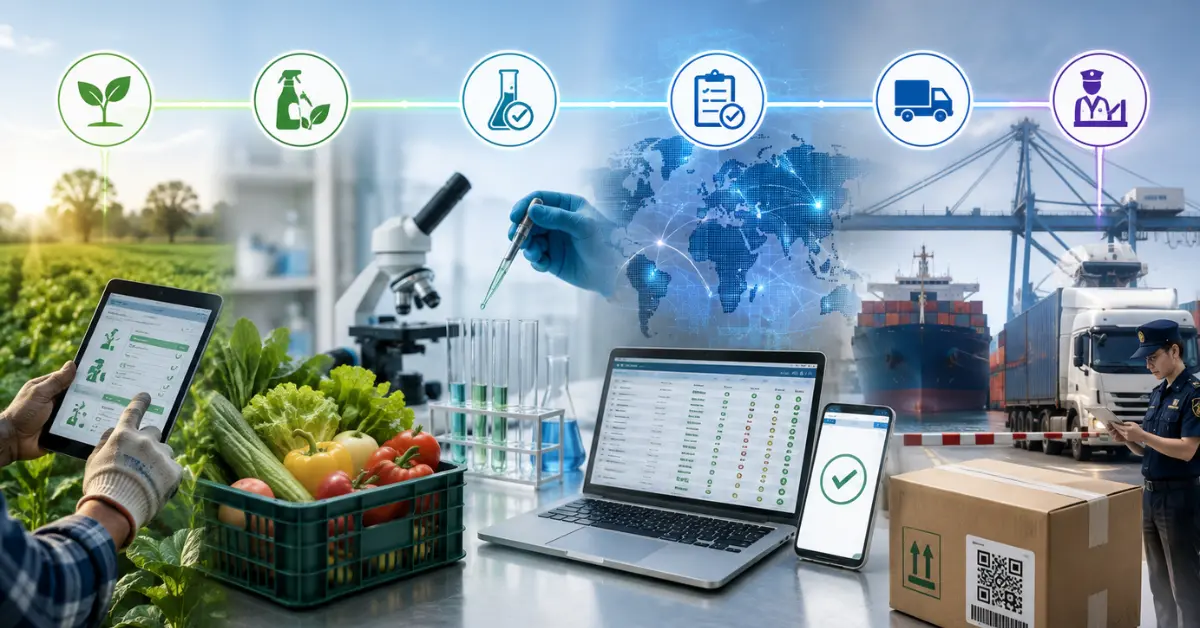
Traceability is what turns MRLs for food exports from a laboratory gamble into a controlled workflow. Third-party certifications and audits demonstrate good practice, but they do not prove what happened in a given field on a given day and authorities test the batch, not the certificate. Handling MRLs for food exports well therefore depends on connecting farm-level input data to the specific batches leaving the packhouse. The TraceX Traceability platform is built to link pesticide application records, pre-harvest intervals and plot geolocation to export consignments, so residue risk surfaces during production rather than at customs That is the difference between reacting to a rejection and never generating one.
See how plot-level input records connect to export batches and clear MRLs for food exports before shipment
MRLs for food exports are a retrieval problem, not a testing problem. By the time a lab result comes back, the container is already packed. The exporters who avoid rejections are the ones who can retrieve, on demand, the complete input history behind every batch one data layer that answers the EU, the US and Codex at once, instead of three disconnected spreadsheets updated by hand. Build the evidence trail at the farm, and MRL compliance stops being a scramble and becomes a query.
Manual vs. Platform: Managing MRLs for Food Exports
Dimension
Manual / spreadsheet approach
TraceX platform approach
MRL data updates
Checked manually, market by market, often after the goods have shipped
Destination limit tables monitored centrally; exposed lots flagged early
Input records
Paper logs kept at farm level, hard to tie to a specific batch
Pesticide applications and pre-harvest intervals captured digitally at plot level
Multi-market shipping
Separate, duplicated tracking per destination country
One batch record mapped to each market’s limits
Rejection response
Manual trace-back after a RASFF alert days of investigation
Batch history retrievable on demand in minutes
Audit & buyer proof
Certificates only; no field-level evidence to show
Plot-to-batch chain of custody attached to the consignment
Buyer’s Checklist: Evaluating an MRL Compliance Solution
Use this checklist when comparing traceability or compliance tools for MRLs for food exports:
Does it capture pesticide applications and pre-harvest intervals at the plot or farm level?
Can it link farm input records to specific export batches and consignments?
Does it track MRL limits for each destination market, not just one?
Can it flag at-risk lots before they ship when a limit changes?
Does it retain geolocation and batch-level evidence for audit and buyer requests?
Does it produce export-ready documentation your buyers and border authorities will accept?
Frequently Asked Questions
What does MRL stand for in food exports?
MRL stands for Maximum Residue Level (or Limit) — the highest concentration of a pesticide or veterinary drug residue legally allowed on a food product entering a destination market. It is measured in milligrams per kilogram (mg/kg).
Who sets MRLs for food exports?
The destination market sets the limit that applies. Codex Alimentarius (FAO/WHO) provides international reference MRLs, while major markets legislate their own: the EU under Regulation (EC) No 396/2005, the US via EPA tolerances enforced by the FDA, and the UK on a post-Brexit track diverging from the EU.
What happens if a food export exceeds the MRL?
A border test showing an exceedance can result in rejection of the entire shipment, a RASFF notification visible across the EU, and an increased rate of control on all future shipments from that exporter or origin plus possible loss of certification and buyer trust.
Are EU MRLs stricter than Codex MRLs?
Often, yes. The EU’s limits are frequently the strictest globally and, where no specific limit is set, a default of 0.01 mg/kg applies the practical limit of detection. Codex limits are international standards but are not automatically adopted by every market.
What is the default MRL when no specific limit exists?
In the EU and many other markets the default is 0.01 mg/kg. In practice, if a residue has no established limit for a commodity, any detectable amount above that default is treated as a compliance breach.
How can exporters prevent MRL rejections?
By capturing plot-level records of every pesticide applied, tracking the correct limit for each destination market, and clearing each batch against those limits before it ships. A traceability platform makes that input history retrievable on demand rather than reconstructed after a rejection.
Do organic or certified products still need to meet MRLs?
Yes. Certification supports good practice and risk mitigation but does not replace the legal MRL requirement or the batch-level evidence border authorities look for. Certified and organic consignments are still tested against the destination market’s residue limits.
Start using TraceX
Transparency, Trust, & Success for your Climate Journey.
We use cookies on our website to give you the most relevant experience by remembering your preferences and repeat visits. By clicking “Accept All”, you consent to the use of ALL the cookies. However, you may visit "Cookie Settings" to provide a controlled consent.
This website uses cookies to improve your experience while you navigate through the website. Out of these, the cookies that are categorized as necessary are stored on your browser as they are essential for the working of basic functionalities of the website. We also use third-party cookies that help us analyze and understand how you use this website. These cookies will be stored in your browser only with your consent. You also have the option to opt-out of these cookies. But opting out of some of these cookies may affect your browsing experience.
Necessary cookies are absolutely essential for the website to function properly. These cookies ensure basic functionalities and security features of the website, anonymously.
Cookie
Duration
Description
cookielawinfo-checkbox-analytics
11 months
This cookie is set by GDPR Cookie Consent plugin. The cookie is used to store the user consent for the cookies in the category "Analytics".
cookielawinfo-checkbox-functional
11 months
The cookie is set by GDPR cookie consent to record the user consent for the cookies in the category "Functional".
cookielawinfo-checkbox-necessary
11 months
This cookie is set by GDPR Cookie Consent plugin. The cookies is used to store the user consent for the cookies in the category "Necessary".
cookielawinfo-checkbox-others
11 months
This cookie is set by GDPR Cookie Consent plugin. The cookie is used to store the user consent for the cookies in the category "Other.
cookielawinfo-checkbox-performance
11 months
This cookie is set by GDPR Cookie Consent plugin. The cookie is used to store the user consent for the cookies in the category "Performance".
viewed_cookie_policy
11 months
The cookie is set by the GDPR Cookie Consent plugin and is used to store whether or not user has consented to the use of cookies. It does not store any personal data.
Functional cookies help to perform certain functionalities like sharing the content of the website on social media platforms, collect feedbacks, and other third-party features.
Performance cookies are used to understand and analyze the key performance indexes of the website which helps in delivering a better user experience for the visitors.
Analytical cookies are used to understand how visitors interact with the website. These cookies help provide information on metrics the number of visitors, bounce rate, traffic source, etc.
Advertisement cookies are used to provide visitors with relevant ads and marketing campaigns. These cookies track visitors across websites and collect information to provide customized ads.
Download the 2026 Traceability Scorecard and Benchmark Your Supply Chain Across 10 Critical Capabilities.
Download our eBook
Don’t Wait for an Audit to Find Your EUDR Gaps
The 2026 Simplification Package changes how HS codes, DDS pass-through and geolocation rules apply to you. Get the free guide and 20-point readiness checklist before enforcement catches you unprepared.