EUDR Compliance Testing: What to Test Now Before December 2026
Published
, 10 minute read
Share this article
Quick summary: EUDR Compliance Testing helps businesses validate supplier data, geolocation, risk checks, DDS workflows, API integrations, and audit trails before the 2026 deadline.
EUDR compliance testingshould start now. With the EU Deforestation Regulation (EUDR) due to apply to large and medium operators on 30 December 2026, the biggest implementation risk is not waiting for the deadline it is waiting to test until the deadline is close. The European Commission’s EUDR Information System has already reopened, with a Production environment for legally valid submissions and an Acceptance environment for training, familiarisation and testing. The Commission is also running operator training in September 2026.
That means businesses now have a practical opportunity to test the full compliance chain: supplier data, geolocation, product information, risk assessment, due diligence statements, integrations and record keeping. December should be the point at which the process is operational not the first time it is exercised.
Key Takeaways
Don’t wait until December to test EUDR readiness. Use the available testing window to identify data, process and integration gaps before the 30 December 2026 application date for large and medium operators.
Start with supplier and origin data. Validate product information, suppliers, countries of production, legal-production evidence and, most importantly, plot-level geolocation data before it reaches the DDS workflow.
Test geolocation with real data. Run individual coordinates, polygons and GeoJSON files through your process and check whether each plot can be reliably linked back to the relevant commodity and product. The Commission’s system supports both individual and bulk geolocation inputs.
Test the complete due-diligence workflow—not just DDS submission. Your process should cover information collection, risk assessment and risk mitigation, with evidence showing how the final negligible-risk conclusion was reached.
Test ERP/API integrations early. If declarations will be automated, validate data mapping, submission responses, errors, retries, reference numbers and status updates before production.
Test exception scenarios. Deliberately test missing supplier data, invalid geolocation, incorrect product information, failed submissions and new information that changes a risk assessment.
Test traceability across the supply chain. Make sure DDS reference numbers and relevant information can move reliably between suppliers, operators, downstream parties and internal systems.
Make auditability part of testing. EUDR due-diligence records must be retained for five years, so teams should be able to reconstruct the evidence, assessment and decisions behind a transaction.
Use the Acceptance environment now. The Commission describes it as a replica of the Production environment for training, familiarisation and testing; submissions there have no legal value
As of September 2026, companies can already exercise the core workflow they will need for EUDR compliance. That includes registering for the system, preparing product information, providing origin information, creating DDS or simplified declarations where applicable, submitting them and managing submitted statements through the dashboard.
The current Information System supports several practical capabilities that should be tested now:
Origin and geolocation data: users can identify the origin of relevant products by drawing areas on a map or providing coordinates individually or in bulk.
GeoJSON uploads: coordinates can be supplied in bulk using the GeoJSON standard, with Commission guidance covering common technical issues.
Product information: users can enter product characteristics such as HS code, product description and quantity, including weight or volume as applicable.
DDS and simplified declarations: the system supports the creation and submission of the relevant declaration type based on the operator’s role and circumstances.
Dashboard management: submitted statements can be searched, viewed and managed, with their status updated as the system processes them.
API integration: companies can manage DDS or simplified declarations in bulk through a machine-to-machine API connection, making integration testing especially important for businesses with high transaction volumes.
The Commission has also resumed Information System training, including sessions aimed at upstream operators submitting DDS and separate sessions for micro or small primary operators using simplified declarations. This is a strong signal that organisations should use the current environment for hands-on preparation rather than treating December as the first testing window.
EUDR Compliance Testing- What should businesses test now?
A strong EUDR compliance testing programme should go beyond checking whether users can log into the Commission system. It should test whether the company can consistently produce complete, accurate and traceable evidence from its own supply chain and submit the required information without last-minute manual work.
The most useful preparation is not simply logging in and confirming that the website opens. Companies should test the complete data-to-declaration workflow using realistic records. The goal is to find data, process, integration and ownership gaps while there is still time to correct them.
1. Test your registration and user roles
Confirm that the right legal entity can access the Production and Acceptance environments and that the people who will actually perform the work understand their roles. If you use authorised representatives, test that process separately. Do not assume that an account created in Acceptance automatically carries over to Production.
2. Test real geolocation files
Geolocation is one of the areas most likely to expose upstream data-quality problems. Test representative point and polygon data, including bulk GeoJSON files. Validate the coordinate format, geometry, file structure and the ability of your internal systems to produce files accepted by the Information System. Do this with real supplier or plot-level examples rather than a clean sample created only for testing.
Take a representative set of products that you expect to place on the EU market or export and run them through the declaration workflow. Check whether your ERP, master-data or compliance systems contain the product description, HS code, quantity, weight and other information required to complete the declaration. Where data is missing, assign ownership now rather than discovering the gap during a December submission.
4. Test the full DDS workflow
Create test declarations from start to finish in the Acceptance environment. Include the steps your team will actually perform: gathering supplier information, assessing risk, preparing the declaration, submitting it, recording the resulting reference information and passing that information into downstream processes. The objective is to confirm that your compliance process and the Information System workflow match.
5. Test your API integration now
If your organisation plans to submit declarations through an API, December is too late to begin integration testing. The Commission provides API reference documentation for economic operators, and the Information System page advises developers to consult the CIRCABC documentation regularly for updates. Test authentication, payload construction, product data, geolocation data, error handling, response processing and the storage of reference and verification information.
For large-volume operators, also test how your internal systems handle failed submissions, retries and status changes. An API that works technically but does not create a reliable audit trail in your ERP or compliance platform is not production-ready.
6. Test the handoff across your supply chain
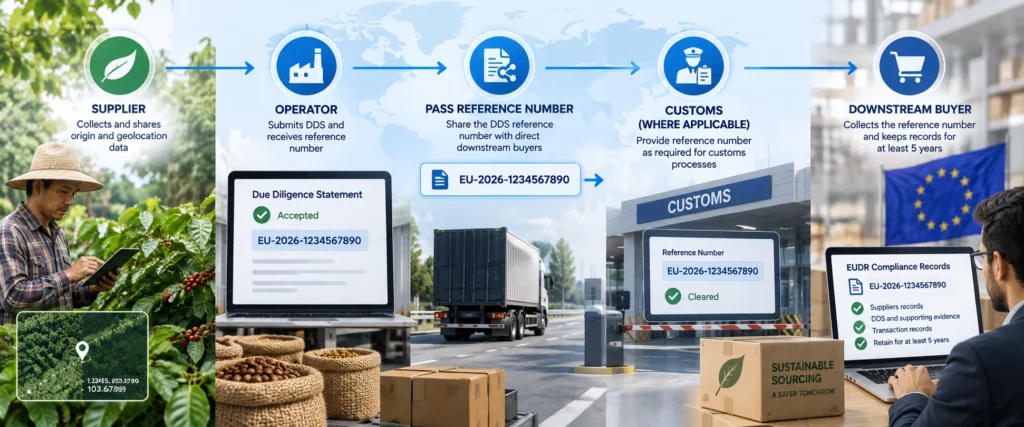
EUDR compliance does not stop when a DDS is accepted. Operators must pass the DDS reference number to their direct downstream buyers. The first downstream operator or trader must collect the relevant reference number and keep records for at least five years. Your test should therefore include the handoff from supplier to operator, operator to buyer, and where relevant into customs or other internal systems.
7. Test exceptions, not just the happy path
Use testing to deliberately surface problems: missing geolocation, invalid geometry, incomplete product data, incorrect quantities, duplicate records, rejected submissions and unavailable-system scenarios. The Commission’s API documentation also describes a contingency reference number for periods when the Information System is unavailable for more than 60 minutes. Your internal procedures should define who acts, what is recorded and how the process is reconciled once the system is restored.
Why December is the wrong time to start testing
The EUDR application date is 30 December 2026 for large and medium operators and for micro and small operators already covered by the EU Timber Regulation; most other micro and small operators have until 30 June 2027. For organisations in the December group, the remaining preparation window is therefore about implementation, validation and remediation not discovery.
The Commission has already reopened the Information System and made the Acceptance environment available for testing. Its September training schedule also provides a timely opportunity for teams to familiarise themselves with the system. Waiting until December creates unnecessary compression across supplier onboarding, data cleansing, geolocation validation, risk assessment, user training, integration testing and actual submissions.
How TraceX Helps with EUDR Compliance Testing
TraceX EUDR Solutions helps businesses test and validate their EUDR compliance workflow before December not just test the final DDS submission. The platform connects supplier onboarding, plot-level geolocation, GeoJSON validation, satellite-based deforestation checks, risk assessment, due diligence and DDS generation in one traceable workflow. It also supports TRACES integration and centralises compliance evidence, allowing teams to identify data gaps, validate submissions and test end-to-end traceability before going live.
Supplier data requirements are mapped and tested with representative suppliers.
Product master data and HS codes have been validated.
Coordinates, polygons and GeoJSON files have been tested.
Plot-to-product traceability has been verified.
Risk assessment and mitigation workflows have been exercised.
DDS or simplified-declaration preparation has been tested in Acceptance.
API/ERP integrations have been tested where applicable.
Submission errors, retries and duplicate scenarios have been tested.
DDS reference-number handoffs have been tested downstream.
Five-year record-keeping and audit retrieval have been tested.
Exception procedures are documented and assigned to named owners.
The takeaway: test the chain, not just the system
EUDR readiness is not achieved by successfully submitting one test declaration. It is achieved when the organisation can repeatedly move from supplier information to traceable origin data, risk assessment, due diligence, declaration submission and evidence retention without relying on last-minute manual intervention.
The EUDR Information System is already available for testing, and the Commission is continuing to update its guidance, documentation and technical capabilities. Use the current window to test your own data and processes against the system. Find the gaps while there is still time to fix them.
The question for September should not be, “Are we ready for December?” It should be: “What will fail if we tested our complete EUDR process today and have we fixed it?”
Frequently Asked Questions (FAQ’s)
What is EUDR compliance testing?
EUDR compliance testing is the process of validating an organisation’s data, traceability, risk assessment, due diligence, declaration and record-keeping workflows before the regulation applies. It should include both internal process testing and testing with the Commission’s Acceptance environment.
When should companies start EUDR compliance testing?
Companies subject to the 30 December 2026 application date should start immediately rather than waiting for December. The Commission’s Acceptance environment is available for training and testing, while the Production environment is used for legally valid submissions.
What should be tested first for EUDR?
Start with supplier and product data, especially geolocation and origin information. These inputs drive the downstream due diligence and declaration process, so data-quality problems should be identified before system submission testing.
What is the EUDR deadline?
The EUDR applies from 30 December 2026 to large and medium operators and to micro and small operators already covered by the EU Timber Regulation. For most other micro and small operators, the application date is 30 June 2027.
Start using TraceX
Transparency, Trust, & Success for your Climate Journey.
We use cookies on our website to give you the most relevant experience by remembering your preferences and repeat visits. By clicking “Accept All”, you consent to the use of ALL the cookies. However, you may visit "Cookie Settings" to provide a controlled consent.
This website uses cookies to improve your experience while you navigate through the website. Out of these, the cookies that are categorized as necessary are stored on your browser as they are essential for the working of basic functionalities of the website. We also use third-party cookies that help us analyze and understand how you use this website. These cookies will be stored in your browser only with your consent. You also have the option to opt-out of these cookies. But opting out of some of these cookies may affect your browsing experience.
Necessary cookies are absolutely essential for the website to function properly. These cookies ensure basic functionalities and security features of the website, anonymously.
Cookie
Duration
Description
cookielawinfo-checkbox-analytics
11 months
This cookie is set by GDPR Cookie Consent plugin. The cookie is used to store the user consent for the cookies in the category "Analytics".
cookielawinfo-checkbox-functional
11 months
The cookie is set by GDPR cookie consent to record the user consent for the cookies in the category "Functional".
cookielawinfo-checkbox-necessary
11 months
This cookie is set by GDPR Cookie Consent plugin. The cookies is used to store the user consent for the cookies in the category "Necessary".
cookielawinfo-checkbox-others
11 months
This cookie is set by GDPR Cookie Consent plugin. The cookie is used to store the user consent for the cookies in the category "Other.
cookielawinfo-checkbox-performance
11 months
This cookie is set by GDPR Cookie Consent plugin. The cookie is used to store the user consent for the cookies in the category "Performance".
viewed_cookie_policy
11 months
The cookie is set by the GDPR Cookie Consent plugin and is used to store whether or not user has consented to the use of cookies. It does not store any personal data.
Functional cookies help to perform certain functionalities like sharing the content of the website on social media platforms, collect feedbacks, and other third-party features.
Performance cookies are used to understand and analyze the key performance indexes of the website which helps in delivering a better user experience for the visitors.
Analytical cookies are used to understand how visitors interact with the website. These cookies help provide information on metrics the number of visitors, bounce rate, traffic source, etc.
Advertisement cookies are used to provide visitors with relevant ads and marketing campaigns. These cookies track visitors across websites and collect information to provide customized ads.
Download the 2026 Traceability Scorecard and Benchmark Your Supply Chain Across 10 Critical Capabilities.
Download our eBook
Don’t Wait for an Audit to Find Your EUDR Gaps
The 2026 Simplification Package changes how HS codes, DDS pass-through and geolocation rules apply to you. Get the free guide and 20-point readiness checklist before enforcement catches you unprepared.