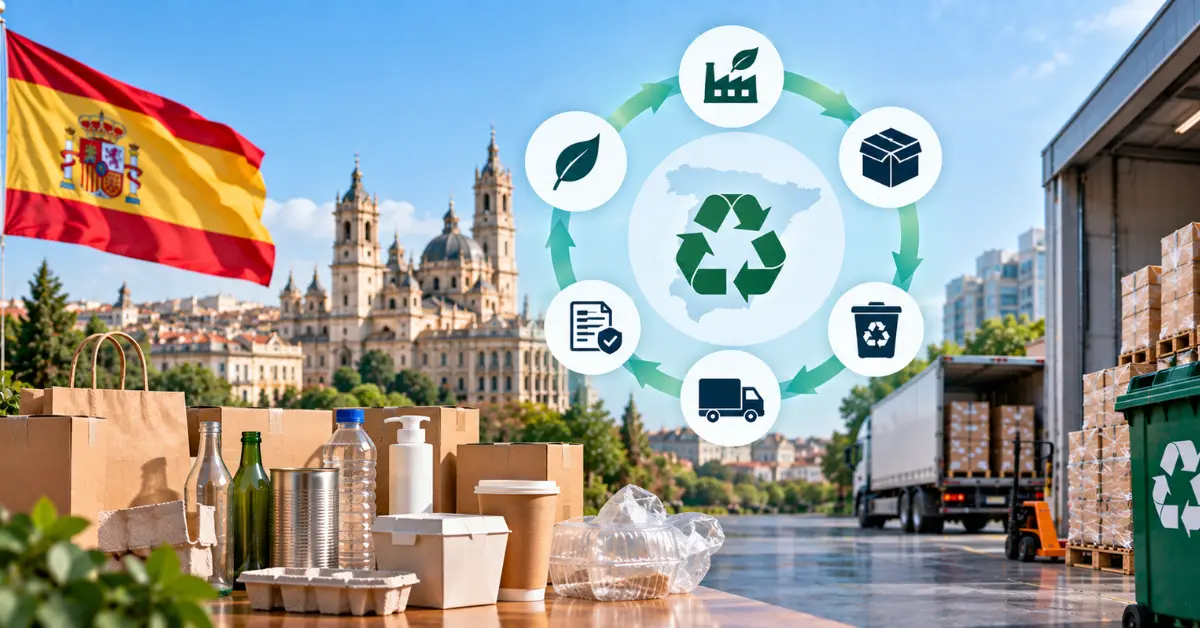
EPR Requirements Spain: A Producer’s Compliance Guide
Published
, 9 minute read
Share this article
Quick summary: EPR requirements Spain explained: producer scope, RPP registration, SCRAP membership, the 31 March declaration, fees, and the 2026 PPWR overlap.
EPR requirements Spain are the packaging producer obligations set by Royal Decree 1055/2022 and Ley 7/2022. Any company that places household, commercial, or industrial packaging on the Spanish market must register in the RPP producer register at MITECO, join a SCRAP compliance scheme or run a SIRAP, file an annual packaging declaration by 31 March, and pay eco-modulated fees. Foreign sellers must appoint a Spanish authorised representative, and from 12 August 2026 the EU PPWR applies alongside the national rules.
Key Takeaways
Spain’s packaging EPR is governed by Royal Decree 1055/2022 and Ley 7/2022.
No de minimis threshold: placing a single packaged item on the market makes you a producer.
Household, commercial, and industrial packaging are all in scope.
Register in the RPP at MITECO and join a SCRAP such as Ecoembes or Ecovidrio (or run a SIRAP).
The annual packaging declaration is due by 31 March for the previous calendar year.
Non-EU sellers must appoint a Spanish authorised representative.
The EU PPWR (Reg (EU) 2025/40) applies in Spain from 12 August 2026, on top of the national regime.
What EPR requirements Spain sets for packaging producers
Spain’s packaging EPR rules stem from Royal Decree 1055/2022 and Ley 7/2022, making producers finance the collection and recycling of the packaging they place on the market.
The EPR requirements Spain enforces come from Royal Decree 1055/2022 on packaging and packaging waste, reinforced by Ley 7/2022 on waste and contaminated soils. Together these rules make any business that places packaging on the Spanish market responsible for financing and organising the collection, sorting, and recycling of that packaging once consumers are finished with it. Meeting the EPR requirements Spain has in force is not a single action but a repeating cycle: register as a producer, join a compliance scheme, declare the packaging you put on the market each year, and pay fees that scale with how much and what type of material you use. Because the framework reaches household, commercial, and industrial packaging alike, almost every company shipping physical goods into Spain now falls inside its scope.
PPWR introduces important responsibilities around packaging placed on the EU market, including producer registration, reporting and EPR obligations. With the PPWR now applying from 12 August 2026, understanding where and how your business needs to register is becoming critical.
Who must comply with EPR requirements Spain applies
Any business that places packaged goods on the Spanish market is a producer. There is no minimum threshold, and household, commercial, and industrial packaging are all covered.
The producer definition behind the EPR requirements Spain applies is deliberately broad. Spain sets no minimum volume or weight, so placing even a single packaged item on the Spanish market makes you an obligated producer. That net captures domestic manufacturers, importers, distributors, cross-border ecommerce sellers, and marketplace merchants alike. The extension of full producer responsibility to commercial and industrial packaging, effective from the end of 2024, is the change that most often surprises B2B suppliers who assumed the EPR requirements Spain maintains only touched consumer goods. If your packaging reaches a Spanish user, the safe assumption is that you are in scope until a formal assessment proves otherwise.
EPR requirements Spain: RPP registration and choosing a SCRAP
Register in the RPP packaging section at MITECO, then join a SCRAP such as Ecoembes or Ecovidrio, or run an individual SIRAP. Commercial and industrial packaging needed a scheme from 31 December 2024.
The first operational step in the EPR requirements Spain enforces is registration in the packaging section of the Registro de Productores de Producto (RPP), managed by the environment ministry, MITECO. Once registered, producers either join a collective producer responsibility scheme, known locally as a SCRAP, such as Ecoembes for most materials or Ecovidrio for glass, or operate their own individual system, a SIRAP. For commercial and industrial packaging, scheme membership became mandatory from 31 December 2024. After registration you receive a producer number, which must appear on invoices and commercial documents for the packaged products you sell.
EPR requirements Spain for foreign and non-EU sellers
Producers with no Spanish establishment must appoint a local authorised representative. Without one, liability passes to the first Spanish distributor, and marketplaces may block listings without a valid registration number.
For companies without an establishment in Spain, the EPR requirements Spain adds a decisive extra step: appointing a local authorised representative, or representante autorizado, before any filing can happen. If no representative is appointed, the legal responsibility falls to the first Spanish distributor in the supply chain, which quickly creates friction with commercial partners. Non-EU brands that reach Spanish shoppers through online platforms should treat the EPR requirements Spain places on them as a condition of market access, because marketplaces increasingly ask for a valid registration number before they will keep products listed.
An Authorised Representative can play an important role in helping non-EU producers meet their PPWR EPR responsibilities. Understand when an Authorised Representative may be required, what responsibilities can be delegated, and what businesses need to prepare.
EPR requirements Spain: annual declaration, fees, and labelling
File the annual packaging declaration by 31 March for the prior year, pay eco-modulated fees, add household sorting labels required since January 2025, and budget for the non-reusable plastic tax.
Ongoing compliance with the EPR requirements Spain maintains centres on the annual packaging declaration, which reports the weight and type of packaging placed on the market during the previous calendar year and is due by 31 March. Fees are eco-modulated under Ley 7/2022, so packaging designed to be easier to recycle should cost less than packaging that is harder to process. Since 1 January 2025, household packaging must also carry sorting instructions that tell consumers which waste stream to use. Layered on top, Spain’s special tax on non-reusable plastic packaging adds a further cost that sits beside the EPR requirements Spain imposes, so finance and compliance teams need to plan for both together.
How EPR requirements Spain connect to the EU PPWR
The EU PPWR applies in Spain from 12 August 2026, layered over the national regime rather than replacing it. One clean packaging dataset can serve both Spanish and EU reporting.
From 12 August 2026, the EU Packaging and Packaging Waste Regulation (PPWR, Regulation (EU) 2025/40) applies directly in Spain, sitting on top of the national framework rather than replacing it. As a result, the EPR requirements Spain runs today increasingly share a data foundation with EU-wide obligations covering recyclability, recycled content, and producer registration. Organisations that build one clean, well-structured packaging dataset can use it to satisfy the EPR requirements Spain sets and their PPWR reporting from the same source, which cuts duplicate effort as they expand across European markets.
From packaging design and recyclability to recycled content, reuse, labelling and EPR obligations, PPWR introduces new requirements across the packaging lifecycle. Understand what applies to your business and how to prepare for compliance.
How TraceX supports EPR requirements Spain compliance
TraceX PPWR platform captures packaging data at source, maps it to declarations, and keeps an audit trail, helping teams manage Spanish and multi-country EPR from one place.
A dedicated traceability platform turns the EPR requirements Spain enforces from a recurring spreadsheet scramble into a repeatable, auditable data workflow. The TraceX platform is designed to capture packaging material and weight data at the point of source, map it to Spanish declaration formats, and hold an evidence trail that stands up to regulator scrutiny [pending product-team sign-off]. For teams managing the EPR requirements Spain alongside comparable schemes in Germany, France, Italy, and other EU countries, a single system reduces the chance of missed deadlines, inconsistent figures, and retroactive fees.
To see how packaging data can be captured once and reused across Spain and the EU
Spanish packaging EPR is no longer a back-office formality. With commercial and industrial packaging now fully in scope, foreign-seller representation enforced, and PPWR layering EU obligations on top from August 2026, the winning move is to treat packaging data as a managed asset rather than an annual fire drill. Capture material and weight data once, at source, and reuse it across Spanish declarations and EU reporting.
EPR requirements Spain: manual process vs the TraceX platform
Compliance task
Manual approach
With the TraceX platform
Producer registration data
Scattered across emails and spreadsheets
Centralised producer and packaging records
Material + weight capture
Manual re-entry each cycle
Captured once at source, then reused
Annual declaration (31 March)
Rebuilt from memory under deadline
Mapped from a maintained dataset
Eco-modulation / fee inputs
Hard to model in advance
Recyclability attributes tracked per SKU
Audit evidence trail
Ad hoc, hard to reconstruct
Continuous, regulator-ready log
Multi-country EPR
Separate process per market
One dataset feeds many markets
Buyer’s checklist: evaluating a Spanish packaging EPR solution
Use these questions when comparing tools to manage Spanish packaging compliance:
☐ Does it capture packaging material and weight data at source, not by manual re-entry?
☐ Can it map one dataset to the Spanish RPP declaration and to PPWR reporting?
☐ Does it track the recyclability attributes needed for eco-modulated fees?
☐ Does it maintain an auditable evidence trail for MITECO scrutiny?
☐ Can it manage authorised-representative and multi-country obligations together?
☐ Does it flag deadlines such as the 31 March declaration automatically?
frequently asked questions
What is the deadline for the Spanish packaging declaration?
The annual declaration covering the previous calendar year is due by 31 March each year, filed through the RPP portal at MITECO.
Do foreign companies need to register for packaging EPR in Spain?
Yes. Any non-established company that places packaged goods on the Spanish market must register and appoint a local authorised representative.
What is a SCRAP and do I have to join one?
A SCRAP is a collective compliance scheme such as Ecoembes or Ecovidrio. Most producers join one; the alternative is running an individual system called a SIRAP.
Is there a minimum threshold before the rules apply?
No. Spain sets no de minimis, so placing a single packaged item on the market makes you an obligated producer.
Does commercial and industrial packaging count?
Yes. Full producer responsibility extended to commercial and industrial packaging, with scheme membership required from 31 December 2024.
How do the Spanish rules connect to the EU PPWR?
The PPWR (Regulation (EU) 2025/40) applies in Spain from 12 August 2026, sitting on top of the national Royal Decree 1055/2022 regime.
What are the penalties for non-compliance?
Penalties can be substantial and may include retroactive fees and marketplace listing suspension. Confirm your exposure with a local adviser before filing.
Start using TraceX
Transparency, Trust, & Success for your Climate Journey.
We use cookies on our website to give you the most relevant experience by remembering your preferences and repeat visits. By clicking “Accept All”, you consent to the use of ALL the cookies. However, you may visit "Cookie Settings" to provide a controlled consent.
This website uses cookies to improve your experience while you navigate through the website. Out of these, the cookies that are categorized as necessary are stored on your browser as they are essential for the working of basic functionalities of the website. We also use third-party cookies that help us analyze and understand how you use this website. These cookies will be stored in your browser only with your consent. You also have the option to opt-out of these cookies. But opting out of some of these cookies may affect your browsing experience.
Necessary cookies are absolutely essential for the website to function properly. These cookies ensure basic functionalities and security features of the website, anonymously.
Cookie
Duration
Description
cookielawinfo-checkbox-analytics
11 months
This cookie is set by GDPR Cookie Consent plugin. The cookie is used to store the user consent for the cookies in the category "Analytics".
cookielawinfo-checkbox-functional
11 months
The cookie is set by GDPR cookie consent to record the user consent for the cookies in the category "Functional".
cookielawinfo-checkbox-necessary
11 months
This cookie is set by GDPR Cookie Consent plugin. The cookies is used to store the user consent for the cookies in the category "Necessary".
cookielawinfo-checkbox-others
11 months
This cookie is set by GDPR Cookie Consent plugin. The cookie is used to store the user consent for the cookies in the category "Other.
cookielawinfo-checkbox-performance
11 months
This cookie is set by GDPR Cookie Consent plugin. The cookie is used to store the user consent for the cookies in the category "Performance".
viewed_cookie_policy
11 months
The cookie is set by the GDPR Cookie Consent plugin and is used to store whether or not user has consented to the use of cookies. It does not store any personal data.
Functional cookies help to perform certain functionalities like sharing the content of the website on social media platforms, collect feedbacks, and other third-party features.
Performance cookies are used to understand and analyze the key performance indexes of the website which helps in delivering a better user experience for the visitors.
Analytical cookies are used to understand how visitors interact with the website. These cookies help provide information on metrics the number of visitors, bounce rate, traffic source, etc.
Advertisement cookies are used to provide visitors with relevant ads and marketing campaigns. These cookies track visitors across websites and collect information to provide customized ads.
Download the 2026 Traceability Scorecard and Benchmark Your Supply Chain Across 10 Critical Capabilities.
Download our eBook
Don’t Wait for an Audit to Find Your EUDR Gaps
The 2026 Simplification Package changes how HS codes, DDS pass-through and geolocation rules apply to you. Get the free guide and 20-point readiness checklist before enforcement catches you unprepared.