Digital Product Passport: The 2026 Guide to EU Requirements, Deadlines and Compliance
Published
, 11 minute read
Share this article
Quick summary: Digital product passport rules explained: ESPR scope, the 18 Feb 2027 battery deadline, EN standards, data fields and a buyer checklist to get compliant.
A digital product passport (DPP) is a structured, machine-readable record linked to a physical product through a data carrier such as a QR code that stores a product’s identity, material composition, sustainability performance, repair and end-of-life information across its lifecycle. It is mandated in the EU under the Ecodesign for Sustainable Products Regulation (ESPR), Regulation (EU) 2024/1781. The ESPR sets the framework; product-specific delegated acts decide which products need a DPP and what data each must carry. The first DPP required in EU law is the battery passport, mandatory from 18 February 2027 under the EU Battery Regulation (Regulation (EU) 2023/1542).
Key facts at a glance:
Legal basis: ESPR (EU) 2024/1781; product rules set group-by-group via delegated acts.
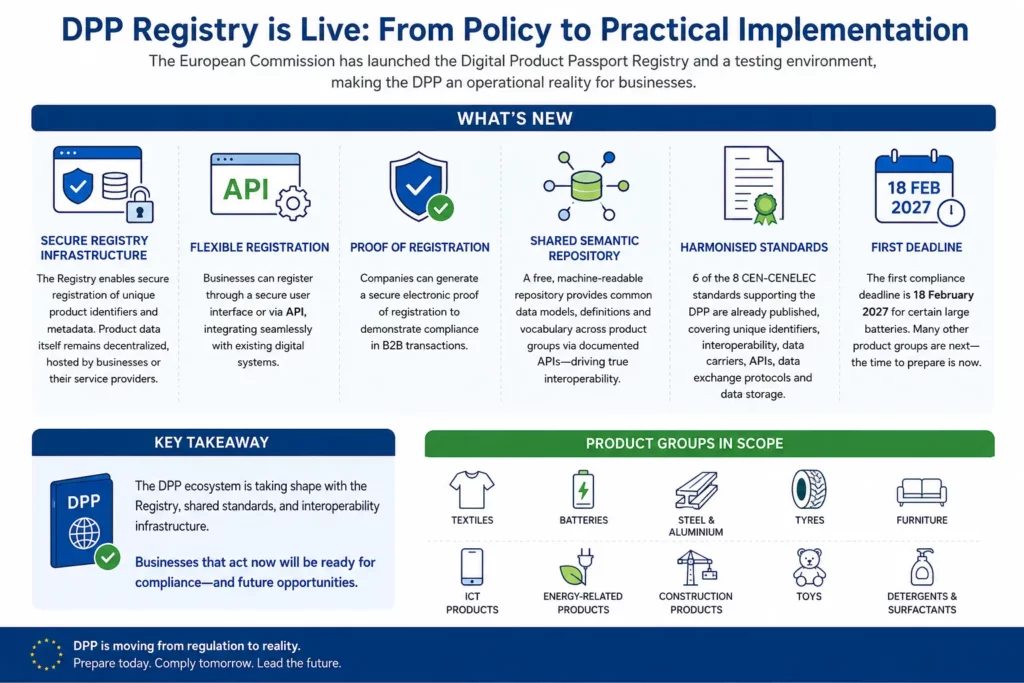
First hard deadline: battery passport, 18 February 2027 (EU Battery Regulation).
First ESPR product group: iron & steel (delegated act indicative 2026); textiles, tyres, aluminium next (2027).
Technical rulebook: six horizontal EN standards published by CEN-CENELEC JTC 24 (27 May 2026).
Key takeaways
A digital product passport is a legally mandated digital record capturing a product’s origin, materials, sustainability impact and end-of-life data to enable transparency and circularity.
The ESPR is a framework regulation your actual obligations (data fields, deadlines, who is responsible) come from the delegated act for your product group, not from the ESPR itself.
The battery passport (18 Feb 2027) is the first DPP in law and the template every later product group is being modelled on.
The EN 18xxx standards define how a passport works (identifiers, data carriers, exchange, storage, interoperability). Build to them now but track their harmonisation status before relying on them for legal presumption of conformity.
Certifications and existing PLM/ERP data help, but they do not replace batch-level, source-verified product data linked to a compliant data carrier.
Digital product passport, defined — and why the EU is mandating it
A digital product passport replaces opaque, paper-based product files with a live, cloud-accessible data trail that travels with the product. Where a traditional technical file sits static in a drawer, the passport is dynamic (updatable through life), interoperable (standardised so different systems can read it) and accessible (scannable instantly via a data carrier). Think of it as a digital twin of the product’s compliance and sustainability record.
The regulatory intent is twofold: empower buyers to make informed, lower-impact choices, and give repairers and recyclers the exact material and structural information needed to keep products in use. It is a cornerstone of the EU Circular Economy Action Plan and the EU Green Deal.
Regulatory interpretation: what ESPR actually obliges you to do
This is the point most guides get wrong, so it is worth stating plainly. The Ecodesign for Sustainable Products Regulation (ESPR), Regulation (EU) 2024/1781, entered into force on 18 July 2024. But the ESPR is a framework: it does not, by itself, require any specific product to carry a digital product passport. It empowers the European Commission to adopt delegated acts that decide, group by group, which products need a DPP, which data fields are mandatory, how data is accessed, and who is legally responsible for accuracy.
Your compliance date and data scope come from the delegated act for your product group not from the ESPR headline. Until that act is adopted, treat published timelines as indicative. Track two things: (1) the delegated act for your category, and (2) whether the DPP technical standards have been cited as harmonised in the Official Journal.
The ESPR Working Plan 2025–2030: the real priority list
The Commission’s first ESPR Working Plan COM(2025) 187, adopted 16 April 2025 names the first-wave product groups. The corrected list below replaces the outdated sector list previously published:
Iron & steel — first product-specific delegated act, indicative adoption 2026 (embodied carbon, recycled content, substances of concern).
Furniture and mattresses — later in the 2025–2030 window.
Horizontal measures on repairability and recycled content span multiple groups.
Note two separate tracks people conflate: batteries are governed by the standalone EU Battery Regulation (not the ESPR Working Plan), and electronics, construction and chemicals are expected later rather than in the first wave. A related destruction-of-unsold-goods ban applies to large companies in textiles and footwear from 19 July 2026.
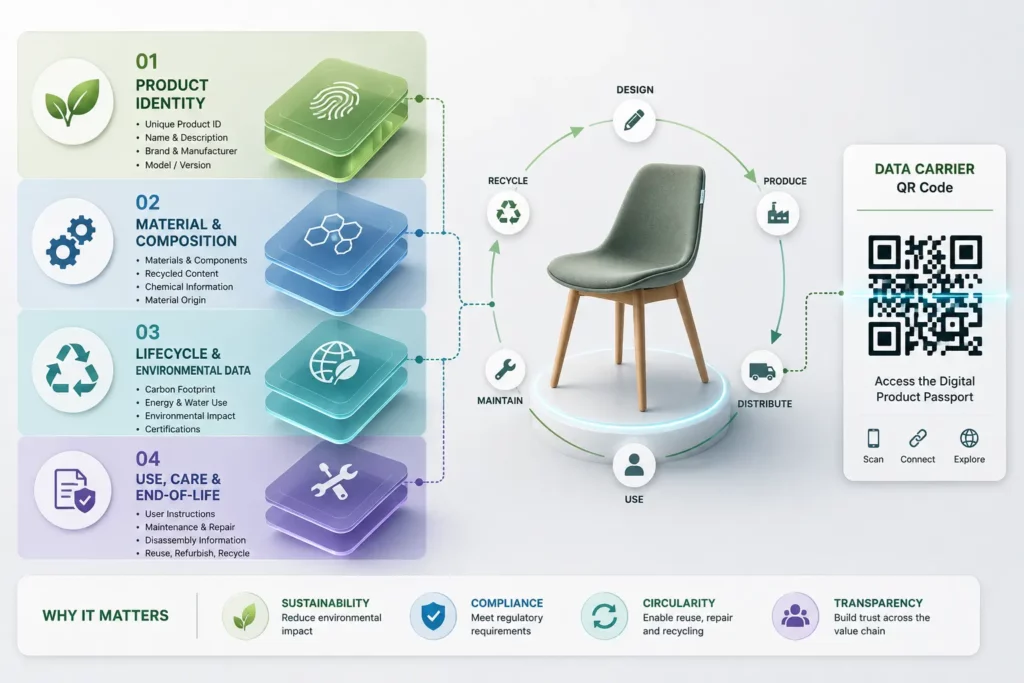
Exact fields vary by delegated act, but most every DPP is built on four data layers:
The four core data layers
Product identity — a unique identifier (e.g. GTIN), batch or serial number, and manufacturing location/date, giving one-to-one linkage between the physical item and its record.
Material composition — component and raw-material breakdown, Substances of Very High Concern (SVHCs), recyclability attributes.
Sustainability metrics — lifecycle carbon footprint (CO₂e), water and resource intensity, and other product-specific indicators.
End-of-life instructions — disassembly, reuse and recycling guidance, and standardised material symbols.
Data carriers, identifiers and the EN standards rulebook
The physical link is usually a QR code (often GS1 Digital Link) or, for high-value or long-life goods, NFC/RFID. On 27 May 2026, CEN-CENELEC’s Joint Technical Committee JTC 24 published the first six horizontal EN standards (under mandate M/604) that define how any DPP is identified, carried, exchanged, stored and made interoperable:
EN 18216 — data exchange protocols; EN 18219 — unique identifiers; EN 18220 — data carriers.
EN 18221 — data storage, archiving and persistence; EN 18222 — APIs; EN 18223 — system interoperability.
Two security standards (prEN 18239, prEN 18246) were under formal vote, with publication expected around September 2026.
“Available” is not “harmonised.” You can buy and build to an EN standard today, but it only grants a presumption of conformity with the law once it is cited as a harmonised standard in the Official Journal of the EU and for the DPP standards, that citation is still pending. The right posture: build to the standards now, but track harmonisation status before you rely on them for legal presumption.
These are horizontal standards they define the machinery, not which data a battery or a T-shirt must disclose. Those data points still come from the product-group delegated act.
System architecture — decentralised, not one big EU database
Contrary to a common assumption, the DPP is not a centralised EU database. Manufacturers host their own product data in compliant systems; a central EU registry acts as an index, pointing to the data location via secure links. This decentralised model improves scalability, data ownership and security while still enabling regulatory access.
The European Commission has taken another significant step toward Digital Product Passport implementation by launching the DPP Registry alongside a dedicated testing environment. This marks the transition from regulatory planning to real-world execution, giving businesses an opportunity to prepare their systems before compliance becomes mandatory.
For manufacturers across textiles, batteries, electronics, furniture, toys, and other regulated sectors, the Digital Product Passport is no longer a future initiative—it is becoming a core operational capability.
DPP by industry: practical guidance
How a DPP plays out depends heavily on your sector. Below are concrete, real-world scenarios and what each industry should prioritise now.
Batteries — the pioneer, and your template
Practical example: an EV battery reaches end of automotive life after 8–10 years but retains usable capacity. The battery passport records State of Health and State of Charge over time, so a second-life operator can instantly judge suitability for home storage or grid balancing, and a recycler knows exactly which materials (lithium, cobalt, nickel) to recover.
Priority now: map battery identity, chemistry and carbon-footprint data ahead of 18 Feb 2027; align with the EN identifier and data-carrier standards. See battery digital product passport.
Textiles & apparel — from claims to proof
Practical example: a brand markets a garment as “organic cotton, low-impact dyed.” A DPP traces the cotton to a specific farm, evidences certification and land-use compliance, and exposes dyeing/finishing chemical data — turning a marketing claim into verifiable proof and cutting greenwashing risk.
Priority now: build fibre-composition and chemical-compliance data capture; watch the 2027 indicative delegated act. See digital product passports for textiles.
Electronics, construction and chemicals — later wave, same groundwork
Electronics: repairability score, spare-part availability and disassembly data support EU right-to-repair; component-level traceability is the hard part.
Construction: structural and material data on beams and panels enables certified reuse after demolition, cutting embodied carbon.
Chemicals: substance identity including SVHCs lets waste handlers apply correct storage and disposal, supporting REACH alignment.
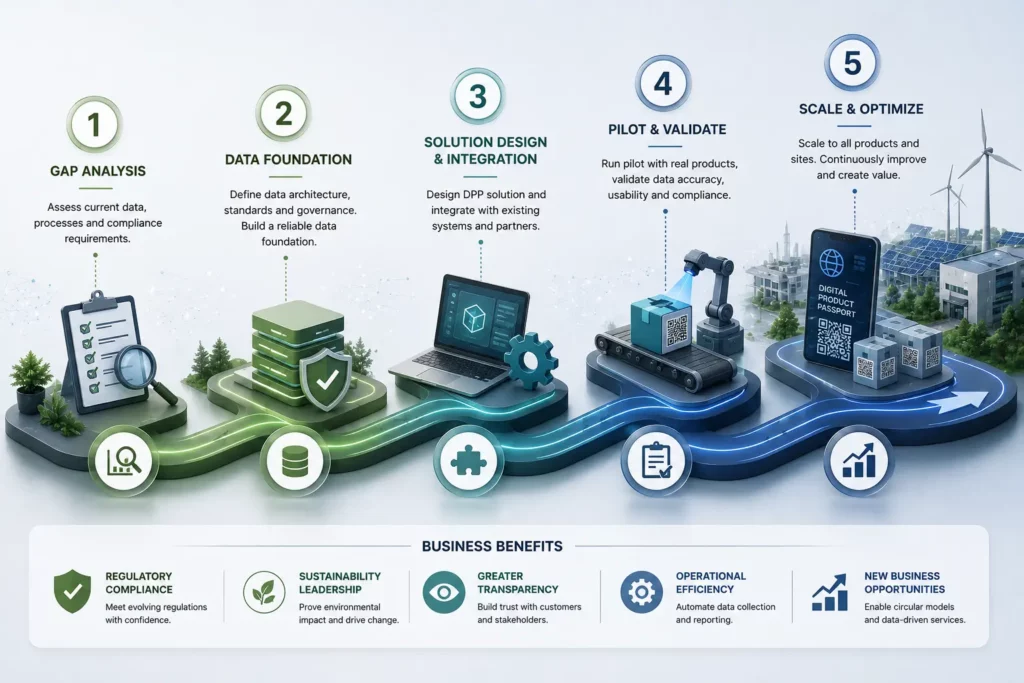
DPP implementation: a five-step roadmap
Creating a DPP is a cross-functional project spanning procurement, sustainability, compliance, IT and operations. A structured sequence reduces cost and rework:
1.Gap analysis — assess current data against your product group’s ESPR / delegated-act requirements and the EN standards.
2. Supplier engagement — digitally onboard Tier 1–3 suppliers to collect standardised material and sustainability data. See supplier engagement for DPP.
3. Technology selection — choose a DPP-ready traceability platform that supports the EN data-carrier, identifier and interoperability standards.
4. Pilot — validate passport generation and data quality on one product line.
5. Scale-up — integrate DPP generation into ERP/PLM for automated, batch-level passports. See the implementation guide.
TraceX DPP Solutions helps businesses prepare for Digital Product Passports by centralizing product, supplier, and sustainability data into a single, structured platform. From supplier onboarding and material traceability to compliance documentation and lifecycle data management, TraceX enables organizations to build DPP-ready digital records that support transparency, interoperability, and regulatory compliance.
See how TraceX generates audit-ready DPPs at batch level.
Digital product passport vs. a traditional product file
Attribute
Traditional product file
DPP
Format
Static PDF / paper
Dynamic, machine-readable record
Access
On request, internal
Instant via QR / NFC data carrier
Update through life
Rarely updated
Updatable across the lifecycle
Interoperability
System-specific
EN-standard, cross-border readable
Data granularity
Product/model level
Batch- and item-level
Regulatory standing
Supporting documentation
Legally mandated where act applies
Circularity support
Limited
Enables reuse, repair, recycling
DPP buyer checklist: evaluating a compliance platform
Use this checklist when comparing DPP and traceability vendors. A capable platform should let you tick every box:
☐ Captures verified data at source (origin, materials, sustainability) not manual re-entry.
☐ Maintains batch- and lot-level traceability through every processing stage.
☐ Generates and links secure data carriers (QR / GS1 Digital Link / RFID) to the correct record.
☐ Aligns with the EN 18xxx horizontal standards (identifiers, carriers, exchange, storage, interoperability, APIs).
☐ Maps to your product group’s delegated act and flags data gaps against required fields.
☐ Supports supplier onboarding for Tier 1–3 data collection.
☐ Integrates with existing ERP / PLM systems for automated passport generation.
☐ Provides audit-ready, tamper-evident records and stores data for the required retention period.
☐ Handles cross-border, multi-language access and role-based data permissions.
Frequently asked questions
What is a digital product passport?
A digital product passport is a structured, machine-readable record linked to a physical product via a data carrier (like a QR code) that stores its identity, materials, sustainability data and end-of-life information, mandated in the EU under the ESPR, Regulation (EU) 2024/1781.
Which products need a digital product passport, and when?
It rolls out group by group via ESPR delegated acts. The first DPP in law is the battery passport (18 Feb 2027). Iron & steel is the first ESPR delegated act (indicative 2026), with textiles, tyres and aluminium indicated for 2027. Confirm your product group’s delegated act at EUR-Lex.
Is the digital product passport one big EU database?
No. Manufacturers host their own data in compliant systems; a central EU registry acts as an index pointing to the data via secure links, so the model is decentralised.
Do the EN standards make my DPP legally compliant?
The six EN 18xxx standards define how a passport works. They are “available” but confer a presumption of conformity only once cited as harmonised standards in the Official Journal a step still pending. Build to them, but track harmonisation status.
How should a company start preparing?
Run a gap analysis against your product group’s requirements, engage suppliers to collect standardised data, pick a DPP-ready traceability platform aligned to the EN standards, pilot on one line, then scale into ERP/PLM for batch-level passports.
We use cookies on our website to give you the most relevant experience by remembering your preferences and repeat visits. By clicking “Accept All”, you consent to the use of ALL the cookies. However, you may visit "Cookie Settings" to provide a controlled consent.
This website uses cookies to improve your experience while you navigate through the website. Out of these, the cookies that are categorized as necessary are stored on your browser as they are essential for the working of basic functionalities of the website. We also use third-party cookies that help us analyze and understand how you use this website. These cookies will be stored in your browser only with your consent. You also have the option to opt-out of these cookies. But opting out of some of these cookies may affect your browsing experience.
Necessary cookies are absolutely essential for the website to function properly. These cookies ensure basic functionalities and security features of the website, anonymously.
Cookie
Duration
Description
cookielawinfo-checkbox-analytics
11 months
This cookie is set by GDPR Cookie Consent plugin. The cookie is used to store the user consent for the cookies in the category "Analytics".
cookielawinfo-checkbox-functional
11 months
The cookie is set by GDPR cookie consent to record the user consent for the cookies in the category "Functional".
cookielawinfo-checkbox-necessary
11 months
This cookie is set by GDPR Cookie Consent plugin. The cookies is used to store the user consent for the cookies in the category "Necessary".
cookielawinfo-checkbox-others
11 months
This cookie is set by GDPR Cookie Consent plugin. The cookie is used to store the user consent for the cookies in the category "Other.
cookielawinfo-checkbox-performance
11 months
This cookie is set by GDPR Cookie Consent plugin. The cookie is used to store the user consent for the cookies in the category "Performance".
viewed_cookie_policy
11 months
The cookie is set by the GDPR Cookie Consent plugin and is used to store whether or not user has consented to the use of cookies. It does not store any personal data.
Functional cookies help to perform certain functionalities like sharing the content of the website on social media platforms, collect feedbacks, and other third-party features.
Performance cookies are used to understand and analyze the key performance indexes of the website which helps in delivering a better user experience for the visitors.
Analytical cookies are used to understand how visitors interact with the website. These cookies help provide information on metrics the number of visitors, bounce rate, traffic source, etc.
Advertisement cookies are used to provide visitors with relevant ads and marketing campaigns. These cookies track visitors across websites and collect information to provide customized ads.
Download the 2026 Traceability Scorecard and Benchmark Your Supply Chain Across 10 Critical Capabilities.
Download our eBook
Don’t Wait for an Audit to Find Your EUDR Gaps
The 2026 Simplification Package changes how HS codes, DDS pass-through and geolocation rules apply to you. Get the free guide and 20-point readiness checklist before enforcement catches you unprepared.