Cocoa Traceability: The 2026 Market-Access Test No Exporter Can Fail
Published
, 9 minute read
Share this article
Quick summary: Cocoa traceability is now the gate to EU market access under EUDR. See what plot-level, deforestation-free proof buyers need before the 2026 deadline — and how to build it.
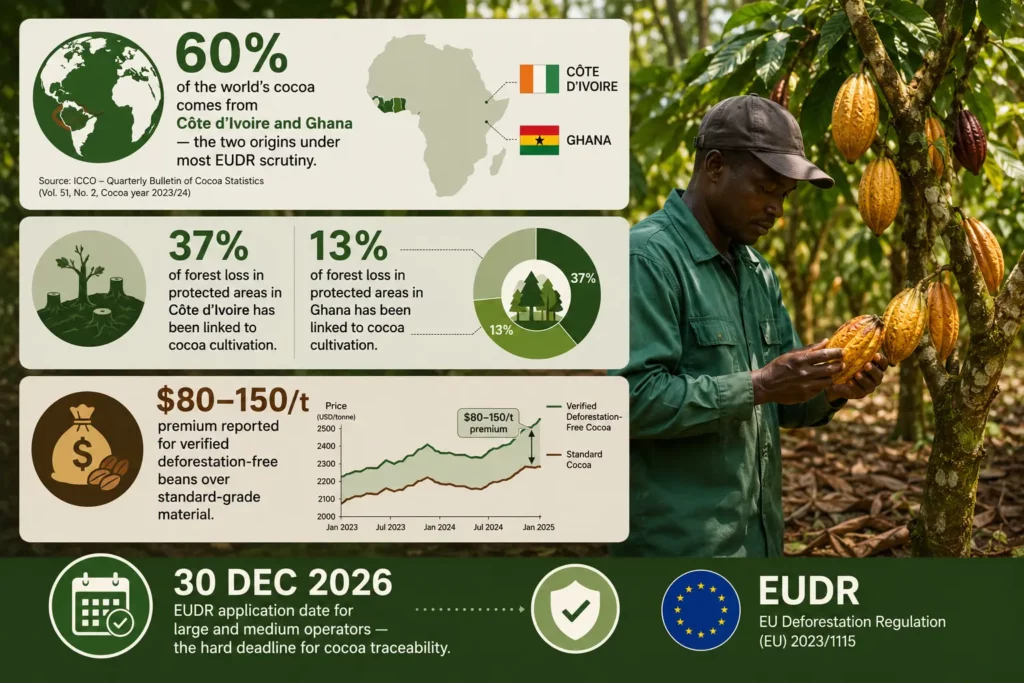
Cocoa traceability is the documented ability to follow every cocoa bean back to the specific plot of land where it was grown, with verifiable geolocation, harvest, and handover data attached at each step of the supply chain. Under the EU Deforestation Regulation (EUDR Regulation (EU) 2023/1115, amended by Regulation (EU) 2025/2650), cocoa traceability becomes a condition of EU market access: from 30 December 2026, large and medium operators must prove their cocoa is deforestation-free grown on land not deforested after 31 December 2020 and file a Due Diligence Statement before the cocoa can be placed on the EU market. Micro and small operators follow by 30 June 2027.
Cocoa traceability used to be a story you told buyers to win a premium. In 2026 it is the paperwork that decides whether your beans clear EU customs at all. If you cannot follow a bag of cocoa back to the exact plot it grew on with geolocation, harvest, and chain-of-custody data that survives an audit that cocoa now risks being turned away at the border, not just priced lower.
This guide is written for the person who has to make that proof real: the cocoa exporter, sustainability lead, or procurement head weighing whether a spreadsheet can carry them through the EU Deforestation Regulation (EUDR) or whether it is time for a dedicated cocoa traceability platform. We’ll be specific about what the regulation demands, where manual traceability breaks, and how to evaluate a system that can actually file.
Key takeaways
Cocoa traceability now gates EU market access it is a compliance requirement, not a premium positioning play.
EUDR needs three things: plot-level geolocation, a deforestation-free claim against the 31 Dec 2020 cut-off, and a filed Due Diligence Statement (DDS).
Deadlines: 30 Dec 2026 (large/medium operators); 30 June 2027 (micro/small, non-timber). [VERIFY at publish]
Certifications support risk mitigation but do not replace geolocation, plot-level evidence, or a filed DDS.
The hard part is data integrity across thousands of smallholder plots not collecting GPS points.
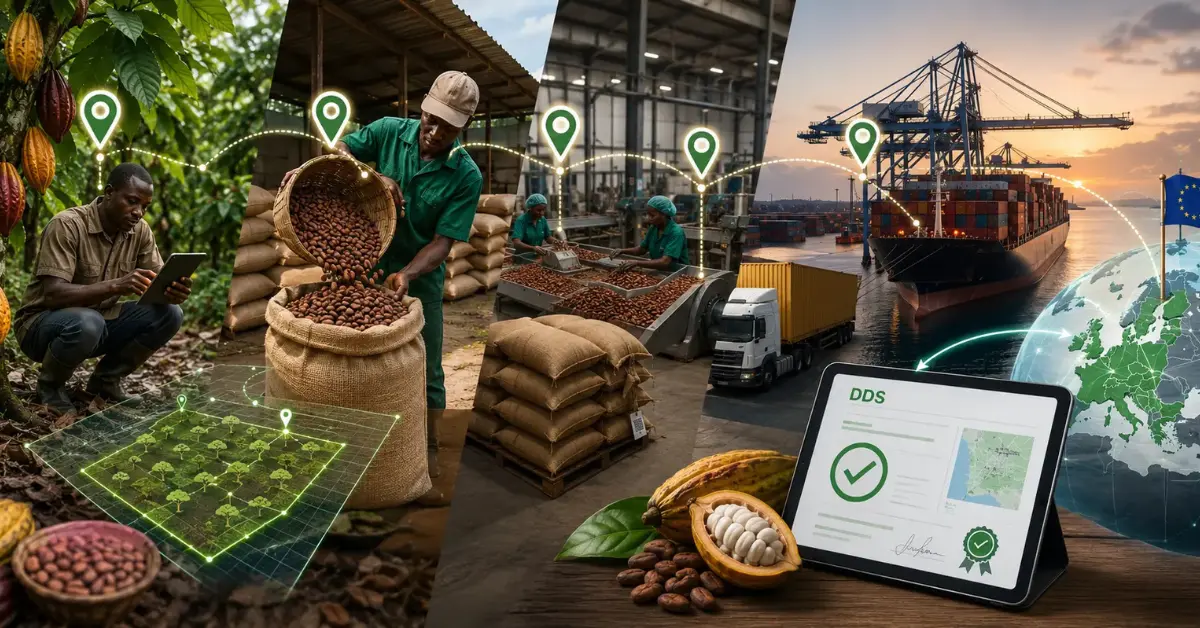
Cocoa traceability is the ability to reconstruct the full journey of a cocoa bean from the mapped farm plot, through the cooperative, buying agent, processor, and exporter, to the port of export with data at each handover that a regulator or buyer can independently verify. The older definition stopped at “we know roughly where it came from.” The 2026 definition is stricter: you need the exact coordinates of production and an unbroken, tamper-evident record connecting those coordinates to the specific consignment you are shipping.
That shift matters because cocoa is one of the seven commodities named in the EUDR, alongside coffee, palm oil, soy, cattle, rubber, and wood and its derivatives, including chocolate, are in scope too. For most of the last decade, cocoa supply chain traceability was a differentiator that helped brands sell an ethical-sourcing story. Now it is the entry ticket. The premium is inverting into a penalty: verified, deforestation-free beans still earn a spread today, but unverified beans increasingly won’t clear customs at all tomorrow.
Why Cocoa Traceability Is Now a Market-Access Gate, Not a Badge
Here is the point most “bean-to-bar” content misses: the buyer is no longer choosing between traceable and non-traceable cocoa the regulator is. The consequence of weak cocoa traceability is not a lost tender; it is stranded inventory. That is not theoretical.
As the deadline tightened, reports emerged of roughly 50,000 metric tonnes of cocoa reportedly piling up at Ghana’s ports because international buyers were turning away from material that lacked the traceability documentation required for EU compliance. Côte d’Ivoire reportedly launched a buyback operation in early 2026 to absorb unsold beans. Meanwhile, large processors Cargill, Barry Callebaut and others accelerated vertical integration and digital farm-mapping precisely so their cocoa traceability would hold up at the border. Suppliers without equivalent capability face a real risk of losing EU market access when the deadline arrives.
The port pile-ups are the whole argument. When compliant cocoa moves and non-compliant cocoa sits, traceability stops being a marketing line item and becomes working capital. The question for a cocoa exporter is no longer “will this differentiate us?” it’s “will our cocoa move?”
What EUDR Cocoa Traceability Actually Requires
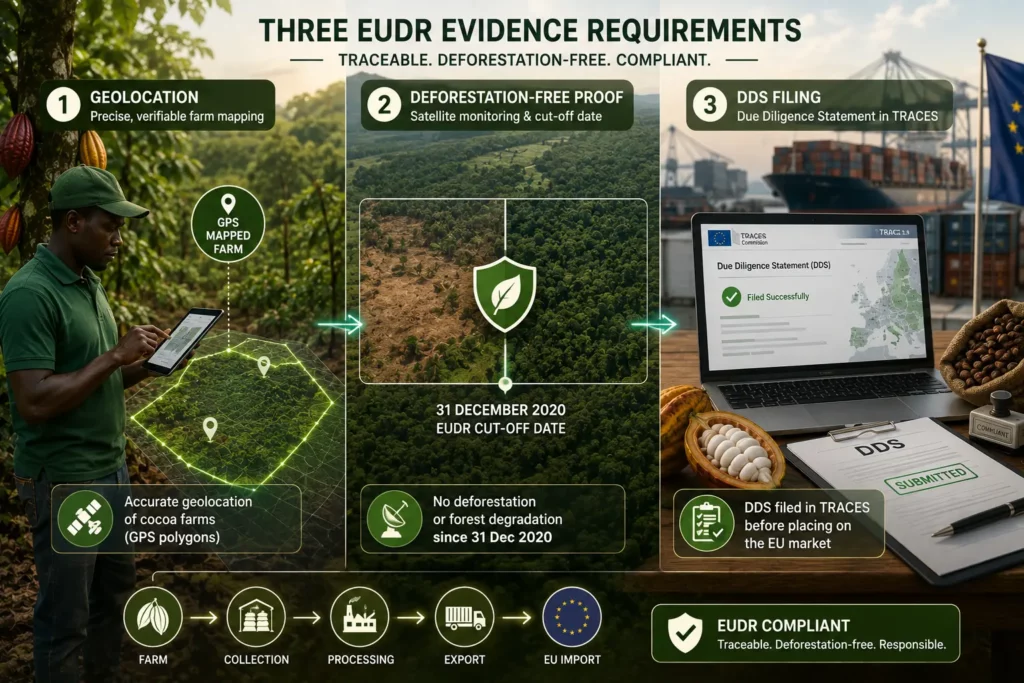
Strip away the noise and EUDR cocoa compliance comes down to proving three things for every consignment you place on or export to the EU market:
Geolocation of production.Coordinates for every plot the cocoa came from a polygon boundary for farms above the small-plot threshold. This is the foundation of any credible cocoa traceability program.
A deforestation-free claim. Evidence that none of those plots were deforested after the 31 December 2020 cut-off, typically checked against satellite forest-cover data.
A filed Due Diligence Statement (DDS).A declaration submitted through the EU Information System (TRACES), backed by information collection, risk assessment, and risk mitigation.
The amended regulation (Reg. (EU) 2025/2650) shifted the dates and simplified some obligations for example, allowing certain smaller operators to reuse existing declarations but it did not soften the core evidence bar. Farm-to-port cocoa traceability, with plot-level data that reconciles all the way through, remains the thing you are actually being asked to produce.
The Real Cocoa Traceability Challenge: Data Integrity, Not Data Collection
Most teams assume the hard part of cocoa traceability is getting farmers to share a GPS point. It isn’t. Handing a field officer a phone and collecting coordinates is the easy 10%. The iceberg beneath it is data integrity across a fragmented, smallholder-heavy supply chain and cocoa is one of the most fragmented chains on earth.
Cocoa traceability is a data-integrity test, not a collection task. A single exporter may aggregate beans from thousands of smallholder plots through layers of buying agents. The failure points aren’t missing data they’re duplicated polygons, plots that overlap protected forest, coordinates that don’t sit inside valid GeoJSON, and volumes that don’t reconcile against what was actually bought. A DDS built on that data fails silently.
Concretely, the challenges that break cocoa supply chain traceability programs are:
Aggregation opacity — beans change hands through agents and depots that were never designed to preserve plot identity.
Smallholder data gaps — many farmers lack formal boundaries, and mass-balance sourcing blurs which plot a bean came from.
Geospatial errors — malformed GeoJSON, overlapping polygons, and plots that intersect protected areas invalidate a filing.
Reconciliation drift — certified volumes that don’t match purchased volumes are exactly what an auditor pulls on.
Empower Smallholder Farmers with End-to-End Cocoa Traceability
Cocoa Traceability vs Certifications: Why One Doesn’t Replace the Other
A common and costly assumption: “We’re Fairtrade / Rainforest Alliance certified, so we’re covered.” You are not. Certifications like Fairtrade and Rainforest Alliance support EUDR risk mitigation they signal good practice and can strengthen a risk assessment but they do not replace the plot-level geolocation, the deforestation-free evidence against the 2020 cut-off, or the filed DDS that the regulation requires. Certification is a helpful input to cocoa traceability; it is not a substitute for it.
Unique POV
Certification proves how you farmed. EUDR asks where. A certificate attests to a practice standard across a group. EUDR asks a different question about a specific consignment: which exact coordinates produced these beans, and was that land forested after 31 Dec 2020? Only plot-level cocoa traceability answers that.
How Automated Cocoa Traceability Software Closes the Gap
This is where a purpose-built cocoa traceability software platform earns its place over spreadsheets. The job isn’t to store data it’s to keep plot identity intact from farm to port and turn that into a filing regulators accept. TraceX’s EUDR solutions specific workflow, is built around that job.
Can your current setup produce a plot-level, deforestation-free, audit-ready record for every consignment today?
Book a demo of TraceX and we’ll map your cocoa traceability gaps against the 2026 deadline.
Mobile-first farmer onboarding & GPS/polygon mapping brings smallholders into the traceability network and fixes the boundary-data gap at the source.
GeoJSON validation & deforestation checks flags malformed geometry and plots overlapping protected forest before they poison a DDS
Chain-of-custody with reconciliation preserves plot identity through agents and processors and checks that volumes add up.
Automated DDS generation & TRACES filing turns verified cocoa traceability data into a submitted declaration instead of a manual scramble.
Immutable, audit-ready records blockchain-backed proof of origin that stands up when a competent authority asks.
Manual vs Platform-Based Cocoa Traceability: A Buyer’s Comparison
Capability
Spreadsheets / manual
Cocoa traceability platform
Plot geolocation
Copy-pasted coordinates, no validation
GPS/polygon capture with GeoJSON validation
Deforestation check
Manual, plot-by-plot, error-prone
Automated against satellite forest data
Chain of custody
Breaks at each aggregation handover
Plot identity preserved farm-to-port
Volume reconciliation
Rarely done; audit exposure
Built-in mass-balance checks
DDS filing
Manual re-entry into TRACES
Auto-generated & submitted [VERIFY]
Audit readiness
Scattered files, hard to defend
Immutable, timestamped records
Scales to 1,000s of farmers
No — collapses under volume
Yes — designed for smallholder scale
Cocoa Traceability Platform: A Buyer’s Evaluation Checklist
Before you sign, pressure-test any cocoa traceability vendor against these:
Does it capture polygon-level plots, not just single GPS pins?
Does it validate GeoJSON and flag protected-area overlaps automatically?
Can it reconcile volumes across aggregation layers?
Does it generate and file a DDS to TRACES, or just export a CSV?
Does it onboard low-connectivity smallholders via mobile?
Are records immutable and audit-ready for a competent authority?
Is there a real cocoa case study with measurable outcomes not a demo mock-up?
Frequently asked questions
What is cocoa traceability?
Cocoa traceability is the ability to follow cocoa from the specific farm plot where it was grown, through every handover, to the point of export or sale with verifiable geolocation and chain-of-custody data at each step.
Is cocoa covered by the EUDR?
Yes. Cocoa is one of the seven EUDR commodities, and derivatives such as chocolate are in scope. That is why cocoa traceability is now a compliance requirement, not just a sustainability choice.
When do the EUDR deadlines hit cocoa?
30 December 2026 for large and medium operators and traders; 30 June 2027 for micro and small operators on non-timber products.
Does Fairtrade or Rainforest Alliance certification satisfy EUDR?
No. Certifications support risk mitigation but do not replace the plot-level geolocation, deforestation-free evidence, or filed DDS that EUDR requires.
What data does cocoa traceability need for EUDR?
Plot geolocation (polygons for larger farms), evidence that land was not deforested after 31 December 2020, and a Due Diligence Statement filed via the EU Information System.
Can spreadsheets handle cocoa traceability?
For a handful of plots, briefly. At smallholder scale they break on geospatial validation, reconciliation, and DDS filing which is where a cocoa traceability platform pays off.
How does TraceX support cocoa traceability?
TraceX’s EUDR Solutions maps farms, validates geospatial data, preserves chain of custody, and generates and files EUDR Due Diligence Statements.
Start using TraceX
Transparency, Trust, & Success for your Climate Journey.
We use cookies on our website to give you the most relevant experience by remembering your preferences and repeat visits. By clicking “Accept All”, you consent to the use of ALL the cookies. However, you may visit "Cookie Settings" to provide a controlled consent.
This website uses cookies to improve your experience while you navigate through the website. Out of these, the cookies that are categorized as necessary are stored on your browser as they are essential for the working of basic functionalities of the website. We also use third-party cookies that help us analyze and understand how you use this website. These cookies will be stored in your browser only with your consent. You also have the option to opt-out of these cookies. But opting out of some of these cookies may affect your browsing experience.
Necessary cookies are absolutely essential for the website to function properly. These cookies ensure basic functionalities and security features of the website, anonymously.
Cookie
Duration
Description
cookielawinfo-checkbox-analytics
11 months
This cookie is set by GDPR Cookie Consent plugin. The cookie is used to store the user consent for the cookies in the category "Analytics".
cookielawinfo-checkbox-functional
11 months
The cookie is set by GDPR cookie consent to record the user consent for the cookies in the category "Functional".
cookielawinfo-checkbox-necessary
11 months
This cookie is set by GDPR Cookie Consent plugin. The cookies is used to store the user consent for the cookies in the category "Necessary".
cookielawinfo-checkbox-others
11 months
This cookie is set by GDPR Cookie Consent plugin. The cookie is used to store the user consent for the cookies in the category "Other.
cookielawinfo-checkbox-performance
11 months
This cookie is set by GDPR Cookie Consent plugin. The cookie is used to store the user consent for the cookies in the category "Performance".
viewed_cookie_policy
11 months
The cookie is set by the GDPR Cookie Consent plugin and is used to store whether or not user has consented to the use of cookies. It does not store any personal data.
Functional cookies help to perform certain functionalities like sharing the content of the website on social media platforms, collect feedbacks, and other third-party features.
Performance cookies are used to understand and analyze the key performance indexes of the website which helps in delivering a better user experience for the visitors.
Analytical cookies are used to understand how visitors interact with the website. These cookies help provide information on metrics the number of visitors, bounce rate, traffic source, etc.
Advertisement cookies are used to provide visitors with relevant ads and marketing campaigns. These cookies track visitors across websites and collect information to provide customized ads.
Download the 2026 Traceability Scorecard and Benchmark Your Supply Chain Across 10 Critical Capabilities.
Download our eBook
Don’t Wait for an Audit to Find Your EUDR Gaps
The 2026 Simplification Package changes how HS codes, DDS pass-through and geolocation rules apply to you. Get the free guide and 20-point readiness checklist before enforcement catches you unprepared.