Sustainable Rice Farming: Practices, SRP Compliance, and How to Prove the Results
Published
, 5 minute read
Share this article
Quick summary: Sustainable rice farming explained: SRI, DSR, and AWD practices, water and methane savings, SRP compliance, and how traceability proves the results.
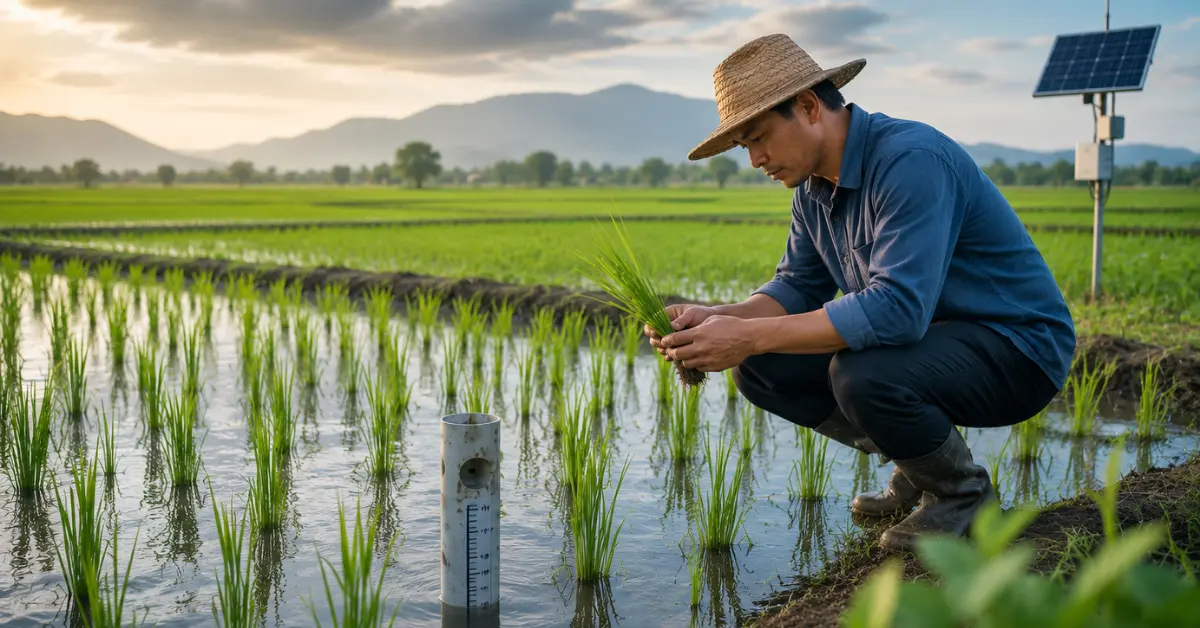
Sustainable rice farming is a way of growing rice that cuts water use, methane emissions, and chemical inputs while maintaining or improving yields. It relies on proven practices the System of Rice Intensification (SRI), Direct Seeded Rice (DSR), and Alternate Wetting and Drying (AWD) plus organic methods, agroforestry, and integrated pest management. Because rice is one of the most water- and methane-intensive crops, and buyers increasingly ask for SRP (Sustainable Rice Platform) compliance, the deciding factor is data: farm management and traceability that turn sustainable practices into verified, reportable results.
Sustainable rice farming has moved from an environmental ideal to a commercial necessity. Rice feeds more than half the world, but it is also one of the most resource-hungry crops on the planet a major user of freshwater and a significant source of methane. As demand rises and water grows scarcer, farmers face a hard equation: produce more, use less, and prove it. That is exactly what sustainable rice farming is designed to solve.
In plain terms, sustainable rice farming means growing rice with methods that minimise environmental harm less water, lower emissions, healthier soil while improving productivity and livelihoods. The practices are well established; the missing piece, for most operations, is the data to show they work.
Key takeaways
Sustainable rice farming reduces water use, methane, and chemicals while protecting yields and farmer income.
Core practices are SRI, DSR, and AWD all water-saving and methane-reducing supported by organic methods, agroforestry, and IPM.
The SRP (Sustainable Rice Platform) standard and buyer demand now make verifiable sustainability a market requirement, not a nice-to-have.
Farm management and traceability software turn field practices into audit-ready proof for SRP, ESG, and premium buyers.
Transform Your Rice Supply Chain with TraceX
Discover how TraceX helps agribusinesses, millers, exporters, and food brands digitize farm data, improve traceability, measure sustainability, and build transparent rice supply chains.
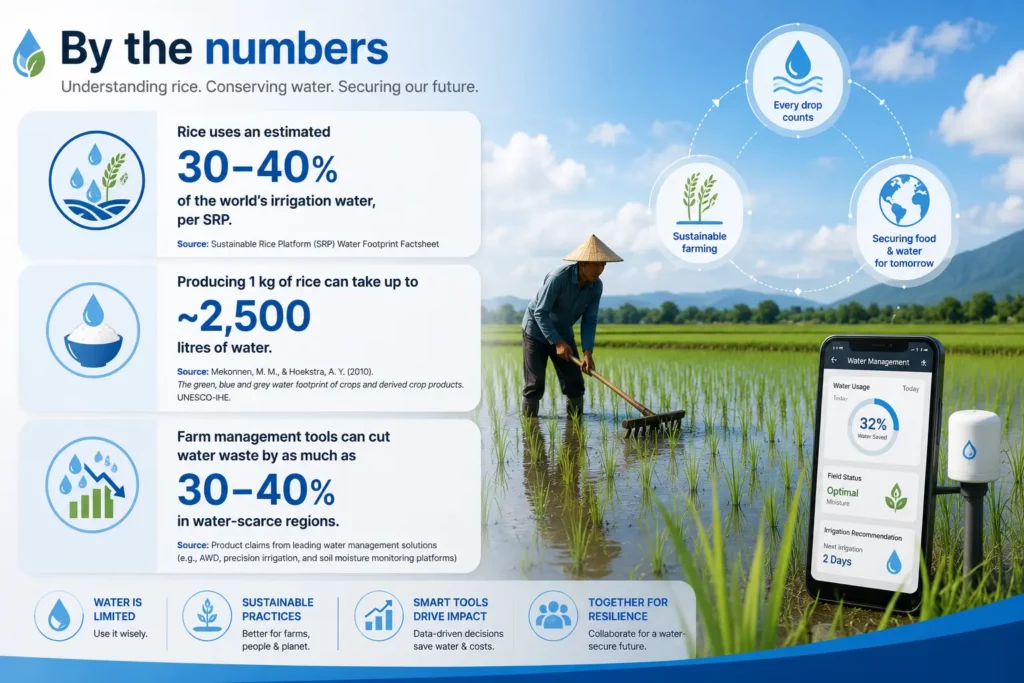
Conventional, continuously flooded rice carries a heavy environmental cost. According to the Sustainable Rice Platform (SRP), rice uses an estimated 30–40% of the world’s irrigation water. Flooded paddies also emit methane a potent greenhouse gas as organic matter breaks down in waterlogged, oxygen-poor soil, while fertiliser and pesticide run-off degrades water and soil. Sustainable rice farming tackles all three at once, which is why it is central to climate-resilient food production.
The Challenges These Practices Set Out to Solve
Traditional rice cultivation runs into three linked problems. Environmentally, continuous flooding drives excessive water use, soil degradation and salinity, and methane emissions. Economically, high input and water-management costs squeeze margins, leaving smallholders especially exposed to price swings. And socially, labour-intensive methods like hand transplanting and manual weeding raise costs and strain families during peak seasons. Sustainable rice farming addresses each of these rather than trading one for another.
The Key Sustainable Rice Farming Practices
Three field methods do most of the work, each cutting water and methane while protecting yields:
System of Rice Intensification (SRI): SRI transplants younger seedlings at wider spacing with intermittent watering and soil aeration improving yields and root health while cutting water use and methane.
Direct Seeded Rice (DSR): DSR sows seed directly into the soil, skipping nursery and transplanting. It saves water, labour, and seed, and lowers methane because fields are not kept continuously flooded.
Alternate Wetting and Drying (AWD): AWD lets fields dry periodically before re-flooding, cutting water use significantly without sacrificing yield and interrupting the anaerobic conditions that generate methane.
Beyond these, organic rice cultivation (with its transition period, documentation, and certification), agroforestry around paddies, and integrated pest management round out a resilient system that supports biodiversity and soil health.
How Farm Management Software Powers Sustainable Rice Farming
This is where practice meets proof. The pain is that sustainable results water saved, methane avoided, inputs reduced are invisible and unrewarded until they are measured, and manual records rarely satisfy SRP or a demanding buyer. The capability that answers TraceX’s Farm Management Solutions : real-time monitoring of water use, soil health, and crop conditions, with automated reporting and full rice traceability from planting to harvest. The benefit is direct farmers optimise resources, prove sustainability, and access SRP certification and premium markets.
Prove your rice sustainability
See how TraceX turns water-smart rice practices into SRP-ready, audit-proof data.
The proof point: a leading agribusiness exporter used TraceX’s farm management solution to transform basmati rice production achieving 94% Package-of-Practice compliance across clusters and tracing 3,000 MT of paddy via unique batch IDs annually.
Conventional vs. Sustainable Rice Farming: How They Compare
Factor
Conventional flooded rice
Sustainable rice farming
Water use
High (continuous flooding)
Lower (AWD / DSR / SRI)
Methane emissions
High
Reduced
Soil health
Degrades, salinity risk
Improved, aerated
Input costs
High (chemicals, water)
Lower
Labour
Intensive (transplanting)
Reduced (direct seeding)
Verifiable for SRP
Hard to prove
Traceable, reportable
Buyer’s Checklist: Choosing a Rice Sustainability Platform
If you run or source from a rice programme, confirm your platform can:
Monitor water use, soil health, and crop conditions in real time
Support SRP-aligned reporting and organic certification documentation
Capture farm-level data on mobile, offline-capable tools
Trace paddy from planting to harvest with batch-level IDs
Generate audit-ready reports for buyers, certifiers, and ESG teams
Quantify water and methane savings for carbon or sustainability claims
Frequently Asked Questions
What are the main practices of sustainable rice cultivation?
The core practices are the System of Rice Intensification (SRI), Direct Seeded Rice (DSR), and Alternate Wetting and Drying (AWD), supported by organic cultivation, agroforestry, and integrated pest management all aimed at saving water, cutting methane, and improving soil.
How does sustainable rice farming reduce environmental impact?
By replacing continuous flooding with water-smart methods, it lowers freshwater use and methane emissions, while reduced chemical inputs cut run-off and protect soil and water quality.
What is SRP and why does it matter for sustainable rice farming?
The Sustainable Rice Platform (SRP) sets global standards that reduce environmental impact, improve social practices, and raise productivity. Meeting SRP standards opens premium markets and requires verifiable, documented practices.
How does technology help rice growers prove sustainability?
Farm management software provides real-time data on water, soil, and crops, automates SRP and sustainability reporting, and traces paddy from farm to market turning good practices into provable results.
We use cookies on our website to give you the most relevant experience by remembering your preferences and repeat visits. By clicking “Accept All”, you consent to the use of ALL the cookies. However, you may visit "Cookie Settings" to provide a controlled consent.
This website uses cookies to improve your experience while you navigate through the website. Out of these, the cookies that are categorized as necessary are stored on your browser as they are essential for the working of basic functionalities of the website. We also use third-party cookies that help us analyze and understand how you use this website. These cookies will be stored in your browser only with your consent. You also have the option to opt-out of these cookies. But opting out of some of these cookies may affect your browsing experience.
Necessary cookies are absolutely essential for the website to function properly. These cookies ensure basic functionalities and security features of the website, anonymously.
Cookie
Duration
Description
cookielawinfo-checkbox-analytics
11 months
This cookie is set by GDPR Cookie Consent plugin. The cookie is used to store the user consent for the cookies in the category "Analytics".
cookielawinfo-checkbox-functional
11 months
The cookie is set by GDPR cookie consent to record the user consent for the cookies in the category "Functional".
cookielawinfo-checkbox-necessary
11 months
This cookie is set by GDPR Cookie Consent plugin. The cookies is used to store the user consent for the cookies in the category "Necessary".
cookielawinfo-checkbox-others
11 months
This cookie is set by GDPR Cookie Consent plugin. The cookie is used to store the user consent for the cookies in the category "Other.
cookielawinfo-checkbox-performance
11 months
This cookie is set by GDPR Cookie Consent plugin. The cookie is used to store the user consent for the cookies in the category "Performance".
viewed_cookie_policy
11 months
The cookie is set by the GDPR Cookie Consent plugin and is used to store whether or not user has consented to the use of cookies. It does not store any personal data.
Functional cookies help to perform certain functionalities like sharing the content of the website on social media platforms, collect feedbacks, and other third-party features.
Performance cookies are used to understand and analyze the key performance indexes of the website which helps in delivering a better user experience for the visitors.
Analytical cookies are used to understand how visitors interact with the website. These cookies help provide information on metrics the number of visitors, bounce rate, traffic source, etc.
Advertisement cookies are used to provide visitors with relevant ads and marketing campaigns. These cookies track visitors across websites and collect information to provide customized ads.
Download the 2026 Traceability Scorecard and Benchmark Your Supply Chain Across 10 Critical Capabilities.
Download our eBook
Don’t Wait for an Audit to Find Your EUDR Gaps
The 2026 Simplification Package changes how HS codes, DDS pass-through and geolocation rules apply to you. Get the free guide and 20-point readiness checklist before enforcement catches you unprepared.