HREDD in Agriculture Supply Chains: A Practical Guide to Human Rights & Environmental Due Diligence
Published
, 10 minute read
Share this article
Quick summary: HREDD in agriculture supply chains helps businesses identify, prevent, mitigate and address human-rights and environmental risks across farmers, suppliers, production locations and value chains. Discover how connected due diligence, traceability, evidence and risk management can help build more responsible and sustainable agricultural supply chains.
HREDD in Agriculture Supply Chains refers to Human Rights & Environmental Due Diligence applied across agricultural operations and supply chains. It is a structured, risk-based process for identifying, preventing, mitigating and addressing actual or potential adverse impacts on people connected to a company’s operations, suppliers and business relationships.
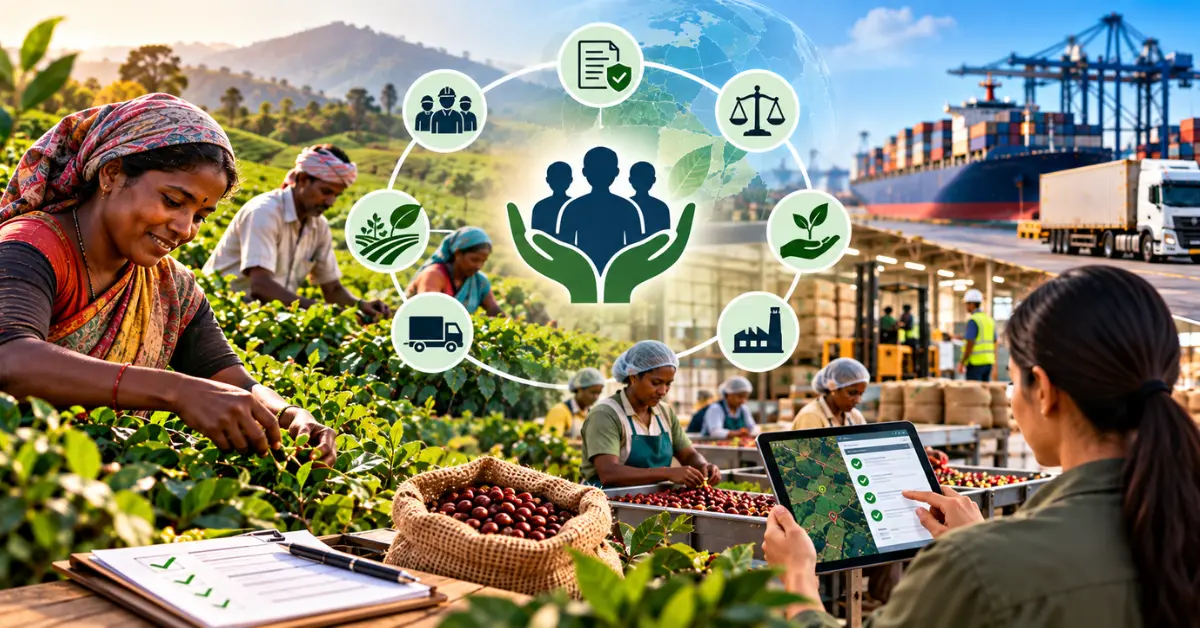
In agriculture, this can mean looking beyond the immediate supplier to understand what is happening at farms, plantations, collection centres, processing facilities and other points in the value chain. The OECD-FAO framework treats due diligence as part of business decision-making and risk management, rather than a one-time compliance exercise. It is designed for businesses across agricultural supply chains, from production through retail.
This matters because agricultural supply chains can involve thousands of smallholders, seasonal workers, labour contractors, cooperatives, aggregators and intermediaries. A company may know who its direct supplier is while having limited visibility into the people, locations and working conditions further upstream.
Key Takeaways
HREDD in Agriculture Supply Chains is a continuous, risk-based process not a one-time supplier questionnaire.
Key risks can include child labour, forced labour, unsafe working conditions, inadequate wages or incomes, land-tenure issues, discrimination and community impacts.
Risk prioritisation is essential when agricultural supply chains involve large numbers of producers.
Supplier, farm, production, evidence, risk and corrective-action data should be connected wherever possible.
Stakeholder engagement and remediation are important parts of meaningful due diligence.
Technology can operationalise HRDD but does not replace human judgement, engagement or remedy.
HREDD and EUDR are different processes, but they can share important supply-chain and evidence infrastructure.
Discover how TraceX can help you monitor sustainability performance, strengthen supplier transparency and turn sustainability commitments into measurable action.
Why Is HREDD Important in Agricultural Supply Chains?
Agriculture is closely connected to livelihoods, land, labour and natural resources. Human-rights and responsible-business-conduct risks can therefore emerge at multiple levels of the supply chain.
Common areas include child labour, forced or exploitative labour, occupational health and safety, wages and farmer income, discrimination, gender-related risks, land and tenure rights, community impacts and access to effective grievance and remedy mechanisms.
The OECD-FAO Guidance identifies human rights, labour and child rights, gender, food security, land tenure, environmental protection, natural-resource depletion and deforestation among the issues businesses should consider in responsible agricultural supply chains. Risk is context-specific: the same commodity can present very different risks depending on country, production model, supplier type and local conditions.
For companies, the challenge is therefore not simply collecting a supplier declaration. It is developing a process that can identify where significant risks exist, prioritise them and demonstrate what action was taken.
Responsible supply chains go beyond sourcing materials. They connect supplier transparency, human rights & environmental due diligence (HREDD), environmental responsibility and end-to-end traceability to help businesses identify risks and make more informed sourcing decisions.
Key Human Rights and Environmental Risks in Agriculture
HREDD expands the due-diligence lens beyond human-rights risks to include relevant environmental impacts. For agricultural supply chains, this can include deforestation and land-use change, biodiversity and ecosystem impacts, water stress or pollution, soil degradation, chemical impacts, climate-related risks and depletion of natural resources. The significance of each risk depends on the commodity, geography, production model and local context.
Child labour: Labour-intensive agricultural production can create child-labour risks in certain contexts. Businesses should identify where these risks are significant and establish prevention, monitoring and remediation processes.
Forced labour and worker exploitation: Seasonal and migrant workers can face recruitment, wage, accommodation, mobility or coercion-related risks.
Wages and farmer income: Low wages and inadequate smallholder income can create persistent social risks. Living-income and living-wage due diligence is increasingly treated as a specific supply-chain issue.
Health and safety: Pesticide exposure, heat stress, machinery, unsafe accommodation and inadequate protective equipment can create serious occupational risks.
Land and tenure rights: Agricultural expansion and sourcing can intersect with formal and customary land rights. Weakly defined or contested tenure can be an important risk indicator.
Indigenous and community rights: Agricultural activities can affect communities and Indigenous Peoples, making meaningful engagement important where relevant.
Discrimination and gender: Women, migrant workers, temporary workers and other vulnerable groups may face unequal access to resources, pay, opportunities or decision-making.
Grievances and remedy: A credible HRDD system needs mechanisms through which affected people can raise concerns and processes for investigation, action and remedy.
The HREDD Process in Agriculture
1. Embed responsible business conduct. Establish policies, responsibilities, governance and supplier expectations. HREDD should connect with procurement and operational decisions.
2. Map the supply chain. Identify suppliers, farms, production locations, intermediaries, processors and other relevant business relationships. Record where information is missing.
3. Identify and assess risks. Assess actual and potential impacts using factors such as commodity, geography, supplier profile, labour model, production practices and available evidence.
4. Prioritise. Not every supplier needs the same level of scrutiny. Higher-risk suppliers, locations or issues may require enhanced assessment and verification.
5. Prevent and mitigate. Use supplier engagement, corrective-action plans, training, contractual measures, worker protections and other controls appropriate to the identified risk.
6. Track implementation and results. Monitor whether actions are completed and whether they reduce the underlying risk. Closing an action is not automatically the same as resolving an impact.
7. Communicate and report. Maintain records of assessments, decisions, actions and outcomes.
8. Remediate where required. Where a company causes or contributes to an adverse impact, appropriate remediation should form part of the due-diligence process.
What Data Does HREDD in Agriculture Supply Chains Require?
HREDD becomes difficult when risk information is separated from the supply-chain records needed to act on it. A practical digital HREDD model can connect:
Supplier and farmer identity
Farm or production location
Commodity and product information
Relevant worker and labour-risk information
Land-tenure or land-rights evidence
Policies, permits and supporting documents
Risk assessments and risk scores
Stakeholder engagement records
Grievances and complaints
Corrective-action plans
Mitigation and remediation evidence
Monitoring results and review dates
The objective is not to collect unlimited information. The objective is to maintain enough reliable information to understand significant risks, make decisions and demonstrate the actions taken.
HREDD and Smallholder Agriculture
Smallholder supply chains create a practical challenge: a company may work with hundreds or thousands of producers through FPOs, cooperatives, aggregators or intermediaries.
An effective HREDD model should not turn every farmer into a full-time compliance administrator. Businesses can use structured onboarding, mobile data collection, field teams, cooperatives and aggregation models to collect information consistently while keeping the process proportionate to the risk.
The important question is whether the business can connect the information collected at farm level to the supplier, commodity, sourcing relationship and risk decision that depends on it.
HREDD, EUDR and Environmental Due Diligence
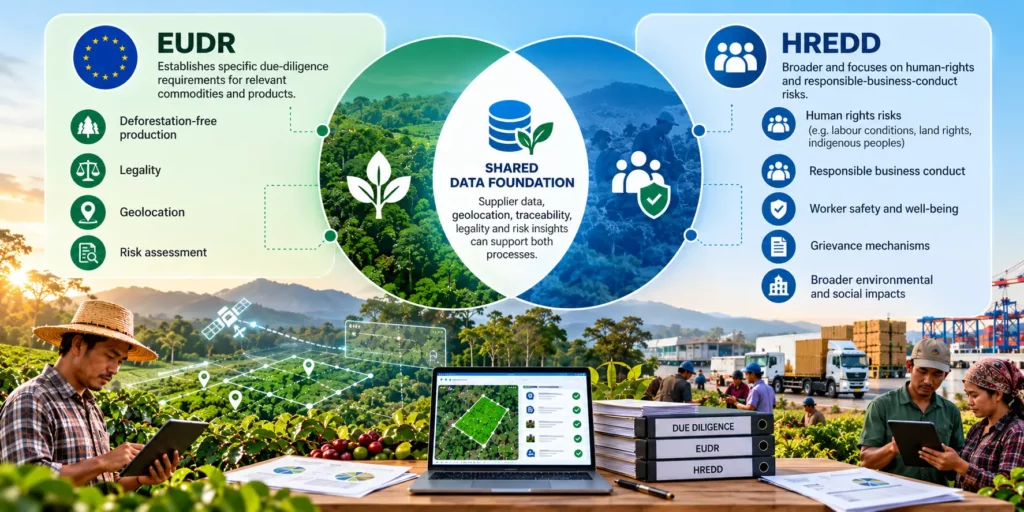
HREDD and EUDR are not the same thing. EUDR establishes specific due-diligence requirements for relevant commodities and products, including requirements relating to deforestation-free production, legality, geolocation and risk assessment. HREDD is broader and focuses on human-rights and responsible-business-conduct risks.
However, the two processes can share an important data foundation. The OECD-FAO deforestation handbook specifically promotes integrating deforestation considerations into broader corporate due-diligence procedures.
A connected architecture can therefore link: Supplier → Farm → Production Location → Commodity → Environmental Risk → Human Rights Risk → Evidence → Mitigation → Monitoring.
This can reduce duplicate data collection and help businesses avoid creating disconnected compliance processes for every regulation.
From Supplier Questionnaire to Continuous HREDD
One of the most common weaknesses in supplier due diligence is treating a completed questionnaire as proof that risk has been managed.
A questionnaire is an input. Effective HREDD may also require documentary evidence, risk indicators, audits or field verification where appropriate, stakeholder engagement, grievance information, corrective actions and periodic reassessment.
The depth of verification should reflect the significance of the risk. A low-risk supplier may require a different process from a supplier operating in a location or commodity context where serious human-rights concerns have been identified.
This is why HRDD should be designed as a continuous workflow rather than a once-a-year questionnaire campaign.
Discover how supplier due diligence helps businesses identify human rights risks, strengthen supplier accountability, and build more transparent, ethical, and sustainable supply chains.
How Technology Can Support HREDD in Agriculture Supply Chains
Technology does not replace human-rights expertise, stakeholder engagement or remediation. It can, however, make the process more structured, consistent and auditable.
Supplier onboarding: Create standardised supplier and farmer profiles.
Supply-chain mapping: Connect suppliers, farms, production locations, commodities and downstream transactions.
Evidence management: Store policies, permits, declarations, assessments and supporting documents against relevant suppliers or locations.
Risk assessment: Apply configurable criteria and prioritise suppliers, locations or commodities requiring enhanced review.
Corrective actions: Assign owners, deadlines, evidence requirements and status.
Grievance management: Record concerns, investigation status, actions and closure evidence.
Monitoring: Schedule reassessments and flag information that requires review.
Audit trail: Maintain a record of assessments, decisions, actions and evidence over time.
How Can Spice Brands Build a Transparent and Sustainable Supply Chain?
Discover how Jayanti Spices, part of the Jayanti Group, leverages TraceX’s Sustainable Sourcing Platform to strengthen spice traceability, improve supply chain transparency, and support responsible sourcing from farm to fork.
How TraceX Can Support HREDD in Agriculture Supply Chains
TraceX Sustainable Sourcing Solutions can help agricultural businesses build a connected digital workflow for supplier data, farm-level information, traceability, geospatial records, evidence and risk management.
The platform approach can connect supplier and production information with assessments, supporting documents, mitigation actions and traceability records, helping teams move from fragmented questionnaires and spreadsheets toward a more structured, evidence-led process.
The same supply-chain data foundation can also support adjacent requirements such as EUDR traceability and deforestation risk assessment, reducing the need to maintain completely separate datasets for each compliance programme.
Ready to Build a More Responsible Agricultural Supply Chain?
Move beyond fragmented supplier questionnaires and spreadsheets. Connect suppliers, farms, production locations, evidence, risk assessments and corrective actions in one digital workflow.
A Practical HREDD Checklist for Agricultural Businesses
Before calling an agricultural HREDD programme mature, ask:
1. Have we mapped our agricultural supply chain beyond tier-one suppliers where relevant?
2. Do we know which commodities, regions and supplier groups present the highest human-rights risks?
3. Can we connect risk assessments to specific suppliers or production locations?
4. Do we have evidence supporting important supplier claims?
5. Do procurement teams understand HREDD requirements?
6. Are vulnerable groups and relevant stakeholders considered?
7. Do we have a documented corrective-action process?
8. Can we track grievances and remediation?
9. Are risk assessments periodically refreshed?
10. Can we demonstrate what action was taken when a risk was identified?
Frequently Asked Questions
What is HREDD in agriculture?
HRDD in agriculture is the process of identifying, preventing, mitigating and addressing actual or potential adverse human-rights and responsible-business-conduct impacts across agricultural operations and supply chains.
Why is HREDD important for agriculture?
Agricultural supply chains can involve vulnerable workers, smallholders and communities and can create risks related to labour, land, income, health and safety, child rights and environmental impacts.
Is HREDD the same as EUDR?
No. EUDR has specific requirements for relevant commodities and products, while HRDD is a broader responsible-business-conduct process. They can nevertheless share data and risk-management infrastructure.
Can certifications replace HREDD?
Certification can provide useful evidence, but companies should assess what the certification covers and whether additional risks require further due diligence.
Can HREDD be managed with spreadsheets?
Spreadsheets may support small processes, but complex agricultural supply chains often require connected supplier, location, evidence, risk, action and monitoring data.
How can technology support HREDD?
Technology can structure supplier onboarding, supply-chain mapping, evidence collection, risk assessment, corrective actions, grievance records, monitoring and audit trails.
Start using TraceX
Transparency, Trust, & Success for your Climate Journey.
We use cookies on our website to give you the most relevant experience by remembering your preferences and repeat visits. By clicking “Accept All”, you consent to the use of ALL the cookies. However, you may visit "Cookie Settings" to provide a controlled consent.
This website uses cookies to improve your experience while you navigate through the website. Out of these, the cookies that are categorized as necessary are stored on your browser as they are essential for the working of basic functionalities of the website. We also use third-party cookies that help us analyze and understand how you use this website. These cookies will be stored in your browser only with your consent. You also have the option to opt-out of these cookies. But opting out of some of these cookies may affect your browsing experience.
Necessary cookies are absolutely essential for the website to function properly. These cookies ensure basic functionalities and security features of the website, anonymously.
Cookie
Duration
Description
cookielawinfo-checkbox-analytics
11 months
This cookie is set by GDPR Cookie Consent plugin. The cookie is used to store the user consent for the cookies in the category "Analytics".
cookielawinfo-checkbox-functional
11 months
The cookie is set by GDPR cookie consent to record the user consent for the cookies in the category "Functional".
cookielawinfo-checkbox-necessary
11 months
This cookie is set by GDPR Cookie Consent plugin. The cookies is used to store the user consent for the cookies in the category "Necessary".
cookielawinfo-checkbox-others
11 months
This cookie is set by GDPR Cookie Consent plugin. The cookie is used to store the user consent for the cookies in the category "Other.
cookielawinfo-checkbox-performance
11 months
This cookie is set by GDPR Cookie Consent plugin. The cookie is used to store the user consent for the cookies in the category "Performance".
viewed_cookie_policy
11 months
The cookie is set by the GDPR Cookie Consent plugin and is used to store whether or not user has consented to the use of cookies. It does not store any personal data.
Functional cookies help to perform certain functionalities like sharing the content of the website on social media platforms, collect feedbacks, and other third-party features.
Performance cookies are used to understand and analyze the key performance indexes of the website which helps in delivering a better user experience for the visitors.
Analytical cookies are used to understand how visitors interact with the website. These cookies help provide information on metrics the number of visitors, bounce rate, traffic source, etc.
Advertisement cookies are used to provide visitors with relevant ads and marketing campaigns. These cookies track visitors across websites and collect information to provide customized ads.
Download the 2026 Traceability Scorecard and Benchmark Your Supply Chain Across 10 Critical Capabilities.
Download our eBook
Don’t Wait for an Audit to Find Your EUDR Gaps
The 2026 Simplification Package changes how HS codes, DDS pass-through and geolocation rules apply to you. Get the free guide and 20-point readiness checklist before enforcement catches you unprepared.