Why Excel and PDFs Become a Problem in Regulatory Compliance
Published
, 10 minute read
Share this article
Quick summary: Learn why Excel and PDFs become a problem in regulatory compliance, from version control and fragmented evidence to audit readiness and changing regulatory requirements.
Excel and PDF regulatory compliance management can become difficult as supplier data, supporting documents, risk assessments and compliance records grow. Disconnected files make it harder to maintain data consistency, track changes, connect evidence and build an audit-ready compliance trail.
TraceX helps businesses move from fragmented Excel and PDF-based compliance to a structured digital workflow connecting data, evidence, traceability, risk assessment and regulatory reporting in one platform.
Key Takeaways
Excel and PDFs become a problem in regulatory compliance when they are used as disconnected systems of record.
Spreadsheets can create version-control, duplicate-data, ownership and audit-trail issues, while PDFs can separate evidence from the products, suppliers and compliance decisions they support.
The solution is not to eliminate these formats, but to place them inside a structured compliance workflow that connects requirements, data, evidence, assessments, approvals and changes.
This creates better traceability and reduces the manual effort required to stay audit-ready.
Why Excel and PDFs Become a Problem in Regulatory Compliance
Excel spreadsheets and PDF documents are not inherently bad for compliance. They are often where compliance programs begin. Teams use Excel to collect supplier information, track obligations, calculate reporting data and assign owners. PDFs are used for certificates, declarations, policies, test reports and evidence.
The problem starts when these files become the operating system for a complex regulatory program. As regulations multiply, suppliers change, product portfolios grow and authorities demand traceable evidence, a collection of spreadsheets and PDFs becomes increasingly difficult to control.
Modern regulatory compliance depends on more than having the right document. Organizations need to know which data is current, who provided it, which requirement it supports, which product or supplier it relates to, when it was approved, and what changed since the last assessment. Practitioner guidance on spreadsheet-based compliance repeatedly identifies version control, fragmented evidence, weak audit trails and manual reconciliation as recurring problems.
Learn how to turn regulatory requirements into practical, repeatable workflows across data collection, supplier management, risk assessment, documentation, and reporting.
A spreadsheet can have multiple copies, owners and update cycles. One team may maintain the master workbook, another may download a copy for analysis, and a supplier may send revised information by email. Soon, different people are working from different versions. In regulatory compliance, this creates a basic question: Which file represents the current truth? If the answer requires asking several people or comparing timestamps, the compliance process is already carrying risk.
Example: A manufacturer tracks packaging supplier declarations in Excel. Procurement updates supplier status monthly, while sustainability maintains a separate workbook for material data. A supplier changes its packaging specification, but only one workbook is updated. During an audit, the company cannot immediately prove which material information was used.
2. PDFs Preserve Information but Not the Compliance Relationship
PDFs are excellent for preserving signed declarations, certificates, reports and approved documents. But a PDF usually represents a static snapshot. It does not inherently show the relationships between a requirement, a supplier, a product, a packaging component, a risk assessment and the evidence supporting a compliance decision. A folder full of PDFs can therefore contain plenty of information while still lacking traceability.
Example: A packaging manufacturer stores supplier certificates, laboratory reports and technical specifications in folders. The files exist, but the compliance manager must manually determine which reports support which packaging version.
3. Regulatory Changes Make Static Trackers Outdated
Regulations evolve. New obligations, implementation dates, technical standards, guidance and reporting requirements can change what organizations need to collect or demonstrate. A spreadsheet that mapped requirements correctly months ago may no longer reflect today’s obligations. Updating one master requirement is not enough if the change must be manually copied across numerous workbooks.
Example: A company manages EUDR, PPWR and Digital Product Passport requirements in separate spreadsheets. A supplier change affects more than one workflow, but teams update only some of the files.
Understand how PPWR and EUDR can overlap across sourcing, traceability, documentation, and compliance workflows and what businesses need to consider when managing both regulations.
4. Evidence Gets Separated From the Decision It Supports
A strong compliance record should answer: Why did we conclude that this product, material, supplier or shipment was compliant? When evidence lives in PDFs, emails and folders while decisions live in Excel, the connection becomes manual. That separation makes audit preparation expensive because teams must reconstruct the chain after the decision has already been made.
Example: A supplier emails a geolocation file and legality document. The compliance team marks ‘received’ in Excel and saves the files in a shared folder. Months later, an auditor asks which evidence supported a particular shipment.
5. Manual Data Entry Creates Duplicate and Inconsistent Records
Compliance data is often copied between procurement systems, spreadsheets, reporting templates and documents. Every manual handoff creates an opportunity for transcription errors, outdated values or inconsistent classifications. The issue is not simply human error; it is duplication. When the same supplier, product or packaging data exists in five places, every change creates five potential update points.
Example: The packaging master says a component weighs 18 grams, an EPR spreadsheet says 20 grams and a supplier PDF says 17.8 grams. The team needs a reconciliation exercise before reporting.
6. Excel Does Not Automatically Create a Strong Audit Trail
A spreadsheet may show a final status, but an auditor may need to understand who changed the status, when it changed, what evidence was reviewed and why it was approved. Spreadsheet auditability often depends on manual controls and file-management discipline rather than being built into the compliance workflow.
Example: A compliance tracker says a supplier assessment is complete, but the team cannot quickly show the approval history or identify which evidence was reviewed.
7. PDFs Can Become an Evidence Graveyard
A shared drive containing thousands of PDFs may look comprehensive, but volume is not the same as traceability. Without structured indexing, teams can struggle to identify expired certificates, duplicate documents, superseded versions or evidence that no longer applies. A compliance repository needs context: document type, supplier, product, regulation, effective date, expiry date, version and approval status.
Example: Three certificates exist for the same supplier. One is expired, one is superseded and one is current, but the filenames do not make the distinction obvious.
8. Cross-Functional Compliance Becomes Harder to Coordinate
Regulatory compliance usually involves procurement, sustainability, legal, quality, packaging engineering, supply chain, IT and finance. Excel files and PDFs are often passed between these groups rather than managed through a common workflow. This creates ownership gaps and makes it easy for one team to work from information another team has already replaced.
Example: Procurement receives a revised supplier declaration, but the compliance team continues using the previous version because the update remained in an email thread.
9. Scaling From One Regulation to Multiple Regulations Gets Expensive
Excel works well for a small, clearly defined dataset. But when the same supplier, material or product must support multiple regulatory processes, separate spreadsheets create duplicated work. Regulations often share underlying business data, so file-based processes can multiply the same data-collection effort.
Example: A forest-based packaging material may require packaging compliance information for PPWR while also creating EUDR-related traceability questions. Collecting overlapping supplier data through separate spreadsheets increases effort and inconsistency.
10. Audit Preparation Becomes a Reconstruction Exercise
The real test of a compliance system comes when someone asks for proof. If teams need days to collect spreadsheets, search folders, request supplier documents again and reconcile versions, the organization is not operating from an audit-ready evidence system. Audit readiness means being able to connect the requirement, owner, evidence, product or supplier, approval and change history.
Example: An authority asks for evidence supporting a compliance decision. The company has the final report but must search email, Excel files and shared folders to reconstruct how the conclusion was reached.
When Excel and PDFs Still Make Sense
The answer is not to eliminate Excel or PDF entirely. Excel remains useful for analysis, calculations, temporary working lists and controlled one-time exercises. PDFs remain valuable for signed declarations, official certificates, laboratory reports and finalized records. The problem is using these formats as the primary system of record for a complex, continuously changing compliance program. The better approach is to use them as inputs or outputs within a governed workflow.
What a Modern Regulatory Compliance Workflow Should Look Like
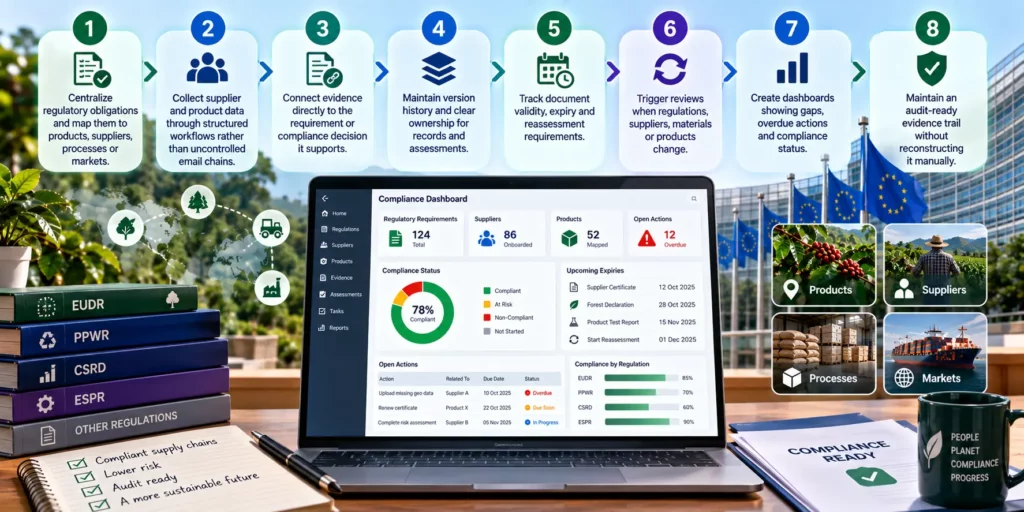
Centralize regulatory obligations and map them to products, suppliers, processes or markets.
Collect supplier and product data through structured workflows rather than uncontrolled email chains.
Connect evidence directly to the requirement or compliance decision it supports.
Maintain version history and clear ownership for records and assessments.
Track document validity, expiry and reassessment requirements.
Trigger reviews when regulations, suppliers, materials or products change.
Create dashboards showing gaps, overdue actions and compliance status.
Maintain an audit-ready evidence trail without reconstructing it manually.
How TraceX Helps Move Beyond Excel and PDFs
TraceX Regulatory Compliance Solutions helps organizations move from disconnected compliance files to a structured regulatory data and evidence workflow. Teams can connect suppliers, products, packaging or commodities with the information, documents, assessments and compliance records required by applicable regulations.
Instead of asking, ‘Where is the latest PDF?’ or ‘Which Excel file is correct?’, teams can work from a connected compliance record that provides context around the evidence. This becomes particularly valuable across EUDR, PPWR and Digital Product Passport requirements, where data quality, supplier collaboration and traceability are central to compliance.
Ready to Move Beyond Excel and PDFs?
Connect regulatory requirements, supplier data, compliance evidence and audit records in one structured workflow with TraceX.
A Quick Self-Assessment: Have You Outgrown Excel and PDFs?
Do multiple teams maintain different compliance spreadsheets?
Do you regularly reconcile conflicting versions of the same data?
Are supplier documents stored separately from supplier records?
Does someone manually check certificate or document expiry dates?
Can you immediately identify which evidence supports a compliance decision?
Do regulatory changes require updating multiple spreadsheets?
Does audit preparation involve searching emails and shared folders?
Are the same supplier or product data fields being entered multiple times?
Do key compliance processes depend on one or two people knowing where everything is?
Can you produce a complete evidence trail quickly when requested?
Conclusion
Regulatory compliance is becoming a data-management problem as much as a documentation problem. The number of spreadsheets and PDFs a company has is not a measure of compliance maturity. The real measure is whether the organization can connect its requirements, data, evidence and decisions and prove that connection when asked.
Excel and PDFs will continue to have a place in compliance. But when every new regulation creates another workbook, every supplier sends another PDF, and every audit requires another round of manual reconciliation, it is a clear signal that the compliance process needs a more connected foundation.
Frequently Asked Questions
Is Excel bad for regulatory compliance?
No. Excel is useful for analysis, planning and controlled short-term tracking. It becomes risky when it is used as the primary system of record for complex, multi-regulation compliance workflows.
Why are PDFs a problem for compliance?
PDFs are useful as final records, but they are static documents. Without structured metadata and links to the relevant product, supplier, requirement and decision, they can become difficult to search, validate and maintain.
What is the biggest risk of spreadsheet-based compliance?
A major risk is loss of traceability: teams may know the current status but struggle to prove who changed it, what evidence supported it, which version was used and why the decision was made.
How can companies become audit-ready?
Create a connected workflow linking regulatory requirements, owners, data, evidence, assessments, approvals and corrective actions, with controlled versions and clear audit history.
Should companies stop using Excel and PDFs?
Not necessarily. They should use them appropriately as analysis tools, source documents or finalized outputs rather than relying on disconnected files as the core compliance system.
Why is centralized compliance data important?
Centralized data reduces duplicate entry, improves consistency, connects evidence to decisions and makes it easier to identify gaps when regulations, suppliers, products or requirements change.
Start using TraceX
Transparency, Trust, & Success for your Climate Journey.
We use cookies on our website to give you the most relevant experience by remembering your preferences and repeat visits. By clicking “Accept All”, you consent to the use of ALL the cookies. However, you may visit "Cookie Settings" to provide a controlled consent.
This website uses cookies to improve your experience while you navigate through the website. Out of these, the cookies that are categorized as necessary are stored on your browser as they are essential for the working of basic functionalities of the website. We also use third-party cookies that help us analyze and understand how you use this website. These cookies will be stored in your browser only with your consent. You also have the option to opt-out of these cookies. But opting out of some of these cookies may affect your browsing experience.
Necessary cookies are absolutely essential for the website to function properly. These cookies ensure basic functionalities and security features of the website, anonymously.
Cookie
Duration
Description
cookielawinfo-checkbox-analytics
11 months
This cookie is set by GDPR Cookie Consent plugin. The cookie is used to store the user consent for the cookies in the category "Analytics".
cookielawinfo-checkbox-functional
11 months
The cookie is set by GDPR cookie consent to record the user consent for the cookies in the category "Functional".
cookielawinfo-checkbox-necessary
11 months
This cookie is set by GDPR Cookie Consent plugin. The cookies is used to store the user consent for the cookies in the category "Necessary".
cookielawinfo-checkbox-others
11 months
This cookie is set by GDPR Cookie Consent plugin. The cookie is used to store the user consent for the cookies in the category "Other.
cookielawinfo-checkbox-performance
11 months
This cookie is set by GDPR Cookie Consent plugin. The cookie is used to store the user consent for the cookies in the category "Performance".
viewed_cookie_policy
11 months
The cookie is set by the GDPR Cookie Consent plugin and is used to store whether or not user has consented to the use of cookies. It does not store any personal data.
Functional cookies help to perform certain functionalities like sharing the content of the website on social media platforms, collect feedbacks, and other third-party features.
Performance cookies are used to understand and analyze the key performance indexes of the website which helps in delivering a better user experience for the visitors.
Analytical cookies are used to understand how visitors interact with the website. These cookies help provide information on metrics the number of visitors, bounce rate, traffic source, etc.
Advertisement cookies are used to provide visitors with relevant ads and marketing campaigns. These cookies track visitors across websites and collect information to provide customized ads.
Download the 2026 Traceability Scorecard and Benchmark Your Supply Chain Across 10 Critical Capabilities.
Download our eBook
Don’t Wait for an Audit to Find Your EUDR Gaps
The 2026 Simplification Package changes how HS codes, DDS pass-through and geolocation rules apply to you. Get the free guide and 20-point readiness checklist before enforcement catches you unprepared.