EORI Number for Economic Operators in EUDR: What Businesses Need to Know
Published
, 8 minute read
Share this article
Quick summary: An EORI number plays an important role in identifying businesses involved in EU customs activities. Discover how EORI requirements relate to EUDR economic operators, customs declarations, Due Diligence Statements, and the information businesses need to prepare for compliant EU trade.
An EORI (Economic Operators Registration and Identification) number for economic operators is the EU customs identifier used to identify economic operators and certain other persons for customs purposes. The European Commission states that an EORI number is mandatory for customs clearance in the EU, including import, export and transit. It is therefore important for businesses that combine EUDR compliance with EU customs processes.
As businesses prepare for EUDR implementation, much of the focus is on due diligence, geolocation, deforestation checks, legality evidence and Due Diligence Statements (DDS). But there is another important identifier that connects an economic operator with EU customs: the EORI number.
December 2026 is approaching. Is your supply chain actually ready?
Move from spreadsheets and fragmented supplier data to a traceable, audit-ready EUDR workflow with TraceX.
An EORI number is the EU customs identifier for economic operators and certain other persons.
EORI is mandatory for EU customs clearance activities such as import, export and transit.
For relevant EUDR operators using release for free circulation or export, the EORI must be included in the EUDR Information System registration profile.
EORI is not a DDS reference number and does not replace EUDR due diligence.
Non-EU operators may need an EORI when they perform specified customs activities.
EUDR technology should keep EORI, DDS references, product classification and shipment data connected but distinct.
What Is an EORI Number?
The EORI number is a unique identifier assigned by an EU Member State customs authority. It allows customs authorities to identify an economic operator consistently across EU customs operations. An operator can have only one valid EORI number at a time, and the number is used in communications with EU customs authorities where a customs identifier is required.
The European Commission states that an EORI number consists of the two-letter country code of the issuing EU country followed by an identifier of up to 15 alphanumeric characters. EORI numbers do not have a normal expiry date, although they can be invalidated in certain circumstances.
Why Does the EORI Number Matter for EUDR?
The EORI number is not an EUDR due-diligence requirement by itself, and it does not replace a DDS. Its importance comes from the connection between customs identity and the EUDR Information System.
Under the current EUDR Regulation, for operators placing relevant products under the customs procedure ‘release for free circulation’ or ‘export’, the EORI number established under the Union Customs Code must be included in the operator’s registration profile in the EUDR Information System.
This creates an important operational connection: the company’s customs identity, EUDR registration and DDS workflow need to be aligned. For technology teams, EORI should therefore be treated as important organisation master data rather than as an isolated customs number.
Who Needs an EORI Number?
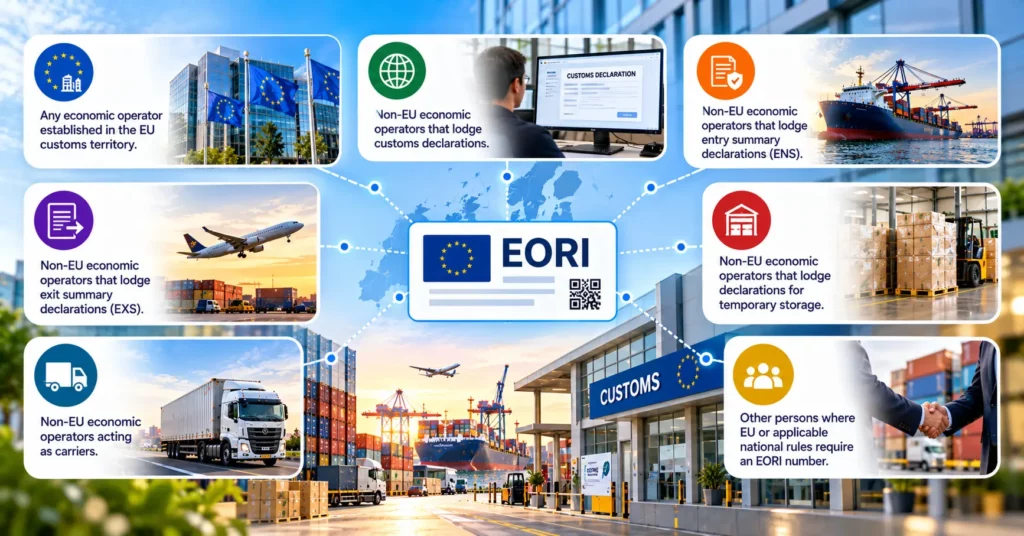
The European Commission identifies several categories of persons who may need an EORI number:
Any economic operator established in the EU customs territory.
Non-EU economic operators that lodge customs declarations.
Non-EU economic operators that lodge entry summary declarations (ENS).
Non-EU economic operators that lodge exit summary declarations (EXS).
Non-EU economic operators that lodge declarations for temporary storage.
Non-EU economic operators acting as carriers.
Other persons where EU or applicable national rules require an EORI number.
Understand how Economic Operators in EUDR are classified and what their responsibilities mean in practice—from upstream operators and downstream operators to traders and Micro and Small Primary Operators (MSPOs).
1. Identify the economic operator. Determine the legal entity responsible for the relevant EUDR activity and its customs role.
2. Confirm customs registration. Check whether the business needs an EORI number based on its EU establishment and customs activities.
3. Register the EUDR activity. For relevant operators using release for free circulation or export, ensure the EORI is included in the EUDR Information System registration profile.
4. Complete due diligence. Collect supplier information, production locations, geolocation, legality evidence, deforestation information and other required data.
5. Submit the DDS. Where a DDS is required, submit it through the EUDR Information System and retain the resulting reference information.
6. Connect EUDR data with shipment and customs data. Ensure the product, CN classification, shipment and applicable EUDR reference can be connected to the customs process.
Identifier
Purpose
EUDR relevance
EORI number
Identifies the economic operator for EU customs purposes.
Included in relevant EUDR Information System registration profiles for operators using release for free circulation or export.
DDS reference number
Identifies a submitted Due Diligence Statement.
Connects the relevant product or shipment to the submitted due diligence statement.
DDS verification number
Supports verification of a DDS.
Used for verification where applicable; it is not the EORI number.
Simplified Declaration identifier
Identifies a simplified declaration.
Relevant where the simplified declaration regime applies.
EORI for Non-EU Economic Operators
A common question is whether a non-EU supplier automatically needs an EORI number simply because it supplies an EUDR-relevant product to an EU customer. The requirement depends on its customs activities.
The European Commission states that non-EU economic operators may need an EORI when they lodge customs declarations, entry summary declarations, exit summary declarations, declarations for temporary storage, or act as a carrier.
Therefore, an EU importer should distinguish between a supplier’s commercial role and its role in the EU customs process. An EORI requirement should be assessed based on the actual customs activity rather than assumed solely because the supplier is outside the EU.
EORI Number vs EUDR DDS Reference Number
These identifiers have different purposes. The EORI identifies the economic operator for customs purposes. A DDS reference number identifies a submitted Due Diligence Statement. A DDS verification number is associated with verification of the statement and is not the same thing as an EORI number. A simplified declaration has its own declaration identifier.
A practical rule is: EORI identifies the business; the DDS reference identifies the due diligence statement. Businesses should keep these fields separate in their compliance systems.
Learn how to manage DDS reference numbers, declaration identifiers, verification details and downstream traceability without losing track of the compliance trail.
EORI and EUDR Technology: What Should Your System Capture?
For businesses managing EUDR through software, EORI should be part of organisation and compliance master data. A robust workflow should connect the EORI with the legal entity, EUDR role, customs activity, products, shipments and DDS records.
Technology should be able to maintain EORI against the correct legal entity, validate that it is present where required, keep EORI separate from DDS references and verification numbers, connect product and shipment information with the relevant EUDR record, maintain an audit trail when registration data changes, and support role-based workflows for operators, downstream operators, traders and authorised representatives.
How TraceX Can Help
TraceX EUDR Solutions helps businesses connect EUDR compliance data with the operational supply chain. EORI can be managed as part of organisation and customs master data, while supplier information, production locations, geolocation, legality evidence, risk assessment, traceability and DDS workflows remain connected in the same compliance process.
This matters because EUDR compliance does not stop when the DDS is submitted. Businesses also need to connect the right product and shipment to the right compliance record and, where applicable, provide the required EUDR information through the customs process. A connected technology workflow reduces the risk of treating customs identifiers, EUDR references and supplier evidence as separate spreadsheets.
EUDR compliance involves more than collecting supplier data and submitting a DDS. Businesses need to connect economic operators, products, geolocation, due diligence evidence, DDS references and customs information in one traceable workflow.
See how TraceX can help connect EUDR due diligence, traceability, customs and compliance workflows.
EORI Compliance Checklist for EUDR Economic Operators
Confirm the legal entity responsible for the EUDR customs activity.
Check whether the entity has a valid EORI number.
Verify the EORI using the EU EORI validation service.
Ensure the EORI is correctly associated with the relevant EUDR Information System registration.
Keep EORI, DDS reference and DDS verification information in separate data fields.
Connect EUDR records with the relevant product, CN code and shipment/customs workflow.
Review organisation and customs data when the legal entity or establishment changes.
Frequently Asked Questions
Is an EORI number the same as a DDS reference number?
No. The EORI identifies the economic operator for customs purposes. The DDS reference identifies a submitted Due Diligence Statement.
Is an EORI number an EUDR compliance certificate?
No. EORI is a customs identification number. It does not prove that a product is deforestation-free, legally produced or covered by a valid due diligence process.
Does every EUDR supplier need an EORI number?
Not automatically. The requirement depends on the supplier’s customs activities and establishment status.
Where is the EORI number used in EUDR?
For operators placing relevant products under release for free circulation or export, the EUDR Regulation requires the EORI number to be included in the operator’s Information System registration profile.
Can a company have multiple EORI numbers?
The Commission states that, at any point in time, a person can have only one valid EORI number. Specific rules apply to non-EU operators with multiple permanent establishments in the EU.
How can an EORI number be checked?
The European Commission provides an EORI validation service for checking whether an EORI number or registered person is valid.
Start using TraceX
Transparency, Trust, & Success for your Climate Journey.
We use cookies on our website to give you the most relevant experience by remembering your preferences and repeat visits. By clicking “Accept All”, you consent to the use of ALL the cookies. However, you may visit "Cookie Settings" to provide a controlled consent.
This website uses cookies to improve your experience while you navigate through the website. Out of these, the cookies that are categorized as necessary are stored on your browser as they are essential for the working of basic functionalities of the website. We also use third-party cookies that help us analyze and understand how you use this website. These cookies will be stored in your browser only with your consent. You also have the option to opt-out of these cookies. But opting out of some of these cookies may affect your browsing experience.
Necessary cookies are absolutely essential for the website to function properly. These cookies ensure basic functionalities and security features of the website, anonymously.
Cookie
Duration
Description
cookielawinfo-checkbox-analytics
11 months
This cookie is set by GDPR Cookie Consent plugin. The cookie is used to store the user consent for the cookies in the category "Analytics".
cookielawinfo-checkbox-functional
11 months
The cookie is set by GDPR cookie consent to record the user consent for the cookies in the category "Functional".
cookielawinfo-checkbox-necessary
11 months
This cookie is set by GDPR Cookie Consent plugin. The cookies is used to store the user consent for the cookies in the category "Necessary".
cookielawinfo-checkbox-others
11 months
This cookie is set by GDPR Cookie Consent plugin. The cookie is used to store the user consent for the cookies in the category "Other.
cookielawinfo-checkbox-performance
11 months
This cookie is set by GDPR Cookie Consent plugin. The cookie is used to store the user consent for the cookies in the category "Performance".
viewed_cookie_policy
11 months
The cookie is set by the GDPR Cookie Consent plugin and is used to store whether or not user has consented to the use of cookies. It does not store any personal data.
Functional cookies help to perform certain functionalities like sharing the content of the website on social media platforms, collect feedbacks, and other third-party features.
Performance cookies are used to understand and analyze the key performance indexes of the website which helps in delivering a better user experience for the visitors.
Analytical cookies are used to understand how visitors interact with the website. These cookies help provide information on metrics the number of visitors, bounce rate, traffic source, etc.
Advertisement cookies are used to provide visitors with relevant ads and marketing campaigns. These cookies track visitors across websites and collect information to provide customized ads.
Download the 2026 Traceability Scorecard and Benchmark Your Supply Chain Across 10 Critical Capabilities.
Download our eBook
Don’t Wait for an Audit to Find Your EUDR Gaps
The 2026 Simplification Package changes how HS codes, DDS pass-through and geolocation rules apply to you. Get the free guide and 20-point readiness checklist before enforcement catches you unprepared.