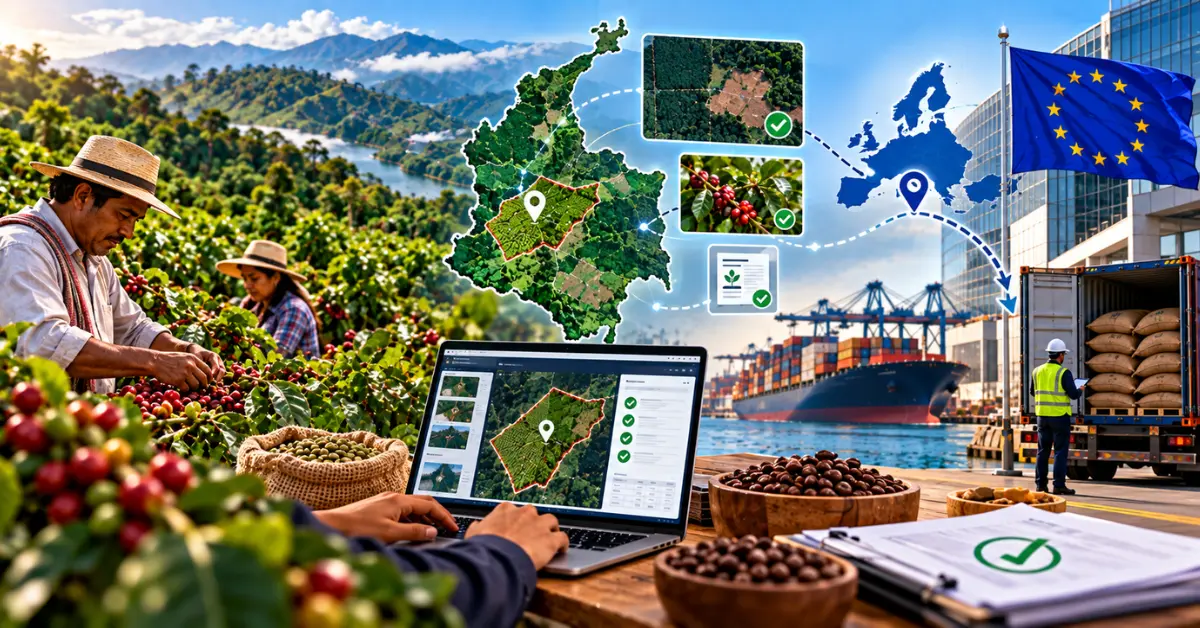
EUDR Coffee Compliance Colombia: How Exporters and EU Importers Turn Farm Data into Audit-Ready Evidence
Published
, 8 minute read
Share this article
Quick summary: EUDR coffee compliance Colombia made practical: turn SICA plot data into DDS-ready evidence, close legality gaps, and meet the 30 Dec 2026 deadline.
EUDR coffee compliance Colombia means proving that every lot of Colombian coffee placed on the EU market was grown on land not deforested after 31 December 2020, was produced in line with Colombian law, and is covered by a due diligence statement (DDS) with plot-level geolocation. Large and medium operators must comply from 30 December 2026; micro and small operators from 30 June 2027.
Key Takeaways
Colombia is a standard-risk origin, so full due diligence applies: information collection, risk assessment, and risk mitigation.
The FNC’s SICA database gives Colombia a head start on geolocation, but it does not produce a DDS or prove legality for you.
Legality (labour informality and land tenure) is the harder evidence gap, not deforestation itself.
Soluble coffee joins the scope from 30 December 2027 under the July 2026 Delegated Act.
Certifications help with risk mitigation but do not replace plot geolocation or DDS filing.
EUDR coffee compliance Colombia is now a commercial question as much as a regulatory one. Colombia is the world’s third-largest coffee producer, and about a quarter of its coffee exports go to Europe. When the EU Deforestation Regulation applies from 30 December 2026, European buyers will only take lots that arrive with verifiable plot data and legality evidence.
The good news is that Colombia starts from a stronger position than most origins. The harder news is that a strong national database is not the same thing as a filed, defensible due diligence statement. This guide shows where the gaps sit and how to close them.
December 2026 is approaching. Is your supply chain actually ready?
Move from spreadsheets and fragmented supplier data to a traceable, audit-ready EUDR workflow with TraceX.
EUDR Coffee Compliance Colombia: What the Regulation Actually Requires
EUDR coffee compliance Colombia rests on three conditions for every shipment, and the operator who first places the coffee on the EU market carries the legal duty.
Deforestation-free: no deforestation on the production plot after 31 December 2020.
Legally produced: compliant with Colombian land, environmental, labour, tax, and human rights law.
Covered by a DDS: submitted to the EU Information System with geolocation for every plot, and polygons for plots above four hectares.
Under Implementing Regulation (EU) 2025/1093, Colombia is not listed as low risk, which places it in the standard-risk tier. That matters. Standard risk means operators cannot use the simplified route and must run a full risk assessment and document mitigation steps. It also means competent authorities check around 3% of operators sourcing from the country each year.
The practical effect for EUDR coffee compliance Colombia programmes is simple: an importer in Hamburg or Antwerp will ask the Colombian exporter for data that stands up to a regulator’s check, not just a supplier declaration.
EUDR Coffee Compliance Colombia Deadlines and Scope Changes
In short: EUDR coffee compliance Colombia dates are fixed for now, and the product scope for coffee widens in 2027.
30 December 2026: application date for large and medium operators and traders.
30 June 2027: application date for micro and small operators.
30 December 2027: soluble coffee comes into scope under the Delegated Act adopted on 13 July 2026.
The simplification package published in May 2026 did not add a further delay, and the amended regulation now places the DDS duty on the first operator in the chain. Downstream roasters keep reference numbers rather than refiling. For Colombian exporters supplying instant coffee manufacturers, the soluble coffee change means a second wave of buyer requests in 2027, so data collected now should cover those supply lines too. Planning EUDR coffee compliance Colombia around the 2027 scope avoids building the same evidence twice.
Exporting coffee to the EU requires more than submitting a DDS. Understand how geolocation, deforestation checks, legality evidence, risk assessment, traceability and DDS requirements come together to help coffee exporters build an EUDR-ready supply chain.
Colombian Coffee EUDR Readiness: Where SICA Helps and Where It Stops
For EUDR coffee compliance Colombia, the geolocation problem is largely solved; its evidence and legality problem is not.
SICA coverage: the National Federation of Coffee Growers (FNC) holds georeferenced records on around 1.8 million coffee lots and nearly 500,000 growing families.
Consent-based access: FNC field teams collect written grower consent so registered exporters can use farm coordinates.
Remaining gaps: labour informality, unclear land tenure, and mixing through intermediaries.
SICA is a genuine advantage. Exporters such as Racafé report that most producers already have mapped plot polygons. But roughly 70% of Colombian coffee comes from smallholders, and lots are aggregated through collection centres, cooperatives, and private buyers before export. Every aggregation point is a place where a SICA-verified lot can be mixed with unverified coffee.
Legality is the other pressure point. Seasonal harvest labour is often informal, and many farms lack formal land titles. Industry leaders have said openly that proving compliance with national law, rather than proving no deforestation, is the harder task. A plot coordinate proves where coffee grew. It does not prove the coffee was produced legally.
This is why EUDR coffee compliance Colombia work cannot stop at downloading SICA data. It needs a system that links each export lot back to verified plots, keeps legality documents alongside them, and flags where the chain breaks.
EUDR Coffee Compliance Colombia Workflow for Exporters and Importers
Five steps take EUDR coffee compliance Colombia from farm records to a DDS that survives a competent authority check.
Consolidate plot data. Pull SICA coordinates, cooperative registers, and your own farm surveys into one register. Pain: data sits in three formats. Benefit: one source of truth per plot.
Screen plots against the cut-off. Run each polygon against satellite forest-cover data for the 31 December 2020 baseline and flag overlaps with protected areas or Indigenous territories.
Attach legality evidence. Store land tenure documents, environmental permits, and labour records at plot or producer level, and record where evidence is missing.
Control mass balance at aggregation points. Track volumes in and out of each collection centre and dry mill so verified and unverified coffee never mix without a record.
Package the DDS. Export geolocation in the format the EU Information System accepts, and give the EU operator a complete evidence file per shipment.
For EU importers, the same workflow runs in reverse: request this file from each Colombian supplier, score it, and keep it for five years. Treating EUDR coffee compliance Colombia as a shared data exercise, rather than a paperwork handoff, cuts rework on both sides of the Atlantic.
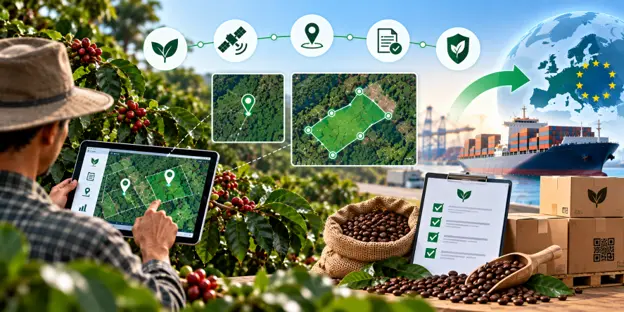
From information collection and geolocation to deforestation risk assessment, risk mitigation and DDS submission, the EUDR due diligence workflow connects every step needed to demonstrate compliance.
Colombia does not have a data shortage. It has a data-linking problem. SICA tells you a plot exists and where it is; the EU needs proof that a specific container came from that plot, legally. The exporters who win EU contracts in 2027 will be the ones who can show that chain in minutes, not weeks.
EUDR Coffee Compliance Colombia with TraceX
TraceX EUDR Solutions connects plot data, legality evidence, and shipment records in one place .
Imports plot coordinates and polygons from existing registers and field surveys, including SICA exports
Screens plots against the 2020 cut-off using satellite deforestation layers
Links export lots to source plots through collection centre and mill records
Generates DDS-ready geolocation files and a shareable evidence pack per shipment
For Colombian exporters, this means answering an EU buyer’s due diligence request with a complete file instead of a spreadsheet chase. Certifications such as Rainforest Alliance or Fairtrade still support your risk mitigation, but they do not replace plot geolocation or DDS filing, and EUDR coffee compliance Colombia programmes should treat them as supporting evidence only.
See how TraceX links SICA plots, legality documents, and export lots in one workflow.
Buyer Evaluation Checklist for EUDR Coffee Compliance Colombia Tools
Before selecting a platform, confirm it can:
Ingest SICA and cooperative plot data without manual re-entry.
Screen polygons against the 31 December 2020 cut-off.
Store legality documents per producer and flag missing items.
Track volumes through collection centres and dry mills.
Export DDS geolocation in the EU Information System format.
Handle soluble coffee supply lines ahead of the 2027 scope change.
Retain records for the five-year period the regulation requires.
Frequently Asked Questions
Is Colombia classified as low risk under the EUDR?
No. Colombia is not on the low-risk list in Implementing Regulation (EU) 2025/1093, so it is treated as standard risk. Operators must carry out full due diligence, including risk assessment and mitigation, as part of EUDR coffee compliance Colombia.
When does EUDR coffee compliance Colombia become mandatory?
From 30 December 2026 for large and medium operators and traders, and from 30 June 2027 for micro and small operators. Soluble coffee is added from 30 December 2027.
Is SICA data enough to file a due diligence statement?
No. SICA provides plot geolocation, but the DDS also needs a risk assessment, legality evidence, and proof that the exported lot came from those plots.
Who files the DDS for Colombian coffee?
The operator who first places the coffee on the EU market, usually the EU importer. Colombian exporters supply the plot and legality data that makes the filing possible.
Does Rainforest Alliance or Fairtrade certification satisfy the EUDR?
No. Certifications support risk mitigation but do not replace plot geolocation, legality evidence, or the DDS.
What is the hardest part of EUDR compliance for Colombian coffee?
Legality evidence. Informal harvest labour and unclear land tenure are harder to document than the absence of deforestation.
Does the EUDR cover instant coffee from Colombia?
Yes, from 30 December 2027, when soluble coffee enters scope under the Delegated Act adopted on 13 July 2026.
Start using TraceX
Transparency, Trust, & Success for your Climate Journey.
We use cookies on our website to give you the most relevant experience by remembering your preferences and repeat visits. By clicking “Accept All”, you consent to the use of ALL the cookies. However, you may visit "Cookie Settings" to provide a controlled consent.
This website uses cookies to improve your experience while you navigate through the website. Out of these, the cookies that are categorized as necessary are stored on your browser as they are essential for the working of basic functionalities of the website. We also use third-party cookies that help us analyze and understand how you use this website. These cookies will be stored in your browser only with your consent. You also have the option to opt-out of these cookies. But opting out of some of these cookies may affect your browsing experience.
Necessary cookies are absolutely essential for the website to function properly. These cookies ensure basic functionalities and security features of the website, anonymously.
Cookie
Duration
Description
cookielawinfo-checkbox-analytics
11 months
This cookie is set by GDPR Cookie Consent plugin. The cookie is used to store the user consent for the cookies in the category "Analytics".
cookielawinfo-checkbox-functional
11 months
The cookie is set by GDPR cookie consent to record the user consent for the cookies in the category "Functional".
cookielawinfo-checkbox-necessary
11 months
This cookie is set by GDPR Cookie Consent plugin. The cookies is used to store the user consent for the cookies in the category "Necessary".
cookielawinfo-checkbox-others
11 months
This cookie is set by GDPR Cookie Consent plugin. The cookie is used to store the user consent for the cookies in the category "Other.
cookielawinfo-checkbox-performance
11 months
This cookie is set by GDPR Cookie Consent plugin. The cookie is used to store the user consent for the cookies in the category "Performance".
viewed_cookie_policy
11 months
The cookie is set by the GDPR Cookie Consent plugin and is used to store whether or not user has consented to the use of cookies. It does not store any personal data.
Functional cookies help to perform certain functionalities like sharing the content of the website on social media platforms, collect feedbacks, and other third-party features.
Performance cookies are used to understand and analyze the key performance indexes of the website which helps in delivering a better user experience for the visitors.
Analytical cookies are used to understand how visitors interact with the website. These cookies help provide information on metrics the number of visitors, bounce rate, traffic source, etc.
Advertisement cookies are used to provide visitors with relevant ads and marketing campaigns. These cookies track visitors across websites and collect information to provide customized ads.
Download the 2026 Traceability Scorecard and Benchmark Your Supply Chain Across 10 Critical Capabilities.
Download our eBook
Don’t Wait for an Audit to Find Your EUDR Gaps
The 2026 Simplification Package changes how HS codes, DDS pass-through and geolocation rules apply to you. Get the free guide and 20-point readiness checklist before enforcement catches you unprepared.