EUDR Cocoa Compliance Côte d’Ivoire: Why the Producer Card Is Only Step One
Published
, 8 minute read
Share this article
Quick summary: EUDR cocoa compliance Côte d'Ivoire: what the new producer card covers, where standard-risk due diligence falls short, and how to get DDS-ready by December.
EUDR cocoa compliance Côte d’Ivoire means proving that every lot of Ivorian cocoa sold into the EU was grown on land not deforested after 31 December 2020, was produced legally under Ivorian law, and is tied to plot geolocation in a Due Diligence Statement (DDS) filed by the EU operator. Obligations apply from 30 December 2026 for large and medium operators. The mandatory producer card, live since 1 September 2026, supplies farmer and transaction data, but operators still need plot-level evidence and a full risk assessment because Côte d’Ivoire is classified standard risk.
Côte d’Ivoire grows roughly 40% of the world’s cocoa and has just moved its entire domestic trade onto a national traceability system. That is real progress. But for EU operators and the exporters who supply them, EUDR cocoa compliance Côte d’Ivoire depends on evidence the new system does not produce on its own. This guide sets out what changed, where the gaps sit, and how to close them before 30 December 2026.
KEY TAKEAWAYS
Côte d’Ivoire is standard risk under Implementing Regulation (EU) 2025/1093: full due diligence and a 3% annual check rate on operators.
The Système national de traçabilité (SNT) and producer card became mandatory for every cocoa transaction on 1 September 2026.
The card identifies the seller. The DDS still needs plot geolocation, deforestation-free evidence and legality proof.
Indirect sourcing is the biggest gap: only 48% of 2024 exports were traceable to cooperatives.
ARS 1000 and certification support risk mitigation but do not replace geolocation or the DDS.
December 2026 is approaching. Is your supply chain actually ready?
Move from spreadsheets and fragmented supplier data to a traceable, audit-ready EUDR workflow with TraceX.
EUDR Cocoa Compliance Côte d’Ivoire: What Changed on 1 September 2026
The 2026/27 main crop is the first season in which Ivorian cocoa trades entirely through a national traceability system.
On 1 September 2026 the Conseil du Café-Cacao made the producer card (carte du producteur) compulsory for all coffee and cocoa transactions as the main crop opened. The SNT rests on three tools: the card, an electronic payment terminal held by the buyer, and seals fixed to each bag so lots can be followed to the port. By mid-September the regulator reported 600 cooperatives buying exclusively through the card, with 10,000 terminals and 10 million seals distributed free before launch.
The timing is deliberate. Europe takes around 70% of Ivorian cocoa exports, and the main crop runs to 28 February 2027, so beans bought this season will reach EU ports after obligations start. For exporters, EUDR cocoa compliance Côte d’Ivoire is no longer a future project; it is written into this season’s contracts.
Côte d’Ivoire Cocoa Under EUDR: Why Standard Risk Raises the Bar
Country benchmarking decides how much due diligence EU buyers must run on Ivorian cocoa.
Implementing Regulation (EU) 2025/1093 places Côte d’Ivoire in the standard-risk tier, while neighbouring Ghana is low risk. The difference is operational. Operators sourcing Ivorian beans cannot use simplified due diligence: they must collect information, assess risk and apply mitigation before filing the DDS, and competent authorities check 3% of operators sourcing from standard-risk origins every year.
Buyers blending West African origins feel this most. One Ivorian lot in a mixed shipment pulls the whole statement into full due diligence, so EU importers now ask exporters for evidence packs, not declarations. Meeting EUDR cocoa compliance Côte d’Ivoire requirements starts with what the buyer’s risk assessment needs to see.
Understand the key EUDR requirements for cocoa from supplier traceability and plot-level geolocation to deforestation checks, risk assessment, and Due Diligence Statements.
EUDR Cocoa Compliance Gaps the National System Leaves Open
The SNT proves who sold the cocoa. EUDR asks where it grew and whether that land was legal and forest-free.
Cocoa Traceability Breaks in Indirect Supply
Trase found that only 48% of Côte d’Ivoire’s 2024 cocoa exports could be traced to the cooperatives that grew them, largely because the rest passes through several intermediaries. A card transaction linked to a missing or inaccurate plot record gives the EU operator nothing usable for a DDS.
Cocoa Plot Geolocation Needs Polygons Above Four Hectares
EUDR requires geolocation for every plot, and plots larger than four hectares need a polygon rather than a single point. Where earlier registration rounds captured one GPS point per farm, exporters should re-survey larger plots before relying on those records as evidence.
Learn what geolocation data EUDR requires, how to collect and validate plot-level coordinates, and how geolocation supports deforestation-free verification and due diligence.
Deforestation-free is only half the test. The operator must also show the cocoa was produced under relevant Ivorian legislation, including rules on protected areas and classified forests. Research cited by the European Commission’s Joint Research Centre estimates that about 30% of the country’s cocoa plantation area lies inside protected areas, which makes legality screening central to EUDR cocoa compliance Côte d’Ivoire.
The producer card tells a buyer who sold the beans. The DDS has to prove where they grew.
ARS 1000 and schemes such as Rainforest Alliance strengthen risk mitigation, but they do not replace plot geolocation, screening against the 31 December 2020 cut-off, or the DDS itself.
Learn how cocoa exporters can prepare for EUDR compliance, including farmer data collection, plot-level geolocation, deforestation checks, risk assessment, traceability, and DDS requirements.
EUDR Cocoa Compliance Côte d’Ivoire Workflow with TraceX
TraceX EUDR Solutions turns SNT transaction data into DDS-ready evidence the EU operator can file.
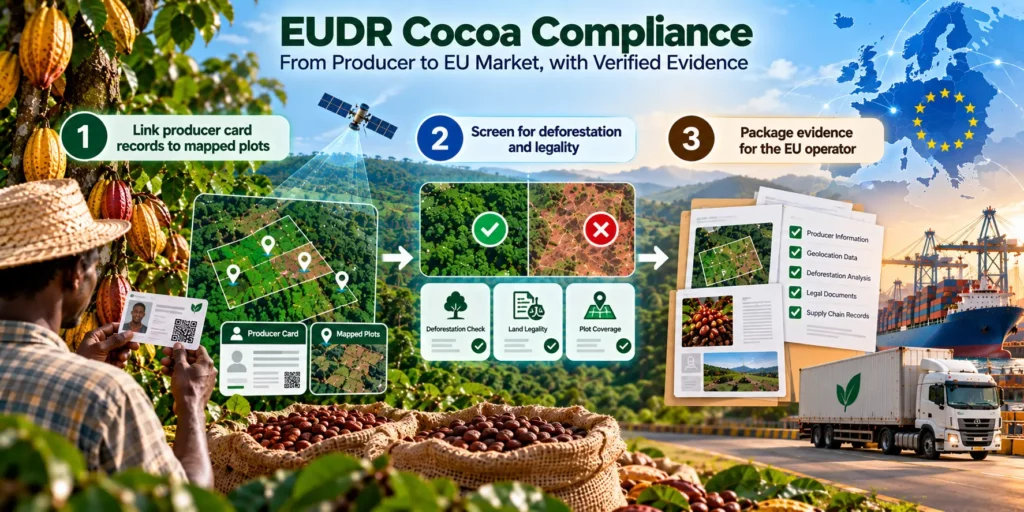
Link producer card records to mapped plots Ingest cooperative and producer card records and match each farmer to mapped plots.
Screen for deforestation and legality Capture or correct polygons in the field with offline mobile mapping for plots above four hectares. Screen every plot against the 31 December 2020 cut-off and protected-area layers, including the national 2020 land-use reference map.
Package evidence for the EU operator Link sealed bag and lot IDs to plots so mixing is traceable from cooperative to port. Package geolocation, risk assessment and mitigation evidence for the EU operator to submit through the EU Information System.
The payoff is fewer held lots and faster buyer onboarding. Exporters turn EUDR cocoa compliance Côte d’Ivoire into a repeatable data flow rather than a scramble before every shipment.
Treat the SNT as an input feed, not your due diligence system. The card solves identity and payment. The EU operator’s risk assessment still hinges on polygon quality, deforestation screening and legality checks that sit outside the card. Exporters who connect the two layers now will set the standard for EUDR cocoa compliance Côte d’Ivoire, and theirs is the cocoa that will move in January 2027.
See how producer card data becomes DDS-ready evidence for your EU buyers
Use these questions to shortlist tools for EUDR cocoa compliance Côte d’Ivoire programmes.
Can it import SNT and producer card data from cooperatives?
Does it enforce polygons for plots above four hectares?
Does it screen against the 2020 cut-off and Ivorian protected areas?
Can it trace lots through intermediaries and mixing?
Does field capture work offline?
Can it deliver DDS-ready data to EU operators?
Does it track country benchmarking changes?
Frequently Asked Questions
What is EUDR cocoa compliance in Côte d’Ivoire?
EUDR cocoa compliance Côte d’Ivoire is the process of proving that Ivorian cocoa and cocoa products placed on the EU market are deforestation-free after 31 December 2020, legally produced, and linked to plot geolocation in a DDS.
When does EUDR apply to Ivorian cocoa?
From 30 December 2026 for large and medium operators and traders, and 30 June 2027 for micro and small operators, under Regulation (EU) 2025/2650. Ivorian officials often cite 1 January 2027; plan against the legal date.
Is Côte d’Ivoire high risk under EUDR?
No. It is standard risk under Implementing Regulation (EU) 2025/1093, which requires full due diligence. The list is due for review in 2026, so monitor it.
Does the producer card make cocoa EUDR compliant?
Not on its own. It records farmer identity and transactions, but operators still need verified plot geolocation, deforestation screening and legality evidence.
Who files the DDS for Ivorian cocoa?
The EU operator that first places the cocoa on the EU market files the DDS. The Ivorian exporter supplies the geolocation and supporting evidence.
Does ARS 1000 or certification replace EUDR due diligence?
No. ARS 1000, Rainforest Alliance and similar schemes support risk mitigation but do not replace geolocation, the DDS or plot-level evidence.
Which cocoa products are covered?
Annex I covers cocoa beans, shells, paste, butter, powder and chocolate (CN 1801 to 1806). Semi-processed exports need the same plot-level evidence for EUDR cocoa compliance Côte d’Ivoire as beans.
Start using TraceX
Transparency, Trust, & Success for your Climate Journey.
We use cookies on our website to give you the most relevant experience by remembering your preferences and repeat visits. By clicking “Accept All”, you consent to the use of ALL the cookies. However, you may visit "Cookie Settings" to provide a controlled consent.
This website uses cookies to improve your experience while you navigate through the website. Out of these, the cookies that are categorized as necessary are stored on your browser as they are essential for the working of basic functionalities of the website. We also use third-party cookies that help us analyze and understand how you use this website. These cookies will be stored in your browser only with your consent. You also have the option to opt-out of these cookies. But opting out of some of these cookies may affect your browsing experience.
Necessary cookies are absolutely essential for the website to function properly. These cookies ensure basic functionalities and security features of the website, anonymously.
Cookie
Duration
Description
cookielawinfo-checkbox-analytics
11 months
This cookie is set by GDPR Cookie Consent plugin. The cookie is used to store the user consent for the cookies in the category "Analytics".
cookielawinfo-checkbox-functional
11 months
The cookie is set by GDPR cookie consent to record the user consent for the cookies in the category "Functional".
cookielawinfo-checkbox-necessary
11 months
This cookie is set by GDPR Cookie Consent plugin. The cookies is used to store the user consent for the cookies in the category "Necessary".
cookielawinfo-checkbox-others
11 months
This cookie is set by GDPR Cookie Consent plugin. The cookie is used to store the user consent for the cookies in the category "Other.
cookielawinfo-checkbox-performance
11 months
This cookie is set by GDPR Cookie Consent plugin. The cookie is used to store the user consent for the cookies in the category "Performance".
viewed_cookie_policy
11 months
The cookie is set by the GDPR Cookie Consent plugin and is used to store whether or not user has consented to the use of cookies. It does not store any personal data.
Functional cookies help to perform certain functionalities like sharing the content of the website on social media platforms, collect feedbacks, and other third-party features.
Performance cookies are used to understand and analyze the key performance indexes of the website which helps in delivering a better user experience for the visitors.
Analytical cookies are used to understand how visitors interact with the website. These cookies help provide information on metrics the number of visitors, bounce rate, traffic source, etc.
Advertisement cookies are used to provide visitors with relevant ads and marketing campaigns. These cookies track visitors across websites and collect information to provide customized ads.
Download the 2026 Traceability Scorecard and Benchmark Your Supply Chain Across 10 Critical Capabilities.
Download our eBook
Don’t Wait for an Audit to Find Your EUDR Gaps
The 2026 Simplification Package changes how HS codes, DDS pass-through and geolocation rules apply to you. Get the free guide and 20-point readiness checklist before enforcement catches you unprepared.