The EUDR-PPWR Intersection: One Data Problem, Two Regulations
Published
, 10 minute read
Share this article
Quick summary: Discover how EUDR and PPWR compliance overlap across packaging data, suppliers and evidence and how one structured data foundation can support both.
The EUDR-PPWR intersection is primarily a data and operating-model challenge, not a claim that the two regulations impose the same obligations. PPWR can require structured packaging information such as material composition, recyclability, recycled content and conformity evidence, while EUDR can require information about relevant commodity origin, production location, geolocation, legality and deforestation-free status. Companies can reduce duplication by maintaining a shared supplier, product, packaging and material data foundation, then adding regulation-specific fields and workflows. The key principle is: one controlled data foundation, multiple compliance outputs.
The EUDR-PPWR Intersection is creating a new data challenge for companies managing packaging and forest-based materials in the EU. While PPWR requires structured information on packaging composition, recyclability, recycled content and supplier evidence, EUDR focuses on origin, geolocation and deforestation-free status. The datasets are different, but they often originate from the same packaging specifications and supplier records. The regulations ask different questions, but the answers often begin with the same business records: packaging specifications, material information and supplier data.
This is why EUDR and PPWR compliance should not automatically be treated as two separate data projects. A structured packaging and supplier data foundation can provide a starting point for both, helping companies avoid duplicate supplier questionnaires, disconnected spreadsheets and parallel compliance processes.
Key Takeaways
EUDR and PPWR have different legal requirements, but they can rely on overlapping supplier, material and product records.
Packaging specifications and supplier records can provide the common starting point for building a multi-regulation compliance data foundation.
PPWR data may focus on composition, recyclability, recycled content and conformity evidence, while EUDR data may require origin, production location, geolocation and due diligence information where applicable.
A shared supplier master reduces duplicate data collection without assuming that PPWR evidence automatically satisfies EUDR.
The most scalable model is one controlled data foundation with regulation-specific fields, workflows and compliance outputs.
Connecting data to evidence is essential for maintaining traceability and audit readiness.
December 2026 is approaching. Is your supply chain actually ready?
Move from spreadsheets and fragmented supplier data to a traceable, audit-ready EUDR workflow with TraceX.
The EUDR-PPWR intersection is not that the two regulations impose identical requirements. They do not. The intersection is operational: the same packaging specifications, material records, supplier relationships and supporting evidence can sit underneath different regulatory obligations.
For example, a company may already maintain a record for a packaging component that identifies its material, weight, supplier and supporting documentation for PPWR. If that packaging contains a relevant EUDR commodity or material sourced through a relevant supply chain, the same supplier relationship may need additional origin, production-location and deforestation-related information.
The practical question is therefore not “How do we combine EUDR and PPWR into one regulation?” It is “How do we design one data architecture that can support the different requirements of both?”
PPWR and EUDR: Different Requirements, Shared Data Foundation
Data Area
PPWR Focus
EUDR Focus
Material information
Material composition and packaging characteristics
Relevant commodity/material and origin
Supplier information
Packaging supplier, declarations and evidence
Supplier/producer and upstream origin information
Production information
Packaging specifications and documentation
Production country and production location
Compliance evidence
Technical documentation and Declaration of Conformity
Due diligence evidence and declaration records
Traceability
Packaging/product relationship
Commodity/product supply-chain and origin traceability
Why Packaging Data Becomes the Common Starting Point
Packaging data rarely exists in one place. Material specifications may sit in product lifecycle systems, supplier declarations may arrive as PDFs, recycled-content information may be stored in spreadsheets, and procurement teams may hold supplier records separately from compliance teams. EUDR can add another layer of information around origin, geolocation and due diligence.
When these records are disconnected, each new regulation creates another collection exercise. Teams may ask suppliers for information they have already provided elsewhere, reconcile different versions of the same material specification, and manually connect evidence to products and shipments.
A better model is to treat packaging as a structured object with connected attributes: Product → Packaging Component → Material → Composition → Weight → Supplier → Origin → Production Location → Evidence → Compliance Status. Not every field applies to every regulation, but the shared record creates a common foundation.
Centralize packaging specifications, material data, supplier information, recyclability evidence, and compliance records in one connected PPWR workflow.
The Supplier Record Is the Critical Link
Supplier data is where the EUDR-PPWR intersection becomes particularly practical. A PPWR-oriented supplier record may already capture packaging specifications, material composition, declarations and supporting documents. EUDR-oriented supplier information may need to extend into producer identity, country of production, production location, geolocation and due diligence information where relevant.
Instead of creating a completely separate supplier database for EUDR, companies can extend the existing supplier record with regulation-specific fields. This does not mean that a PPWR supplier record automatically satisfies EUDR. It means that the same supplier master can become the controlled starting point for collecting additional EUDR information.
Is Your EUDR Supplier Data Ready?
Engage suppliers, collect plot-level origin and geolocation data, and build the traceability needed to support EUDR compliance.
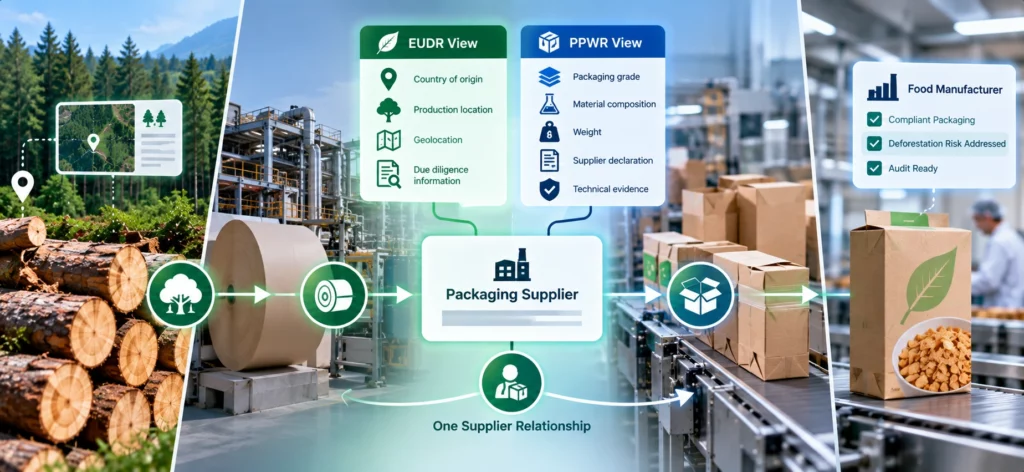
Consider a food manufacturer buying paperboard cartons from a supplier. The PPWR process may already capture the packaging grade, material composition, weight, supplier declaration and relevant technical evidence. If the paper or another relevant input falls within an EUDR-relevant supply chain, the company may also need to understand the origin and production information associated with the relevant wood-based material.
Rather than maintaining two unrelated supplier workflows, the manufacturer can use the existing packaging supplier record as the starting point. The EUDR layer can then add the relevant origin, production-location, geolocation and due diligence information. This creates one supplier relationship with different regulatory views.
Example: Wooden Transport Packaging
Consider a company purchasing wooden pallets or crates that are marketed as products in their own right. The packaging record can contain product type, wood material, supplier, dimensions and supporting documents. Where EUDR applies to the relevant product and supply chain, additional information concerning the origin and production location of the wood becomes important.
The lesson is simple: the packaging master record should not end with “wooden pallet.” It should be capable of connecting the product to the supplier, relevant material information, origin information and evidence. That structure can support both packaging compliance processes and relevant EUDR workflows without assuming that the two regulations have identical legal tests.
Example: One Supplier, Two Compliance Workflows
Imagine a packaging supplier serving a multinational consumer-goods company. The supplier provides paper cartons, plastic pouches and wooden transport packaging. The buyer needs PPWR data across the portfolio and EUDR information for relevant wood-based supply chains.
A fragmented approach creates separate spreadsheets for packaging compliance and EUDR. A structured approach keeps a common supplier master while attaching regulation-specific attributes to each packaging component. The workflow becomes: Supplier → Packaging Component → Material → Applicable Regulation → Required Data → Evidence → Compliance Output.
This approach reduces duplication while preserving the important distinction between regulatory requirements.
Need Help Navigating EUDR & PPWR Compliance?Connect with our experts to understand your regulatory requirements, identify data gaps, and build a practical compliance strategy for your supply chain.
The Data Architecture: One Foundation, Multiple Compliance Outputs
A scalable architecture should separate common master data from regulation-specific compliance data. Common fields may include supplier identity, product ID, packaging component, material, weight and documentation. Regulation-specific fields can then be layered on top.
For PPWR, this may support packaging composition, recyclability information, recycled-content evidence, technical documentation and the Declaration of Conformity workflow. For EUDR, relevant records can extend to country of production, production location, geolocation, risk information, due diligence records and the applicable declaration or identifier.
The principle is simple: one controlled source of data, multiple compliance outputs.
Why Excel and PDFs Become a Problem
Spreadsheets and PDFs can be useful inputs, but they are difficult to scale as the number of products, packaging formats and suppliers grows. A single supplier may provide multiple versions of specifications. A packaging component may appear across dozens of SKUs. Evidence may be stored in email attachments without a consistent link to the exact material or packaging component.
When EUDR and PPWR are managed independently, these weaknesses are multiplied. Teams may have one version of supplier information for PPWR and another for EUDR. The result is duplication, inconsistent records and a greater risk of missing evidence.
The goal is not simply to digitize the spreadsheet. It is to create relationships between data objects so that a change in a supplier, material or packaging specification can be traced across affected products and compliance workflows.
How to Build a Shared EUDR-PPWR Data Model
1. Build a packaging master — Create a controlled record for each packaging component, including product relationships, material and weight.
2. Create a supplier master — Maintain one controlled supplier record rather than separate EUDR and PPWR supplier lists.
3. Add material composition — Capture composition and relevant characteristics at component level rather than using only broad labels such as “paper” or “plastic.”
4. Add origin fields where relevant — For EUDR-relevant materials, extend the record with production country, production location and geolocation information.
5. Connect evidence — Link declarations, certificates, test reports and other supporting evidence to the relevant supplier, material or packaging component.
6. Create regulation-specific workflows — Use the common data foundation to drive PPWR assessment and documentation alongside relevant EUDR due diligence workflows.
7. Maintain change management — Track changes to suppliers, materials, specifications and evidence so compliance records remain current.
The Role of Supplier Engagement
Supplier engagement is often the bottleneck. Asking suppliers for everything at once can produce incomplete responses and poor-quality evidence. A better approach is to make requests structured and specific to the material and regulatory requirement.
For example, a supplier record can identify which PPWR fields are missing and, where relevant, which EUDR origin or production-location fields are missing. This allows procurement and compliance teams to follow up with suppliers using a common data model rather than multiple disconnected questionnaires.
How TraceX Can Help
TraceX Regulatory Compliance Solutions can help companies create a connected compliance data foundation across products, packaging, materials and suppliers. For PPWR workflows, this can support packaging data collection, supplier collaboration, compliance assessment, technical documentation and Declaration of Conformity workflows. For relevant EUDR workflows, the same supplier and material relationships can be extended with origin, geolocation, risk and due diligence information.
The objective is not to claim that one dataset makes two regulations identical. The objective is to avoid rebuilding the underlying data architecture every time a new EU requirement arrives.
One Data Foundation. Multiple EU Compliance Workflows.
Connect packaging, material, supplier, origin and compliance data with TraceX.
Companies that already manage PPWR should not build an entirely separate data universe for EUDR. The smarter approach is to examine where the two compliance processes touch the same suppliers, materials, packaging components and evidence. Build those shared records once, then extend them with the information each regulation requires.
The result is more than regulatory efficiency. It creates a reusable compliance data layer that can support future EU sustainability requirements without restarting supplier data collection from scratch.
Frequently Asked Questions (FAQ’s)
Are EUDR and PPWR the same regulation?
No. EUDR addresses deforestation-free supply chains for relevant commodities and products, while PPWR addresses packaging and packaging waste. Their data requirements can overlap operationally but remain legally distinct.
Does PPWR compliance automatically satisfy EUDR?
No. PPWR data should not be treated as proof of EUDR compliance. Existing supplier and material records can be used as a starting point for collecting additional EUDR information that is relevant.
What data can be shared between EUDR and PPWR workflows?
Supplier identity, product and packaging relationships, material information, specifications and supporting evidence can form a shared foundation. EUDR-specific origin, production-location and due diligence fields can then be added where applicable.
Why should companies use one supplier master?
A controlled supplier master reduces duplicate data collection, inconsistent versions and fragmented evidence while allowing each regulation to have its own required fields and workflows.
Can wooden packaging create an EUDR and PPWR data intersection?
Potentially. Where relevant wood products fall within EUDR scope, the same wooden packaging product record can connect supplier, material and packaging information with the additional origin and production-location data required for the applicable EUDR process.
How can companies prepare now?
Start by mapping products, packaging components, materials and suppliers; identify existing evidence; locate data gaps; and design a structured data model that can accommodate regulation-specific requirements.
Start using TraceX
Transparency, Trust, & Success for your Climate Journey.
We use cookies on our website to give you the most relevant experience by remembering your preferences and repeat visits. By clicking “Accept All”, you consent to the use of ALL the cookies. However, you may visit "Cookie Settings" to provide a controlled consent.
This website uses cookies to improve your experience while you navigate through the website. Out of these, the cookies that are categorized as necessary are stored on your browser as they are essential for the working of basic functionalities of the website. We also use third-party cookies that help us analyze and understand how you use this website. These cookies will be stored in your browser only with your consent. You also have the option to opt-out of these cookies. But opting out of some of these cookies may affect your browsing experience.
Necessary cookies are absolutely essential for the website to function properly. These cookies ensure basic functionalities and security features of the website, anonymously.
Cookie
Duration
Description
cookielawinfo-checkbox-analytics
11 months
This cookie is set by GDPR Cookie Consent plugin. The cookie is used to store the user consent for the cookies in the category "Analytics".
cookielawinfo-checkbox-functional
11 months
The cookie is set by GDPR cookie consent to record the user consent for the cookies in the category "Functional".
cookielawinfo-checkbox-necessary
11 months
This cookie is set by GDPR Cookie Consent plugin. The cookies is used to store the user consent for the cookies in the category "Necessary".
cookielawinfo-checkbox-others
11 months
This cookie is set by GDPR Cookie Consent plugin. The cookie is used to store the user consent for the cookies in the category "Other.
cookielawinfo-checkbox-performance
11 months
This cookie is set by GDPR Cookie Consent plugin. The cookie is used to store the user consent for the cookies in the category "Performance".
viewed_cookie_policy
11 months
The cookie is set by the GDPR Cookie Consent plugin and is used to store whether or not user has consented to the use of cookies. It does not store any personal data.
Functional cookies help to perform certain functionalities like sharing the content of the website on social media platforms, collect feedbacks, and other third-party features.
Performance cookies are used to understand and analyze the key performance indexes of the website which helps in delivering a better user experience for the visitors.
Analytical cookies are used to understand how visitors interact with the website. These cookies help provide information on metrics the number of visitors, bounce rate, traffic source, etc.
Advertisement cookies are used to provide visitors with relevant ads and marketing campaigns. These cookies track visitors across websites and collect information to provide customized ads.
Download the 2026 Traceability Scorecard and Benchmark Your Supply Chain Across 10 Critical Capabilities.
Download our eBook
Don’t Wait for an Audit to Find Your EUDR Gaps
The 2026 Simplification Package changes how HS codes, DDS pass-through and geolocation rules apply to you. Get the free guide and 20-point readiness checklist before enforcement catches you unprepared.