EUDR Compliance for Indian Coffee Exporters: Your Readiness Guide
Published
, 9 minute read
Share this article
Quick summary: EUDR compliance for Indian coffee exporters: capture plot geolocation, legality proof and DDS-ready data to keep coffee shipments EU-market bound in 2026.
EUDR Compliance for Indian Coffee Exporters means proving that every coffee shipment bound for the EU is deforestation-free after 31 December 2020, legally produced, and traceable to the exact farm plot where it was grown. Indian exporters capture plot-level geolocation, legality records, and chain-of-custody data, then pass that evidence to their EU buyer, who files the Due Diligence Statement (DDS). India’s low-risk rating lowers audit rates but does not remove these duties.
Key takeaways
Coffee is an EUDR commodity (HS 0901). No valid DDS, no EU market access.
The EU importer (the operator) files the DDS. Indian exporters supply the geolocation and legality evidence behind it.
India is low risk (Reg. (EU) 2025/1093), so EU buyers can use simplified due diligence, but geolocation and the DDS are still mandatory.
Dates track the EU buyer’s size: 30 Dec 2026 (large/medium), 30 Jun 2027 (micro/small).
The real bottleneck is smallholder aggregation, which erases plot-level identity. Digital plot mapping fixes it.
December 2026 is approaching. Is your supply chain actually ready?
Move from spreadsheets and fragmented supplier data to a traceable, audit-ready EUDR workflow with TraceX.
What EUDR Compliance for Indian Coffee Exporters Requires
EUDR Compliance for Indian Coffee Exporters starts with a plain fact: coffee is one of the seven commodities named in the EU Deforestation Regulation, Regulation (EU) 2023/1115, and it enters the EU under HS code 0901. Any coffee placed on the EU market must be deforestation-free against a fixed cut-off of 31 December 2020, produced legally in India, and traceable to the geolocation of each source plot.
The document that carries this proof is the Due Diligence Statement. Here is the part most exporters get wrong. The DDS is filed by the EU operator, usually the importer that first places the coffee on the market, not by the exporter in India. Your job as the exporter is to supply the underlying evidence: GPS points, polygons for larger plots, legality documents, and a clean record of who handled the beans between farm and port, so the buyer can submit a valid statement. If your company also acts as the EU importer, you take the operator role on directly.
In practice, EUDR Compliance for Indian Coffee Exporters is a documentation problem before it is anything else. Miss a piece and the outcome is commercial, not theoretical: a container arriving in Hamburg or Rotterdam without a valid DDS reference is held at customs, penalties can reach 4% of EU-wide annual turnover, and records must be kept for five years.
Why EUDR Compliance for Indian Coffee Exporters Is Harder Than It Looks
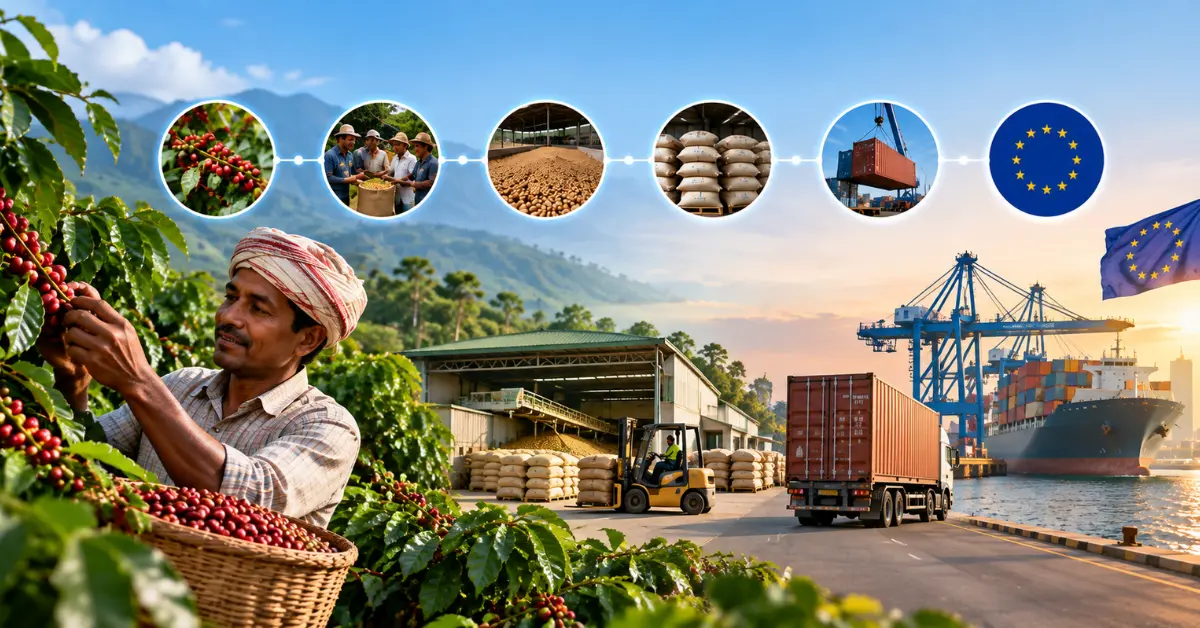
India’s coffee flows through many hands before export, and each handoff threatens plot-level traceability.
EUDR Compliance for Indian Coffee Exporters runs into one structural problem. India’s coffee is grown by hundreds of thousands of smallholders across Karnataka, Kerala, and Tamil Nadu, then pooled through collectors, curing works, and traders before it reaches an exporter. Every time coffee from many farms is aggregated into a single lot, plot-level identity is at risk of being lost.
That matters because the regulation asks for evidence farm by farm, not lot by lot. A collector who buys from 200 growers in one market day and records a single weight has already broken the geolocation trail the DDS depends on. Rebuilding it after the fact is slow, costly, and error-prone. This aggregation gap is the single biggest threat to EUDR Compliance for Indian Coffee Exporters.
Sourcing shifts add another layer. An exporter who moves buying from Coorg to Wayanad for a season has to reassess deforestation risk for the new geography before shipping. Manual teams reconciling certificates, purchase slips, and GPS photos across spreadsheets and PDFs tend to sink under exactly this kind of work.
India’s Low-Risk Status and What It Changes for EUDR Compliance
Low risk lightens the audit load for your EU buyers, but it does not waive the data or the DDS.
For EUDR Compliance for Indian Coffee Exporters, India’s country rating helps, within limits. Under Commission Implementing Regulation (EU) 2025/1093, adopted on 22 May 2025, India is classified as low risk. That entitles EU buyers sourcing only from low-risk origins to a simplified due diligence route under Article 13, and it drops the authority check rate to roughly 1% of operators.
What low risk does not do is remove the core duties. Buyers still need the plot geolocation, the legality evidence, and a filed DDS. Simplified due diligence lets them skip the formal risk assessment and mitigation steps, not the data collection. So EUDR Compliance for Indian Coffee Exporters remains a data exercise even under the lighter route. Treat low risk as a smaller audit burden, never as an exemption.
Certifications such as Rainforest Alliance play a supporting role here. They strengthen a risk-mitigation story, but they do not replace geolocation, the DDS, or plot-level evidence. The classification can also move: the first benchmarking review was scheduled for 2026, so India’s tier needs monitoring rather than a one-time check.
Certification can strengthen your EUDR due-diligence process, but it does not automatically demonstrate compliance
A Practical EUDR Compliance Roadmap for Indian Coffee Exporters
Turning EUDR Compliance for Indian Coffee Exporters into a working routine comes down to six moves that build on each other:
Map your supply chain. List every producer, cooperative, curing works, and trader that feeds your export lots.
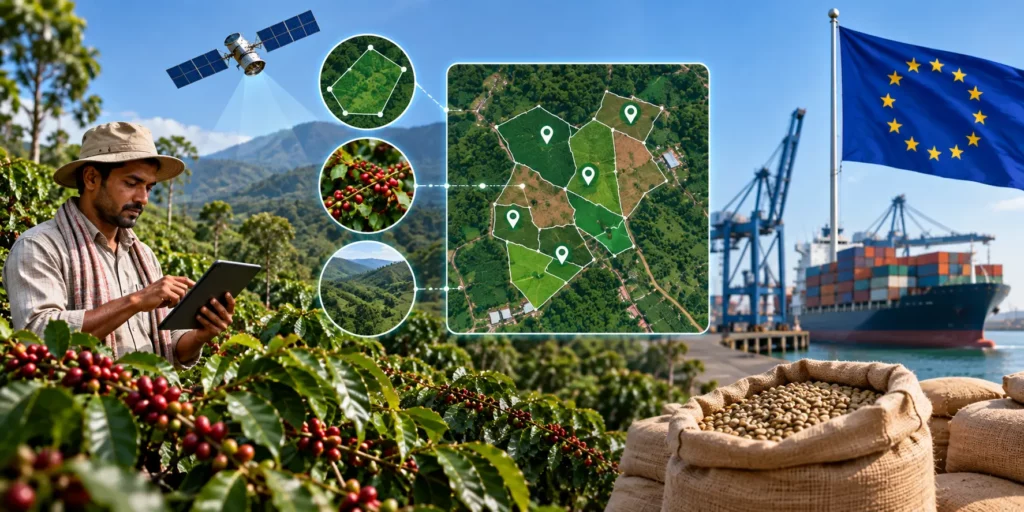
Capture plot-level geolocation. Record GPS points, and polygons above the 4-hectare threshold, for every farm you source from.
Verify legality. Collect land and production documents that confirm the coffee was legally grown in India.
Screen for deforestation. Check each plot against the 31 December 2020 baseline using satellite data.
Package the evidence. Assemble geodata, legality proof, and chain-of-custody records into a buyer-ready file.
Hand off for the DDS. Give your EU buyer a complete pack so they can file the DDS before the shipment reaches an EU border.
Done well, EUDR Compliance for Indian Coffee Exporters becomes a repeatable shipment routine rather than a scramble. The exporters who begin plot mapping now will clear the deadline comfortably; those who wait will be rebuilding trails under pressure.
EUDR Timeline for Indian Coffee Exporters
Timing is the other half of EUDR Compliance for Indian Coffee Exporters. The operative dates track the EU operator’s size, not the exporter’s: 30 December 2026 for large and medium operators and traders, and 30 June 2027 for micro and small operators, both set by Regulation (EU) 2025/2650. Indian exporters should be data-ready well ahead of whichever date applies to their buyers.
The exporters who win EU contracts through 2027 will not be the ones with the best certificates. They will be the ones who can hand a buyer clean, plot-level evidence on demand. Data readiness is becoming a supplier-selection criterion in its own right, and it is the part you can start building today.
TraceX EUDR Solutions helps Indian coffee exporters simplify EUDR compliance by connectingfarmer data, farm geolocation, procurement, traceability, risk assessment and DDS preparation in one digital workflow. Exporters can map coffee farms, validate source-level data, identify potential compliance gaps, link coffee to batches and shipments, and maintain supporting evidence helping them move from fragmented records to a more transparent and EUDR-ready supply chain.
See plot-level coffee traceability, deforestation screening, and DDS-ready evidence in one workflow.
EUDR Compliance for Indian Coffee Exporters: Manual vs Platform
Most Indian exporters weighing EUDR Compliance for Indian Coffee Exporters face a build-or-buy decision. The table sets the manual route against a purpose-built platform such as TraceX .
Capability
Manual / spreadsheets
TraceX
Plot geolocation
GPS photos and manual entry; overlap and boundary errors common
Points and polygons with validation and overlap checks
Smallholder onboarding
Ad-hoc, slow at first-mile aggregation points
Farmer network capture before beans aggregate
Deforestation screening
Separate vendor or manual satellite checks
Screening built into the workflow
DDS-ready pack
Reconciled by hand across PDFs and sheets
Buyer-ready evidence file generated from source data
Audit trail (5-yr)
Scattered files, hard to retrieve
Retained, authority-ready export
Buyer Evaluation Checklist for EUDR Coffee Tools
If you are choosing a traceability platform, score each option against these:
Captures plot-level points and polygons, with overlap and boundary validation.
Onboards smallholders at the first-mile aggregation point, before lots are pooled.
Screens plots against the 31 December 2020 deforestation baseline.
Produces a buyer-ready evidence pack that maps cleanly to DDS fields.
Retains records for five years with an authority-ready export.
Handles re-assessment when your sourcing geography changes mid-season.
Frequently Asked Questions
Who files the Due Diligence Statement for Indian coffee exported to the EU?
The EU operator, usually the importer that first places the coffee on the EU market, files the DDS. The Indian exporter supplies the geolocation, legality, and chain-of-custody data that make a valid DDS possible. If the Indian company is itself the EU importer, it files the DDS as the operator.
Is coffee covered by the EUDR?
Yes. Coffee is one of the seven EUDR commodities and is regulated under HS code 0901, along with derived products. It must be deforestation-free after 31 December 2020 and legally produced.
What is the EUDR deadline for Indian coffee exporters?
The date follows the EU buyer’s size: 30 December 2026 for large and medium operators and traders, and 30 June 2027 for micro and small operators, set by Regulation (EU) 2025/2650. Indian exporters should be data-ready before whichever date applies to their buyers.
Does India’s low-risk status exempt coffee exporters from the EUDR?
No. India is low risk under Regulation (EU) 2025/1093, which lets EU buyers use simplified due diligence and lowers audit rates to about 1%. Plot geolocation and a filed DDS are still required. Low risk is a lighter audit burden, not an exemption.
What data do Indian coffee exporters need to collect for EUDR?
Plot-level GPS coordinates (polygons above 4 hectares), documents proving legal production, and a chain-of-custody record from farm to port, screened against the 31 December 2020 deforestation baseline.
Do Rainforest Alliance or other certifications satisfy the EUDR?
No. Certifications support a risk-mitigation story but do not replace geolocation, the DDS, or plot-level evidence. They sit alongside compliance, not in place of it.
What happens if coffee reaches the EU without a valid DDS?
The shipment can be held at customs and refused entry. Penalties can reach 4% of EU-wide annual turnover, and operators must retain records for five years.
Start using TraceX
Transparency, Trust, & Success for your Climate Journey.
We use cookies on our website to give you the most relevant experience by remembering your preferences and repeat visits. By clicking “Accept All”, you consent to the use of ALL the cookies. However, you may visit "Cookie Settings" to provide a controlled consent.
This website uses cookies to improve your experience while you navigate through the website. Out of these, the cookies that are categorized as necessary are stored on your browser as they are essential for the working of basic functionalities of the website. We also use third-party cookies that help us analyze and understand how you use this website. These cookies will be stored in your browser only with your consent. You also have the option to opt-out of these cookies. But opting out of some of these cookies may affect your browsing experience.
Necessary cookies are absolutely essential for the website to function properly. These cookies ensure basic functionalities and security features of the website, anonymously.
Cookie
Duration
Description
cookielawinfo-checkbox-analytics
11 months
This cookie is set by GDPR Cookie Consent plugin. The cookie is used to store the user consent for the cookies in the category "Analytics".
cookielawinfo-checkbox-functional
11 months
The cookie is set by GDPR cookie consent to record the user consent for the cookies in the category "Functional".
cookielawinfo-checkbox-necessary
11 months
This cookie is set by GDPR Cookie Consent plugin. The cookies is used to store the user consent for the cookies in the category "Necessary".
cookielawinfo-checkbox-others
11 months
This cookie is set by GDPR Cookie Consent plugin. The cookie is used to store the user consent for the cookies in the category "Other.
cookielawinfo-checkbox-performance
11 months
This cookie is set by GDPR Cookie Consent plugin. The cookie is used to store the user consent for the cookies in the category "Performance".
viewed_cookie_policy
11 months
The cookie is set by the GDPR Cookie Consent plugin and is used to store whether or not user has consented to the use of cookies. It does not store any personal data.
Functional cookies help to perform certain functionalities like sharing the content of the website on social media platforms, collect feedbacks, and other third-party features.
Performance cookies are used to understand and analyze the key performance indexes of the website which helps in delivering a better user experience for the visitors.
Analytical cookies are used to understand how visitors interact with the website. These cookies help provide information on metrics the number of visitors, bounce rate, traffic source, etc.
Advertisement cookies are used to provide visitors with relevant ads and marketing campaigns. These cookies track visitors across websites and collect information to provide customized ads.
Download the 2026 Traceability Scorecard and Benchmark Your Supply Chain Across 10 Critical Capabilities.
Download our eBook
Don’t Wait for an Audit to Find Your EUDR Gaps
The 2026 Simplification Package changes how HS codes, DDS pass-through and geolocation rules apply to you. Get the free guide and 20-point readiness checklist before enforcement catches you unprepared.