EUDR Inbound Goods: How Importers Can Connect DDS, Customs and Supply-Chain Data
Published
, 12 minute read
Share this article
Quick summary: Learn how importers can manage EUDR inbound goods by linking DDS references with suppliers, customs, purchase orders, batches, goods receipts and ERP systems.
EUDR Inbound Goods are becoming an important operational consideration for importers, manufacturers and traders preparing for the EU Deforestation Regulation. The challenge is no longer simply obtaining a Due Diligence Statement (DDS) from a supplier. Businesses need to connect the DDS reference, supplier, origin, geolocation, shipment, customs declaration, batch and goods receipt so that EUDR information remains traceable throughout the inbound process.
For companies importing EUDR-relevant commodities and products into the European Union, one of the most practical questions is what happens when the goods actually arrive. A supplier may have provided a Due Diligence Statement (DDS) reference number, but how does that reference move into the importer’s operational systems? Can it be linked to the purchase order, inbound delivery, goods receipt and batch? How does the business know which quantity is covered? And can compliance teams trace the material back to the supplier and production origin?
These questions turn EUDR from a regulatory exercise into an operational data problem. The European Commission states that for relevant products entering the EU market, due diligence must have been carried out, the DDS or simplified declaration submitted, and the reference number or declaration identifier obtained before the customs declaration is lodged. The customs declarant must include the applicable reference or identifier on the customs declaration.
For enterprise importers, that creates a critical connection between compliance data and the physical flow of goods.
Key Takeaways
EUDR inbound compliance starts before customs clearance: The DDS must be submitted and its reference number obtained before the customs declaration is lodged for relevant imports.
Connect the DDS to the physical flow of goods: Link supplier → origin → geolocation → DDS → shipment → batch → goods receipt rather than storing the DDS reference separately.
Make DDS references operational: Capture the DDS reference against the relevant purchase order, inbound delivery, material, batch or shipment so procurement, logistics and compliance teams can access the same information.
Manage multiple DDS relationships: One DDS can cover multiple shipments or batches where applicable, while a single customs declaration can also contain multiple DDS references.
Track quantity against DDS coverage: Once the quantity covered by a DDS has been used, an additional DDS is required for further quantities.
Don’t treat customs as a separate process: Supplier documentation, DDS records, product classifications, quantities and customs declarations need to remain aligned to avoid operational delays.
Build ERP integration into the EUDR workflow: Connect EUDR data with POs, inbound deliveries, batches, inventory and customs processes instead of relying on spreadsheets or email.
Maintain the evidence behind the DDS: A reference number alone isn’t the complete compliance record. Businesses need access to the underlying supplier, origin, geolocation and due-diligence information.
Design for exceptions: Missing DDS references, incorrect data, supplier delays or quantity mismatches should trigger a defined workflow rather than being discovered at the border.
Think beyond compliance: The goal is to create a connected data chain that makes EUDR information traceable, searchable and usable across procurement, logistics, customs and supply-chain operations.
December 2026 is approaching. Is your supply chain actually ready?
Move from spreadsheets and fragmented supplier data to a traceable, audit-ready EUDR workflow with TraceX.
EUDR inbound goods management is the process of connecting incoming EUDR-relevant materials or products with the information needed to demonstrate due diligence and manage the import workflow.
The exact system sequence will differ by organisation. In some businesses, customs clearance happens before the warehouse goods receipt; in others, an advance inbound record may be created before physical arrival. The important principle is that the EUDR reference should remain connected to the transaction and product records it supports.
Common Questions asked on EUDR Inbound Goods
1. How Do We Capture the EUDR DDS Reference When Goods Arrive?
This is often the first question procurement, logistics and compliance teams ask. The supplier may provide the DDS reference through a purchase document, shipping documentation, portal, email or another channel. The business then needs to capture it reliably.
A mature process should avoid leaving the reference only in an email or PDF. Instead, it should become a structured data field linked to the relevant supplier, product, shipment and quantity.
This makes the reference searchable and gives compliance and logistics teams the same source of information.
A DDS reference number isn’t the end of the EUDR workflow. Can you quickly trace each reference back to the right supplier, product and shipment?Learn how to manage EUDR reference numbers effectively.
2. Can the DDS Reference Be Linked to the Purchase Order or Goods Receipt?
This is where EUDR becomes an ERP integration question. Buyers are increasingly asking whether the DDS reference can be connected to existing SAP, Oracle, Microsoft Dynamics or other ERP workflows rather than maintained in a separate spreadsheet.
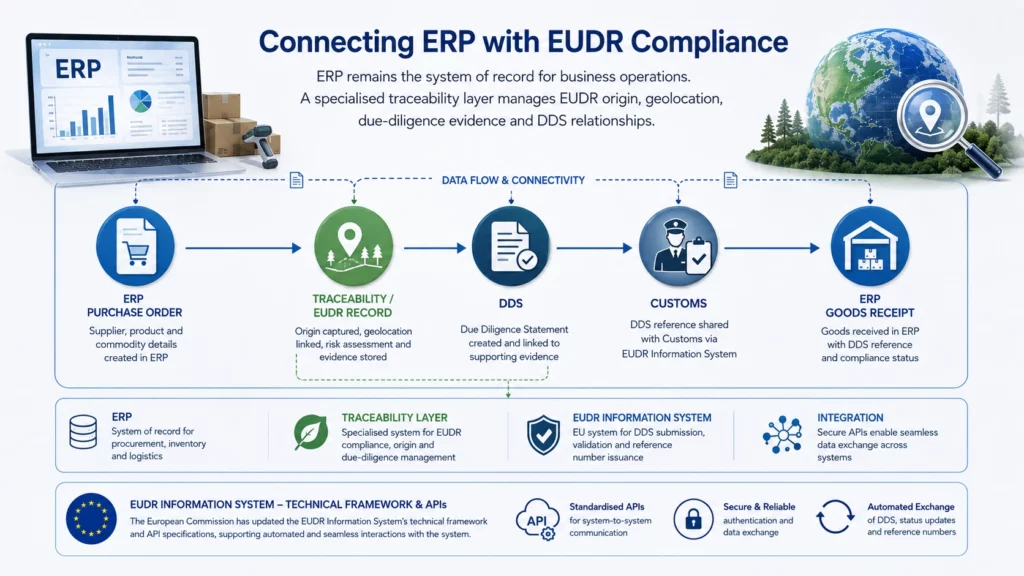
The practical objective is not necessarily to make the ERP the EUDR compliance system. Instead, the ERP can remain the system of record for procurement, inventory and logistics while a specialised traceability layer manages EUDR origin, geolocation, due-diligence evidence and DDS relationships.
A connected architecture can look like:
ERP PURCHASE ORDER → TRACEABILITY / EUDR RECORD → DDS → CUSTOMS → ERP GOODS RECEIPT
The Commission has also updated the EUDR Information System’s technical framework and API specifications, supporting automated interactions with the system.
3. How Do We Know Whether the Incoming Material Has the Required EUDR Record?
A buyer may ask whether a goods receipt should proceed if the relevant EUDR information is missing. This is primarily an internal control question rather than a rule that automatically requires every ERP goods-receipt process to be blocked.
Companies can define their own control points based on their legal role, import process and risk appetite. For example, an organisation may configure an EUDR status such as:
EUDR data not received
DDS reference received
Reference validated
Geolocation/evidence linked
Ready for customs
Customs declaration lodged
Goods received
Exception / follow-up required
This provides visibility without assuming that the EUDR Information System itself is an ERP warehouse-control system.
4. How Do We Handle Multiple DDS References for One Inbound Shipment?
Complex shipments can involve more than one DDS reference. The Commission confirms that where multiple DDS references or declaration identifiers apply, multiple references can be included in one customs declaration. It also confirms that where one DDS covers multiple shipments or batches, the same reference can be used in several customs declarations as long as the EUDR requirements are respected.
For enterprise systems, this means the data model should not assume a simple one-to-one relationship between shipment and DDS.
This becomes particularly important when a container combines products from different origins or when several declarations support one commercial movement.
Managing multiple EUDR DDS records? Learn how to consolidate declarations, simplify traceability and maintain control across your supply chain.Read the guide on EUDR DDS Consolidation.
5. Can One DDS Reference Be Linked to Multiple Inbound Deliveries?
Yes, a single DDS can cover multiple physical batches or shipments where the legal requirements are met. The Commission specifically notes that the same DDS reference may be referred to in several customs declarations when a DDS covers multiple shipments or batches.
The operational challenge is quantity control. The importer should be able to determine which receipts or shipments draw on the declared quantity and whether the DDS still covers the relevant flow.
This is why quantity-level traceability matters as much as reference-number storage.
6. How Do We Track Quantity Received Against the DDS?
Consider an importer with a DDS covering 500 tonnes of a relevant commodity. If the material arrives in five deliveries, the compliance team needs visibility into the relationship between the declared quantity and the quantities received.
The EUDR rules allow a DDS to cover multiple batches or shipments, but once the quantity covered by the DDS has been used, a new DDS is required for additional quantities.
This makes quantity allocation an important control for high-volume importers.
7. What If the Supplier Sends the DDS Reference After the Goods Arrive?
This is a common operational scenario, but it should be separated from the customs requirement. For imports, the reference number or simplified declaration identifier must be obtained before the customs declaration is lodged.
Therefore, receiving a reference after physical arrival is not the same as satisfying the import timing requirement. Companies should design supplier processes so the necessary information is available early enough for customs and internal controls.
An exception workflow can flag shipments where the physical goods have arrived at a warehouse or port but the relevant EUDR record is incomplete, allowing teams to investigate rather than relying on manual email follow-up.
8. Can We Trace Inbound Material Back to Supplier, Origin and Geolocation?
This is arguably the most valuable capability for an enterprise importer. The DDS reference should be more than a customs field. It can be connected to the supply-chain evidence behind the product.
This allows compliance teams to answer questions such as: Which production locations support this batch? Which supplier provided it? Which DDS covers the material? Which shipment received it? Which inventory or production records consumed it?
The European Commission also requires upstream operators to pass their DDS reference number to direct downstream buyers for traceability, while first downstream operators and traders have record-keeping obligations for the references they receive.
From geolocation to due diligence connect the EUDR dots. → Read More
9. What Should Happen When Goods Enter Inventory?
Once an inbound material is received, the EUDR information should remain connected to the batch or inventory record where appropriate. This is especially important when the material is transformed or combined with other inputs.
For example, a manufacturer importing cocoa may need to connect the incoming cocoa batch to the production order and finished product batches that use it. The exact legal obligations depend on the company’s role and the products involved, but from a traceability perspective, preserving the upstream link reduces the effort required to answer customer, audit or compliance questions.
A practical model is:
INBOUND BATCH → PRODUCTION ORDER → FINISHED PRODUCT BATCH → OUTBOUND TRANSACTION
10. What Does ERP Integration Need to Solve?
The strongest enterprise EUDR integrations are not about duplicating the ERP. They are about connecting systems around the events each system is best positioned to manage.
ERP: supplier, purchase order, material, batch, inventory and shipment records
EUDR/traceability platform: origin, geolocation, due-diligence evidence, risk and DDS relationships
Customs workflow: import declaration and applicable DDS reference
Supplier portal: collection of origin and compliance information
Analytics layer: exceptions, gaps and compliance status
This creates a controlled data flow instead of requiring teams to copy EUDR references manually between systems.
Scenario: An EU Manufacturer Receives Imported Rubber
Imagine an EU manufacturer importing natural rubber from several suppliers. Each supplier provides a DDS reference associated with the relevant production origins. The shipment arrives with multiple batches, and the manufacturer needs to connect the incoming material to its ERP purchase order, customs process and warehouse receipt.
A fragmented workflow might leave the compliance team searching emails to identify which DDS belongs to which batch.
When the rubber is later consumed in manufacturing, the upstream traceability relationship remains available for internal controls and downstream information requests.
Buyer Questions: What Are Enterprise Importers Asking?
Does the DDS reference need to be available before goods receipt?
The EUDR-specific timing requirement for imports is tied to customs: due diligence must be completed, the DDS submitted and the reference obtained before the customs declaration is lodged. Whether an organisation blocks its internal goods-receipt process is an internal control decision.
Can EUDR data be integrated with SAP or another ERP?
Businesses can design integrations that connect ERP procurement, material, batch and shipment data with a specialised EUDR traceability workflow. The Commission’s Information System also supports API-based automation.
Can one DDS cover multiple inbound shipments?
Yes, where the legal requirements are met. The Commission states that the same DDS reference can be used in several customs declarations when the DDS covers multiple shipments or batches.
Can one shipment have multiple DDS references?
Yes. The Commission states that multiple DDS reference numbers or declaration identifiers can be included in one customs declaration.
How long should received DDS references be retained?
The current roles-and-responsibilities guidance states that first downstream operators or traders must keep DDS reference numbers or simplified declaration identifiers for at least five years. The exact record-keeping obligation depends on the actor’s role.
How TraceX Can Help With EUDR Inbound Goods
TraceX EUDR Solutions can help enterprises connect EUDR compliance data with operational supply-chain events. Instead of storing DDS references separately from procurement and inventory records, TraceX can link supplier, origin, geolocation, product, shipment, batch and compliance information into a traceable record.
Centralise supplier and origin data.
Capture and manage geolocation and supporting evidence.
Link DDS references to products, shipments and batches.
Track inbound EUDR status and exceptions.
Support quantity-level traceability across shipments.
Integrate EUDR workflows with enterprise systems through APIs and data exchange.
Maintain searchable compliance records for audits and customer requests.
Create a traceability chain from origin through customs and goods receipt.
The goal is to make EUDR part of the operational supply chain rather than a separate compliance spreadsheet.
Make EUDR Part of the Inbound Process
For enterprise importers, EUDR compliance becomes much easier to manage when the DDS reference is treated as part of the inbound supply-chain record. The strongest model connects supplier and origin information with customs, shipments, quantities, batches and goods receipts.
This approach helps teams answer the questions that matter: Which DDS covers this material? Which supplier and origin support it? How much quantity has been received? Which batch consumed it? Can we retrieve the evidence?
EUDR readiness is not just about filing a DDS. It is about making that DDS reference usable across the flow of goods.
Start using TraceX
Transparency, Trust, & Success for your Climate Journey.
We use cookies on our website to give you the most relevant experience by remembering your preferences and repeat visits. By clicking “Accept All”, you consent to the use of ALL the cookies. However, you may visit "Cookie Settings" to provide a controlled consent.
This website uses cookies to improve your experience while you navigate through the website. Out of these, the cookies that are categorized as necessary are stored on your browser as they are essential for the working of basic functionalities of the website. We also use third-party cookies that help us analyze and understand how you use this website. These cookies will be stored in your browser only with your consent. You also have the option to opt-out of these cookies. But opting out of some of these cookies may affect your browsing experience.
Necessary cookies are absolutely essential for the website to function properly. These cookies ensure basic functionalities and security features of the website, anonymously.
Cookie
Duration
Description
cookielawinfo-checkbox-analytics
11 months
This cookie is set by GDPR Cookie Consent plugin. The cookie is used to store the user consent for the cookies in the category "Analytics".
cookielawinfo-checkbox-functional
11 months
The cookie is set by GDPR cookie consent to record the user consent for the cookies in the category "Functional".
cookielawinfo-checkbox-necessary
11 months
This cookie is set by GDPR Cookie Consent plugin. The cookies is used to store the user consent for the cookies in the category "Necessary".
cookielawinfo-checkbox-others
11 months
This cookie is set by GDPR Cookie Consent plugin. The cookie is used to store the user consent for the cookies in the category "Other.
cookielawinfo-checkbox-performance
11 months
This cookie is set by GDPR Cookie Consent plugin. The cookie is used to store the user consent for the cookies in the category "Performance".
viewed_cookie_policy
11 months
The cookie is set by the GDPR Cookie Consent plugin and is used to store whether or not user has consented to the use of cookies. It does not store any personal data.
Functional cookies help to perform certain functionalities like sharing the content of the website on social media platforms, collect feedbacks, and other third-party features.
Performance cookies are used to understand and analyze the key performance indexes of the website which helps in delivering a better user experience for the visitors.
Analytical cookies are used to understand how visitors interact with the website. These cookies help provide information on metrics the number of visitors, bounce rate, traffic source, etc.
Advertisement cookies are used to provide visitors with relevant ads and marketing campaigns. These cookies track visitors across websites and collect information to provide customized ads.
Download the 2026 Traceability Scorecard and Benchmark Your Supply Chain Across 10 Critical Capabilities.
Download our eBook
Don’t Wait for an Audit to Find Your EUDR Gaps
The 2026 Simplification Package changes how HS codes, DDS pass-through and geolocation rules apply to you. Get the free guide and 20-point readiness checklist before enforcement catches you unprepared.