PPWR Compliance Pharma Importers Belgium: Your Readiness Guide
Published
, 10 minute read
Share this article
Quick summary: PPWR compliance for pharma importers in Belgium: what's exempt, Fost Plus & Valipac duties, the Annex VIII Declaration of Conformity, and Aug 2026 readiness.
PPWR compliance pharma Importers Belgium is the set of packaging obligations a company takes on the moment it places medicinal products imported from inside or outside the EU on the Belgian market. From 12 August 2026, Regulation (EU) 2025/40 (the PPWR) makes the Belgian-side importer directly accountable for packaging it did not design: verifying supplier documentation, holding an EU Declaration of Conformity for every packaging type, meeting substance and minimisation limits, and layering all of that on top of Belgium’s existing Fost Plus and Valipac producer-responsibility duties.
Key takeaways
The date that matters is 12 August 2026. PPWR applies directly across all 27 Member States, with no grace period for stock placed on the market on or after that date.
Pharma is not blanket-exempt. Only immediate (contact) packaging escapes certain recyclability and recycled-content rules cartons, leaflets and transport packaging stay fully in scope.
Belgium adds a second layer. Fost Plus (household) and Valipac (industrial/commercial) EPR duties, run via IVC/CIE, sit alongside not instead of PPWR.
The work is documentary. Article 18 requires importers to verify the supplier’s Declaration of Conformity, keep records for years, and answer authorities within 10 days.
Own-brand imports raise the bar. Sell under your own name and Article 21 turns you into the manufacturer, with the full conformity file on your shoulders.
What PPWR compliance for pharma importers in Belgium actually means
A pharma importer is the company that first places imported medicinal products on the EU (Belgian) market. Under PPWR Article 18 you must verify the supplier’s conformity assessment and Declaration of Conformity, keep the documentation, and be able to produce it to authorities even though you never designed the packaging.
PPWR compliance pharma Importers Belgium turns on a single question: who first places the packaged medicine on the market? That party carries the packaging obligations. For an importer, PPWR (via Article 18) means checking that the manufacturer performed the conformity assessment, that a valid EU Declaration of Conformity exists for each packaging type, that the packaging carries the required identification and contact details, and that the technical documentation is retained five years for most packaging, ten years for reusable formats.
The trap is Article 21. If you import a medicine and sell it under your own brand or name, you step into the manufacturer’s shoes and inherit the full conformity burden, not just verification. For any importer running private-label or repackaging operations in Belgium, that single article reshapes the whole PPWR compliance pharma Importers Belgium workload.
Which pharma packaging is exempt from PPWR and which is not
Only immediate (contact) packaging of medicinal products blister packs, vials, ampoules, syringes is excluded from certain recyclability (Art. 6) and recycled-content (Art. 7) requirements, and only where compliance would compromise safety, quality or efficacy. Secondary cartons, patient-information leaflets and transport packaging get no such relief.
This is the most misunderstood part of PPWR compliance pharma Importers Belgium. The regulation grants narrow, health-and-safety-based derogations, not a sector exemption. Under Article 6(11), immediate packaging in direct contact with the medicinal product and outer packaging needed to preserve the medicine’s quality is excluded from the design-for-recycling grades (A/B/C in Annex II, Table 3). Article 7 similarly excludes that immediate packaging from the minimum recycled-content targets. Everything else still applies.
So the recyclability and recycled-content carve-outs do nothing for your secondary cartons, your patient-information leaflet inserts, or your transport packaging and they never touch minimisation, the substances-of-concern limits (PFAS in food-contact packaging, heavy metals), labelling, EPR contributions, or the Declaration of Conformity. Any exemption you claim must be justified and documented. Getting PPWR compliance pharma Importers Belgium right means proving, packaging component by component, exactly where a derogation applies and where it does not.
Ready to Simplify PPWR Compliance?Understand the key PPWR requirements, organize your packaging data, and build an audit-ready compliance workflow.
How Belgium’s EPR layer stacks on top of PPWR
PPWR harmonises the conformity and design rules, but Belgium’s national EPR stays in place. Importers that place more than 300 kg of packaging a year on the Belgian market join Fost Plus (household packaging) and/or Valipac (industrial/commercial packaging), declaring volumes annually through the interregional commission, IVC/CIE.
A frequent error in PPWR compliance pharma Importers Belgium planning is assuming the EU regulation replaces the Belgian scheme. It does not. Belgium runs a dual producer-responsibility system overseen by IVC/CIE the joint commission of Flanders, Wallonia and Brussels: Fost Plus handles household packaging and Valipac handles commercial and industrial packaging. The duty attaches to the party that first places the packaged goods on the Belgian market, which for imported medicines is the local importer, not the foreign seller.
For PPWR compliance pharma Importers Belgium, membership generally applies once you place more than 300 kg of packaging on the Belgian market per year, and declarations are due annually (the reporting deadline falls on 28 February of the following year). Late declarations carry penalties. On top of this, Belgium’s single-use packaging levy and litter-cost duties are phasing in from 2026. The pharma-specific wrinkle: your blister-and-carton retail pack is household packaging (Fost Plus), while pallets and shipper cases are commercial packaging (Valipac) so most importers need both. The TraceX platform can map each SKU’s packaging components to the right Belgian scheme and consolidate the evidence for annual declarations
Ready to Simplify PPWR EPR Registration?Understand your registration obligations, organize packaging data, and stay on top of EPR requirements across EU markets with one connected compliance workflow.
The August 2026 documents pharma importers must hold
From 12 August 2026, importers must hold, per packaging type: the manufacturer’s EU Declaration of Conformity (Article 39, Annex VIII), the supporting technical documentation (conformity assessment under Article 38, Annex VII), and evidence that packaging carries the required identification. Article 18 requires you to respond to authority requests within 10 days.
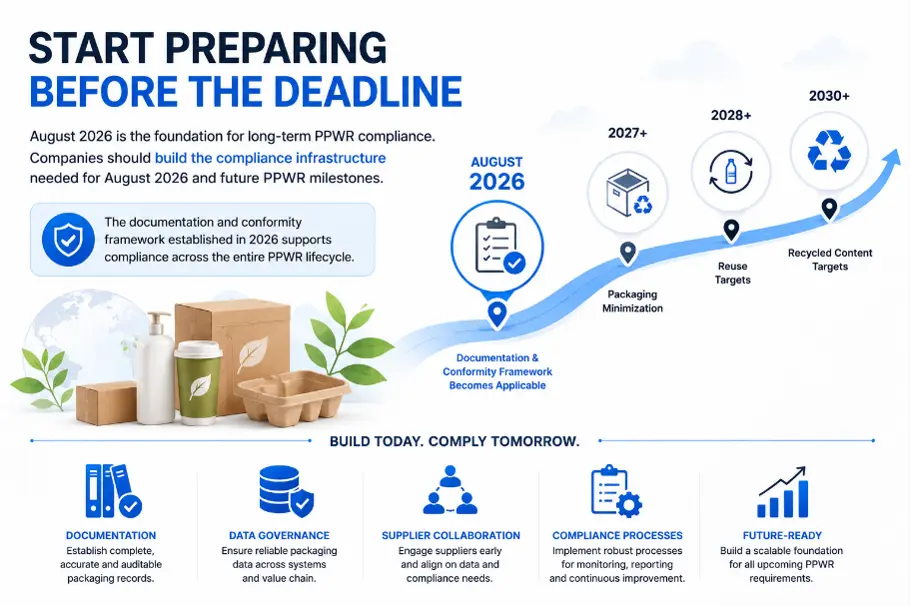
The near-term PPWR compliance pharma Importers Belgium task is documentary, not a packaging redesign the redesign obligations (recyclability grades, recycled content) phase in from 2030 to 2038. What binds you now is proof. For every unique packaging type placed on the market, you need a signed EU Declaration of Conformity (Article 39, Annex VIII), backed by a technical file demonstrating the conformity assessment (Article 38, Annex VII). Importers verify that these exist and are correct; they do not generally create them unless Article 21 has made you the manufacturer.
Note two labels that secondary sources routinely swap, because they matter for PPWR compliance pharma Importers Belgium: the Declaration of Conformity is Annex VIII; the technical file is Annex VII. Confusing them is the fastest way to fail an audit. Retention runs to five years (ten for reusable packaging), and authorities can demand the file within 10 days. Where a producer is not established in Belgium, Article 45 requires a locally established authorised representative for EPR one per Member State.
Is Your PPWR Technical Documentation Ready?Build complete, traceable technical documentation with the right packaging data, supplier evidence, assessments, and supporting records all in one workflow.
How to build your PPWR readiness roadmap
A workable PPWR compliance pharma Importers Belgium roadmap sequences the documentary work first, then the Belgian EPR registrations, then the 2030 design questions:
Build a component-level packaging inventory. Break every SKU into immediate, secondary and transport packaging, with materials and weights.
Classify each component. Mark where an Article 6/7 contact-sensitive derogation genuinely applies and document the justification.
Collect the conformity evidence. One EU Declaration of Conformity (Annex VIII) plus technical file (Annex VII) per packaging type; verify, don’t assume.
Confirm your Belgian EPR position. Register with Fost Plus and/or Valipac; set up the annual IVC/CIE declaration and diarise 28 February.
Check the Article 21 trigger. If you sell under your own brand, plan for full manufacturer obligations, not just verification.
Stand up a 10-day response process. Store documents so any packaging type’s file can be produced to authorities on request.
Most importers fail PPWR not on packaging design but on evidence: no single, current, component-level record linking each SKU to its Declaration of Conformity, its exemption justification, and its Belgian scheme. The TraceX PPWR platform is built to hold that one data layer mapping packaging components to PPWR obligations and to Fost Plus / Valipac declarations, flagging where a contact-sensitive derogation applies, and keeping every document audit-ready for the 10-day rule . The regulation rewards importers who can prove compliance on demand not those who merely believe they comply.
Manual spreadsheets vs a compliance platform
Task
Manual / spreadsheets
TraceX platform [pending sign-off]
Packaging inventory
Static sheets, drift out of date per SKU change
Live component-level records tied to each SKU
Exemption tracking
Ad-hoc notes; justification often missing
Structured Art. 6/7 derogation flags with evidence
Declaration of Conformity
Emails and shared drives; version chaos
One DoC + Annex VII file per packaging type, versioned
Belgium EPR (Fost Plus/Valipac)
Manual re-keying; deadline risk
SKU-to-scheme mapping; annual declaration export
10-day authority request
Scramble to locate files
Instant retrieval, audit-ready
See PPWR Compliance in ActionDiscover how TraceX helps you centralize packaging data, manage supplier evidence, streamline compliance workflows, and stay audit-ready.
Use this to pressure-test any tool or your own process against the obligations above:
Does it hold packaging data at component level (immediate / secondary / transport), not just per SKU?
Can it store and version an EU Declaration of Conformity (Annex VIII) and technical file (Annex VII) per packaging type?
Does it flag where an Article 6/7 contact-sensitive derogation applies and force a documented justification?
Can it map each component to Fost Plus or Valipac and export the annual IVC/CIE declaration?
Does it surface the Article 21 own-brand trigger for private-label lines?
Can it produce any file within the 10-day authority window?
Frequently Asked Questions
When does PPWR apply to pharma importers in Belgium?
PPWR (Regulation (EU) 2025/40) applies from 12 August 2026, directly and without national transposition. There is no grace period for packaging placed on the market on or after that date.
Is pharmaceutical packaging exempt from PPWR?
No blanket exemption exists. Only immediate (contact) packaging of medicinal products is excluded from certain recyclability (Art. 6) and recycled-content (Art. 7) rules, where compliance would compromise safety, quality or efficacy. Secondary cartons, leaflets and transport packaging remain fully in scope.
Does PPWR replace Fost Plus and Valipac?
No. PPWR harmonises the conformity and design framework, but Belgium’s national EPR schemes Fost Plus for household packaging and Valipac for industrial/commercial packaging, overseen by IVC/CIE continue to apply for registration, declaration and fees.
What documents must an importer hold from August 2026?
Per packaging type: the EU Declaration of Conformity (Art. 39, Annex VIII) and the supporting technical documentation showing the conformity assessment (Art. 38, Annex VII), plus evidence of required identification. Authorities can request these within 10 days (Art. 18).
What happens if I sell imported medicines under my own brand?
Article 21 treats you as the manufacturer, so you take on the full conformity obligations conformity assessment, Declaration of Conformity and technical file not just importer verification.
What is the 300 kg threshold in Belgium?
Fost Plus membership generally applies once a company places more than 300 kg of packaging on the Belgian market per year. Many pharma importers exceed this once cartons, leaflets and transport packaging are counted.
Do the recyclability grades apply now?
Not yet. Grade C is the minimum from 1 January 2030 and only grades A or B may be placed on the market from 1 January 2038 (Annex II, Table 3). The 2026 obligations are documentary conformity, DoC, labelling, minimisation and EPR.
Start using TraceX
Transparency, Trust, & Success for your Climate Journey.
We use cookies on our website to give you the most relevant experience by remembering your preferences and repeat visits. By clicking “Accept All”, you consent to the use of ALL the cookies. However, you may visit "Cookie Settings" to provide a controlled consent.
This website uses cookies to improve your experience while you navigate through the website. Out of these, the cookies that are categorized as necessary are stored on your browser as they are essential for the working of basic functionalities of the website. We also use third-party cookies that help us analyze and understand how you use this website. These cookies will be stored in your browser only with your consent. You also have the option to opt-out of these cookies. But opting out of some of these cookies may affect your browsing experience.
Necessary cookies are absolutely essential for the website to function properly. These cookies ensure basic functionalities and security features of the website, anonymously.
Cookie
Duration
Description
cookielawinfo-checkbox-analytics
11 months
This cookie is set by GDPR Cookie Consent plugin. The cookie is used to store the user consent for the cookies in the category "Analytics".
cookielawinfo-checkbox-functional
11 months
The cookie is set by GDPR cookie consent to record the user consent for the cookies in the category "Functional".
cookielawinfo-checkbox-necessary
11 months
This cookie is set by GDPR Cookie Consent plugin. The cookies is used to store the user consent for the cookies in the category "Necessary".
cookielawinfo-checkbox-others
11 months
This cookie is set by GDPR Cookie Consent plugin. The cookie is used to store the user consent for the cookies in the category "Other.
cookielawinfo-checkbox-performance
11 months
This cookie is set by GDPR Cookie Consent plugin. The cookie is used to store the user consent for the cookies in the category "Performance".
viewed_cookie_policy
11 months
The cookie is set by the GDPR Cookie Consent plugin and is used to store whether or not user has consented to the use of cookies. It does not store any personal data.
Functional cookies help to perform certain functionalities like sharing the content of the website on social media platforms, collect feedbacks, and other third-party features.
Performance cookies are used to understand and analyze the key performance indexes of the website which helps in delivering a better user experience for the visitors.
Analytical cookies are used to understand how visitors interact with the website. These cookies help provide information on metrics the number of visitors, bounce rate, traffic source, etc.
Advertisement cookies are used to provide visitors with relevant ads and marketing campaigns. These cookies track visitors across websites and collect information to provide customized ads.
Download the 2026 Traceability Scorecard and Benchmark Your Supply Chain Across 10 Critical Capabilities.
Download our eBook
Don’t Wait for an Audit to Find Your EUDR Gaps
The 2026 Simplification Package changes how HS codes, DDS pass-through and geolocation rules apply to you. Get the free guide and 20-point readiness checklist before enforcement catches you unprepared.