EUDR Simplified Declaration: Who Can Use It, What It Contains and How It Works
Published
, 10 minute read
Share this article
Quick summary: Learn what the EUDR Simplified Declaration is, who can use it, what information it contains, how it replaces per-shipment DDS and how the SD works in the EUDR Information System.
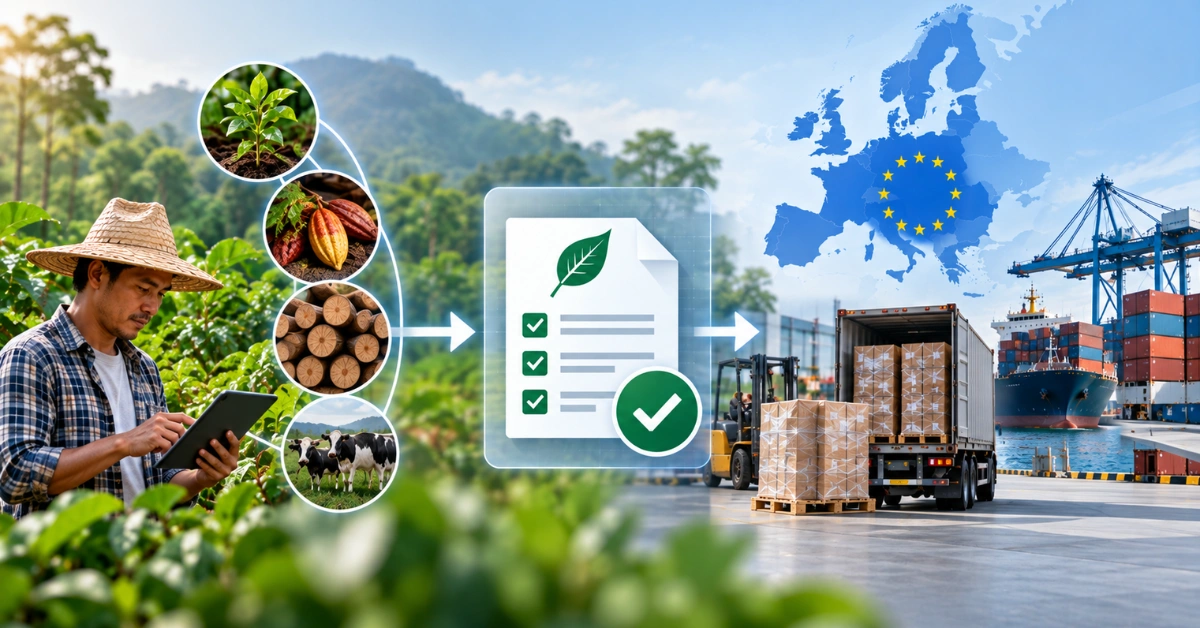
The EUDR Simplified Declaration is a one-time submission available to eligible micro or small primary operators established in low-risk countries that place on the market or export relevant products they produced themselves in that country. It replaces the per-shipment DDS for eligible operators. The declaration contains Annex III information, remains valid indefinitely unless major changes occur, and receives a declaration identifier that follows the relevant products through the supply chain. The current EUDR Information System V3 API supports submission, update, withdrawal and retrieval of Simplified Declarations.
For eligible micro or small primary operators, the EUDR Simplified Declaration (SD) provides a different way to meet the declaration requirement under the EUDR framework. Instead of submitting a separate Due Diligence Statement (DDS) for every shipment, an eligible operator can submit one Simplified Declaration covering the relevant products it produces.
The European Commission’s current EUDR Information System API documentation describes the SD as a one-time submission by micro or small primary operators established in a low-risk country, covering the information set out in Annex III and submitted before placing relevant products on the market or exporting them. Once accepted, the Information System assigns a declaration identifier that accompanies the relevant products through the supply chain in place of a DDS reference number.
This makes the Simplified Declaration important not only for eligible producers, but also for downstream businesses that receive products supported by an SD. Understanding who qualifies, what the SD contains and how its identifier flows through the supply chain is therefore essential.
Key Takeaways
EUDR Simplified Declaration (SD) is a one-time submission designed for eligible micro or small primary operators, replacing the need for a separate DDS for each shipment.
Eligibility matters. The operator must be a micro or small primary operator established in a low-risk country and must place on the market or export relevant products that they themselves produced.
The SD covers relevant EUDR commodities including cattle, cocoa, coffee, oil palm, rubber, soya and wood, along with the applicable products made from them.
An SD still requires structured product and production information, including activity type, commodity/product details, HS codes, quantities and producer information.
Production location requirements are more flexible than a standard DDS. Eligible SD operators can provide GeoJSON, a postal address or a cadastral identifier for the production location, whereas DDS geolocation requires GeoJSON.
The declaration receives a unique identifier from the EUDR Information System. This declaration identifier accompanies the relevant products through the supply chain instead of a DDS reference number.
An SD is not a “submit and forget” process. It remains valid indefinitely unless major changes occur, in which case it can be updated.
Authorised representatives can submit SDs on behalf of eligible micro or small primary operators when acting under a written mandate.
The SD can be integrated into automated compliance workflows. The current EUDR API provides dedicated operations for submitting, updating, withdrawing and retrieving Simplified Declarations.
December 2026 is approaching. Is your supply chain actually ready?
Move from spreadsheets and fragmented supplier data to a traceable, audit-ready EUDR workflow with TraceX.
An EUDR Simplified Declaration is a one-time submission in the EUDR Information System for an eligible micro or small primary operator. It contains the information specified in Annex III and is submitted before the operator places relevant products on the market or exports them.
Unlike a standard DDS, the SD is not designed as a per-shipment declaration. The current API reference states that a single simplified declaration covers all relevant products produced by the eligible operator, rather than requiring a separate declaration for each shipment. It remains valid indefinitely unless major changes occur.
This distinction is the core idea behind the SD: reduce repetitive declaration activity for a defined category of small primary producers while retaining the information needed to support EUDR traceability.
Who Is Eligible to Submit an EUDR Simplified Declaration?
Eligibility is specific. The current Information System documentation defines the relevant operator as a natural person or micro/small undertaking, irrespective of legal form, established in a low-risk country, that places on the market or exports relevant products they themselves produced in that country.
The permitted submission roles in the API are MICRO_OPERATOR and REPRESENTATIVE_MSPO, with an authorised representative able to act for a micro or small primary operator under a written mandate.
This means the SD should not be treated as a general alternative to the DDS. Businesses should first determine whether the operator, country, activity and production circumstances satisfy the eligibility conditions.
Understand your obligations, streamline compliance, and stay ready for EUDR reporting
What Products and Commodities Can Be Covered?
The current API documentation identifies the EUDR relevant commodities as cattle, cocoa, coffee, oil palm, rubber, soya and wood. The products covered by an SD are relevant products listed in Annex I that contain, have been fed with, or have been made using relevant commodities.
The underlying deforestation-free conditions remain important. The Information System documentation describes deforestation-free production as commodities produced on land not deforested after 31 December 2020 and, for wood, harvested without inducing forest degradation after that date.
When Must the Simplified Declaration Be Submitted?
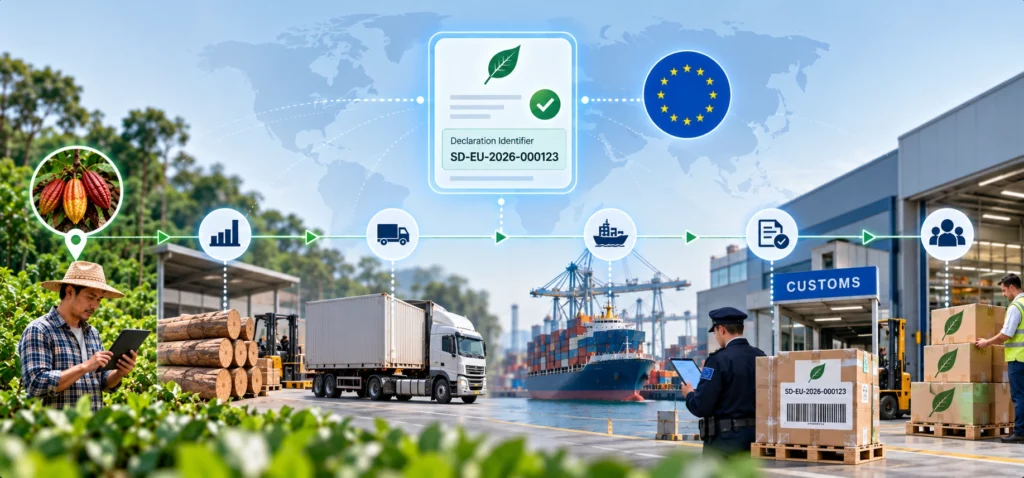
The SD must be submitted before the eligible operator places the relevant products on the market or exports them. This timing is important because the declaration identifier is subsequently used to accompany the relevant products through the supply chain in place of a DDS reference number.
In operational terms, businesses should avoid treating the SD as a document generated after a shipment has already moved. The declaration needs to be part of the upstream compliance workflow.
Is Your Commodity Supply Chain EUDR-Ready?
Know your EUDR commodities, map their origins, and build the traceability needed for compliance.
The Simplified Declaration contains information from Annex III. The API model includes an internal reference number, activity type, operator information where applicable, country of activity, border-crossing country where relevant, comments, commodities and product information, confidentiality settings for geolocation and optional references to previously submitted SD declarations for grouping.
The location requirement is particularly notable. For an SD, the producer location can be provided using GeoJSON geometry, a postal address or a cadastral identifier. This differs from the DDS model, for which GeoJSON geolocation is mandatory according to the Information System documentation.
For postal addresses, the documentation specifies required postal code and city fields, with the street and number field optional.
The Declaration Identifier: The Key Downstream Link
After successful submission, the Information System assigns a unique declaration identifier. This identifier accompanies relevant products through the supply chain in place of a DDS reference number and must be made available to customs authorities before release for free circulation or export.
This is a critical distinction. Downstream organisations should not assume that every EUDR-compliant product will arrive with a DDS reference. For products covered by a Simplified Declaration, the declaration identifier is the key reference that connects the product to the upstream compliance record.
Can a Simplified Declaration Be Updated or Withdrawn?
Yes, but the lifecycle is controlled. The current V3 API provides operations to update and withdraw an SD. An update can follow major changes to the information provided and re-triggers risk profiling. Updates are blocked when the SD is not in an available status or is subject to a customs lock.
Withdrawal is also subject to conditions. It is blocked when the SD is not in available status for example, when it has been associated with a grouped declaration or when it is under active checks by competent authorities or subject to a customs lock.
This reinforces an important operational principle: the SD is a living compliance record, not a static PDF.
Simplified Declaration and API Integration
For businesses managing EUDR data digitally, the SD is also available through a dedicated V3 API service. The current service is EUDRSimplifiedDeclarationServiceV3 and uses WS-Security UsernameToken over HTTPS. The API supports submission, update, withdrawal and retrieval operations.
Organisations supporting multiple eligible operators can therefore build the SD into a broader EUDR workflow. An internal system can maintain an operator’s own reference, submit the required information, capture the declaration identifier, and connect that identifier to products and downstream transactions.
The API also supports retrieval by the operator’s internal reference, which can help connect the EUDR Information System record back to an organisation’s own compliance or enterprise records.
Ready to Automate Your EUDR Compliance?
Connect your ERP, supplier, traceability and shipment data with EUDR APIs to reduce manual work and streamline DDS workflows.Explore TraceX EUDR APIs
What Should Businesses Do With SD Data?
Confirm whether the upstream operator is genuinely eligible for the Simplified Declaration route.
Collect and retain the declaration identifier associated with the relevant products.
Map the declaration identifier to products, suppliers, purchases and shipments in internal systems.
Understand whether the SD uses GeoJSON, a postal address or a cadastral identifier for producer location.
Monitor major changes that may require the SD to be updated.
Build downstream verification and reference checks into the supply-chain workflow.
Keep the SD record connected to supporting EUDR evidence rather than treating the identifier as the entire compliance record.
EUDR Simplified Declaration vs DDS
Feature
Simplified Declaration
DDS
Eligible submitter
Micro or small primary operator in a low-risk country meeting the eligibility conditions
Operators subject to the standard DDS route
Submission model
One-time submission covering relevant products produced by the eligible operator
Per relevant activity/shipment workflow as applicable
Validity
Indefinite unless major changes occur
Declaration-specific lifecycle
Supply-chain reference
Declaration identifier
DDS reference number
Producer location
GeoJSON, postal address or cadastral identifier may be used
GeoJSON required under the current Information System documentation
How TraceX Helps with EUDR Simplified Declarations
TraceX EUDR Solutions helps eligible micro and small primary operators organize, validate, and connect the data required for EUDR Simplified Declarations in one digital workflow. From producer and commodity information to production locations and declaration identifiers, TraceX helps reduce manual data handling and maintain a traceable compliance record. The platform can also connect SD data with suppliers, products and shipments, making it easier to manage EUDR compliance as part of day-to-day supply-chain operations.
Ready to Simplify Your EUDR Compliance?
Connect supplier data, production locations, traceability and EUDR reporting in one platform.
The first mistake is assuming that the SD is available to every small supplier. Eligibility is conditional on the operator, its establishment in a low-risk country, and the fact that it places on the market or exports products it produced itself in that country.
The second is confusing the declaration identifier with a DDS reference number. They serve the supply-chain reference function for different declaration routes, and downstream systems should be designed to handle both.
The third is treating the SD as permanently fixed. Major changes can trigger an update, and the API includes explicit lifecycle operations for updating and withdrawing declarations.
Frequently Asked Questions (FAQ’s)
What is an EUDR Simplified Declaration?
It is a one-time EUDR Information System submission by eligible micro or small primary operators, containing Annex III information and replacing the per-shipment DDS for those eligible operators.
Who can submit an SD?
A micro or small primary operator established in a low-risk country that places on the market or exports relevant products it produced itself in that country can use the route, subject to the applicable conditions. An authorised representative may also act under a written mandate.
How long is an SD valid?
The current API documentation states that the declaration remains valid indefinitely unless major changes occur.
Does an SD replace the DDS?
It replaces the per-shipment DDS for eligible micro or small primary operators covered by the Simplified Declaration route.
What reference accompanies products covered by an SD?
The Information System assigns a declaration identifier, which accompanies relevant products through the supply chain in place of a DDS reference number.
Can an SD use a postal address instead of GeoJSON?
Yes. The current Information System documentation allows GeoJSON geometry, a postal address or a cadastral identifier for SD producer locations.
Can an SD be updated?
Yes. The V3 API supports updates following major changes, and an update re-triggers risk profiling.
Can an SD be submitted through an API?
Yes. The EUDRSimplifiedDeclarationServiceV3 supports submission and lifecycle operations through the API.
Start using TraceX
Transparency, Trust, & Success for your Climate Journey.
We use cookies on our website to give you the most relevant experience by remembering your preferences and repeat visits. By clicking “Accept All”, you consent to the use of ALL the cookies. However, you may visit "Cookie Settings" to provide a controlled consent.
This website uses cookies to improve your experience while you navigate through the website. Out of these, the cookies that are categorized as necessary are stored on your browser as they are essential for the working of basic functionalities of the website. We also use third-party cookies that help us analyze and understand how you use this website. These cookies will be stored in your browser only with your consent. You also have the option to opt-out of these cookies. But opting out of some of these cookies may affect your browsing experience.
Necessary cookies are absolutely essential for the website to function properly. These cookies ensure basic functionalities and security features of the website, anonymously.
Cookie
Duration
Description
cookielawinfo-checkbox-analytics
11 months
This cookie is set by GDPR Cookie Consent plugin. The cookie is used to store the user consent for the cookies in the category "Analytics".
cookielawinfo-checkbox-functional
11 months
The cookie is set by GDPR cookie consent to record the user consent for the cookies in the category "Functional".
cookielawinfo-checkbox-necessary
11 months
This cookie is set by GDPR Cookie Consent plugin. The cookies is used to store the user consent for the cookies in the category "Necessary".
cookielawinfo-checkbox-others
11 months
This cookie is set by GDPR Cookie Consent plugin. The cookie is used to store the user consent for the cookies in the category "Other.
cookielawinfo-checkbox-performance
11 months
This cookie is set by GDPR Cookie Consent plugin. The cookie is used to store the user consent for the cookies in the category "Performance".
viewed_cookie_policy
11 months
The cookie is set by the GDPR Cookie Consent plugin and is used to store whether or not user has consented to the use of cookies. It does not store any personal data.
Functional cookies help to perform certain functionalities like sharing the content of the website on social media platforms, collect feedbacks, and other third-party features.
Performance cookies are used to understand and analyze the key performance indexes of the website which helps in delivering a better user experience for the visitors.
Analytical cookies are used to understand how visitors interact with the website. These cookies help provide information on metrics the number of visitors, bounce rate, traffic source, etc.
Advertisement cookies are used to provide visitors with relevant ads and marketing campaigns. These cookies track visitors across websites and collect information to provide customized ads.
Download the 2026 Traceability Scorecard and Benchmark Your Supply Chain Across 10 Critical Capabilities.
Download our eBook
Don’t Wait for an Audit to Find Your EUDR Gaps
The 2026 Simplification Package changes how HS codes, DDS pass-through and geolocation rules apply to you. Get the free guide and 20-point readiness checklist before enforcement catches you unprepared.