EUDR Reference Number Management: How to Maintain Submission Records
Published
, 11 minute read
Share this article
Quick summary: EUDR Reference Number Management helps link DDS records to products, shipments, suppliers, evidence, and downstream traceability for audit-ready compliance.
A practical guide to tracking, connecting and retaining EUDR submission records
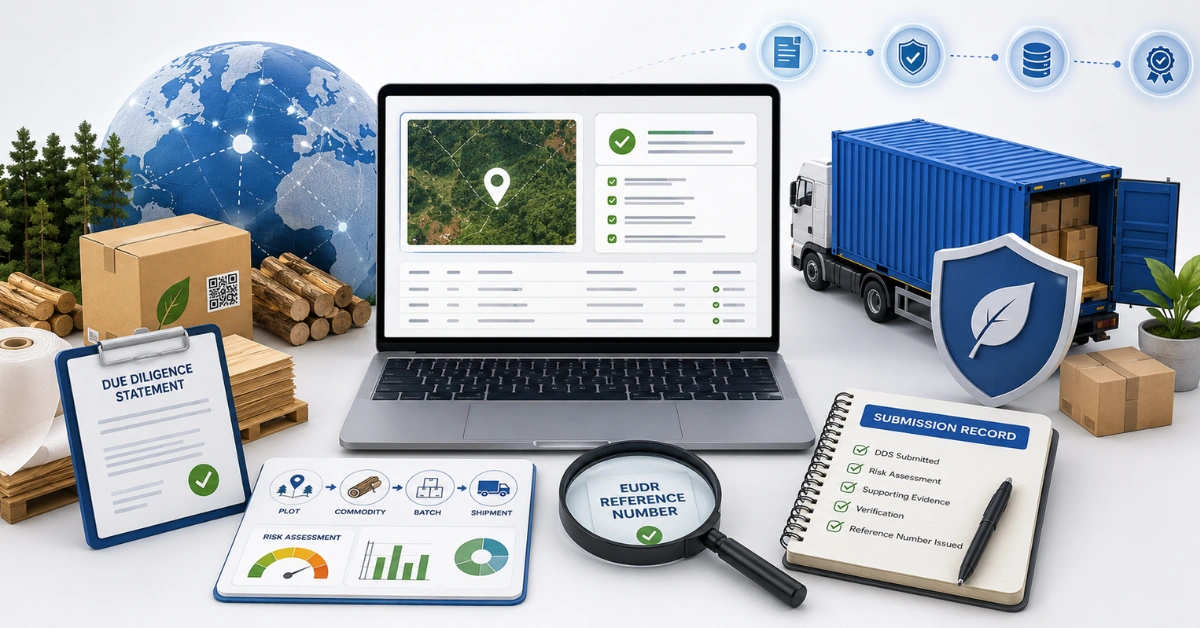
EUDR Reference Number management an operational traceability task not simply an administrative activity. An EUDR Due Diligence Statement (DDS) does not end when the submission is accepted. The reference number generated by the EUDR Information System becomes an important link between the submitted due-diligence record and the relevant product moving through the supply chain.
The European Commission states that once a DDS has been accepted in the Information System, the operator may place the product on the market or export it, and the operator must pass the DDS number to its direct downstream buyer for traceability.
The real value of an EUDR Reference Number is not the number itself. It is the ability to connect that number to the product, shipment, supplier, due-diligence evidence and downstream transaction it represents.
Key Takeaways:
Every DDS needs traceable submission records: Maintain a clear link between the Due Diligence Statement and the relevant products, suppliers, transactions and supporting evidence.
Reference numbers are critical identifiers: They help organisations retrieve and track submitted DDS records efficiently.
Keep submission history organised: Maintain records of reference numbers, submission status, dates and related DDS information in a structured system.
Connect DDS records to the supply chain: A reference number should lead back to the relevant commodity, supplier, farm geolocation, batch and compliance assessment.
Avoid spreadsheet dependency: Managing large volumes of DDS reference numbers manually can create duplication, missing records and retrieval challenges.
Make records audit-ready: Structured reference-number management helps teams quickly retrieve the evidence associated with a particular submission.
Support post-submission tracking: Maintain visibility of DDS records even after submission so compliance teams can manage historical submissions effectively.
The bigger takeaway:An EUDR reference number isn’t just a submission ID,it should be the gateway to the complete compliance record behind that submission.
Experience a connected EUDR workflow with TraceX.
See how digital traceability can make your compliance process more efficient, scalable and audit-ready.
An EUDR Reference Number is the identifier generated by the EUDR Information System for an accepted Due Diligence Statement. It provides a reference to the submitted statement and supports traceability between upstream due diligence and relevant products moving downstream.
The European Commission’s Information System allows operators and authorised representatives to create, submit and manage DDSs and simplified declarations. The system assigns the relevant reference number or declaration identifier to the submitted record.
It is important to distinguish a DDS reference number from a simplified declaration identifier. Micro and small primary operators using the simplified declaration process receive a declaration identifier rather than a standard DDS reference number.
Filing a DDS is more than entering information into the EUDR Information System. Your submission depends on having accurate product data, supplier information, geolocation, risk assessment and supporting evidence ready beforehand.
In a complex supply chain, one company may handle many suppliers, commodities, batches, products and shipments. A single DDS can potentially cover multiple shipments or batches, while one customs declaration can also contain multiple DDS reference numbers or declaration identifiers, subject to the applicable requirements.
This creates a record-management challenge.
Which EUDR Reference Number supports this product?
Which supplier and source plots are covered?
Which batch or shipment is linked to the DDS?
When was the statement submitted and accepted?
Who submitted it?
Has the reference number been communicated to the appropriate downstream party?
Can the business retrieve the supporting due-diligence record if requested?
Without a structured approach, teams can end up maintaining reference numbers in spreadsheets, emails, ERP notes and shipment folders making reconciliation difficult.
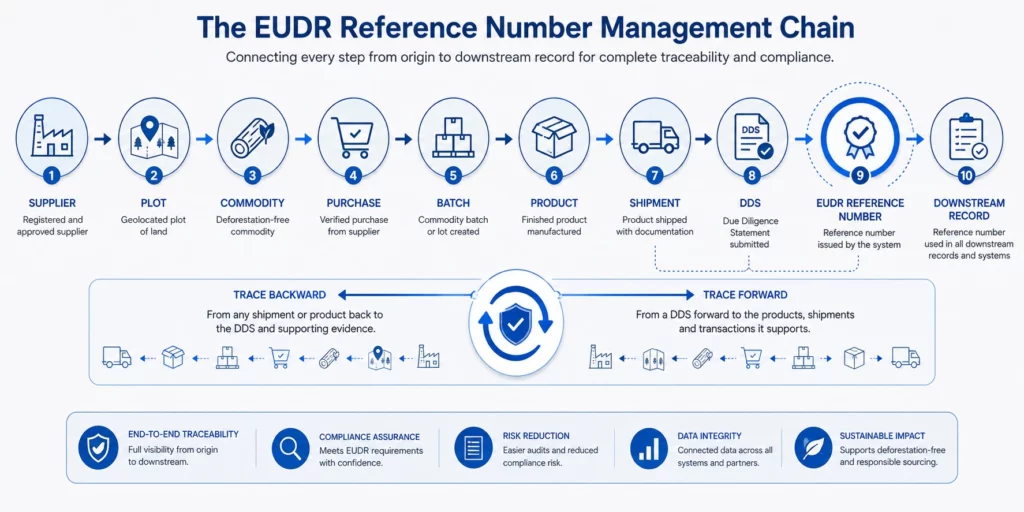
The reference number should sit within this chain rather than outside it.
That makes it possible to move in both directions: from a shipment back to the DDS and supporting evidence, or from a DDS forward to the products and transactions it supports.
1. Create a Central EUDR Reference Number Register
The first step is to create a controlled register of submitted DDSs and their identifiers.
EUDR Reference Number
DDS submission date
DDS status
Operator or submitting entity
Product and HS/CN classification
Commodity
Quantity
Country of production
Relevant supplier
Associated batch or shipment
Related evidence record
Downstream communication status
The exact fields should reflect the organisation’s compliance process and applicable EUDR requirements.
2. Link the Reference Number to the Product
A reference number has limited operational value if it is stored without product context.
Businesses should establish a relationship between the EUDR Reference Number and the relevant product, commodity and quantity. This is particularly important when a company manages multiple similar products or shipments from different sourcing origins.
The EUDR Information System itself supports viewing and managing DDSs through a dashboard, while bulk management is also available through an API.
3. Connect DDS Records to Batches and Shipments
The next level of traceability is connecting the DDS to the physical movement of goods.
This allows logistics, customs and compliance teams to work from the same traceability relationship.
For imports, the DDS reference number or simplified declaration identifier must be available to customs authorities through the customs declaration. The Commission states that due diligence and submission must occur before the customs declaration is lodged for the relevant product.
EUDR traceability requires more than knowing who your supplier is. Businesses need to connect origin, farm geolocation, suppliers, transactions, batches and products to build a defensible compliance trail.
4. Understand When One Reference Number Covers Multiple Shipments
Businesses should not automatically assume that every shipment requires a unique DDS.
The Commission states that where a DDS covers multiple shipments or batches, the same DDS reference number can be referred to in several customs declarations, provided the legal requirements of the EUDR are respected. Multiple reference numbers or declaration identifiers can also be included in one customs declaration.
This makes relationship management more important than simple one-to-one numbering.
DDS consolidation can help simplify compliance when multiple transactions or product flows need to be managed across the same supply chain. Learn how to organise DDS records, connect submissions with underlying traceability data, and maintain a clear compliance trail.
Reference numbers also have a role beyond the organisation that submitted the DDS.
Operators must pass the DDS number generated by the Information System to their direct downstream buyers for traceability.
Under the current Commission guidance, the first downstream operator or trader must collect and keep DDS reference numbers or simplified declaration identifiers for at least five years, but does not need to pass those numbers or identifiers to its own buyers. citeturn0search0
This makes it important to distinguish the different roles in the supply chain rather than assuming every company has the same reference-number obligation.
Downstream operators face specific responsibilities when placing or making relevant products available on the EU market. Understanding how supplier information, Due Diligence Statements, traceability records and risk information flow through your supply chain is critical.
6. Maintain the Audit Trail Behind the Reference Number
A reference number should lead back to the evidence supporting the due-diligence decision.
That can include:
Supplier information
Farm and plot geolocation
Production information
Purchase and transaction records
Quantity calculations
Legality evidence
Deforestation-free assessment
Risk assessment
Risk-mitigation activities
Approval records
The Commission states that operators must maintain their due-diligence system and retain documents related to due diligence for five years from the date the product is placed on the EU market or exported.
7. Track Reference Number Status
A good EUDR Reference Number management process should distinguish between different submission states.
Draft or not yet submitted
Submitted
Accepted
Rejected or requiring correction
Linked to shipment
Communicated downstream
Archived
The EUDR Information System provides a dashboard for viewing and managing submissions, with status updates as records are processed.
Keeping internal workflow status aligned with the official submission status can reduce confusion when several teams are working on the same transaction.
8. Avoid Manual Reference Number Management
Spreadsheets can be useful for an initial register, but they become harder to control as transaction volumes grow.
Common problems include:
Duplicate reference numbers being entered incorrectly
Reference numbers not linked to the right shipment
Manual copy-and-paste errors
Missing downstream communication records
Difficulty identifying which DDS covers a particular batch
Disconnected supporting evidence
Limited visibility into submission status
A digital traceability layer can reduce these risks by making the reference number part of the product and transaction record.
How TraceX Can Help With EUDR Reference Number Management
TraceX EUDR Solutions can help organisations connect EUDR submission records with the broader supply-chain data behind them.
Maintain structured EUDR Reference Number records.
Connect DDS references to products, commodities, batches and shipments.
Link supplier and farm-level traceability information to relevant due-diligence records.
Associate supporting evidence with the compliance record.
Track internal submission and approval status.
Maintain downstream reference-number communication records.
Provide an auditable trace from shipment back to the underlying due-diligence information.
The objective is not to create another reference-number spreadsheet. It is to make the EUDR Reference Number part of a connected traceability record.
Ready to strengthen your EUDR submission and reference-number management?
Explore how TraceX can connect EUDR data, due diligence, traceability and submission records in one structured workflow.
Don’t Manage the Number. Manage What the Number Represents.
The biggest mistake businesses can make is treating the EUDR Reference Number as a standalone compliance field.
A number without context does not tell your team which product it supports, where the commodity originated, which supplier provided it or what evidence was used to reach the due-diligence conclusion.
The better approach is to treat the reference number as a digital link:
This turns reference-number management into a traceability capability rather than an administrative exercise.
EUDR Reference Number management is becoming an important part of supply-chain traceability. The reference number connects the formal due-diligence submission with the products, shipments and downstream relationships that depend on it.
The strongest approach is therefore not to maintain a list of numbers, but to build a connected record around every number linking it to the product, source, batch, shipment, evidence and relevant downstream transaction.
EUDR Reference Number Management Checklist
DDS submitted and accepted before the applicable market placement or export event
EUDR Reference Number captured accurately
Reference number linked to the relevant product
Quantity and shipment context recorded
Supplier and source information connected
Relevant batches or shipments mapped
Supporting due-diligence evidence retained
Downstream communication completed where applicable
Reference number status tracked
Records retained for the required period
Frequently Asked Questions (FAQ’s)
What is an EUDR Reference Number?
It is the identifier generated by the EUDR Information System for an accepted Due Diligence Statement. It supports traceability between the submitted statement and relevant products in the supply chain.
When do I receive an EUDR Reference Number?
The EUDR Information System generates the reference number for a DDS submitted through the system. For products requiring a DDS, due diligence and submission must be completed before the relevant product is placed on the EU market or exported.
Who needs the EUDR Reference Number?
The operator receives the reference number and must pass it to the direct downstream buyer for traceability. The first downstream operator or trader must collect and retain applicable DDS reference numbers or simplified declaration identifiers for at least five years.
Can one EUDR Reference Number cover multiple shipments?
Yes, where a DDS covers multiple shipments or batches, the same reference number can be used in several customs declarations provided the EUDR’s legal requirements are met.
How long should EUDR records be retained?
Operators must keep documents related to due diligence for five years from the date the relevant product is placed on the EU market or exported. First downstream operators or traders must also keep applicable DDS reference numbers or simplified declaration identifiers for at least five years
What is the difference between a DDS reference number and a simplified declaration identifier?
A DDS reference number identifies a submitted Due Diligence Statement. A simplified declaration identifier is generated for the simplified declaration process available to eligible micro and small primary operators.
Start using TraceX
Transparency, Trust, & Success for your Climate Journey.
We use cookies on our website to give you the most relevant experience by remembering your preferences and repeat visits. By clicking “Accept All”, you consent to the use of ALL the cookies. However, you may visit "Cookie Settings" to provide a controlled consent.
This website uses cookies to improve your experience while you navigate through the website. Out of these, the cookies that are categorized as necessary are stored on your browser as they are essential for the working of basic functionalities of the website. We also use third-party cookies that help us analyze and understand how you use this website. These cookies will be stored in your browser only with your consent. You also have the option to opt-out of these cookies. But opting out of some of these cookies may affect your browsing experience.
Necessary cookies are absolutely essential for the website to function properly. These cookies ensure basic functionalities and security features of the website, anonymously.
Cookie
Duration
Description
cookielawinfo-checkbox-analytics
11 months
This cookie is set by GDPR Cookie Consent plugin. The cookie is used to store the user consent for the cookies in the category "Analytics".
cookielawinfo-checkbox-functional
11 months
The cookie is set by GDPR cookie consent to record the user consent for the cookies in the category "Functional".
cookielawinfo-checkbox-necessary
11 months
This cookie is set by GDPR Cookie Consent plugin. The cookies is used to store the user consent for the cookies in the category "Necessary".
cookielawinfo-checkbox-others
11 months
This cookie is set by GDPR Cookie Consent plugin. The cookie is used to store the user consent for the cookies in the category "Other.
cookielawinfo-checkbox-performance
11 months
This cookie is set by GDPR Cookie Consent plugin. The cookie is used to store the user consent for the cookies in the category "Performance".
viewed_cookie_policy
11 months
The cookie is set by the GDPR Cookie Consent plugin and is used to store whether or not user has consented to the use of cookies. It does not store any personal data.
Functional cookies help to perform certain functionalities like sharing the content of the website on social media platforms, collect feedbacks, and other third-party features.
Performance cookies are used to understand and analyze the key performance indexes of the website which helps in delivering a better user experience for the visitors.
Analytical cookies are used to understand how visitors interact with the website. These cookies help provide information on metrics the number of visitors, bounce rate, traffic source, etc.
Advertisement cookies are used to provide visitors with relevant ads and marketing campaigns. These cookies track visitors across websites and collect information to provide customized ads.
Download the 2026 Traceability Scorecard and Benchmark Your Supply Chain Across 10 Critical Capabilities.
Download our eBook
Don’t Wait for an Audit to Find Your EUDR Gaps
The 2026 Simplification Package changes how HS codes, DDS pass-through and geolocation rules apply to you. Get the free guide and 20-point readiness checklist before enforcement catches you unprepared.