Battery Supply Chain Traceability: A Complete Guide for DPP-Ready Manufacturers
Published
, 11 minute read
Share this article
Quick summary: Battery supply chain traceability is the backbone of a compliant battery DPP. Learn how to trace materials from mine to recycling before the 2027 deadline.
Battery supply chain traceability is the ability to identify, capture, and connect verified data about every material, component, and supplier that goes into a battery from the mine, through cells, modules and packs, to the finished product and on to recycling. Under the EU Battery Regulation (Regulation (EU) 2023/1542), that connected record is what makes a compliant battery Digital Product Passport (DPP) possible. From 18 February 2027, every EV, LMT, and industrial battery above 2 kWh placed on the EU market must carry a battery passport accessible by QR code and it can only be as trustworthy as the traceability behind it.
KEY TAKEAWAYS
Two deadlines, one data model: The battery passport (Art. 77) applies from 18 February 2027 for EV, LMT, and industrial batteries above 2 kWh; supply-chain due diligence (Art. 48) applies from 18 August 2027 after the Omnibus IV “stop-the-clock” delay.
The passport is only the surface: A DPP is a live data record, not a PDF. It needs mine-to-recycling data connected across tiers, batches, and serial numbers.
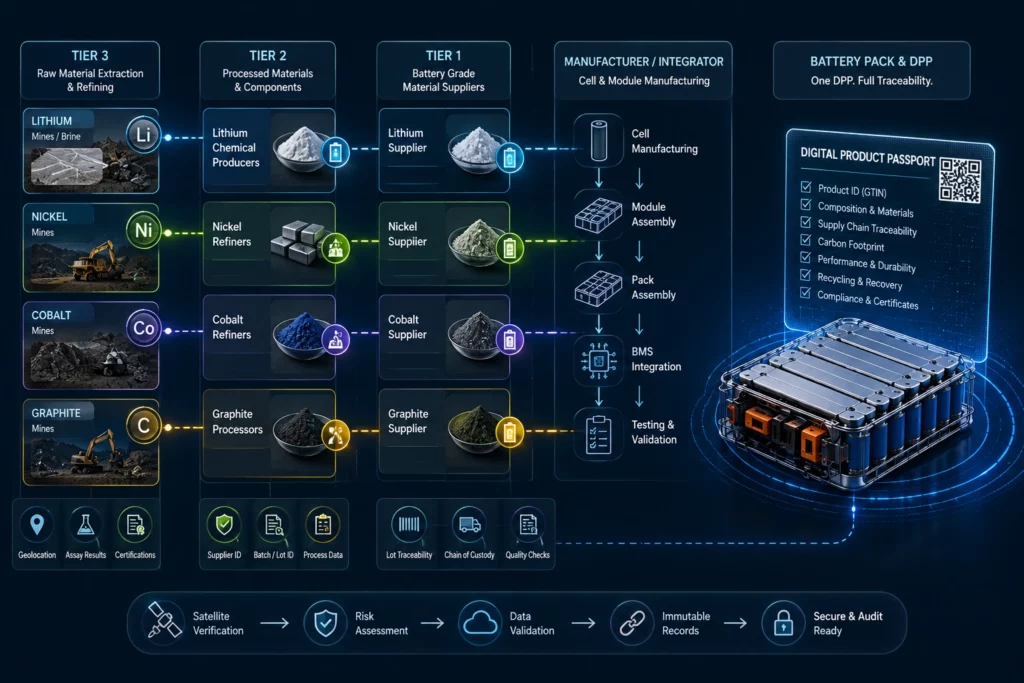
Four critical raw materials: Cobalt, lithium, nickel, and natural graphite drive the hardest traceability work visibility usually breaks below tier 2.
Build the data layer once: Enforcement readiness is a retrieval problem, not a policy problem you need to produce the evidence on demand, per battery.
Battery DPP introduces new expectations around battery data, traceability, sustainability information and digital access across the battery lifecycle.
Our eBook breaks down the key requirements and practical considerations businesses need to understand as they prepare for implementation.
At its simplest, battery supply chain traceability means connecting verified data across every step a battery takes before and after it reaches the market. It answers three questions regulators and customers now ask together: where did the materials come from, who handled them, and can you prove it? For years, manufacturers treated this as a sustainability nice-to-have. The EU Battery Regulation turned it into a market-access condition.
This is why battery supply chain traceability sits at the centre of DPP readiness. The passport itself is thin a unique identifier, a QR code, and a set of data fields defined in Annex XIII. The weight sits underneath it: the sourcing records, supplier declarations, carbon-footprint inputs, and chain-of-custody evidence that populate those fields. A battery DPP with no traceability behind it is an empty shell that will not survive a market-surveillance check.
A battery passport is only as compliant as the traceability data feeding it. The QR code is the easy part; the connected supply-chain record is the moat.
Preparing for the EU Battery Digital Product Passport?
Our guide to Battery DPP explains what manufacturers need to understand about battery identity, material composition, environmental performance, compliance information and lifecycle dataand how these elements come together into a structured digital record.
How to Trace Battery Materials From Mine to Battery
Battery supply chain traceability starts at the mine. The Battery Regulation’s due-diligence obligations (Article 48, Annex X) single out four critical raw materials cobalt, lithium, nickel, and natural graphite because their supply chains carry the highest human-rights and environmental risk and the lowest visibility. Tracing them from extraction to finished battery is the hardest, and most scrutinised, part of the job.
Raw material traceability for DPP compliance
Battery raw material traceability for DPP compliance means being able to tie each unit of cobalt, lithium, nickel, or graphite in a battery back to its origin, its processing route, and the risk assessment applied to it. That evidence feeds both the Annex XIII passport fields and the Article 48 due-diligence policy one data set, two obligations. Certification schemes and responsible-sourcing programmes support this work, but they do not replace origin data and documented risk mitigation.
Origin evidence: Capture point of extraction, refiner, and each transfer of custody for the four Annex X materials.
Risk linkage: Attach the risk assessment and mitigation actions to the material record, not a separate spreadsheet.
Audit trail: Keep records retrievable per battery model and batch, ready for third-party verification.
Are you ready for Battery DPP compliance?
Our guide to Battery DPP Compliance Requirements breaks down the key information manufacturers need to preparefrom battery identification and material composition to environmental performance, compliance evidence and lifecycle information.
Battery Component Traceability: Cells, Modules and Packs
Once materials become parts, battery supply chain traceability now extends to cells, modules, and packs. Each level has its own identity and its own suppliers, and the DPP has to reconcile them into one coherent record for the finished battery placed on the market. A pack assembled in Europe may contain cells from three continents; without component-level traceability, the passport cannot honestly describe what is inside.
Bottom-up identity: Cell-level data (chemistry, energy content, manufacturing location, date) roll up into module and pack records.
One accountable party: The economic operator placing the battery on the market owns passport accuracy even for data generated by upstream suppliers.
Measured attributes: Performance and durability attributes (capacity, cycle life, state of health) attach at the level where they are measured.
Multi-Tier Battery Supplier Traceability and Tier 2–3 Mapping
Multi-tier battery supplier mapping is where battery supply chain traceability usually breaks. Most manufacturers can see tier 1 their direct suppliers clearly. Visibility fades at tier 2 and disappears by tier 3, which is exactly where the mines, refiners, and cell producers sit. Battery tier 2 and tier 3 supplier mapping is therefore not an edge case; it is the core of the regulation’s intent.
The practical fix is to make each supplier responsible for passing structured data to the tier above them, rather than trying to interview the entire chain yourself. When every tier submits consistent, machine-readable declarations, the map assembles itself and the same data serves the passport, the due-diligence policy, and the carbon-footprint declaration at once.
Multi-tier visibility is a data-collection design problem, not a headcount problem. Push structured declarations upstream instead of chasing the chain downstream.
Battery Chain of Custody and the Digital Product Passport
A battery chain of custody turns battery supply chain traceability into an unbroken, verifiable sequence: each handover of material or component is recorded, timestamped, and linked to the parties involved. This is what lets a DPP claim that recycled-content or origin figures are real rather than estimated the chain of custody is the proof layer beneath the declared numbers.
How to connect supplier data to a battery DPP
Connecting supplier data to a battery DPP means mapping each supplier’s declaration to the specific Annex XIII field it populates, then keeping that link current as products and suppliers change. The reliable pattern is a single data layer that ingests supplier submissions once and outputs to the passport, the due-diligence file, and internal reporting instead of re-keying the same facts into three systems.
Structured intake: Standardise the submission format so every supplier reports the same fields the same way.
Validation at the door: Validate on entry flag missing origin, expired certificates, or unverified custody before they reach the passport.
Point-in-time proof: Version the record so you can show what the passport said, and on what evidence, at any past date.
Batch and Serial Number Traceability for DPP Compliance
Batch and serial-level battery supply chain traceability is what makes a passport specific rather than generic. The regulation requires both model-level information and information specific to the individual battery, accessed through a unique identifier and QR code aligned to recognised standards. That means your data has to resolve down to the batch and, for the individual-battery fields, to the serial number.
Battery batch traceability for DPP compliance
Battery batch traceability groups units that share materials, processing, and test results, so a sourcing change or a quality event can be traced to exactly the batteries it affects essential for recalls, warranty, and evidence requests. Battery serial number traceability then makes each unit individually addressable: scan the QR code, resolve the unique identifier, and reach that battery’s record. Together they let the DPP carry both the shared model story and the individual-unit facts the regulation demands.
Battery Traceability From Manufacturing to Recycling
Battery supply chain traceability does not end at the factory gate. The Battery Regulation is built around the full lifecycle, so the passport must stay useful through use, second life, and recycling. Battery traceability from manufacturing to recycling gives recyclers the chemistry and composition data they need to recover materials efficiently, and it closes the loop back to recycled-content declarations on the next generation of batteries.
Lifecycle continuity: End-of-life data (state of health, composition, dismantling information) has to remain accessible via the same identifier years after sale.
Closed loop: Recovered-material data flows back into recycled-content evidence, turning traceability into a circular-economy asset, not just a compliance cost.
One data layer, many regulations. Battery supply chain traceability, the battery DPP, Article 48 due diligence, and carbon-footprint declarations are not four projects they draw on the same underlying supply-chain data. The TraceX platform is designed to capture that data once, at the tier where it originates, and serve every obligation from a single source
Enforcement readiness is a retrieval problem. When a market-surveillance authority asks for proof, the question is not whether you have a policy it is whether you can produce the origin, custody, and batch evidence for a specific battery, on demand. TraceX is built to make that retrieval fast and per-unit
TraceX Battery DPP Solutions helps battery manufacturers build the supply-chain traceability foundation needed for a DPP-ready operation by connecting data across suppliers, raw materials, components, manufacturing, battery records and lifecycle activities. It enables structured supplier data collection, product and batch-level traceability, and links compliance evidence such as certificates, declarations and test reports directly to relevant product records. TraceX also helps teams monitor DPP readiness, data quality and missing supplier information, while connecting ERP, PLM and other enterprise systems into a structured data layer. This gives manufacturers greater visibility from source to battery and beyond manufacturing, helping turn fragmented supply-chain information into a connected, auditable record that can support Battery DPP implementation.
See how the TraceX platform captures mine-to-recycling data once and serves your battery passport, due-diligence, and carbon-footprint obligations from a single source
Battery Supply Chain Traceability: Manual Effort vs a Traceability Platform
The gap between spreadsheet-based tracking and a purpose-built platform widens sharply once you move past tier 1 and toward per-battery evidence.
Capability
Manual / spreadsheets
TraceX platform
Tier 2–3 supplier mapping
Breaks down; relies on email chases
Structured upstream declarations assemble the map
Per-battery evidence retrieval
Hours of digging across files
Scan-to-record via unique identifier
One data set, many obligations
Re-keyed into DPP, due diligence, CFP
Single data layer feeds all three
Batch & serial resolution
Manual, error-prone
Native batch and serial traceability
Audit / surveillance readiness
Reactive scramble
On-demand, versioned proof
Manufacturing-to-recycling data
Lost after sale
Persistent lifecycle record
Buyer’s Checklist: Evaluating a Battery Supply Chain Traceability Platform
Use this checklist when evaluating a battery supply chain traceability platform against your 2027 DPP and due-diligence obligations:
Maps to Annex XIII passport fields and Article 48 due-diligence data without duplicate data entry.
Handles tier 2 and tier 3 supplier mapping through structured, machine-readable supplier declarations.
Traces the four Annex X critical raw materials (cobalt, lithium, nickel, natural graphite) to origin.
Resolves to both batch and individual serial number via a unique identifier and QR code (ISO/IEC 15459 or equivalent).
Produces per-battery evidence on demand for market-surveillance and third-party verification.
Retains manufacturing-to-recycling data accessible through the same identifier across the lifecycle.
Feeds carbon-footprint and recycled-content declarations from the same underlying data layer.
Versions records so you can show what the passport stated, and on what evidence, at any past date.
Frequently Asked Questions (FAQ’s)
What is battery supply chain traceability?
It is the practice of capturing and connecting verified data about every material, component, and supplier in a battery from mine to recycling so the information can be trusted, retrieved, and used to populate a battery Digital Product Passport.
When does the EU battery passport become mandatory?
From 18 February 2027, every electric-vehicle battery, light-means-of-transport (LMT) battery, and industrial battery above 2 kWh placed on the EU market must carry a battery passport accessible via QR code, under Article 77 of Regulation (EU) 2023/1542.
When do battery due-diligence obligations apply?
Supply-chain due-diligence obligations under Article 48 apply from 18 August 2027, after a two-year postponement introduced by Regulation (EU) 2025/1561 (the Omnibus IV “stop-the-clock” amendment). The passport deadline of 18 February 2027 was not changed, so the two run about six months apart.
Which raw materials must be traced under the Battery Regulation?
The due-diligence rules focus on four critical raw materials: cobalt, lithium, nickel, and natural graphite (Annex X). These carry the highest supply-chain risk and the lowest visibility, so they require origin-level traceability.
Is a battery DPP just a QR code?
No. The QR code and unique identifier are only the access point. Behind them sits a live data record defined largely in Annex XIII that depends entirely on the traceability data collected across the supply chain.
Who is responsible for battery passport accuracy?
The economic operator that places the battery on the EU market is responsible for ensuring the passport data is accurate, complete, accessible, and up to date even for information generated by upstream suppliers.
How does batch and serial number traceability fit the DPP?
The passport carries both model-level information and information specific to the individual battery. Batch traceability groups units by shared materials and processing; serial-number traceability makes each unit individually addressable via its unique identifier.
Start using TraceX
Transparency, Trust, & Success for your Climate Journey.
We use cookies on our website to give you the most relevant experience by remembering your preferences and repeat visits. By clicking “Accept All”, you consent to the use of ALL the cookies. However, you may visit "Cookie Settings" to provide a controlled consent.
This website uses cookies to improve your experience while you navigate through the website. Out of these, the cookies that are categorized as necessary are stored on your browser as they are essential for the working of basic functionalities of the website. We also use third-party cookies that help us analyze and understand how you use this website. These cookies will be stored in your browser only with your consent. You also have the option to opt-out of these cookies. But opting out of some of these cookies may affect your browsing experience.
Necessary cookies are absolutely essential for the website to function properly. These cookies ensure basic functionalities and security features of the website, anonymously.
Cookie
Duration
Description
cookielawinfo-checkbox-analytics
11 months
This cookie is set by GDPR Cookie Consent plugin. The cookie is used to store the user consent for the cookies in the category "Analytics".
cookielawinfo-checkbox-functional
11 months
The cookie is set by GDPR cookie consent to record the user consent for the cookies in the category "Functional".
cookielawinfo-checkbox-necessary
11 months
This cookie is set by GDPR Cookie Consent plugin. The cookies is used to store the user consent for the cookies in the category "Necessary".
cookielawinfo-checkbox-others
11 months
This cookie is set by GDPR Cookie Consent plugin. The cookie is used to store the user consent for the cookies in the category "Other.
cookielawinfo-checkbox-performance
11 months
This cookie is set by GDPR Cookie Consent plugin. The cookie is used to store the user consent for the cookies in the category "Performance".
viewed_cookie_policy
11 months
The cookie is set by the GDPR Cookie Consent plugin and is used to store whether or not user has consented to the use of cookies. It does not store any personal data.
Functional cookies help to perform certain functionalities like sharing the content of the website on social media platforms, collect feedbacks, and other third-party features.
Performance cookies are used to understand and analyze the key performance indexes of the website which helps in delivering a better user experience for the visitors.
Analytical cookies are used to understand how visitors interact with the website. These cookies help provide information on metrics the number of visitors, bounce rate, traffic source, etc.
Advertisement cookies are used to provide visitors with relevant ads and marketing campaigns. These cookies track visitors across websites and collect information to provide customized ads.
Download the 2026 Traceability Scorecard and Benchmark Your Supply Chain Across 10 Critical Capabilities.
Download our eBook
Don’t Wait for an Audit to Find Your EUDR Gaps
The 2026 Simplification Package changes how HS codes, DDS pass-through and geolocation rules apply to you. Get the free guide and 20-point readiness checklist before enforcement catches you unprepared.