Battery DPP Data: Every Data Point the EU Battery Passport Requires by 2027
Published
, 10 minute read
Share this article
Quick summary: Battery DPP data explained: all 11 data points the EU battery passport requires from 18 Feb 2027 - identity, carbon footprint, recycled content, SoH and more.
Battery DPP data is the structured, machine-readable set of identity, sustainability, composition and lifecycle information that every in-scope battery must carry in its digital battery passport under the EU Battery Regulation (Regulation (EU) 2023/1542). From 18 February 2027, EV batteries, light-means-of-transport (LMT) batteries and industrial batteries above 2 kWh cannot be placed on the EU market without a passport linked by QR code to a unique identifier. Article 77 and Annex XIII define the data every operator is accountable for roughly 80 mandatory attributes for EV batteries alone.
Key takeaways
Deadline is fixed: the battery passport is mandatory from 18 February 2027 it is law, not a pilot.
Data is defined by Article 77 + Annex XIII: ~80 mandatory attributes across seven content clusters.
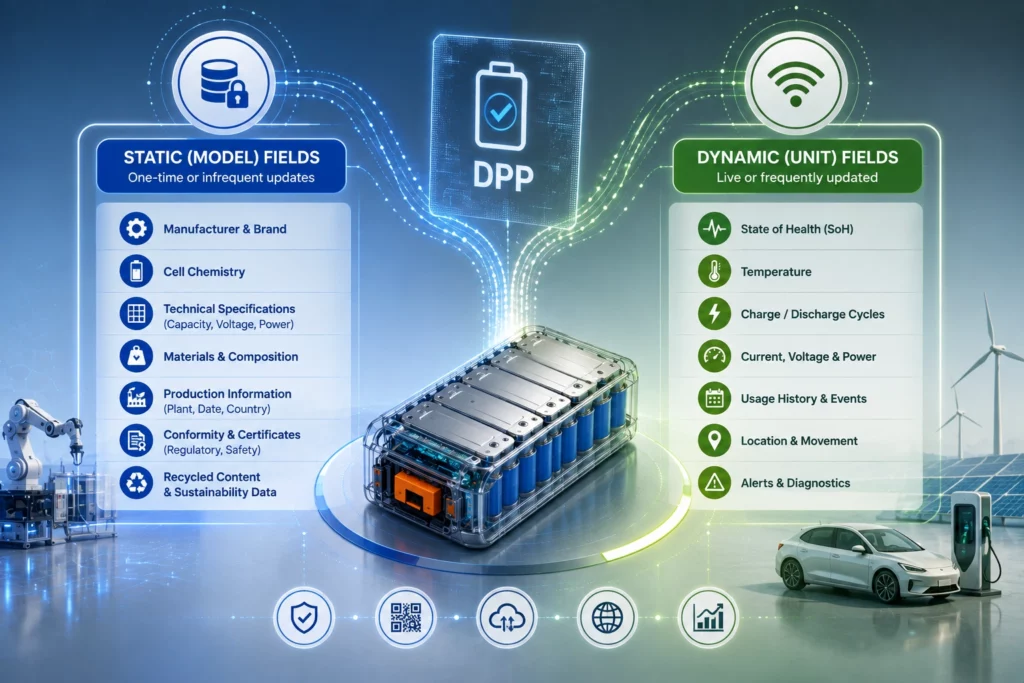
Static vs. dynamic split matters: model-level fields (chemistry, manufacturing site) are entered once; unit-level fields (state of health, charge cycles) must stay live.
Access is tiered: public, notified-body/authority, and legitimate-interest (repair, second-life, recycling) layers.
The bottleneck is retrieval, not policy: spreadsheets fail on auditability and data integrity long before they fail on volume.
Want to understand where your organisation stands?
See how you can identify data gaps, connect supplier and product information, manage supporting evidence and build a DPP-ready data foundation.
Most teams underestimate battery DPP data because they picture a label or a PDF. The passport is neither it is a governed data record with permissioned access, spanning the full lifecycle from raw-material sourcing to recycling. The Battery Pass consortium organises the roughly 80 attributes into seven clusters: general battery and manufacturer information, compliance and labels, carbon footprint, supply-chain due diligence, materials and composition, circularity and resource efficiency, and performance and durability.
The European Commission has recently updated its Digital Batteries Passport data-point guidance, giving businesses a more structured view of the information required for EV, LMT and industrial batteries above 2 kWh. The latest update clarifies the applicability of certain data points, including points 19 and 20–23, and explains why points 16 and 25 do not need to be completed
Preparing for the EU Battery Digital Product Passport?
Our guide to Battery DPP explains what businesses need to know about the upcoming requirementsfrom battery identification and material composition to carbon footprint, compliance evidence and lifecycle data.
The sections below break the battery DPP data into the eleven data domains every economic operator must own before February 2027.
Battery Passport Battery Identification Data
Identification data is the anchor of every battery DPP data record. It ties the physical unit to its passport through a unique identifier and a QR code (Article 13(6)), and it is the first thing a market-surveillance authority checks. Required fields include:
Unique battery identifier, model identifier, batch and serial number
Manufacturing date and place, and the manufacturer’s legal name and address
Battery category and, for EV batteries, the vehicle types the battery was designed for
Battery DPP Manufacturer and Supplier Data Requirements
The economic operator placing the battery on the EU market is legally responsible for the accuracy and completeness of the battery DPP data even when the underlying facts live upstream. That means manufacturer identity, importer details and the responsible economic operator must be captured, alongside supplier records that feed composition, carbon-footprint and due-diligence fields. If a supplier cannot supply primary data, EU-approved secondary datasets apply, and those conservative averages can push a battery into a lower performance class.
Battery DPP Material Composition Data
Material composition is one of the richest data domains in the passport. The passport must declare the battery chemistry LFP, NMC, NCA, sodium-ion or other plus a summary of hazardous substances and the components needed for safe handling, dismantling and recycling. Commercially sensitive formulations are protected: Annex XIII’s tiered access means a recycler sees what it needs to process the unit without proprietary recipes being exposed to the public.
Battery DPP Critical Raw Material Data
Critical raw material data links battery DPP data to supply-chain due diligence. Operators must document the origin and sourcing of cobalt, lithium, nickel and natural graphite, and maintain risk-based due-diligence records under the Regulation’s Chapter VII obligations. Note the timing: due-diligence obligations were postponed to 18 August 2027 by Regulation (EU) 2025/1561, but the sourcing evidence behind them has to be assembled well before then to be audit-ready.
Battery DPP Carbon Footprint Data Requirements
The carbon footprint declaration is the most methodology-heavy field in the passport. It must be calculated across four lifecycle stages raw-material acquisition and pre-processing, manufacturing, distribution, and end-of-life and recycling using the EU method set by delegated act, with company-specific activity data for the manufacturing and distribution stages. The declaration and performance-class rollout is staggered: EV batteries first, with LMT carbon footprint required from 18 August 2028.
Battery DPP Recycled Content Data
Recycled content is a discrete, verifiable slice of battery DPP data: the share of recycled cobalt, lithium, nickel and lead by weight percentage, consistent with Article 8 and Annex VI verification. Minimum recycled-content thresholds begin to apply from 18 August 2028, so the passport field exists before the mandatory floor bites which means declarations are scrutinised early even where a minimum is not yet enforced.
Battery DPP State of Health Data
State of health (SoH) is the flagship dynamic field in battery DPP data. Unlike static composition data entered once, SoH alongside remaining capacity, charge cycles and internal resistance where applicable changes throughout the use phase and must stay up to date. This is where one-time spreadsheet entries break down: dynamic fields require a live connection to operational or telematics data, not an annual manual refresh.
Battery DPP Battery Performance Data
Performance and durability parameters let recyclers and second-life buyers assess a unit without physically testing it. This performance data includes rated and nominal capacity, nominal and min/max voltage, rated power, round-trip efficiency, energy density and expected cycle life at defined operating conditions. Technical documentation on electrochemical performance including how the data was obtained must sit behind the passport for notified bodies and authorities.
Battery DPP End-of-Life Data Requirements
End-of-life data closes the loop on battery DPP data. The passport must carry information supporting safe collection, dismantling and recycling including composition detail relevant to recovery, and guidance for the actors handling the unit at end of life. Under Article 77(8), the battery passport ceases to exist once the battery has been recycled, so the record must remain accessible and accurate for the battery’s entire useful life up to that point.
Battery DPP Repair, Reuse and Refurbishment Data
Circularity is impossible without repair-and-reuse battery DPP data. Repairers, remanufacturers and second-life operators sit in the legitimate-interest access tier and need condition, diagnostic and history data to safely re-use a unit. Critically, when a battery enters second life a new passport must be created and linked to the original battery’s passport preserving provenance rather than resetting it.
Battery DPP Lifecycle Data: What Should Be Captured?
Lifecycle battery DPP data is the sum of the above viewed as a timeline rather than a snapshot. In practice, the question is not “what fields exist?” but “who owns each field, where does it live, and who updates it after the use phase?” Capture should cover: birth data (identity, composition, carbon footprint at manufacture), use-phase data (SoH, cycles, events), and end-of-life data (recovery, second-life linkage). Getting ownership and update responsibility mapped now is what separates an audit-ready passport from a compliance scramble in 2027.
Is your business ready for Battery DPP compliance?
Our guide to Battery DPP Compliance Requirements breaks down the key data and information businesses need to prepare from battery identification and material composition to environmental performance, compliance evidence and lifecycle information.
Battery DPP data is a retrieval problem, not a policy problem. The Regulation tells you which fields to hold; it does not solve the hard part pulling verified, unit-level data from cell suppliers, contract manufacturers, telematics and recyclers into one governed record that survives an audit years later. This is where the “one data layer, many regulations” approach pays off: the same traceability layer that captures composition and sourcing for the passport also serves carbon-footprint, due-diligence and end-of-life reporting, instead of standing up a point solution per obligation.
The TraceX platform is built to capture, verify and serve battery DPP data at unit level static model fields and live dynamic fields with tiered access aligned to Annex XIII.
How TraceX Helps with Battery DPP Data Management
With the EU now providing a more structured Battery Passport data-point framework for EV, LMT and industrial batteries above 2 kWh, the challenge for manufacturers is no longer simply understanding the requirements it is collecting, validating and connecting the underlying data. TraceX Battery DPP Solutions helps create this data foundation by connecting product and battery master data, multi-tier supplier information, material and substance data, carbon and environmental information, compliance evidence, manufacturing records and lifecycle data in one traceability workflow. Teams can use TraceX to structure supplier data requests, link certificates and declarations to specific battery records, monitor missing or incomplete data, and maintain an auditable evidence trail. This helps turn the EU’s data-point requirements into an actionable data collection, validation and readiness workflow, rather than a last-minute spreadsheet exercise.
See how identity, composition, carbon-footprint, SoH and end-of-life battery DPP data is captured, verified and served from one governed layer audit-ready for 2027.
Battery DPP Data: Manual Approach vs. a Traceability Platform
Where spreadsheets and document folders break down against the battery DPP data the passport actually demands:
Battery DPP data need
Manual (spreadsheets / docs)
TraceX platform [pending sign-off]
Unit-level unique IDs at scale
Error-prone, hard to keep unique
Auto-assigned, linked to QR + carrier
Dynamic fields (SoH, cycles)
Stale between manual refreshes
Live connection to operational data
Supplier composition & sourcing
Email chains, no audit trail
Structured supplier data capture
Carbon footprint (4 stages)
Rebuilt each cycle by hand
Reusable primary-data model
Tiered access (Annex XIII)
All-or-nothing sharing
Role-based public/restricted layers
Audit-ready retrieval years later
Fragmented, version chaos
Single governed record
Battery DPP Data Readiness: Buyer Evaluation Checklist
Use this to pressure-test any battery DPP data solution before 18 February 2027:
Can it assign and manage unique identifiers at individual-battery level, linked to a QR code and data carrier?
Does it separate model-level (static) from unit-level (dynamic) data, and keep dynamic fields live?
Can it capture verified supplier data for composition, critical raw materials and due diligence?
Does it support the four-stage carbon-footprint methodology with company-specific activity data?
Can it enforce tiered, role-based access aligned to Annex XIII (public / authority / legitimate interest)?
Does it keep the record accessible and auditable for the battery’s full useful life, and link second-life passports?
Does one data layer also serve your other obligations (ESPR/DPP, CSRD, due diligence) not a point solution?
Frequently Asked Questions (FAQ’s)
What is battery DPP data?
Battery DPP data is the identity, composition, sustainability and lifecycle information a battery must carry in its digital battery passport under the EU Battery Regulation, defined by Article 77 and Annex XIII.
When is battery DPP data mandatory?
From 18 February 2027, EV batteries, LMT batteries and industrial batteries above 2 kWh placed on the EU market must carry a passport with the required battery DPP data.
How many battery DPP data points are there?
For EV batteries, Article 77 and Annex XIII set out roughly 80 mandatory attributes across seven content clusters, from identity to end-of-life.
Is all battery DPP data public?
No. Access is tiered: some data is public, some is restricted to authorities and notified bodies, and some is available only to legitimate-interest actors like repairers and recyclers.
Which battery DPP data fields are dynamic?
Unit-level fields such as state of health, remaining capacity and charge cycles change during use and must stay up to date unlike static model data such as chemistry.
Who is responsible for battery DPP data accuracy?
The economic operator placing the battery on the EU market is responsible for ensuring the battery DPP data is accurate, complete and accessible.
Do spreadsheets work for battery DPP data?
They rarely scale spreadsheets typically fail on auditability, unique identifiers and live dynamic fields long before they fail on volume.
Start using TraceX
Transparency, Trust, & Success for your Climate Journey.
We use cookies on our website to give you the most relevant experience by remembering your preferences and repeat visits. By clicking “Accept All”, you consent to the use of ALL the cookies. However, you may visit "Cookie Settings" to provide a controlled consent.
This website uses cookies to improve your experience while you navigate through the website. Out of these, the cookies that are categorized as necessary are stored on your browser as they are essential for the working of basic functionalities of the website. We also use third-party cookies that help us analyze and understand how you use this website. These cookies will be stored in your browser only with your consent. You also have the option to opt-out of these cookies. But opting out of some of these cookies may affect your browsing experience.
Necessary cookies are absolutely essential for the website to function properly. These cookies ensure basic functionalities and security features of the website, anonymously.
Cookie
Duration
Description
cookielawinfo-checkbox-analytics
11 months
This cookie is set by GDPR Cookie Consent plugin. The cookie is used to store the user consent for the cookies in the category "Analytics".
cookielawinfo-checkbox-functional
11 months
The cookie is set by GDPR cookie consent to record the user consent for the cookies in the category "Functional".
cookielawinfo-checkbox-necessary
11 months
This cookie is set by GDPR Cookie Consent plugin. The cookies is used to store the user consent for the cookies in the category "Necessary".
cookielawinfo-checkbox-others
11 months
This cookie is set by GDPR Cookie Consent plugin. The cookie is used to store the user consent for the cookies in the category "Other.
cookielawinfo-checkbox-performance
11 months
This cookie is set by GDPR Cookie Consent plugin. The cookie is used to store the user consent for the cookies in the category "Performance".
viewed_cookie_policy
11 months
The cookie is set by the GDPR Cookie Consent plugin and is used to store whether or not user has consented to the use of cookies. It does not store any personal data.
Functional cookies help to perform certain functionalities like sharing the content of the website on social media platforms, collect feedbacks, and other third-party features.
Performance cookies are used to understand and analyze the key performance indexes of the website which helps in delivering a better user experience for the visitors.
Analytical cookies are used to understand how visitors interact with the website. These cookies help provide information on metrics the number of visitors, bounce rate, traffic source, etc.
Advertisement cookies are used to provide visitors with relevant ads and marketing campaigns. These cookies track visitors across websites and collect information to provide customized ads.
Download the 2026 Traceability Scorecard and Benchmark Your Supply Chain Across 10 Critical Capabilities.
Download our eBook
Don’t Wait for an Audit to Find Your EUDR Gaps
The 2026 Simplification Package changes how HS codes, DDS pass-through and geolocation rules apply to you. Get the free guide and 20-point readiness checklist before enforcement catches you unprepared.