FSC Chain of Custody: How It Works, Control Systems & Verification
Published
, 9 minute read
Share this article
Quick summary: FSC Chain of Custody explained: how the transfer, percentage and credit control systems work, how claims are verified, and what businesses need to stay audit-ready.
FSC Chain of Custody is the system that keeps an FSC claim intact as material moves from a certified forest through every business that processes, trades, or sells it. Governed by the standard FSC-STD-40-004, it requires each certified organisation to keep eligible material identified and separated from ineligible material, to apply one of three FSC control systems when determining output claims, and to keep records that let an auditor and your trading partners reconcile what you bought against what you sold. Any company that takes legal ownership of FSC material and wants to pass on an FSC claim needs FSC Chain of Custody certification.
KEY TAKEAWAYS
It protects the claim, not the forest: Forest Management certification covers the forest; FSC Chain of Custody covers everyone who handles the material afterwards.
Three control systems: transfer, percentage, and credit each a different way to determine what output claim your product can legitimately carry.
Product groups organise everything: inputs and outputs are managed in defined product groups, and claims are calculated within them over a claim period.
Claims are verified against partners: certification bodies use transaction verification (via the Online Claims Platform) to check your output claims match your suppliers’ input claims.
FSC CoC ≠ EUDR: it supports EU Deforestation Regulation due diligence but does not replace the plot-level geolocation and Due Diligence Statement the law requires.
Looking to get FSC Chain of Custody (CoC) ready but not sure where to start?
TraceX to understand your FSC CoC requirements, identify gaps in your current traceability process, and prepare your systems and documentation for certification.
What FSC Chain of Custody is (and how it differs from Forest Management)
FSC Chain of Custody is the tracking backbone of the whole FSC system. Forest Management certification proves a forest is responsibly managed; Chain of Custody proves that the certified material from it stays accounted for at every transfer downstream. Without an unbroken chain, the label on the finished product means nothing.
That is why CoC certification applies to sawmills, manufacturers, printers, converters, distributors, and retailers essentially anyone who takes ownership of the material and wants to sell it on with an FSC claim. The rulebook is FSC-STD-40-004, which sets requirements for sourcing, processing, labelling, sale, and record-keeping, and can be combined with complementary standards for reclaimed material, projects, and multi-site operations.
How FSC Chain of Custody works: the three control systems
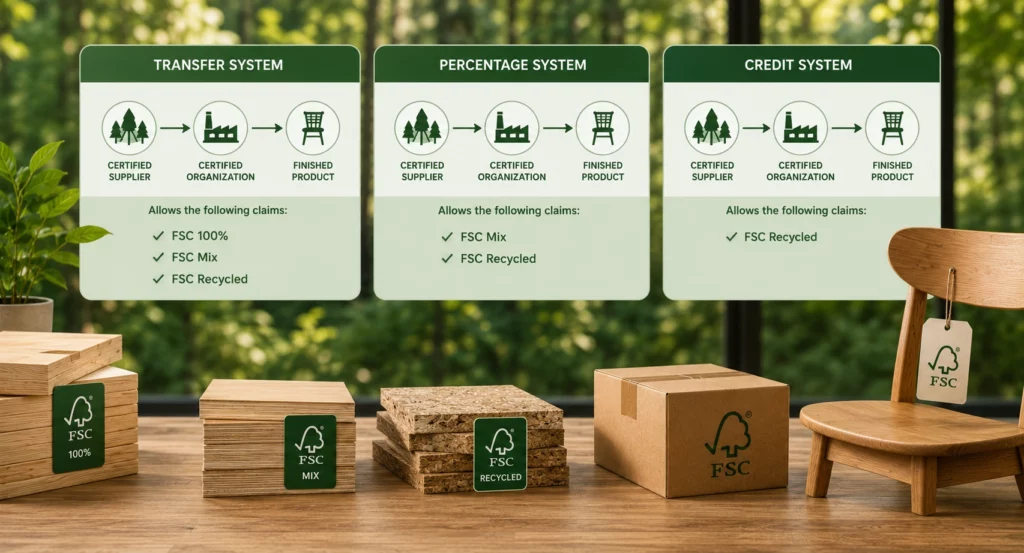
At the heart of the system are three control systems. Which one you use determines the FSC claim your output products can carry, and each suits a different kind of operation.
Transfer, percentage, and credit
Transfer system — the simplest approach. FSC claims pass directly from input to output as long as eligible material is segregated from ineligible material. The output claim can match, or be lower than, the input claim.
Percentage system — outputs carry a percentage claim matching the proportion of claim-contributing input over a defined claim period. Applied to FSC Mix and FSC Recycled product groups.
Credit system — a proportion of outputs is sold against an FSC credit account built up from claim-contributing inputs; when the credit runs out, further volume is sold as controlled wood or uncertified.
All three operate inside product groups defined groupings of products with the same input types and claim, which is how volumes are tracked and claims calculated. Eligible claim-contributing inputs are FSC-certified material, post-consumer reclaimed material, and pre-consumer reclaimed paper.
Want to understand FSC Certification and what it takes to build a responsible, traceable forest-product supply chain? Read our complete guide to FSC Certification, covering Chain of Custody, FSC claims, verification, and key requirements.
FSC Chain of Custody claims and transaction verification
An FSC Chain of Custody claim only holds if the numbers reconcile not just internally, but against the businesses you trade with. This is the part teams most often underestimate.
Claims on documents — every FSC-certified sale must state the FSC claim and the certificate (C-code) on invoices and delivery documents.
Transaction verification — certification bodies check that your output claims match the input claims your trading partners declared, catching over-claiming across the supply chain.
The Online Claims Platform (OCP) — FSC’s secure platform for submitting transaction data; use is voluntary except where there is a high risk of false claims.
Want to understand how FSC Traceability works and how certified materials can be tracked through the supply chain?
Multi-site and group FSC Chain of Custody certification
Larger and smaller organisations both have routes tailored to them, and choosing the right structure controls both cost and audit burden.
Multi-site certification — lets an organisation manage several sites under one certificate, with shared credit accounts permitted under defined conditions (and, historically, only within the same country or the Eurozone).
Group / small-business certification — operations under roughly 25 employees and US$1M turnover may qualify for lower-cost group schemes.
Want to understand FSC Claims and how they are verified? Read our guide to FSC Claims & Verification to learn how FSC claims work, what businesses need to document, and how verification supports credible forest-product traceability.
Read the blog: FSC Claims & Verification:
How to get FSC Chain of Custody certification
Getting FSC Chain of Custody certification runs through an FSC-accredited certification body. Building the management system is the real work; the audit tests it.
Choose an accredited certification body and request quotes (or join a group scheme).
Build the CoC management system — sourcing, segregation, product groups, control system, labelling, and records per FSC-STD-40-004.
Meet the core labour requirements — no child or forced labour, no discrimination, freedom of association, documented via self-assessment.
Pass the audit — an auditor tests your system, volume reconciliation, and claims at each site handling material.
Receive the certificate and C-code — you are listed in the public FSC database and may use FSC trademarks; surveillance audits follow annually.
FSC Chain of Custody and EUDR: related, but not the same
It is worth stating plainly: FSC Chain of Custody supports EU Deforestation Regulation (EUDR) due diligence but does not replace it. A documented chain of custody is strong evidence of legal, responsible sourcing but EUDR asks a different question.
What FSC CoC gives you — an auditable trail of custody and claims that buyers already trust.
What EUDR still requires — a Due Diligence Statement with plot-level geolocation, legality proof, and a deforestation-free assessment against the 31 December 2020 cut-off.
So the certified chain lowers your risk profile, but the operator placing goods on the EU market still owns the EUDR obligation. For that regulated layer, TraceX EUDR Solutionscaptures geolocation, runs risk screening, and generates the EUDR Due Diligence Statement
Read our guide to FSC and EUDR to understand the connection between FSC certification, Chain of Custody, traceability, and the additional due diligence requirements businesses need to consider under EUDR.
Managing FSC Chain of Custody with the TraceX platform
Managing FSC Chain of Custody is fundamentally a data-reconciliation problem: input volumes, product-group calculations, credit accounts, and claims on outgoing documents all have to line up and match your trading partners under transaction verification. Spreadsheets buckle under that. The TraceX Sustainability Solutions centralises supplier certificate status, product-group volume reconciliation, credit-account tracking, and claim-to-source traceability so the evidence an FSC Chain of Custody audit tests is assembled continuously, not the night before
FSC Chain of Custody is a reconciliation discipline, not a filing exercise. The label survives only if your input claims, product-group maths, credit accounts, and output claims agree with each other and with your partners’ declarations. Teams that treat custody as live, connected data pass transaction verification cleanly and can extend the same trail into EUDR due diligence. Teams that treat it as annual paperwork get caught by the arithmetic.
Book a TraceX platform demo to see product-group reconciliation, credit-account tracking, and claim-to-source traceability against a real FSC Chain of Custody workflow
FSC Chain of Custody management: manual vs. the TraceX platform
What an audit tests
Manual / spreadsheets
TraceX platform
Product-group volume reconciliation
Manual formulas, error-prone
Reconciled by product group and claim period
Credit-account tracking
Separate sheet, easily out of sync
Live credit balances per account
Transaction verification (OCP)
Data re-keyed under pressure
Transaction data assembled to match partners
Claim-to-source traceability
Rebuilt from scattered PDFs
Any claim traced to eligible input in minutes
EUDR hand-off
Disconnected, restarts from zero
CoC evidence feeds TraceX EUDR due diligence
Buyer’s checklist: evaluating FSC Chain of Custody management
Use these questions to evaluate any FSC Chain of Custody management approach before you commit:
Can it reconcile input against output volume by product group and claim period?
Does it keep live credit-account balances rather than a stale spreadsheet?
Can it assemble transaction data that matches your trading partners for verification?
Can it trace any single FSC claim back to eligible source input in minutes?
Can the same evidence feed EUDR due diligence, or does that restart from zero?
Frequently Asked Questions (FAQ’s)
What is the difference between FSC Chain of Custody and Forest Management certification?
Forest Management certification covers the forest itself; FSC Chain of Custody covers every business that handles the material afterwards, keeping the FSC claim intact from forest to finished product.
Which FSC control system should I use?
The transfer system is simplest and passes claims straight through; the percentage and credit systems suit operations that blend certified and non-certified inputs and need to calculate claims across a product group over a claim period.
What is transaction verification?
It is how certification bodies confirm your FSC output claims match the input claims your suppliers declared, often via FSC’s Online Claims Platform (OCP). It catches over-claiming across the supply chain.
Does FSC Chain of Custody make my product EUDR-compliant?
No. FSC Chain of Custody supports EUDR due diligence and lowers risk, but you still need a Due Diligence Statement with plot-level geolocation and legality proof.
Do I need FSC Chain of Custody if I only distribute pre-packaged, labelled goods?
Businesses that only sell already-labelled FSC products without taking ownership of unlabelled material may not need certification, but anyone who repacks, relabels, or takes ownership of the material typically does.
Can multiple sites share one FSC Chain of Custody certificate?
Yes. Multi-site certification lets an organisation manage several sites under one certificate, with shared credit accounts allowed under defined conditions.
How is an FSC claim shown on paperwork?
Each FSC-certified sale must state the FSC claim (e.g., FSC Mix) and the certificate C-code on invoices and delivery documents so the claim can be verified downstream.
Start using TraceX
Transparency, Trust, & Success for your Climate Journey.
We use cookies on our website to give you the most relevant experience by remembering your preferences and repeat visits. By clicking “Accept All”, you consent to the use of ALL the cookies. However, you may visit "Cookie Settings" to provide a controlled consent.
This website uses cookies to improve your experience while you navigate through the website. Out of these, the cookies that are categorized as necessary are stored on your browser as they are essential for the working of basic functionalities of the website. We also use third-party cookies that help us analyze and understand how you use this website. These cookies will be stored in your browser only with your consent. You also have the option to opt-out of these cookies. But opting out of some of these cookies may affect your browsing experience.
Necessary cookies are absolutely essential for the website to function properly. These cookies ensure basic functionalities and security features of the website, anonymously.
Cookie
Duration
Description
cookielawinfo-checkbox-analytics
11 months
This cookie is set by GDPR Cookie Consent plugin. The cookie is used to store the user consent for the cookies in the category "Analytics".
cookielawinfo-checkbox-functional
11 months
The cookie is set by GDPR cookie consent to record the user consent for the cookies in the category "Functional".
cookielawinfo-checkbox-necessary
11 months
This cookie is set by GDPR Cookie Consent plugin. The cookies is used to store the user consent for the cookies in the category "Necessary".
cookielawinfo-checkbox-others
11 months
This cookie is set by GDPR Cookie Consent plugin. The cookie is used to store the user consent for the cookies in the category "Other.
cookielawinfo-checkbox-performance
11 months
This cookie is set by GDPR Cookie Consent plugin. The cookie is used to store the user consent for the cookies in the category "Performance".
viewed_cookie_policy
11 months
The cookie is set by the GDPR Cookie Consent plugin and is used to store whether or not user has consented to the use of cookies. It does not store any personal data.
Functional cookies help to perform certain functionalities like sharing the content of the website on social media platforms, collect feedbacks, and other third-party features.
Performance cookies are used to understand and analyze the key performance indexes of the website which helps in delivering a better user experience for the visitors.
Analytical cookies are used to understand how visitors interact with the website. These cookies help provide information on metrics the number of visitors, bounce rate, traffic source, etc.
Advertisement cookies are used to provide visitors with relevant ads and marketing campaigns. These cookies track visitors across websites and collect information to provide customized ads.
Download the 2026 Traceability Scorecard and Benchmark Your Supply Chain Across 10 Critical Capabilities.
Download our eBook
Don’t Wait for an Audit to Find Your EUDR Gaps
The 2026 Simplification Package changes how HS codes, DDS pass-through and geolocation rules apply to you. Get the free guide and 20-point readiness checklist before enforcement catches you unprepared.