Packaging Regulations 2026: What Procurement Teams Must Know
Published
, 9 minute read
Share this article
Quick summary: Packaging regulations 2026 add compliance to price, quality and lead time. The PPWR, EUDR and green-claims rules procurement teams must build into every RFQ.
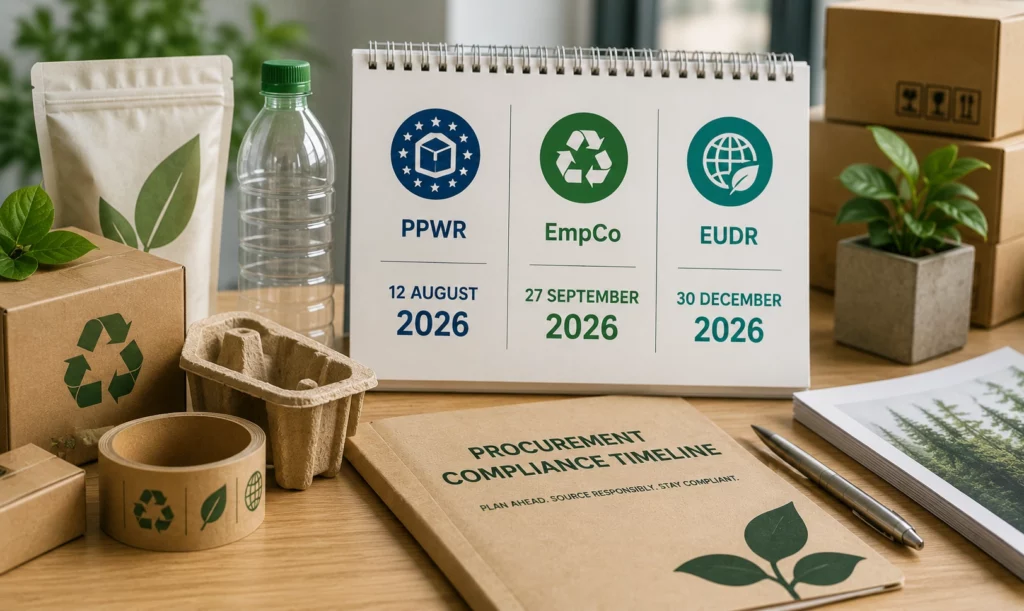
Packaging regulations 2026 add a fourth dimension to packaging sourcing compliance alongside price, quality and lead time. Three EU rules bite this year: the Packaging and Packaging Waste Regulation (PPWR, Reg. (EU) 2025/40) applies from 12 August 2026 and requires a Declaration of Conformity for every pack; the Empowering Consumers (EmpCo) Directive (EU) 2024/825 applies from 27 September 2026 and bans unsubstantiated green claims; and the EU Deforestation Regulation (EUDR) reaches paper, board and wood packaging from 30 December 2026. For procurement, each one turns into supplier data you must collect before you award a contract.
Key takeaways
PPWR is a go/no-go. No Declaration of Conformity, no market access DoC readiness is a hard go/no-go in supplier qualification from 12 August 2026.
EUDR reaches packaging. Paper, board and wood packaging sold as products in their own right need geolocation to the harvest site not just an FSC or PEFC certificate.
Green claims still bite. The standalone Green Claims Directive was withdrawn in 2025; the binding rule is EmpCo (2024/825), which bans generic “recyclable” or “sustainable” claims from 27 September 2026.
Data is the real deliverable. Every one of these packaging regulations 2026 turns into supplier data you must collect, verify and retain the RFQ is the new compliance gate.
Not sure where to start? Talk to TraceX.
Understand your packaging compliance gaps, supplier-data requirements, and how to build a more structured compliance process.
Why packaging regulations 2026 are a procurement problem
Packaging regulations 2026 have moved compliance out of the legal department and into your supplier data. For decades, packaging procurement balanced price, quality and lead time. This year, a fourth criterion becomes a legal precondition for selling into the EU: whether the packaging and the supplier behind it can produce the documentation each regulation demands.
The reason procurement owns this is simple. If packaging carries your brand name, the compliance obligation sits with you, not your supplier. A missing Declaration of Conformity, an unverifiable recyclability claim, or absent deforestation due-diligence data does not just risk a fine it can remove your right to place the product on the market. That is why packaging regulations 2026 belong in supplier selection criteria, not in a post-award audit.
The three packaging regulations 2026 procurement teams must track
These three packaging regulations 2026 reshape sourcing this year. Each carries its own deadline, its own data requirement, and its own liability. Here is what each demands from your process.
PPWR: the Declaration of Conformity gate
The PPWR (Regulation (EU) 2025/40) entered into force on 11 February 2025 and applies from 12 August 2026, replacing the old Packaging and Packaging Waste Directive with one directly applicable rulebook across all 27 member states. From that date, no packaging may be placed on the EU market without a valid Declaration of Conformity (Annex VIII), backed by technical documentation (Annex VII), covering the sustainability requirements in Articles 5–12. The manufacturer self-declares no notified body but suppliers must hand you the underlying evidence, which makes PPWR the first of the packaging regulations 2026 to bite.
Substance rules first. An intentionally added PFAS ban in food-contact packaging, plus a combined heavy-metals limit, both apply from 12 August 2026 with no grace period.
2030 roadmap. Design-for-recycling grades (A/B/C) and minimum recycled-content targets apply from 1 January 2030, with harmonised labelling from 2028 suppliers without a credible roadmap are a future risk today.
EUDR: deforestation due diligence on paper, board and wood
The EU Deforestation Regulation is known for coffee and soy, but it reaches packaging wherever paper, cardboard or wood is involved. Under Regulation (EU) 2025/2650, large and medium operators must comply from 30 December 2026 and micro and small operators from 30 June 2027, against a 31 December 2020 cut-off. Wooden crates, pallets and paper packaging sold as products in their own right fall in scope; secondary cardboard used purely to protect finished goods generally does not but the line needs a case-by-case check. In-scope material requires geolocation to the forest of origin and a Due Diligence Statement filed in TRACES. FSC and PEFC certification strengthen the evidence but do not replace it and this is the packaging regulations 2026 obligation procurement teams most often underestimate.
EmpCo: substantiating “recyclable” and “sustainable”
Here is where accuracy matters. The standalone Green Claims Directive proposal was withdrawn by the Commission in June 2025 but greenwashing is still regulated. The binding instrument is the Empowering Consumers for the Green Transition Directive (EU) 2024/825 (EmpCo), which applies from 27 September 2026 and amends the Unfair Commercial Practices Directive. From that date, terms like “recyclable,” “eco-friendly” and “sustainable” on a pack must be substantiated; generic claims and self-created sustainability labels are banned, and penalties can reach at least 4% of annual turnover in the relevant member state. Of the three packaging regulations 2026, EmpCo is the one your marketing team feels most directly. Your PPWR Declaration of Conformity is the evidentiary foundation for any recyclability claim.
Preparing a PPWR Declaration of Conformity but not sure what needs to be behind it?
Packaging regulations 2026: the supplier data you must collect
Packaging regulations 2026 are, at their core, a supplier-data problem: compliance is only as good as the data behind it. The table maps each regulation to the supplier data procurement must now collect, retain and be able to retrieve under PPWR, within 10 days of a market-surveillance request.
Declaration of Conformity (Annex VIII), technical documentation (Annex VII), material composition, recycled-content %, PFAS test reports (food contact)
5 yrs single-use / 10 yrs reusable
Brand owner / importer if own-label
EUDR
Geolocation (GPS) of harvest site, risk assessment, Due Diligence Statement reference, FSC/PEFC certificate
5 years
Operator placing goods on EU market
EmpCo
Recyclability assessment under real collection conditions, LCA data, third-party verification for each environmental claim
Life of the claim + audit window
Trader making the claim
Stop running three parallel document chases. PPWR conformity, EUDR geolocation and EmpCo claim evidence look like three problems, but they resolve to one question can you retrieve the specific supplier record that proves this pack is compliant, on demand? Procurement teams that build a single supplier data layer once, and reuse it across all three packaging regulations 2026, turn compliance from a cost centre into a sourcing advantage.
Packaging regulations 2026 RFQ checklist for procurement
Every packaging regulations 2026 requirement lives in your supplier data, so it belongs in the RFQ. Add these as mandatory fields in every packaging tender and supplier-qualification questionnaire if a supplier cannot answer, treat it as a gap, not a formality.
PPWR. Can you provide a PPWR Declaration of Conformity (Annex VIII) for each packaging type?
PPWR. What are the material composition, recycled-content % and PFAS status (food contact) of this pack?
EUDR. Does this packaging fall under an EUDR-relevant CN code, and can you provide harvest-site geolocation?
EUDR. Do you hold a current FSC/PEFC certificate and the underlying due-diligence documentation and DDS reference?
EmpCo. What environmental claims appear on this pack, and what third-party evidence substantiates each one?
Contract. Will a change to material or recycled content be notified in advance — since it triggers a new DoC?
How TraceX helps procurement meet packaging regulations 2026
TraceX Regulatory Compliance Solutions gives procurement one place to connect packaging specifications to the supplier, source, material and evidence behind them so a Declaration of Conformity, a geolocation point and a recyclability assessment all sit against the SKU they belong to. That closes the gap between a packaging regulations 2026 obligation and the supplier data that proves it, and it replaces spreadsheets that will not scale across hundreds of SKUs and multiple suppliers. [pending product-team sign-off]
The strategic payoff is reuse. The same structured supplier data layer that answers PPWR also feeds EUDR due diligence and EmpCo substantiation build it once, satisfy all three, and respond to a market-surveillance request in days rather than weeks. That is what turns packaging regulations 2026 from a recurring fire drill into a category-management discipline.
Is your supplier data ready for PPWR, EUDR and EmpCo?
See how TraceX connects packaging specs, supplier records and compliance evidence in one place.
What are the key packaging regulations 2026 procurement teams must know?
The three that bite in 2026 are the PPWR (Reg. (EU) 2025/40, applies 12 August 2026), the EmpCo green-claims Directive (EU) 2024/825 (applies 27 September 2026), and the EUDR (large/medium operators from 30 December 2026), which reaches paper, board and wood packaging.
When does the PPWR apply and what is a Declaration of Conformity?
The PPWR applies from 12 August 2026. A Declaration of Conformity (Annex VIII) is a manufacturer self-declaration, backed by technical documentation, confirming a pack meets PPWR requirements. No packaging can be placed on the EU market without one.
Does the EUDR apply to packaging?
Yes, where paper, cardboard or wood packaging is sold as a product in its own right wooden crates, pallets, standalone paper packaging. Secondary cardboard used only to protect finished goods is generally out of scope, but the line requires a case-by-case assessment.
Was the Green Claims Directive withdrawn, and what replaced it?
The standalone Green Claims Directive proposal was withdrawn in June 2025. The binding rule is the Empowering Consumers (EmpCo) Directive (EU) 2024/825, which applies from 27 September 2026 and bans unsubstantiated environmental claims.
What PPWR requirements start on 12 August 2026?
The Declaration of Conformity requirement, the intentionally added PFAS ban in food-contact packaging, and the combined heavy-metals limit all apply from 12 August 2026 with no grace period the first packaging regulations 2026 obligations to take effect. Recyclability grades and recycled-content targets follow from 2030.
What supplier data do procurement teams need for packaging regulations 2026?
PPWR DoC and technical documentation, EUDR harvest-site geolocation and DDS reference, and EmpCo recyclability assessments and third-party claim evidence collected in the RFQ, verified, and retained for 5 to 10 years depending on the regulation.
What are the penalties for non-compliance?
Penalties under the packaging regulations 2026 have real teeth. PPWR: packaging without a valid DoC cannot be placed on the market. EmpCo: penalties up to at least 4% of annual turnover in the relevant member state, plus forced claim withdrawal. EUDR: market-access denial and potential seizure of non-compliant goods.
Start using TraceX
Transparency, Trust, & Success for your Climate Journey.
We use cookies on our website to give you the most relevant experience by remembering your preferences and repeat visits. By clicking “Accept All”, you consent to the use of ALL the cookies. However, you may visit "Cookie Settings" to provide a controlled consent.
This website uses cookies to improve your experience while you navigate through the website. Out of these, the cookies that are categorized as necessary are stored on your browser as they are essential for the working of basic functionalities of the website. We also use third-party cookies that help us analyze and understand how you use this website. These cookies will be stored in your browser only with your consent. You also have the option to opt-out of these cookies. But opting out of some of these cookies may affect your browsing experience.
Necessary cookies are absolutely essential for the website to function properly. These cookies ensure basic functionalities and security features of the website, anonymously.
Cookie
Duration
Description
cookielawinfo-checkbox-analytics
11 months
This cookie is set by GDPR Cookie Consent plugin. The cookie is used to store the user consent for the cookies in the category "Analytics".
cookielawinfo-checkbox-functional
11 months
The cookie is set by GDPR cookie consent to record the user consent for the cookies in the category "Functional".
cookielawinfo-checkbox-necessary
11 months
This cookie is set by GDPR Cookie Consent plugin. The cookies is used to store the user consent for the cookies in the category "Necessary".
cookielawinfo-checkbox-others
11 months
This cookie is set by GDPR Cookie Consent plugin. The cookie is used to store the user consent for the cookies in the category "Other.
cookielawinfo-checkbox-performance
11 months
This cookie is set by GDPR Cookie Consent plugin. The cookie is used to store the user consent for the cookies in the category "Performance".
viewed_cookie_policy
11 months
The cookie is set by the GDPR Cookie Consent plugin and is used to store whether or not user has consented to the use of cookies. It does not store any personal data.
Functional cookies help to perform certain functionalities like sharing the content of the website on social media platforms, collect feedbacks, and other third-party features.
Performance cookies are used to understand and analyze the key performance indexes of the website which helps in delivering a better user experience for the visitors.
Analytical cookies are used to understand how visitors interact with the website. These cookies help provide information on metrics the number of visitors, bounce rate, traffic source, etc.
Advertisement cookies are used to provide visitors with relevant ads and marketing campaigns. These cookies track visitors across websites and collect information to provide customized ads.
Download the 2026 Traceability Scorecard and Benchmark Your Supply Chain Across 10 Critical Capabilities.
Download our eBook
Don’t Wait for an Audit to Find Your EUDR Gaps
The 2026 Simplification Package changes how HS codes, DDS pass-through and geolocation rules apply to you. Get the free guide and 20-point readiness checklist before enforcement catches you unprepared.