FSC Certification: The Complete Guide to Chain of Custody, Claims & Verification
Published
, 8 minute read
Share this article
Quick summary: FSC certification explained: how Chain of Custody, claims, labels and verification work, and what businesses need to manage certified forest-based products.
FSC certification is a voluntary, third-party scheme run by the Forest Stewardship Council that verifies forest-based materials come from responsibly managed forests, controlled sources, or reclaimed material and that this status is preserved at every step from the forest to the finished product. In practice, FSC certification has two parts: Forest Management (FM) certification for the forest itself, and Chain of Custody (CoC) certification for every business that processes, trades, or sells the material downstream. If your company buys, transforms, or sells wood, paper, packaging, or other forest-based products and wants to make an FSC claim, you need Chain of Custody certification.
KEY TAKEAWAYS
Two certificate types: Forest Management covers the forest; Chain of Custody covers everyone handling the material afterwards. Most businesses need CoC.
The core standard is FSC-STD-40-004, which sets the sourcing, tracking, labelling, and record-keeping rules an audited management system must meet.
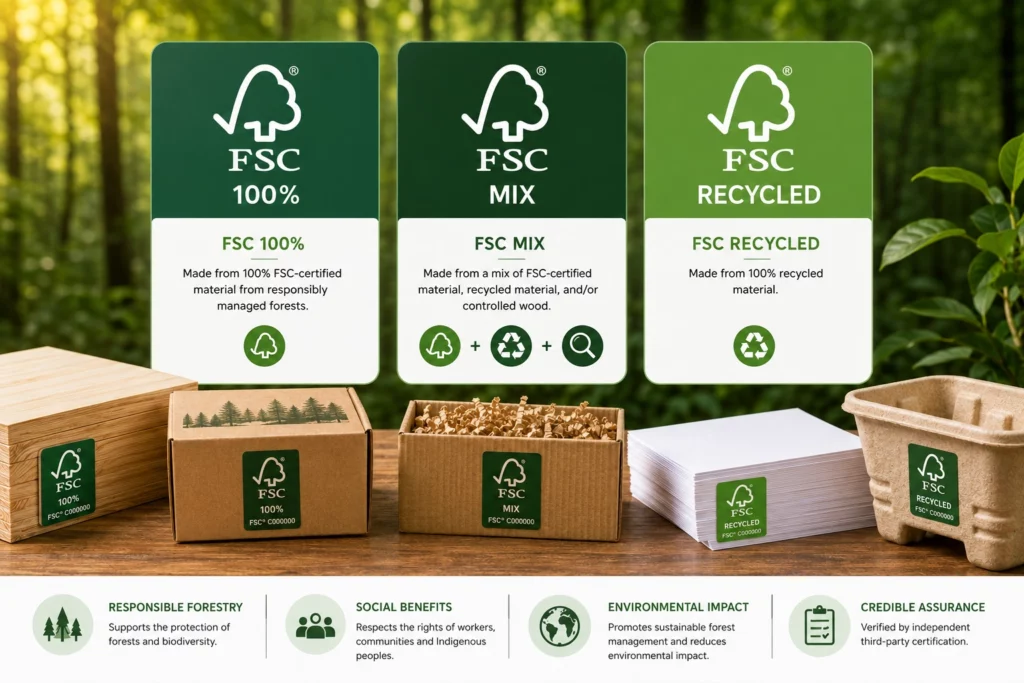
Three labels, one code: FSC 100%, FSC Mix, and FSC Recycled every genuine label carries an FSC C-code identifying the licence holder.
Claims must be defensible: a label is only as strong as the documents and transaction records behind it that is what an auditor tests.
FSC ≠ EUDR: certification supports EU Deforestation Regulation due diligence but does not replace the plot-level geolocation and Due Diligence Statement the law requires.
Looking to simplify FSC compliance and strengthen traceability across your supply chain?
Book a consulting session with TraceX to understand your FSC requirements, identify compliance gaps, and explore the right approach for your business.
What FSC certification is (and the two certificate types)
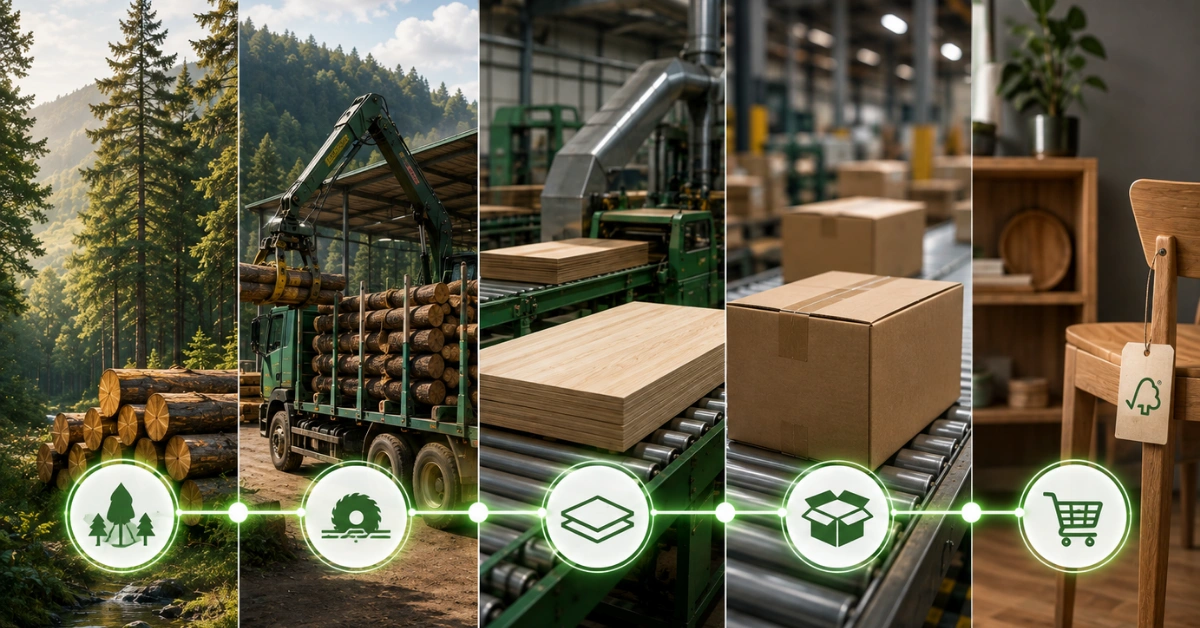
FSC certification is best understood as a chain of trust rather than a single stamp. It links a responsibly managed forest to the shelf, and it only holds if every business in between can prove the material stayed accounted for.
Forest Management (FM) certification — audits the forest against FSC’s environmental, social, and economic standards for responsible forestry.
Chain of Custody (CoC) certification — audits every organisation that sources, processes, or sells the material so certified inputs stay identified and separated from ineligible material along the supply chain.
For sawmills, manufacturers, printers, distributors, packaging producers, and retailers, this almost always means CoC certification governed by FSC-STD-40-004. That standard is the rulebook: sourcing, processing, labelling, sale, and the records that tie them together.
How FSC Chain of Custody certification protects traceability
The scheme works because certified volume is controlled, not just claimed. At each transfer, a certified organisation has to know exactly how much eligible input entered, how it flowed through production, and how much can legitimately be sold with an FSC claim.
The control mechanisms behind the label
Material identification & separation — certified inputs are tracked and kept apart from non-eligible material during manufacturing and distribution.
Percentage vs. credit systems — under the percentage system a product carries the FSC share of its inputs; under the credit system, only a volume matching your certified input can be sold with an FSC claim.
Documented volume reconciliation — purchases, production, and sales records must reconcile, and every FSC-labelled sale must trace back to eligible input.
Core labour requirements — no child or forced labour, no employment discrimination, and respect for freedom of association, assessed via self-assessment.
Want to understand how FSC Chain of Custody works, from sourcing and traceability to FSC claims and certification requirements? Read our complete guide to FSC Chain of Custody and learn how to build a more transparent, verifiable forest-product supply chain.
FSC claims, labels, and controlled wood
Products covered by FSC certification carry one of three on-pack labels, each backed by a different sourcing rule. Reading them correctly is the difference between a defensible claim and a compliance risk.
FSC 100% — all forest material comes from FSC-certified forests. The strongest origin claim.
FSC Mix — a blend of FSC-certified virgin fibre, reclaimed material, and/or FSC controlled wood; the most common label in paper and packaging.
FSC Recycled — 100% pre- or post-consumer reclaimed material, independently verified rather than self-declared.
Controlled wood is not from certified forests but has been assessed as low-risk against FSC’s unacceptable-source categories, so it can be mixed into FSC Mix products. Every valid label also carries an FSC C-code (FSC C######) identifying the certificate holder a fast way to spot a counterfeit or expired claim.
Want to understand how FSC traceability works and how to maintain transparency across your forest-product supply chain? Read our complete guide to FSC Traceability and learn how businesses can strengthen sourcing, tracking, and verification.
Read the blog: FSC Traceability: A Complete Guide to Tracking Certified Forest Products
How to get FSC certification: the process step by step
Getting FSC certification follows a defined path through an FSC-accredited certification body. The management-system work usually takes longer than the audit itself.
Choose a certification body — request quotes from FSC-accredited bodies (or a group scheme if you are a small operation).
Build the CoC management system — put sourcing, tracking, labelling, and record-keeping procedures in place per FSC-STD-40-004.
Complete the labour self-assessment — document conformance with FSC’s core labour requirements.
Undergo the FSC certification audit — an independent auditor tests your system and records at each site where material is handled.
Receive the certificate and C-code — on a successful audit you are issued a certificate, listed in the public FSC database, and may use FSC trademarks; surveillance audits follow annually.
Small businesses typically under 25 employees and below roughly US$1 million turnover may qualify for lower-cost group certification. First-year cost and timeline vary by size and scope
FSC certification and EUDR: support, not a substitute
This is the most misunderstood point, so it is worth stating plainly: FSC certification supports EU Deforestation Regulation (EUDR) due diligence but does not replace it. A shipment can be FSC-certified and still fall short of EUDR because the two answer different questions.
What FSC gives you — credible evidence of legal, responsibly managed sourcing and a documented chain of custody buyers already trust.
What EUDR still requires — a Due Diligence Statement with plot-level geolocation, proof of legality, and a deforestation-free assessment against the 31 December 2020 cut-off.
So the certification lowers your risk profile and shortens buyer vetting, but the operator placing goods on the EU market still owns the EUDR obligation. For that regulated layer, TraceX EUDR Solutions is built specifically to capture geolocation, run risk screening, and generate the EUDR Due Diligence Statement
Want to understand how FSC-certified wood can support your EUDR compliance journey? Read our guide to FSC-Certified Wood for EUDR and learn how certification, traceability, and due diligence come together for responsible sourcing.
Managing FSC certification with the TraceX platform
Managing FSC certification manually is where most CoC systems break down. Spreadsheets track volume, PDFs track claims, and email tracks supplier certificate expiries until an auditor asks you to reconcile all three under time pressure. The TraceX Sustainability Solutions centralises the evidence base a CoC audit actually tests: supplier certificate status, input/output volume reconciliation, claim-by-claim traceability, and document trails
An FSC label is a claim you must be able to defend, not a document you file once. Certification proves your intent; your records prove your claim. The businesses that pass audits cleanly and that plug FSC evidence straight into EUDR due diligence are the ones that treat chain of custody as live, connected data rather than an annual paperwork scramble.
See it on your own supply chain. Book a TraceX platform demo to see how supplier certificate tracking, volume reconciliation, and claim traceability work against a real FSC certification workflow
FSC certification management: manual vs. the TraceX platform
Use these questions to evaluate any FSC certification management approach internal or vendor before you commit.
Can it flag supplier FSC certificate expiries before they lapse?
Does it reconcile certified input against labelled output by product group?
Can it trace any single FSC claim back to its eligible source in minutes?
Does it hold the document trail an FSC-STD-40-004 audit will ask for?
Can the same evidence feed EUDR due diligence, or does that restart from zero?
Frequently Asked Questions (FAQ’s)
Is FSC certification mandatory?
No. FSC certification is voluntary, but many multinational retailers and public tenders require FSC (or PEFC) as a condition of purchase, which makes it commercially close to mandatory in some markets.
What is the difference between FSC and PEFC?
Both are legitimate, ISO-aligned forest certification systems. FSC and PEFC use different governance and standards, and many certification bodies can audit either — buyers often accept both as sourcing evidence.
How long does FSC certification take?
The audit is quick; building a compliant Chain of Custody management system is the longer part. Timelines vary by size and scope.
Does FSC certification make my product EUDR-compliant?
No. FSC certification supports EUDR due diligence and reduces risk, but you still need a Due Diligence Statement with plot-level geolocation and legality proof.
What does the FSC Mix label actually mean?
That the product blends FSC-certified virgin fibre, reclaimed material, and/or controlled wood controlled wood is low-risk, non-certified material, not fully certified fibre.
How do I check if an FSC claim is genuine?
Look for the FSC C-code (FSC C######) on the label and verify the certificate holder in the public FSC database; expired or missing codes are red flags.
Do small businesses have an easier route to FSC certification?
Yes. Operations under roughly 25 employees and US$1M turnover may qualify for lower-cost group certification schemes.
Start using TraceX
Transparency, Trust, & Success for your Climate Journey.
We use cookies on our website to give you the most relevant experience by remembering your preferences and repeat visits. By clicking “Accept All”, you consent to the use of ALL the cookies. However, you may visit "Cookie Settings" to provide a controlled consent.
This website uses cookies to improve your experience while you navigate through the website. Out of these, the cookies that are categorized as necessary are stored on your browser as they are essential for the working of basic functionalities of the website. We also use third-party cookies that help us analyze and understand how you use this website. These cookies will be stored in your browser only with your consent. You also have the option to opt-out of these cookies. But opting out of some of these cookies may affect your browsing experience.
Necessary cookies are absolutely essential for the website to function properly. These cookies ensure basic functionalities and security features of the website, anonymously.
Cookie
Duration
Description
cookielawinfo-checkbox-analytics
11 months
This cookie is set by GDPR Cookie Consent plugin. The cookie is used to store the user consent for the cookies in the category "Analytics".
cookielawinfo-checkbox-functional
11 months
The cookie is set by GDPR cookie consent to record the user consent for the cookies in the category "Functional".
cookielawinfo-checkbox-necessary
11 months
This cookie is set by GDPR Cookie Consent plugin. The cookies is used to store the user consent for the cookies in the category "Necessary".
cookielawinfo-checkbox-others
11 months
This cookie is set by GDPR Cookie Consent plugin. The cookie is used to store the user consent for the cookies in the category "Other.
cookielawinfo-checkbox-performance
11 months
This cookie is set by GDPR Cookie Consent plugin. The cookie is used to store the user consent for the cookies in the category "Performance".
viewed_cookie_policy
11 months
The cookie is set by the GDPR Cookie Consent plugin and is used to store whether or not user has consented to the use of cookies. It does not store any personal data.
Functional cookies help to perform certain functionalities like sharing the content of the website on social media platforms, collect feedbacks, and other third-party features.
Performance cookies are used to understand and analyze the key performance indexes of the website which helps in delivering a better user experience for the visitors.
Analytical cookies are used to understand how visitors interact with the website. These cookies help provide information on metrics the number of visitors, bounce rate, traffic source, etc.
Advertisement cookies are used to provide visitors with relevant ads and marketing campaigns. These cookies track visitors across websites and collect information to provide customized ads.
Download the 2026 Traceability Scorecard and Benchmark Your Supply Chain Across 10 Critical Capabilities.
Download our eBook
Don’t Wait for an Audit to Find Your EUDR Gaps
The 2026 Simplification Package changes how HS codes, DDS pass-through and geolocation rules apply to you. Get the free guide and 20-point readiness checklist before enforcement catches you unprepared.