EUDR Audit: How to Be Ready Before the Competent Authority Knocks
Published
, 9 minute read
Share this article
Quick summary: An EUDR audit tests your evidence system, not just your supply chain. Learn what competent authorities check, why it’s when-not-if, and how to build an audit-ready file.
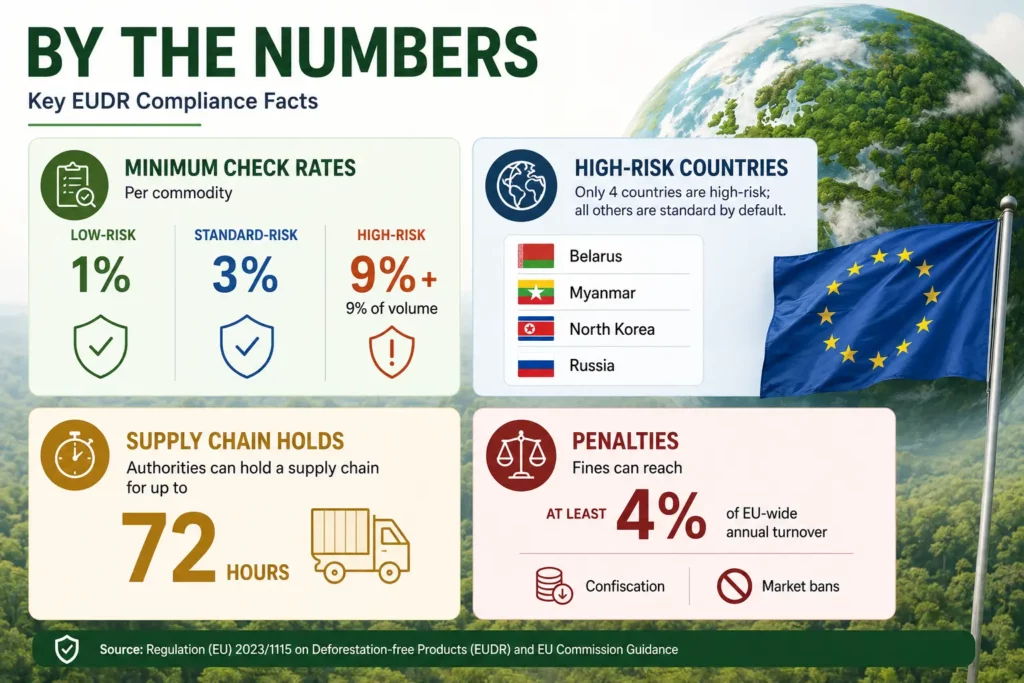
In an EUDR audit, a national competent authority checks whether your due diligence system meets the regulation. That means documentary checks of your Due Diligence Statements, verification of plot geolocation against satellite imagery, review of your risk assessment and mitigation, and sometimes physical or lab tests (such as isotope or DNA analysis) to confirm a product’s declared origin. Checks are risk-based and mandatory: authorities must inspect at least 1% of operators sourcing from low-risk countries, 3% from standard-risk, and 9% (plus 9% of volume) from high-risk. Authorities can also hold a supply chain for up to 72 hours and impose fines of at least 4% of EU turnover so an EUDR audit is a matter of when, not if.
Key Takeaways
It tests your system, not your intentions. An audit checks whether your due diligence system can produce complete, dated, batch-linked evidence on demand not just whether your sourcing is clean.
It’s when, not if. Check rates are mandatory minimums (1% / 3% / 9% by country risk, per commodity). For real volume, an audit is a statistical certainty, not a sign of suspicion.
Audits are lost on retrieval. The common failure is records that exist but can’t be reconciled to a sampled batch in time not dirty supply.
Paper must match the ground. Authorities verify geolocation against satellite imagery and can run isotope or DNA tests, then hold goods for up to 72 hours. Declared origin has to be real.
Could you produce the full evidence file for any batch — today?
See how TraceX keeps a batch-linked, five-year audit trail that answers a competent authority in minutes
An EUDR audit is a compliance check carried out by a national competent authority to confirm that an operator or trader is meeting the EU Deforestation Regulation. In plain terms, it is an examination of your evidence, not just your product. The authority is testing whether your due diligence system under Article 12 can stand behind every Due Diligence Statement (DDS) you have filed.
A typical audit can include several layers:
Documentary checks: your DDS records, geolocation data, risk assessment and mitigation evidence, and supplier reference numbers.
Satellite verification: your plot geolocation compared against satellite forest imagery to confirm the deforestation-free claim.
Physical and lab checks: inspection of goods and facilities, and technical means such as isotope or DNA testing to confirm a product’s declared origin and species.
Enforcement powers: authorities can hold a supply chain for up to 72 hours, and sanctions run to confiscation, market bans, exclusion from public procurement and fines of at least 4% of EU turnover.
Those obligations become enforceable from 30 December 2026 for large and medium operators, and 30 June 2027 for micro and small operators — so an audit is a 2027 reality to prepare for now.
Why an Audit Is When, Not If
The most useful mindset shift is to stop treating an audit as something that happens to companies that did wrong. The checks are a mandatory, risk-tiered quota. Under Article 16, competent authorities must inspect at least 1% of operators sourcing from low-risk countries, 3% from standard-risk, and 9% plus 9% of product volume from high-risk, and those targets are met for each commodity separately.
Because the country benchmarking published in May 2025 puts only Belarus, Myanmar, North Korea and Russia in the high-risk band, almost everyone else sits at standard risk, facing that 3% floor every year. Spread across commodities and shipments, an audit becomes a statistical certainty for any serious importer not a red flag. On top of the quota, a substantiated concern raised by an NGO, whistleblower or competitor can pull you into a check with no warning at all.
So the honest question isn’t whether you’ll face an audit. It’s whether, on the day you do, you can produce a defensible file fast enough.
Understanding whether a sourcing country is classified as low, standard, or high risk is essential for designing the right due diligence strategy.
Where an Audit Is Really Won or Lost: Real-World Scenarios
These illustrative field scenarios show that audits usually fail on evidence handling, not on deforestation and the practice that prevents each one.
The records that existed but couldn’t be pulled
An operator held its DDS and geolocation data across spreadsheets and email threads. When the authority asked for the complete file behind one sampled batch within days, the team couldn’t reconcile which plots fed which shipment in time and was flagged on process, despite clean sourcing. Best practice: keep a batch-linked, queryable evidence system so any shipment’s file is one click, not a scavenger hunt.
The reference numbers that didn’t reconcile
A downstream operator had stored plenty of DDS reference numbers, but they didn’t map to the invoices and consignments the authority sampled. The mismatch alone triggered a deeper check. Best practice: reconcile every reference number to its shipment at intake, so the paper trail ties end to end.
The paper that didn’t match the ground
Declared geolocation didn’t line up with the satellite forest layer, and an isotope test on a timber consignment didn’t match the declared region. The authority placed a 72-hour hold and opened an investigation. Best practice: pre-screen every plot against satellite data before filing, and make sure declared origin reflects physical reality.
The substantiated concern nobody saw coming
An NGO filed a substantiated concern about a sourcing region. Operators there were pulled into checks with no notice; those with a ready evidence file cleared quickly, while others scrambled for weeks. Best practice: maintain audit-ready files continuously, not reactively assume the request could land tomorrow.
How to Prepare for an EUDR Audit: An Audit-Ready System
Passing an EUDR audit is an exercise in retrieval and reconciliation. A platform built for audit-readiness should do six things.
Link every record to a batch. Tie each DDS, geolocation set, risk assessment and reference number to a specific shipment, so any batch’s file is retrievable in one step.
Reconcile reference numbers end to end. Match DDS reference and verification numbers to invoices and consignments at intake, closing the gap authorities probe first.
Pre-screen geolocation against satellite. Confirm plots hold up against forest data before filing, so paper and ground already agree when the authority checks.
Retain everything for five years. Keep a complete, tamper-evident record for the full retention period, with nothing purged early.
Run a mock audit. Drill the request: pick a random past shipment and time how long it takes to produce its full file. Fix whatever is slow before an authority finds it.
Keep one source of truth. Consolidate DDS, supplier and monitoring data in one system so nothing lives only in an inbox or a laptop.
TraceX EUDR Solutions simplifies EUDR audits by creating a centralized, audit-ready repository of supplier information, geolocation data, due diligence records, risk assessments, and supporting evidence. Every compliance activity is digitally documented, time-stamped, and traceable, enabling businesses to quickly demonstrate compliance, respond to auditor requests, and reduce the effort required during regulatory inspections.
Walk into any EUDR audit with the file already built.
TraceX links every DDS, geolocation set and reference number to its batch, pre-screens plots against satellite data, and keeps a five-year audit trail you can produce on demand.
EUDR compliance depends on more than knowing where commodities originate it requires maintaining a verifiable chain of custody from production plot to final product.
Before an authority asks, confirm you can tick every box.
✓Any sampled batch’s full evidence file can be produced within the authority’s deadline.
✓DDS reference and verification numbers reconcile to invoices and consignments.
✓Plot geolocation has been checked against satellite data and holds up.
✓Risk assessment and mitigation are documented for standard- and high-risk sourcing.
✓All records are retained for five years, with nothing purged early.
✓You have run at least one mock audit and fixed the slow points.
✓DDS, supplier and monitoring data live in one source of truth, not scattered files.
Frequently Asked Questions
Who carries out an EUDR audit?
National competent authorities in each EU member state. They check operators and traders against the regulation using documentary review, satellite verification of geolocation, and physical or lab inspection of goods.
How likely am I to be audited?
It is a mandatory quota, not a random event. Authorities must check at least 1% of operators for low-risk sourcing, 3% for standard-risk and 9% (plus 9% of volume) for high-risk, per commodity so for real volume an audit is a matter of when.
What documents do I need for an EUDR audit?
Your DDS records, plot geolocation, risk assessment and mitigation evidence, supplier DDS reference and verification numbers, and transaction records all retained for at least five years and reconcilable to specific shipments.
What are the penalties for failing an audit?
Sanctions include fines of at least 4% of EU-wide annual turnover, confiscation of products and revenues, temporary market bans, and exclusion from public procurement, with escalation for repeat offences.
Can authorities physically test my products?
Yes. Beyond documents, they can inspect goods and facilities and use technical means such as isotope or DNA analysis to verify a product’s declared origin and species, and can hold a supply chain for up to 72 hours.
Start using TraceX
Transparency, Trust, & Success for your Climate Journey.
We use cookies on our website to give you the most relevant experience by remembering your preferences and repeat visits. By clicking “Accept All”, you consent to the use of ALL the cookies. However, you may visit "Cookie Settings" to provide a controlled consent.
This website uses cookies to improve your experience while you navigate through the website. Out of these, the cookies that are categorized as necessary are stored on your browser as they are essential for the working of basic functionalities of the website. We also use third-party cookies that help us analyze and understand how you use this website. These cookies will be stored in your browser only with your consent. You also have the option to opt-out of these cookies. But opting out of some of these cookies may affect your browsing experience.
Necessary cookies are absolutely essential for the website to function properly. These cookies ensure basic functionalities and security features of the website, anonymously.
Cookie
Duration
Description
cookielawinfo-checkbox-analytics
11 months
This cookie is set by GDPR Cookie Consent plugin. The cookie is used to store the user consent for the cookies in the category "Analytics".
cookielawinfo-checkbox-functional
11 months
The cookie is set by GDPR cookie consent to record the user consent for the cookies in the category "Functional".
cookielawinfo-checkbox-necessary
11 months
This cookie is set by GDPR Cookie Consent plugin. The cookies is used to store the user consent for the cookies in the category "Necessary".
cookielawinfo-checkbox-others
11 months
This cookie is set by GDPR Cookie Consent plugin. The cookie is used to store the user consent for the cookies in the category "Other.
cookielawinfo-checkbox-performance
11 months
This cookie is set by GDPR Cookie Consent plugin. The cookie is used to store the user consent for the cookies in the category "Performance".
viewed_cookie_policy
11 months
The cookie is set by the GDPR Cookie Consent plugin and is used to store whether or not user has consented to the use of cookies. It does not store any personal data.
Functional cookies help to perform certain functionalities like sharing the content of the website on social media platforms, collect feedbacks, and other third-party features.
Performance cookies are used to understand and analyze the key performance indexes of the website which helps in delivering a better user experience for the visitors.
Analytical cookies are used to understand how visitors interact with the website. These cookies help provide information on metrics the number of visitors, bounce rate, traffic source, etc.
Advertisement cookies are used to provide visitors with relevant ads and marketing campaigns. These cookies track visitors across websites and collect information to provide customized ads.
Download the 2026 Traceability Scorecard and Benchmark Your Supply Chain Across 10 Critical Capabilities.
Download our eBook
Don’t Wait for an Audit to Find Your EUDR Gaps
The 2026 Simplification Package changes how HS codes, DDS pass-through and geolocation rules apply to you. Get the free guide and 20-point readiness checklist before enforcement catches you unprepared.