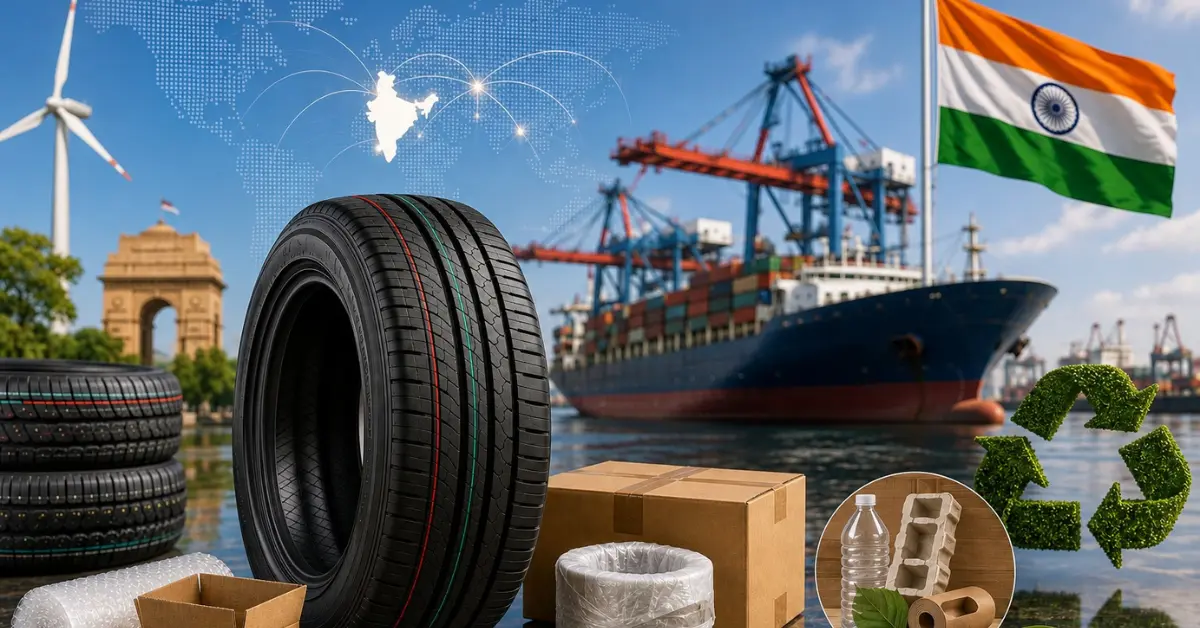
PPWR Compliance for Tire Manufacturers in India: The Exporter’s Guide to EU Packaging Rules
Published
, 10 minute read
Share this article
Quick summary: PPWR compliance for tire manufacturers in India explained: packaging conformity, EU authorised representative, EPR and recyclability deadlines for tyre exporters.
PPWR compliance for tire manufacturers in India applies to the packaging around exported tyres not the tyres themselves. Under Regulation (EU) 2025/40, in force across the EU since 12 August 2026, Indian producers that place packaged tyres on the EU market must meet packaging conformity, documentation, labelling and Extended Producer Responsibility (EPR) obligations, usually through an EU-based authorised representative appointed in each destination country.
Key takeaways
PPWR (Regulation (EU) 2025/40) has applied directly in all 27 EU member states since 12 August 2026, replacing the old Packaging Directive 94/62/EC.
For tyre exporters, the regulation governs transport, grouped and sales packaging film wrap, pallets, banding, labels and cartons not the tyre as a product.
Non-EU manufacturers must appoint an EU authorised representative and register for EPR in each member state where their packaging is placed on the market.
Immediate obligations include substance-of-concern limits, an EU Declaration of Conformity, technical documentation, and identification details on the packaging.
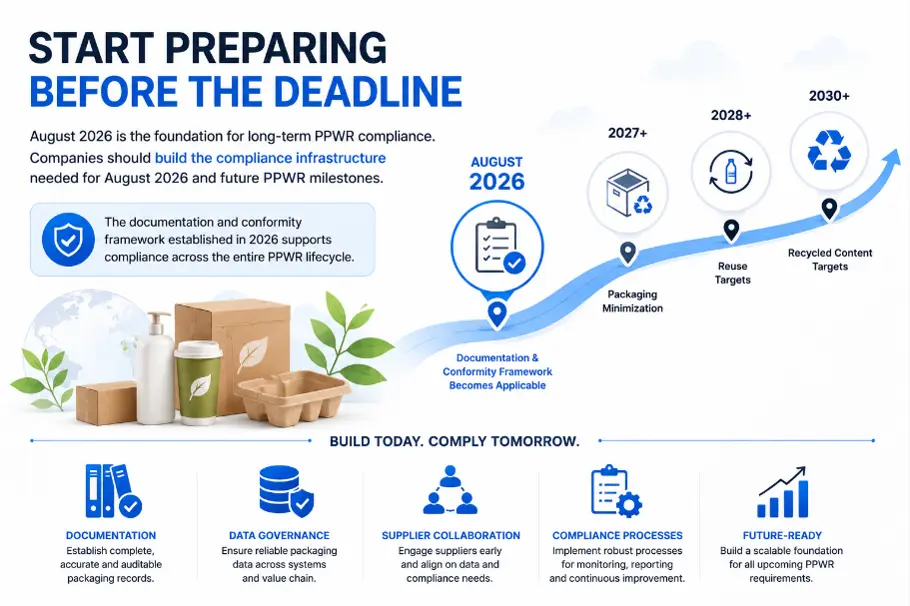
Recyclability grades (A/B/C) and minimum recycled-content thresholds apply from 1 January 2030 packaging redesign lead times mean the work starts now.
Why PPWR Compliance for Tire Manufacturers in India Now Matters
A single missing declaration can hold a container of tyres at an EU port. Here is what changed and why compliance teams can no longer treat packaging as paperwork.
PPWR applies directly no national transposition, no grace for third-country suppliers.
Enforcement is at the border and through market surveillance, with EPR fees layered on top.
Liability flows up the chain: the EU importer’s exposure becomes the Indian supplier’s contractual risk.
India is one of the world’s largest tyre-exporting nations, and the European Union is a high-value destination for passenger, truck, bus and off-highway tyres. The moment a consignment crosses into the EU, the film wrap, pallets, banding, labels and cartons around those tyres become regulated packaging. That is why PPWR compliance for tire manufacturers in India has moved from a downstream customer request to a board-level export condition. Buyers in Germany, France, Belgium and Spain are now writing packaging conformity into purchase contracts, because their own placing-on-market liability depends on it.
Treating packaging as a procurement afterthought breaks under a regulation that carries documentation duties, substance limits and producer-responsibility fees. For an exporter, ignoring PPWR compliance for tire manufacturers in India carries a blunt risk: shipments delayed or refused at customs, EU customers switching to compliant suppliers, and retroactive EPR liabilities never priced into the contract.
Not Sure Where Your Business Stands on PPWR?Understand the key requirements, deadlines and compliance obligations businesses need to prepare for.
What PPWR Compliance for Tire Manufacturers in India Actually Covers
A plain-language definition, plus the packaging types and operator roles that decide who owes what.
Scope: the packaging around the tyre, in three categories sales, grouped and transport packaging.
Roles: manufacturer of packaged products, importer, distributor, and authorised representative.
Core duties: conformity assessment, EU Declaration of Conformity, technical file, EPR registration.
At its core, PPWR compliance for tire manufacturers in India is the set of obligations a producer takes on when the packaging protecting its tyres is placed on the EU market. PPWR the Packaging and Packaging Waste Regulation, Regulation (EU) 2025/40 defines packaging broadly and assigns duties by operator role, not geography. An Indian producer whose brand appears on the packaged product is typically the “manufacturer,” triggering the documentation and conformity obligations directly, even from outside the EU.
From the 12 August 2026 application date, the immediate obligations that touch tyre packaging include: minimising substances of concern (with strict PFAS and heavy-metal limits); a conformity assessment; an EU Declaration of Conformity backed by a technical file; and identification and contact details on the packaging. Because the producer sits outside the EU, these duties run through an EU authorised representative, with EPR registration required in each member state where the packaging first reaches the market. Later phases harmonised labelling from 2028, and recyclability grading plus recycled-content minimums from 1 January 2030 reward exporters who redesign early.
How the TraceX Platform Supports PPWR Compliance for Tire Manufacturers in India
What a purpose-built system does that spreadsheets and email threads cannot.
Digitises the packaging bill of materials and links each component to its substance and material data.
Generates and version-controls the Declaration of Conformity and technical file per packaging type.
Centralises EPR data and authorised-representative coordination across multiple EU member states.
The TraceX packaging-compliance platform is built to make PPWR compliance for tire manufacturers in India repeatable rather than a per-shipment scramble. It captures the packaging bill of materials for each tyre SKU, maps every film, pallet, band and carton to its material and substance data, and holds the evidence trail an EU authority or customer can ask to see
From that single source, the platform is designed to assemble the EU Declaration of Conformity and technical documentation, flag substance-of-concern thresholds before packing, and organise the EPR and authorised-representative records that differ by member state. For exporters juggling German, French, Belgian and Spanish buyers at once, that consolidation turns PPWR compliance for tire manufacturers in India into a controlled process rather than a filing cabinet of PDFs.
To see how the packaging-compliance platform structures your packaging data, generates Declarations of Conformity, and manages EPR across EU markets
The Business Case for PPWR Compliance for Tire Manufacturers in India
Compliance framed as revenue protection, not cost with the levers that move margin.
Protected EU revenue: documentation ready means shipments clear rather than sit.
Lower EPR fees over time: better recyclability data feeds fee eco-modulation from 2030.
Preferred-supplier status with EU buyers who need conformity guarantees from upstream.
The commercial case for PPWR compliance for tire manufacturers in India is straightforward: EU revenue is only secure if the packaging clears the regulation. Exporters that can hand a buyer a complete conformity pack become the easy choice; those that cannot get designed out of tenders. And as fee eco-modulation aligns with recyclability grades from 2030, cleaner packaging data translates directly into lower EPR charges a recurring saving, not a one-off.
Framed this way, PPWR compliance for tire manufacturers in India is revenue insurance for the EU book of business, not a cost centre.
Is Your Business Ready for PPWR EPR Registration?Understand who needs to register, where EPR obligations apply, and what packaging data you need to stay compliant.
PPWR Compliance for Tire Manufacturers in India: What Good Looks Like
A composite, illustrative picture of a mature compliance posture not a specific company.
Consider a mid-sized Indian tyre exporter shipping passenger and off-highway tyres to buyers in three EU countries. Rather than react to each customer questionnaire, it treats PPWR compliance for tire manufacturers in India as a standing capability: every packaging component is logged against its material and substance data, an authorised representative is appointed in each destination market, EPR registrations are live, and a Declaration of Conformity is generated per packaging type and refreshed when a material changes.
The result is a business that answers a buyer’s compliance request in hours, clears customs without documentation queries, and has a head start on the 2030 recyclability and recycled-content thresholds because its packaging data is already structured. That is what mature PPWR compliance for tire manufacturers in India looks like in practice a competitive moat, not just a legal box ticked.
Most tyre exporters discover PPWR through a buyer’s compliance questionnaire which is the worst time to start. Our view is that packaging compliance should live in the same system as the rest of your supply-chain data, so a Declaration of Conformity, a substance check and an EPR record are outputs of a process you already run, not a fire drill per shipment. The regulation is phased through 2030 and beyond; the exporters who structure their packaging data now will absorb each new deadline instead of scrambling for it
PPWR Compliance for Tire Manufacturers in India: Manual vs. the TraceX Platform
How an in-house, spreadsheet-driven approach compares with a purpose-built packaging-compliance platform.
Compliance task
Manual / in-house approach
TraceX platform [pending sign-off]
Packaging data capture
Scattered spreadsheets per SKU; data re-keyed for every buyer request.
Single packaging bill of materials linked to material and substance data.
Declaration of Conformity
Drafted from scratch each time; version confusion across teams.
Generated per packaging type and version-controlled centrally.
Substances of concern (PFAS, metals)
Checked ad hoc, often after packing.
Flagged against thresholds before a shipment is packed.
EPR & authorised representative
Tracked in email across member states; easy to miss a market.
Centralised records and coordination per EU member state.
2030 recyclability readiness
Reactive redesign under deadline pressure.
Structured data gives a head start on grading and recycled content.
PPWR Compliance for Tire Manufacturers in India: A Buyer’s Evaluation Checklist
Use this to pressure-test any compliance approach internal build or vendor before you commit.
Does it capture a packaging bill of materials for every tyre SKU you export to the EU?
Can it generate and version an EU Declaration of Conformity per packaging type?
Does it flag substances of concern (PFAS, heavy metals) before packing, not after?
Does it manage EPR registration and authorised-representative records per member state?
Will it help you meet the 1 January 2030 recyclability grades and recycled-content targets?
Does it keep an audit-ready evidence trail for EU authorities and customers?
Does it scale across multiple EU destination markets without duplicating work?
Frequently Asked Questions
Does PPWR apply to the tyres themselves or only the packaging?
PPWR applies to the packaging around the tyres film, pallets, banding, labels and cartons not to the tyre as a product. The tyre is the packaged product; it is the packaging that must meet the regulation’s conformity, substance and EPR requirements.
Do Indian tyre manufacturers really fall under an EU regulation?
Yes, if their packaged tyres are placed on the EU market. PPWR assigns obligations by operator role, not by location. An Indian producer whose brand appears on the packaged product is generally treated as the manufacturer and owes the documentation and conformity duties directly.
What is an authorised representative and do we need one?
It is an EU-established entity appointed by written mandate to carry certain PPWR and EPR responsibilities for a non-EU producer. Producers outside the EU generally need one, with EPR handled per member state where the packaging is placed on the market.
When did PPWR start applying?
Regulation (EU) 2025/40 entered into force on 11 February 2025 and has applied across all 27 EU member states since 12 August 2026. Harmonised labelling, recyclability grading and recycled-content minimums phase in through 2028, 2030 and beyond.
What are the recyclability grades and when do they matter?
From 1 January 2030, packaging must meet design-for-recyclability grades (A, B or C), and recycled-content minimums apply to plastic packaging. EPR fees are eco-modulated against these grades higher-graded packaging pays lower fees which is why redesign should start now.
Is this the same as EUDR for natural rubber?
No. EUDR covers natural rubber as a commodity and requires geolocation and due-diligence statements for the rubber itself. PPWR is a separate regulation covering the packaging around the tyres. Exporters may face both, but they are distinct obligations.
How can a platform help with PPWR compliance?
It centralises packaging data, generates Declarations of Conformity and technical files, flags substance-of-concern thresholds, and manages EPR and authorised-representative records across member states turning per-shipment scrambles into a repeatable process.
Start using TraceX
Transparency, Trust, & Success for your Climate Journey.
We use cookies on our website to give you the most relevant experience by remembering your preferences and repeat visits. By clicking “Accept All”, you consent to the use of ALL the cookies. However, you may visit "Cookie Settings" to provide a controlled consent.
This website uses cookies to improve your experience while you navigate through the website. Out of these, the cookies that are categorized as necessary are stored on your browser as they are essential for the working of basic functionalities of the website. We also use third-party cookies that help us analyze and understand how you use this website. These cookies will be stored in your browser only with your consent. You also have the option to opt-out of these cookies. But opting out of some of these cookies may affect your browsing experience.
Necessary cookies are absolutely essential for the website to function properly. These cookies ensure basic functionalities and security features of the website, anonymously.
Cookie
Duration
Description
cookielawinfo-checkbox-analytics
11 months
This cookie is set by GDPR Cookie Consent plugin. The cookie is used to store the user consent for the cookies in the category "Analytics".
cookielawinfo-checkbox-functional
11 months
The cookie is set by GDPR cookie consent to record the user consent for the cookies in the category "Functional".
cookielawinfo-checkbox-necessary
11 months
This cookie is set by GDPR Cookie Consent plugin. The cookies is used to store the user consent for the cookies in the category "Necessary".
cookielawinfo-checkbox-others
11 months
This cookie is set by GDPR Cookie Consent plugin. The cookie is used to store the user consent for the cookies in the category "Other.
cookielawinfo-checkbox-performance
11 months
This cookie is set by GDPR Cookie Consent plugin. The cookie is used to store the user consent for the cookies in the category "Performance".
viewed_cookie_policy
11 months
The cookie is set by the GDPR Cookie Consent plugin and is used to store whether or not user has consented to the use of cookies. It does not store any personal data.
Functional cookies help to perform certain functionalities like sharing the content of the website on social media platforms, collect feedbacks, and other third-party features.
Performance cookies are used to understand and analyze the key performance indexes of the website which helps in delivering a better user experience for the visitors.
Analytical cookies are used to understand how visitors interact with the website. These cookies help provide information on metrics the number of visitors, bounce rate, traffic source, etc.
Advertisement cookies are used to provide visitors with relevant ads and marketing campaigns. These cookies track visitors across websites and collect information to provide customized ads.
Download the 2026 Traceability Scorecard and Benchmark Your Supply Chain Across 10 Critical Capabilities.
Download our eBook
Don’t Wait for an Audit to Find Your EUDR Gaps
The 2026 Simplification Package changes how HS codes, DDS pass-through and geolocation rules apply to you. Get the free guide and 20-point readiness checklist before enforcement catches you unprepared.