PPWR Compliance for Tire Manufacturers in Germany: What You Must File Before Enforcement
Published
, 11 minute read
Share this article
Quick summary: PPWR compliance for tire manufacturers in Germany covers every pallet wrap, shrink hood and strap under Reg (EU) 2025/40 and the VerpackDG. See what to file.
PPWR compliance for tire manufacturers in Germany is the set of obligations that Regulation (EU) 2025/40 places on the packaging tyres are shipped and sold in not on the tyre itself. From 12 August 2026, every pallet wrap, shrink hood, strapping band, tyre bag and carton a manufacturer places on the German market must satisfy PPWR rules on recyclability, recycled content, substances, minimisation and Extended Producer Responsibility, administered nationally through Germany’s VerpackDG and the ZSVR-operated LUCID register.
Key takeaways
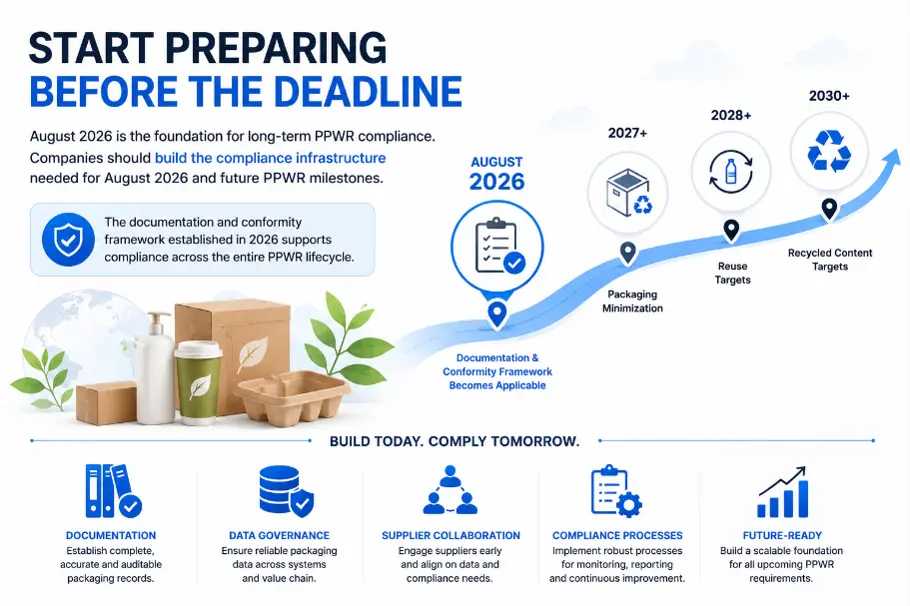
PPWR (Regulation (EU) 2025/40) applies from 12 August 2026; Germany’s VerpackDG replaced the old VerpackG on the same day.
For tyre makers the regulated object is the transport and industrial packaging around the tyre stretch film, shrink hoods, straps, pallets and bags not the end-of-life tyre, which sits under a separate producer-responsibility stream.
Producer status is reassessed under the broader PPWR Article 3 definition and applies per Member State; existing LUCID numbers carry over but the scope of what must be declared widens.
Each packaging type needs a Declaration of Conformity (Annex VIII) plus technical documentation and a conformity assessment (Annex VII), retained five to ten years.
The February 2026 delegated act exempts pallet wrapping film and straps used domestically or intra-group from the 100% reuse target but the cross-border reuse and recyclability rules still bite.
Download the Free Declaration of Conformity (DoC) Template
What PPWR Compliance for Tire Manufacturers in Germany Actually Covers
The regulated object is the packaging, not the tyre. Confusing the two is the costliest early mistake.
PPWR applies to all packaging placed on the EU market, industrial shipments included.
End-of-life tyres are governed separately PPWR governs the film, straps, pallets and cartons that move them.
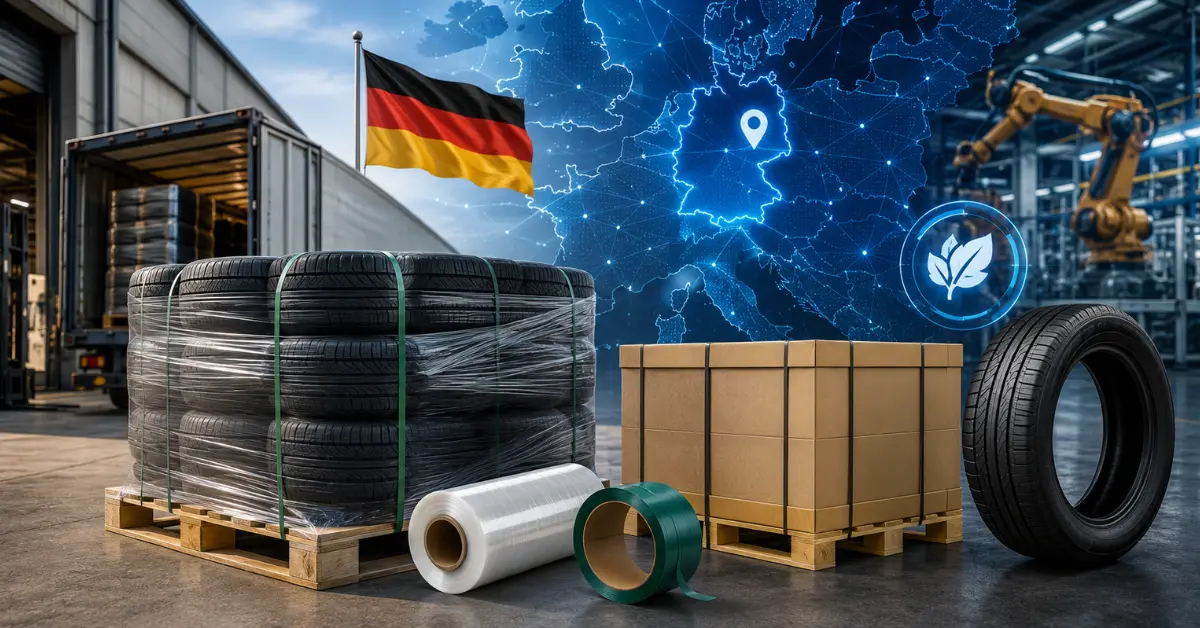
PPWR compliance for tire manufacturers in Germany begins with one distinction that most plants get wrong. Most tyre plants assume the Packaging and Packaging Waste Regulation is a beverage-and-consumer-goods rule and that bulk industrial shipments fall outside it. They do not. The tyre itself is regulated under end-of-life tyre (ELT) schemes; PPWR regulates the packaging that protects and transports it. That single distinction defines the whole scope: a tyre manufacturer’s PPWR exposure is dominated by transport and industrial packaging the stretch wrap on a pallet of 200 tyres, the shrink hood, the polyester or steel straps, the interleaving bags and the retail cartons that reach the aftermarket. Every one of those items is packaging under Article 3, and every one of them now carries design, documentation and reporting duties.
The VerpackDG and LUCID Layer for Tyre Producers in Germany
Germany didn’t transpose PPWR it applies directly but the VerpackDG wires it into the national EPR machinery.
LUCID register, ZSVR oversight and the dual systems all carry forward.
Existing LUCID numbers do not reset; existing system-participation contracts run to 31 December 2026.
In practice, PPWR compliance for tire manufacturers in Germany runs through this national layer. The Verpackungsrecht-Durchführungsgesetz (VerpackDG) took effect on 12 August 2026, replacing the VerpackG and designating the Zentrale Stelle Verpackungsregister (ZSVR) as the competent authority. The practical trap is producer status. Under the broader Article 3 definition, producer obligations are reassessed and apply per Member State. A manufacturer shipping the same tyre SKU into five EU markets can become five separate producers with five separate EPR registrations this is a map problem, not a label problem. Non-German manufacturers must appoint an Authorised Representative, and the annual Declaration of Completeness is filed with the ZSVR by 15 May using a qualified electronic signature.
Is your business ready for PPWR compliance?
Our guide to PPWR Compliance Requirements breaks down the key obligations businesses need to understandfrom packaging design and recyclability to recycled content, labelling, EPR and packaging data management.
Transport and Industrial Packaging Obligations Tyre Makers Cannot Skip
This is where most of the tyre-specific engineering work sits.
Recyclability: all packaging graded against Annex II; below-grade-C formats are barred from 2030.
Recycled content: minimum recycled-content thresholds phase in from 2030 [figures to be sourced from the final act].
Reuse: the Article 29 cross-border 40%-by-2030 target survives; the February 2026 act exempts domestic/intra-group pallet wrap and straps from the 100% reuse rule.
Minimisation: Article 10 down-gauging must be evidenced — load-stability standards such as EUMOS 40509 support the case.
Within PPWR compliance for tire manufacturers in Germany, transport packaging carries the most engineering weight. For pigmented films this is not abstract: carbon-black masterbatch defeats near-infrared sortation, so dark shrink hoods can drop below the recyclable grade. Switching to detectable dark pigments and mono-polyethylene structures is now a compliance decision, not just a procurement one. Substances of concern under Article 5 must also be minimised and evidenced.
Declaration of Conformity and Technical Documentation for Tyre Packaging
The paperwork is per packaging type, and it must be producible on demand.
Declaration of Conformity follows Annex VIII; the conformity assessment and technical file follow Annex VII.
Retain documentation for ten years (reusable packaging) or five years (single-use), available to enforcement authorities on request.
The documentation core of PPWR compliance for tire manufacturers in Germany is per packaging type, and it is where audits are won or lost. A LUCID entry proves you are registered for EPR it says nothing about whether each packaging type has a recyclability assessment or a Declaration of Conformity. Those are separate, additional obligations. For a tyre manufacturer running dozens of packaging SKUs across multiple plants, the burden is not writing one declaration; it is keeping every declaration current, versioned and retrievable as film suppliers, resin grades and destination markets change.
Are you clear on your EPR registration obligations?
Our guide to EPR Registration explains what businesses need to know about registering as a producer, understanding their responsibilities, managing packaging data, and preparing for EPR reporting requirements across relevant markets.
Why PPWR Compliance for Tire Manufacturers in Germany Is a Data Problem
The obligations are knowable. What breaks is retrieval under time pressure.
Producer status, declarations and recyclability grades all draw on the same underlying packaging facts.
Enforcement asks point-in-time questions which declaration applied to which SKU, in which market, on which date.
Seen end to end, PPWR compliance for tire manufacturers in Germany is less a policy exercise than a data-management one. The Article 3 producer test, the Annex VIII declaration and the Annex II recyclability grade are three views of one dataset: the packaging bill of materials for every tyre SKU, keyed to destination market and supplier. When that data lives in disconnected spreadsheets across plants, each obligation is re-derived by hand and every market change reopens work already done. When it lives in one structured layer, a reconciliation query becomes a lookup rather than a fire drill — which is exactly the posture the ZSVR and downstream customers now expect.
PPWR compliance for tire manufacturers in Germany is a retrieval problem, not a policy problem. The obligations are knowable; what breaks is the ability to answer a point-in-time question which declaration applied to which SKU in which market on which date. TraceX treats this as one data layer, many regulations: the same packaging dataset that resolves LUCID producer status also generates Annex VIII declarations and feeds recyclability grading, so evidence is assembled once and reused across obligations
For tire manufacturers in Germany, TraceX’s PPWR solution can help create a connected packaging compliance record across the company’s packaging portfolio covering items such as tyre packaging, pallets, wraps, labels, cartons and other shipment packaging. TraceX can centralise packaging inventory, material composition, weight, supplier information, recycled-content data, recyclability evidence and supporting documentation, while linking the data to products and suppliers. This can help teams identify missing information, maintain evidence for conformity and organise the data needed for German EPR processes. Germany requires producers to register with the LUCID Packaging Register, and packaging subject to system participation also requires a system participation agreement and packaging-volume reporting. TraceX can therefore provide a structured digital layer connecting supplier → packaging component → tyre/product → market → compliance evidence, helping large tyre manufacturers move beyond spreadsheets and fragmented supplier documentation toward a more auditable PPWR compliance workflow.
To see how TraceX assembles your PPWR packaging evidence once and reuses it across LUCID, Annex VIII declarations and recyclability grading
For PPWR compliance for tire manufacturers in Germany, the difference is not effort it’s whether the evidence survives an enforcement query.
Compliance task
Manual / spreadsheet approach
TraceX platform approach
Packaging inventory per SKU
Static spreadsheets per plant, quickly outdated
Live packaging register linked to each tyre SKU and destination market
LUCID / EPR producer mapping
Manual re-check each time a SKU enters a new market
Producer obligations resolved per Member State from one dataset
Declaration of Conformity (Annex VIII)
Rebuilt by hand, versions scattered across teams
Generated from structured supplier data, versioned and retrievable
Recyclability grading (Annex II)
Ad-hoc emails to film and strap suppliers
Supplier declarations intake against A/B/C grades
Enforcement / ZSVR reconciliation
Days of retrieval; point-in-time gaps
Point-in-time evidence returned on request
PPWR Compliance Checklist for Tyre Manufacturers Evaluating a Platform
Use this to score any tool for PPWR compliance for tire manufacturers in Germany including TraceX against the obligations above.
Can it hold a live packaging inventory linked to each tyre SKU and destination market?
Does it resolve producer status per Member State, not just for Germany?
Can it generate a versioned Annex VIII Declaration of Conformity from structured supplier data?
Does it intake supplier recyclability declarations against Annex II A/B/C grades?
Can it flag carbon-black and non-recyclable film SKUs before 2030 bans bite?
Does it return point-in-time evidence for a ZSVR reconciliation or enforcement request?
Does it map to other regimes (EPR, DPP, CSRD) from the same dataset?
Frequently Asked Questions
Does PPWR regulate the tyre or the packaging?
PPWR regulates the packaging tyres are shipped and sold in — pallet wrap, shrink hoods, straps, bags and cartons. The end-of-life tyre itself is covered by separate producer-responsibility schemes, so tyre manufacturers must treat the two regimes distinctly.
When does PPWR compliance for tire manufacturers in Germany start?
The core obligations apply from 12 August 2026, the date Regulation (EU) 2025/40 became applicable and Germany’s VerpackDG took effect. Several requirements, including reuse targets and recycled-content thresholds, phase in through 2030 and beyond.
Do we need to re-register in LUCID?
No. Existing LUCID registration numbers carry over and existing system-participation contracts run to 31 December 2026. However, producer status is reassessed under the broader PPWR Article 3 definition, so the scope of what you must declare may widen.
Are pallet wrap and straps exempt from the reuse rules?
The February 2026 delegated act exempts pallet wrapping film and securing straps used domestically or intra-group from the 100% reuse obligation. The cross-border 40%-by-2030 reuse target and the recyclability requirements still apply.
What documentation must a tyre manufacturer keep?
A Declaration of Conformity per packaging type (Annex VIII), plus the conformity assessment and technical documentation (Annex VII), retained ten years for reusable and five years for single-use packaging, and produced to authorities on request.
Do non-German tyre manufacturers need a representative?
Yes. Manufacturers established outside Germany must appoint an Authorised Representative for EPR, confirmed by the ZSVR, and file the annual Declaration of Completeness with a qualified electronic signature.
How is this different from EPR reporting we already do?
EPR volume declarations and the PPWR Declaration of Conformity are distinct instruments. A LUCID entry proves registration; it does not prove that each packaging type is recyclable or conformity-assessed those are separate PPWR duties.
Start using TraceX
Transparency, Trust, & Success for your Climate Journey.
We use cookies on our website to give you the most relevant experience by remembering your preferences and repeat visits. By clicking “Accept All”, you consent to the use of ALL the cookies. However, you may visit "Cookie Settings" to provide a controlled consent.
This website uses cookies to improve your experience while you navigate through the website. Out of these, the cookies that are categorized as necessary are stored on your browser as they are essential for the working of basic functionalities of the website. We also use third-party cookies that help us analyze and understand how you use this website. These cookies will be stored in your browser only with your consent. You also have the option to opt-out of these cookies. But opting out of some of these cookies may affect your browsing experience.
Necessary cookies are absolutely essential for the website to function properly. These cookies ensure basic functionalities and security features of the website, anonymously.
Cookie
Duration
Description
cookielawinfo-checkbox-analytics
11 months
This cookie is set by GDPR Cookie Consent plugin. The cookie is used to store the user consent for the cookies in the category "Analytics".
cookielawinfo-checkbox-functional
11 months
The cookie is set by GDPR cookie consent to record the user consent for the cookies in the category "Functional".
cookielawinfo-checkbox-necessary
11 months
This cookie is set by GDPR Cookie Consent plugin. The cookies is used to store the user consent for the cookies in the category "Necessary".
cookielawinfo-checkbox-others
11 months
This cookie is set by GDPR Cookie Consent plugin. The cookie is used to store the user consent for the cookies in the category "Other.
cookielawinfo-checkbox-performance
11 months
This cookie is set by GDPR Cookie Consent plugin. The cookie is used to store the user consent for the cookies in the category "Performance".
viewed_cookie_policy
11 months
The cookie is set by the GDPR Cookie Consent plugin and is used to store whether or not user has consented to the use of cookies. It does not store any personal data.
Functional cookies help to perform certain functionalities like sharing the content of the website on social media platforms, collect feedbacks, and other third-party features.
Performance cookies are used to understand and analyze the key performance indexes of the website which helps in delivering a better user experience for the visitors.
Analytical cookies are used to understand how visitors interact with the website. These cookies help provide information on metrics the number of visitors, bounce rate, traffic source, etc.
Advertisement cookies are used to provide visitors with relevant ads and marketing campaigns. These cookies track visitors across websites and collect information to provide customized ads.
Download the 2026 Traceability Scorecard and Benchmark Your Supply Chain Across 10 Critical Capabilities.
Download our eBook
Don’t Wait for an Audit to Find Your EUDR Gaps
The 2026 Simplification Package changes how HS codes, DDS pass-through and geolocation rules apply to you. Get the free guide and 20-point readiness checklist before enforcement catches you unprepared.