EUDR Cross-Border Manufacturing: Who Files the DDS When EU Material Is Processed Abroad?
Published
, 12 minute read
Share this article
Quick summary: EUDR cross-border manufacturing raises one hard question: who files the DDS when EU material is processed abroad and re-imported? 4 examples + a guide.
In EUDR cross-border manufacturing, the company that first places the finished, in-scope product on the EU market files the Due Diligence Statement (DDS). When EU-origin material is exported, significantly transformed abroad and re-imported as a new Annex I product, that re-import is a fresh placing on the market under Article 2(16) so the EU importer is normally the operator and files the DDS via TRACES, regardless of who supplied the input or where the invoice was issued.
Key takeaways
An EU purchase invoice does not, on its own, prove a product was placed on the EU market. Article 2(16) turns on the first making-available of a relevant product.
Significant transformation abroad usually creates a new relevant product, so bringing it back is a new placing on the market not a continuation of the input’s status.
The EU importer of the finished product is normally the operator and files the DDS via TRACES.
A downstream operator can rely on an upstream DDS reference only where the product is already covered by one; otherwise full due diligence applies.
Application dates: 30 December 2026 (large/medium operators and traders; micro/small timber) and 30 June 2027 (micro/small non-timber), per Regulation (EU) 2025/2650.
December 2026 is approaching. Is your supply chain actually ready?
Move from spreadsheets and fragmented supplier data to a traceable, audit-ready EUDR workflow with TraceX.
What EUDR cross-border manufacturing actually means
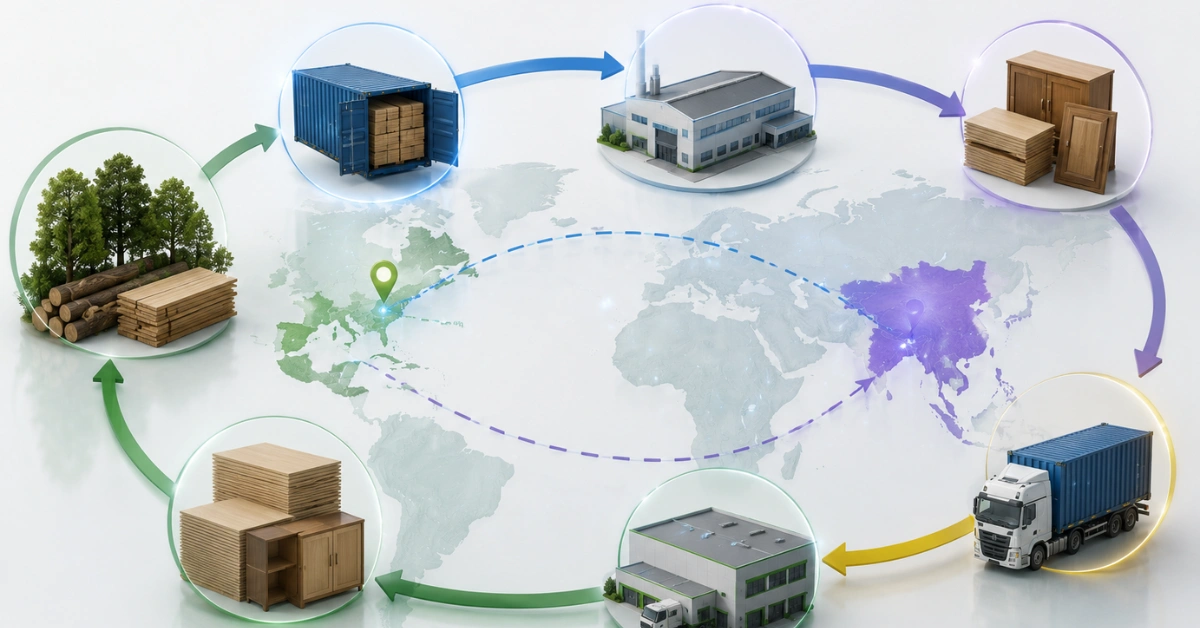
EUDR cross-border manufacturing describes a pattern most global buyers already run without naming it: you buy a relevant commodity or product linked to an EU supplier, ship it outside the EU for processing, and import the finished product back into the Union. The trouble starts the moment a buyer assumes the EU purchase settles the compliance question. It rarely does and by the time the finished goods clear customs, the missing due-diligence evidence can no longer be recreated retroactively.
In plain terms: under Regulation (EU) 2023/1115, as amended by Regulation (EU) 2025/2650, the EUDR governs seven commodities cattle, cocoa, coffee, oil palm, rubber, soy and wood plus the products derived from them in Annex I. A cross-border manufacturing scenario forces two separate EUDR questions that buyers routinely collapse into one: what happened to the original input, and what obligation attaches when the finished product enters the EU.
Why “placed on the EU market” beats “purchased in the EU”
The single biggest misconception in EUDR cross-border manufacturing is treating an EU supplier invoice as proof of EUDR status. Article 2(16) defines placing on the market as the first making-available of a relevant product on the Union market for distribution or use. An invoice from a German or Belgian supplier only equals placement if that product was genuinely placed on the market first and even then, once you significantly transform it abroad, you create a new product whose re-import is a new placing on the market.
This is where the value sits for a buyer: get the distinction right and you know exactly whose obligation it is, what evidence to demand, and when. Get it wrong and you inherit an operator’s full due-diligence duty at the border with no geolocation data to satisfy it. During the transitional period, a customs declaration is accepted as evidence that goods were placed on the EU market before the application date (EUDR FAQ, Q9.2) useful, but only for the original input, not for a newly manufactured finished product.
Purchased in the EU vs. Placed on the EU market
Purchased in the EU: a commercial transaction with an EU supplier. Proves ownership, not regulatory placement.
Placed on the EU market: the first making-available of the relevant product on the Union market. Proven by customs/placement records, not by the invoice alone. A significant transformation abroad resets this for the finished product.
Are you a downstream operator or trader? Your EUDR responsibilities may be very different from those of the company that originally sourced the commodity.
Read our guide on EUDR Downstream Obligations to understand what information you need to collect, what records you need to maintain, when verification may be required, and how your responsibilities change when you receive a substantiated concern.
EUDR cross-border manufacturing examples: four supply chains, four answers
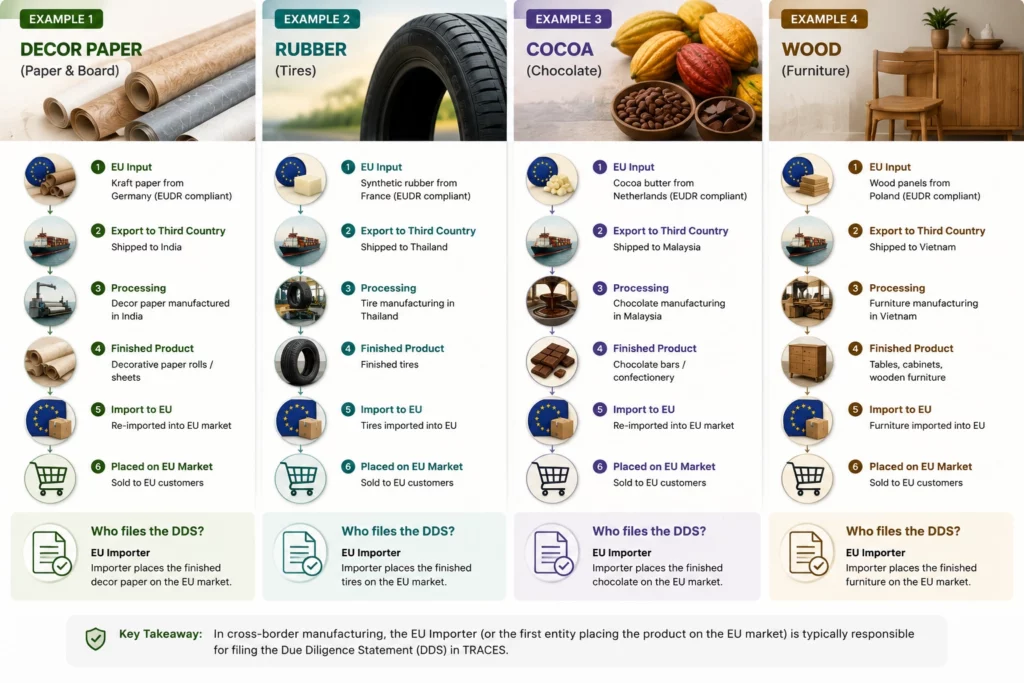
These four EUDR cross-border manufacturing examples show why the answer to “who files the DDS?” cannot be read off the purchase invoice. In each, input status and finished-product status must be assessed separately.
Example 1 — Decor paper: Germany → India → HPL laminate → EU
An Indian manufacturer buys decor paper (a wood-derived Annex I product) from a German supplier, exports it to India, impregnates and presses it into high-pressure laminate (HPL), then ships the laminate back to the EU. The finished HPL is a new relevant product with its own CN classification. The EU entity importing the laminate places it on the market for the first time and is normally the operator that files the DDS even though the original paper was bought in Germany. If the paper was placed on the EU market during the transitional period, retain the customs declaration; it evidences the input’s status but does not discharge the finished-product obligation.
Wood supply chains can be complexwith multiple suppliers, production locations, processing stages and documentation requirements making traceability difficult.
Read our guide on EUDR Wood Challenges to understand the key challenges around geolocation, deforestation checks, legality evidence, supplier traceability and DDS readiness.
Example 2 — Natural rubber: EU → India → tyres → EU
A buyer sources EU natural rubber, sends it to India for tyre manufacturing, and imports finished tyres. Buying the rubber in the EU does not automatically remove the obligation. The tyre is a new rubber-derived product; the EU importer places it on the market and is the operator. The rubber input must be linked to the finished tyre by batch, and the EU importer should request origin and geolocation data up-front not after arrival. (Note: only newly applied material carries the obligation for repairs/retreads; that nuance sits outside this cross-border build.)
See How a Global Tire Manufacturer Built EUDR-Ready Rubber Traceability
How do you prove that every gram of natural rubber used in tyres comes from deforestation-free land?
This case study explores how a global tire manufacturer addressed EUDR compliance across rubber plantations in India and Southeast Asia, strengthening traceability and supporting continued access to the EU market.
Read the case study: How a Tire Company Future-Proofed Its Rubber Exports with EUDR Compliance and discover how digital traceability can help connect rubber sourcing, plot-level data, compliance evidence and EU exports.
Example 3 — Cocoa: Belgium → India → chocolate → EU
Belgian cocoa is shipped to India, processed into chocolate, and imported back into the EU. The cocoa’s status does not silently transfer to the chocolate. Chocolate (HS 1806) is in Annex I, so the EU importer of the finished chocolate holds the obligation. If the cocoa was already placed on the EU market and covered by an upstream DDS, a subsequent EU actor may qualify as a trader or downstream operator for that flow but manufacturing abroad into a new product changes the analysis and pushes the duty back to whoever re-imports.
Example 4 — Wood panels: Italy → Vietnam → furniture → EU
Italian wood-based panels go to Vietnam for furniture manufacturing and return as finished furniture. The EU importer of the furniture becomes the relevant operator and needs supply-chain information from the Vietnamese manufacturer. Where several wood inputs are combined during manufacturing, each must be traceable to plot-level geolocation and tied to the finished item combination does not dilute the evidence requirement.
EUDR cross-border manufacturing: who actually files the DDS?
Across every EUDR cross-border manufacturing chain, DDS responsibility resolves to a short set of questions none of which is “who ran the factory?”:
Who places the finished relevant product on the EU market? (First making-available = the operator.)
Who imports it, and are they established inside or outside the EU? (Under Article 7, when a non-EU entity places a product on the EU market, the first EU person to make it available is also an operator with full due diligence.)
Is the actor an operator, a downstream operator or a trader? A downstream operator can rely on an upstream DDS reference only where the product is already covered by one.
Read together, these show why DDS responsibility in EUDR cross-border manufacturing cannot be determined by asking who manufactured the product it follows the regulatory status and movement of the relevant product to the EU border.
Filing a DDS can seem like the final stepbut getting the supplier data, geolocation, risk assessment and supporting evidence right beforehand is what makes the filing process smoother.
EUDR cross-border manufacturing data: what must cross the EU–non-EU boundary
Getting the EUDR cross-border manufacturing answer right is only half the job; the evidence has to actually travel with the goods. The table below is the minimum data set an EU importer should be able to reconstruct from source to finished product.
Data domain
What must flow across the border
Supplier
Legal entity, address, country, direct business relationship
Country of production, production date, plot-level geolocation
Compliance
Deforestation assessment, legality evidence, risk assessment and mitigation, DDS reference where applicable
Manufacturing
Input batch, production batch, output quantity, input-to-output transformation link
Common EUDR cross-border manufacturing mistakes buyers make
The most expensive EUDR cross-border manufacturing errors are assumptions that feel reasonable and are simply wrong:
“We bought it in Europe, so we’re automatically compliant.” — Purchase ≠ placement, and processing abroad resets the finished-product status.
“Our supplier already did the DDS, so we don’t need to check.” — An upstream DDS only helps where the finished product is genuinely covered by it.
“The finished product is different, so the original material doesn’t matter.” — The opposite: the new product usually creates a fresh obligation for whoever re-imports.
“We’ll collect geolocation after the shipment arrives.” — In EUDR cross-border manufacturing, plot data must exist before the product is placed on the market, not retrofitted at the border.
Most EUDR cross-border manufacturing failures are not legal misreadings they are broken data journeys. The invoice survives the trip; the geolocation, batch linkage and DDS reference do not. Our view is that the fix is structural: connect supplier, plot, batch, processing event and finished-product shipment as one continuous record, so the EU importer can prove placement and origin at the moment of import instead of scrambling for it afterwards. TraceX EUDR Solutions is built to hold that source-to-finished-product chain across the EU–non-EU boundary capability claim pending product-team sign-off
Managing cross-border manufacturing under EUDR?
TraceX EUDR Solutions connects supplier data, plot-level geolocation, batches, processing events, risk assessments and DDS workflows so you can prove a traceable compliance record from source to finished product, at the moment of import.
Manual spreadsheets vs. a connected traceability record
Dimension
Manual / spreadsheet approach
Connected traceability (Cleara AI)
Input-to-output linkage
Re-keyed by hand; breaks at each processing step
Batch linkage preserved through transformation events
Placement evidence
Invoice treated as proof; customs records scattered
Placement + customs evidence attached to the product record
Geolocation
Requested late, often missing at import
Plot data captured upstream and carried to the border
DDS readiness
Reconstructed under deadline pressure
DDS reference and Article 9 data assembled continuously
Audit trail
Email threads and folders
Single source-to-finished-product trail
Buyer’s checklist: evaluating your EUDR cross-border manufacturing exposure
Can you show that each relevant input was placed on the EU market (not merely purchased)?
For every re-imported finished product, have you identified who places it on the market and files the DDS?
Is plot-level geolocation captured before shipment, and linked to the finished-product batch?
Where you rely on an upstream DDS, is the finished product genuinely covered by it?
Can you reconstruct the full journey — input → supplier → plot → batch → manufacturing → finished product → shipment — from one record?
Frequently Asked Questions (FAQ’s)
Who files the DDS in EUDR cross-border manufacturing?
In EUDR cross-border manufacturing, the entity that first places the finished, in-scope product on the EU market files the DDS normally the EU importer of the re-imported product, via TRACES.
Does buying material from an EU supplier make me EUDR-compliant?
No. An EU purchase invoice proves a transaction, not that the product was placed on the EU market. Article 2(16) turns on the first making-available, and processing abroad creates a new product with its own obligation.
Is a product processed outside the EU a new relevant product?
Usually, yes. Significant transformation abroad for example decor paper into HPL laminate, or cocoa into chocolate creates a new Annex I product whose re-import is a new placing on the EU market.
Can I rely on my supplier’s DDS instead of filing my own?
Only where the finished product is genuinely covered by an upstream DDS. A downstream operator can reference it; but if you re-import a newly manufactured product, you typically need your own due diligence.
What is the Article 7 double-operator rule?
When a non-EU entity places a relevant product on the EU market, the first EU person to make it available is also treated as an operator with full due diligence, so there is always an EU-based party accountable.
When does the EUDR apply to my cross-border flows?
From 30 December 2026 for large and medium operators and traders (and micro/small timber), and 30 June 2027 for micro and small non-timber operators, under Regulation (EU) 2025/2650.
What evidence should I keep for cross-border manufacturing?
Purchase invoices, customs and placement records, bills of lading, production and batch records, plot-level geolocation, supplier declarations, DDS references and import documentation enough to prove the whole journey.
Start using TraceX
Transparency, Trust, & Success for your Climate Journey.
We use cookies on our website to give you the most relevant experience by remembering your preferences and repeat visits. By clicking “Accept All”, you consent to the use of ALL the cookies. However, you may visit "Cookie Settings" to provide a controlled consent.
This website uses cookies to improve your experience while you navigate through the website. Out of these, the cookies that are categorized as necessary are stored on your browser as they are essential for the working of basic functionalities of the website. We also use third-party cookies that help us analyze and understand how you use this website. These cookies will be stored in your browser only with your consent. You also have the option to opt-out of these cookies. But opting out of some of these cookies may affect your browsing experience.
Necessary cookies are absolutely essential for the website to function properly. These cookies ensure basic functionalities and security features of the website, anonymously.
Cookie
Duration
Description
cookielawinfo-checkbox-analytics
11 months
This cookie is set by GDPR Cookie Consent plugin. The cookie is used to store the user consent for the cookies in the category "Analytics".
cookielawinfo-checkbox-functional
11 months
The cookie is set by GDPR cookie consent to record the user consent for the cookies in the category "Functional".
cookielawinfo-checkbox-necessary
11 months
This cookie is set by GDPR Cookie Consent plugin. The cookies is used to store the user consent for the cookies in the category "Necessary".
cookielawinfo-checkbox-others
11 months
This cookie is set by GDPR Cookie Consent plugin. The cookie is used to store the user consent for the cookies in the category "Other.
cookielawinfo-checkbox-performance
11 months
This cookie is set by GDPR Cookie Consent plugin. The cookie is used to store the user consent for the cookies in the category "Performance".
viewed_cookie_policy
11 months
The cookie is set by the GDPR Cookie Consent plugin and is used to store whether or not user has consented to the use of cookies. It does not store any personal data.
Functional cookies help to perform certain functionalities like sharing the content of the website on social media platforms, collect feedbacks, and other third-party features.
Performance cookies are used to understand and analyze the key performance indexes of the website which helps in delivering a better user experience for the visitors.
Analytical cookies are used to understand how visitors interact with the website. These cookies help provide information on metrics the number of visitors, bounce rate, traffic source, etc.
Advertisement cookies are used to provide visitors with relevant ads and marketing campaigns. These cookies track visitors across websites and collect information to provide customized ads.
Download the 2026 Traceability Scorecard and Benchmark Your Supply Chain Across 10 Critical Capabilities.
Download our eBook
Don’t Wait for an Audit to Find Your EUDR Gaps
The 2026 Simplification Package changes how HS codes, DDS pass-through and geolocation rules apply to you. Get the free guide and 20-point readiness checklist before enforcement catches you unprepared.