Technical Dossier Examples for PPWR: The Evidence Behind Every DoC
Published
, 11 minute read
Share this article
Quick summary: Technical dossier examples for PPWR by packaging type - pouch, bottle, box, pallet. See the exact evidence behind every Declaration of Conformity before Aug 2026.
Technical dossier examples for PPWR show exactly what evidence sits behind a signed Declaration of Conformity for each packaging type. For a plastic pouch, glass bottle, corrugated box or a pallet-and-stretch-film transport unit, the dossier compiles material composition, weight, recyclability assessment, substance and PFAS test reports, supplier declarations and design/minimisation records assembled under Annex VII (Module A) of Regulation (EU) 2025/40 so the one-page Annex VIII declaration has proof underneath it before the 12 August 2026 application date.
Key takeaways
The Declaration of Conformity (Annex VIII) is a one-page signature; the technical dossier (Annex VII, Module A) is the proof underneath it.
Every unique packaging type pouch, bottle, box, pallet needs its own file. A 200-SKU portfolio can mean up to 200 dossiers.
At the 12 August 2026 gate, substances-of-concern evidence (Article 5) is the first obligation to bite; recyclability grades and minimisation records phase in later.
Market surveillance authorities can request the full file and expect it within 10 days.
Build the dossier structure now; populate it in the order the obligations actually apply.
Download the Free Declaration of Conformity (DoC) Template
What Technical dossier examples for PPWR actually show
Technical dossier examples for PPWR are worked models of the documented evidence that proves one packaging type meets Articles 5 to 12 of Regulation (EU) 2025/40. In plain terms: the Declaration of Conformity is the conclusion, and the technical dossier is the working. The declaration takes five minutes to sign. The dossier is where the real effort lives and it is where market surveillance authorities look when they ask you to defend a claim.
Here is the pain most compliance and packaging teams hit. They download an Annex VIII template, populate the ten mandatory fields, and feel ready. Then someone asks: where is the substance test report for the inner film layer? Where is the supplier declaration for the closure liner? Which recyclability class did you assign, and on what basis? The signature is easy; the file behind it is scattered across supplier emails, PDF attachments and a spreadsheet nobody has updated since procurement changed vendors. That gap is exactly why technical dossier examples for PPWR matter they show what “done” looks like before an auditor defines it for you.
Good technical dossier examples for PPWR share a common spine regardless of material: an identity block (what the packaging is, its weight and configuration), a composition block (materials by layer or component), an evidence block (test reports, recyclability and minimisation assessments, substance declarations) and a provenance block (supplier documentation tying each claim to a source). Swap the material and the spine holds; only the specifics change.
The benefit of studying technical dossier examples for PPWR before you build is speed and defensibility. When the structure is defined up front, populating it becomes a data-collection exercise you can delegate and track, not a last-minute scramble. And when an authority requests the file, you produce a complete, versioned dossier inside the ten-day window instead of reconstructing it from your inbox.
Most guidance treats the technical dossier as a single monolith due on day one. It isn’t. At the 12 August 2026 application date, the substances-of-concern obligation (Article 5) is the first to sit inside the conformity-assessment scope, while recyclability grading and packaging minimisation obligations phase in later. The practical move is to build the full dossier skeleton now every block, every packaging type but populate it in the order the obligations bite. That way you are compliant at each gate without boiling the ocean before you have to.
A Declaration of Conformity is only as strong as the evidence supporting it.
Read our guide on PPWR Technical Documentation to understand what information, supplier evidence and supporting records you need to build a complete, traceable and audit-ready technical dossier for your packaging.
Technical dossier examples for PPWR, by packaging type
The fastest way to understand the evidence burden is to see it per format. Below are four practical technical dossier examples for PPWR a flexible, a rigid, a fibre-based and a transport format each with the specific evidence a defensible file should hold.
Plastic pouch (flexible, often multi-layer)
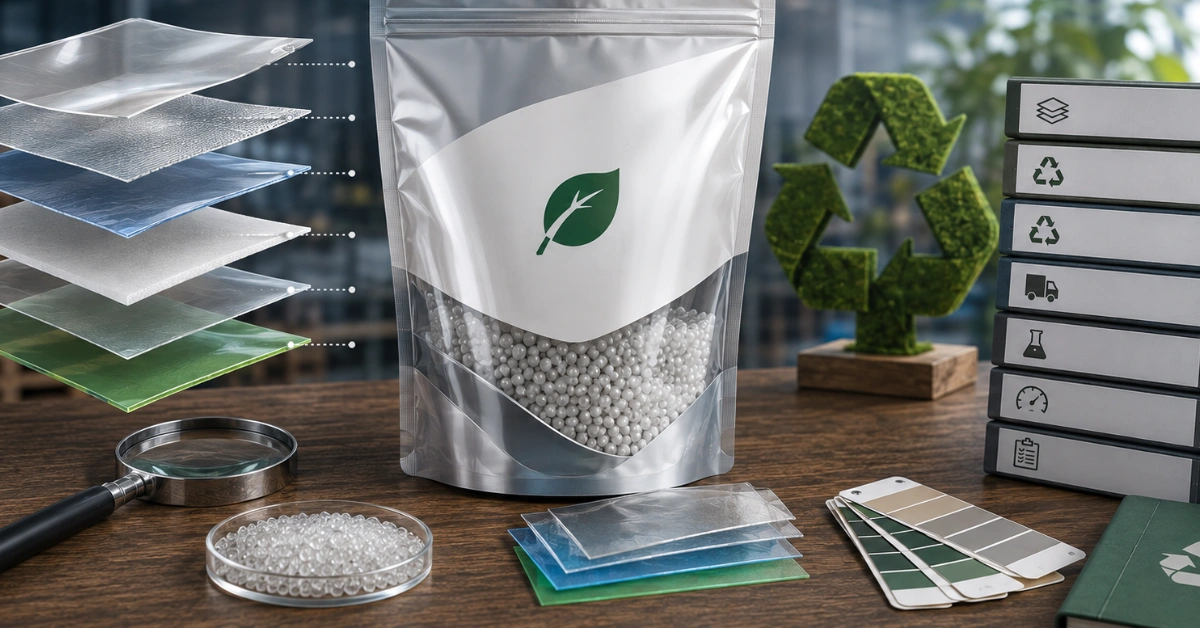
The plastic pouch is one of the hardest technical dossier examples for PPWR because multi-layer laminates complicate both recyclability and substance evidence. Its file should hold:
Material composition — each layer identified (e.g. PET / adhesive / PE), with the polymer and function of every layer.
Weight — per unit, in grams, as placed on the market.
Recyclability assessment — design-for-recycling evaluation and the recyclability class assigned under the Annex II framework, with the reasoning.
Substance information — heavy-metal evidence (combined Pb, Cd, Hg, Cr(VI) below 100 mg/kg) and, for food contact, PFAS test results referencing Regulation (EU) 2025/40.
Supplier specifications — technical data sheets for the film, ink and adhesive.
Test reports — laboratory results per material layer, not a single blanket statement.
Design / minimisation assessment — justification that weight and layer count are the minimum needed for function and protection.
Glass bottle (rigid, multi-component)
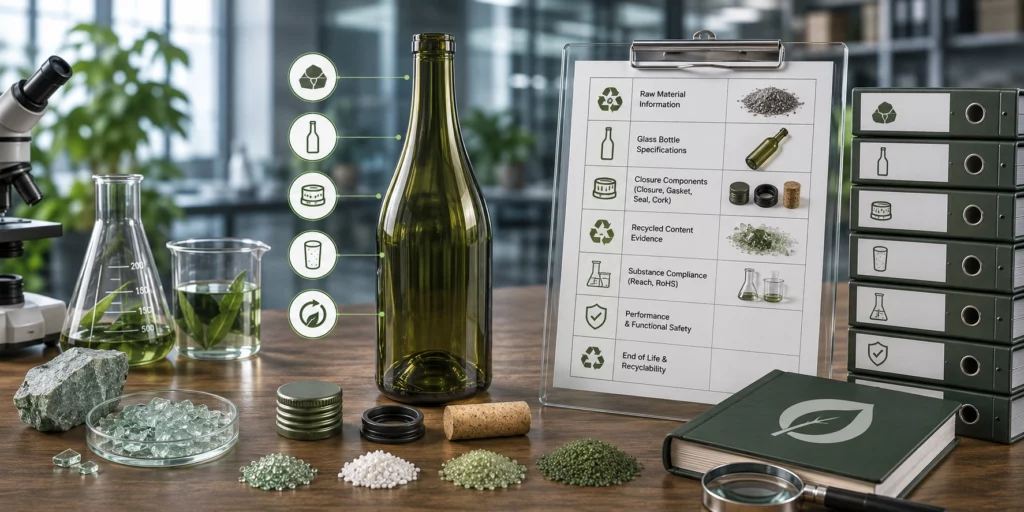
Among technical dossier examples for PPWR, the glass bottle looks simple but hides a multi-component trap: the closure is a separate packaging component with its own evidence trail. Its file should hold:
Glass composition — glass type and any relevant additives.
Weight — bottle and closure recorded separately.
Closure / cap materials — metal, plastic or cork liner, each documented as its own component.
Recyclability evidence — recyclability class for the glass, plus how the closure affects the assessment; note the heavy-metal derogation route for recycled-content glass where it applies.
Supplier documentation — declarations from both the glassmaker and the closure supplier.
Testing / technical specifications — substance and heavy-metal reports covering glass and closure.
Corrugated cardboard box (fibre-based)
The corrugated box is one of the more forgiving technical dossier examples for PPWR, but coatings, inks and adhesives quietly undermine an otherwise recyclable file. Its file should hold:
Paper / cardboard composition — fibre type and board grade (e.g. single-wall B-flute).
Recycled content — percentage recycled fibre, with supporting evidence.
Weight — grammage and finished-unit weight.
Coating / adhesive information — any barrier coatings, laminates, tapes or glues that affect recyclability.
Recyclability evidence — class assignment and confirmation the box remains fibre-recyclable with its coatings and inks.
Supplier declarations — corrugator and ink/adhesive supplier statements.
Transport packaging (pallet, stretch film, strapping, edge protectors)
Transport packaging is the most overlooked of the technical dossier examples for PPWR it still counts as packaging placed on the market, and each component needs its own line of evidence. Treat the shipping unit as a set of components, not a single item:
Pallet — material (wood, plastic, composite), weight, reuse status and supplier documentation.
Stretch film — polymer type, weight per unit, recyclability class and substance evidence.
Strapping — material (PP, PET, steel), weight and supplier specification.
Edge protectors — fibre or plastic composition, weight and recyclability.
Material and weight data — a consolidated bill of materials for the full transport configuration.
Supplier evidence — declarations and test reports for every component, since no single vendor covers the whole unit.
Before preparing a Declaration of Conformity, you need to know what packaging you actually have.
Read our guide on PPWR Packaging Inventoryto learn how to map SKUs, packaging components, materials, weights, suppliers and supporting documentation into one structured inventory.
Technical dossier examples for PPWR: spreadsheet vs. platform
The same dossier can be maintained two ways. The difference shows up the day an authority requests the file.
Dossier task
Spreadsheets + supplier emails
TraceX platform
One file per packaging type
Manual folders; easy to duplicate or lose
One record per SKU/packaging type, linked to its DoC
Supplier evidence collection
Chase by email; versions drift
Structured supplier requests and stored declarations
Recyclability & substance data
Re-keyed from PDFs
Captured against each component in one data layer
Authority request (10-day window)
Reconstruct from inbox under pressure
Export a complete, versioned dossier on demand
Phased obligations (2026 to 2030)
Track manually per Article
Skeleton built once; populated as obligations apply
How TraceX PPWR Solutions Help
TraceX PPWR Solutions helps manufacturers move beyond simply creating a Declaration of Conformity (DoC) by building the structured evidence behind it. The platform connects products and SKUs to packaging components, materials, suppliers, technical documentation and compliance evidence, creating a centralized packaging compliance record. Teams can identify missing supplier data, collect and organize supporting documents, and maintain the evidence required for the applicable PPWR assessments and DoC workflows. This means that when a DoC needs to be prepared or reviewed, the supporting information is already connected to the relevant packaging rather than scattered across spreadsheets, emails and supplier PDFs. TraceX turns technical documentation from a one-time compliance exercise into a structured, traceable and audit-ready PPWR workflow.
See how the TraceX platform builds and versions a technical dossier per packaging type, links it to each Declaration of Conformity, and exports an audit-ready file inside the 10-day window.
Use the four examples above as your test. Any compliance tool worth adopting should let you do the following per packaging type:
Create a distinct dossier for every unique packaging type and link it to its Annex VIII declaration.
Capture composition at layer or component level not just a single material field.
Store supplier declarations and test reports against the exact component they support.
Record recyclability class and minimisation justification, with the reasoning retained.
Version the file so you can prove which evidence backed which declaration, and when.
Export the complete dossier fast enough to meet a 10-day authority request.
Map obligations to their application dates so you populate evidence in the right order.
Frequently Asked Questions (FAQ’s)
What is a PPWR technical dossier?
A PPWR technical dossier is the Annex VII technical documentation, compiled under Module A internal production control, that proves a packaging type meets Articles 5 to 12 of Regulation (EU) 2025/40. It sits beneath the Annex VIII Declaration of Conformity and holds the composition, weight, recyclability, substance and supplier evidence.
What evidence does a plastic pouch dossier need?
Technical dossier examples for PPWR always start with composition. A plastic pouch needs layer-by-layer material composition, unit weight, a recyclability assessment and class, heavy-metal and (for food contact) PFAS test reports, supplier specifications for film/ink/adhesive, and a design/minimisation justification.
Do I need a separate dossier for transport packaging like pallets and stretch film?
Yes. Transport packaging is still packaging placed on the market. Treat the shipping unit as components pallet, stretch film, strapping, edge protectors and hold material, weight, recyclability and supplier evidence for each, plus a consolidated bill of materials.
Is the Declaration of Conformity the same as the technical dossier?
No. The Declaration of Conformity (Annex VIII) is the signed one-page statement; the technical dossier (Annex VII) is the evidence behind it. The declaration is the conclusion; the dossier is the proof authorities can request.
Which PPWR obligations require evidence from 12 August 2026?
At the 12 August 2026 application date, substances-of-concern evidence under Article 5 is the first obligation inside the conformity-assessment scope. Recyclability grading and packaging minimisation obligations phase in later, so build the full dossier structure now and populate it in application order.
How long do authorities give me to produce the technical file?
Market surveillance authorities can issue a reasoned request, and the relevant documentation must be made available within 10 days. That is why a pre-assembled, versioned dossier per packaging type matters far more than a template you fill in later.
Can recyclability logos or certifications replace the technical dossier?
No. Labels and third-party marks can support your evidence, but they do not replace the Annex VII file. You still need the underlying composition, test reports, recyclability class reasoning and supplier declarations to defend the declaration.
Start using TraceX
Transparency, Trust, & Success for your Climate Journey.
We use cookies on our website to give you the most relevant experience by remembering your preferences and repeat visits. By clicking “Accept All”, you consent to the use of ALL the cookies. However, you may visit "Cookie Settings" to provide a controlled consent.
This website uses cookies to improve your experience while you navigate through the website. Out of these, the cookies that are categorized as necessary are stored on your browser as they are essential for the working of basic functionalities of the website. We also use third-party cookies that help us analyze and understand how you use this website. These cookies will be stored in your browser only with your consent. You also have the option to opt-out of these cookies. But opting out of some of these cookies may affect your browsing experience.
Necessary cookies are absolutely essential for the website to function properly. These cookies ensure basic functionalities and security features of the website, anonymously.
Cookie
Duration
Description
cookielawinfo-checkbox-analytics
11 months
This cookie is set by GDPR Cookie Consent plugin. The cookie is used to store the user consent for the cookies in the category "Analytics".
cookielawinfo-checkbox-functional
11 months
The cookie is set by GDPR cookie consent to record the user consent for the cookies in the category "Functional".
cookielawinfo-checkbox-necessary
11 months
This cookie is set by GDPR Cookie Consent plugin. The cookies is used to store the user consent for the cookies in the category "Necessary".
cookielawinfo-checkbox-others
11 months
This cookie is set by GDPR Cookie Consent plugin. The cookie is used to store the user consent for the cookies in the category "Other.
cookielawinfo-checkbox-performance
11 months
This cookie is set by GDPR Cookie Consent plugin. The cookie is used to store the user consent for the cookies in the category "Performance".
viewed_cookie_policy
11 months
The cookie is set by the GDPR Cookie Consent plugin and is used to store whether or not user has consented to the use of cookies. It does not store any personal data.
Functional cookies help to perform certain functionalities like sharing the content of the website on social media platforms, collect feedbacks, and other third-party features.
Performance cookies are used to understand and analyze the key performance indexes of the website which helps in delivering a better user experience for the visitors.
Analytical cookies are used to understand how visitors interact with the website. These cookies help provide information on metrics the number of visitors, bounce rate, traffic source, etc.
Advertisement cookies are used to provide visitors with relevant ads and marketing campaigns. These cookies track visitors across websites and collect information to provide customized ads.
Download the 2026 Traceability Scorecard and Benchmark Your Supply Chain Across 10 Critical Capabilities.
Download our eBook
Don’t Wait for an Audit to Find Your EUDR Gaps
The 2026 Simplification Package changes how HS codes, DDS pass-through and geolocation rules apply to you. Get the free guide and 20-point readiness checklist before enforcement catches you unprepared.