Supplier Onboarding in EUDR: Inherit a DDS, Don’t Inherit a Compliance Gap
Published
, 10 minute read
Share this article
Quick summary: Supplier onboarding in EUDR decides whether you inherit a valid DDS or must build one yourself. Classify suppliers by role and risk, and validate reference numbers early.
Supplier onboarding in EUDR is the process of classifying each supplier by their role (first operator, downstream operator, or trader), size (SME or non-SME) and country risk, then collecting exactly what that role requires. From first operators you gather full Article 9 data geolocation, country, quantity, production period and legality evidence plus their Due Diligence Statement (DDS) reference and verification numbers. From downstream suppliers you collect and validate those reference numbers so you can rely on upstream due diligence instead of repeating it. Done right, onboarding lets you inherit a valid DDS; done wrong, you inherit the supplier’s compliance gap.
Key Takeaways
Classify before you collect. The supplier’s EUDR role, SME status and country risk decide what data you legally need. Onboarding the same way for everyone over-collects from some and under-protects against others.
Reference numbers are the currency. Downstream operators rely on upstream DDS by collecting and validating reference and verification numbers not by redoing Article 9. Capture and check them at onboarding.
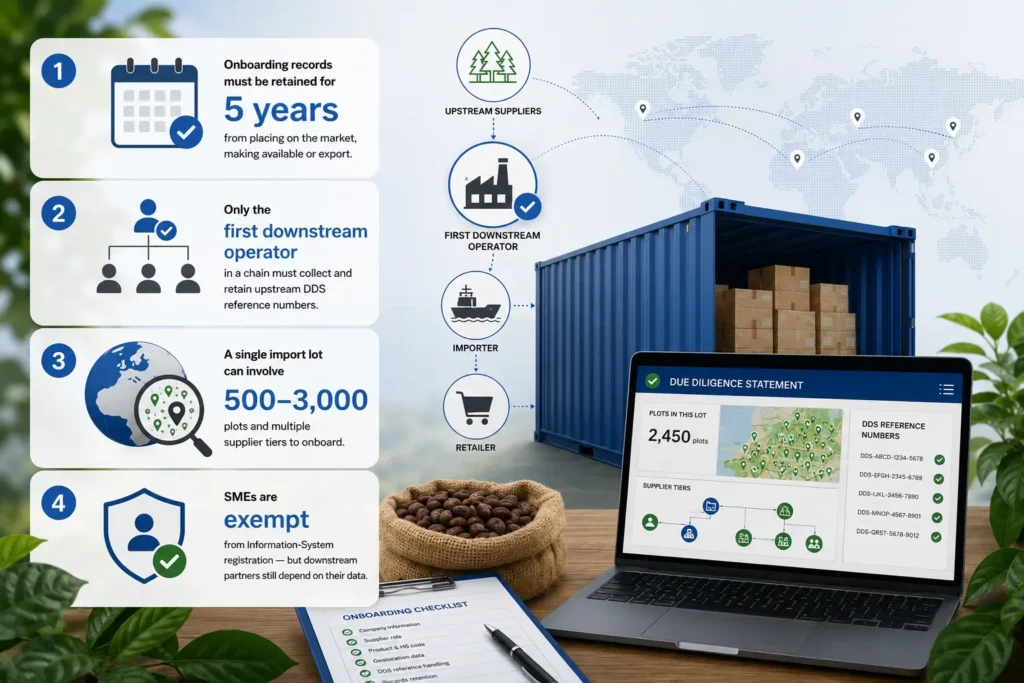
Only the first operator can originate a DDS. If none of your suppliers is the first operator, there is no DDS to reference and you may have to build the due diligence yourself.
Contracts are part of onboarding. Bake a DDS-disclosure clause into supplier agreements so reference numbers are shared by obligation, not goodwill.
Don’t discover a broken supplier chain at the border.
See how TraceX classifies suppliers by EUDR role, validates DDS reference numbers, and builds an audit-ready supplier file.
Supplier Onboarding in EUDR: What You’re Really Collecting
Supplier onboarding in EUDR is the work of bringing each supplier into your compliance system with the exact data the regulation attaches to their role. It is not a generic vendor sign-up. In plain terms, onboarding answers one question for every supplier: can they hand you a valid Due Diligence Statement to rely on, or must you gather the raw evidence and build that due diligence yourself?
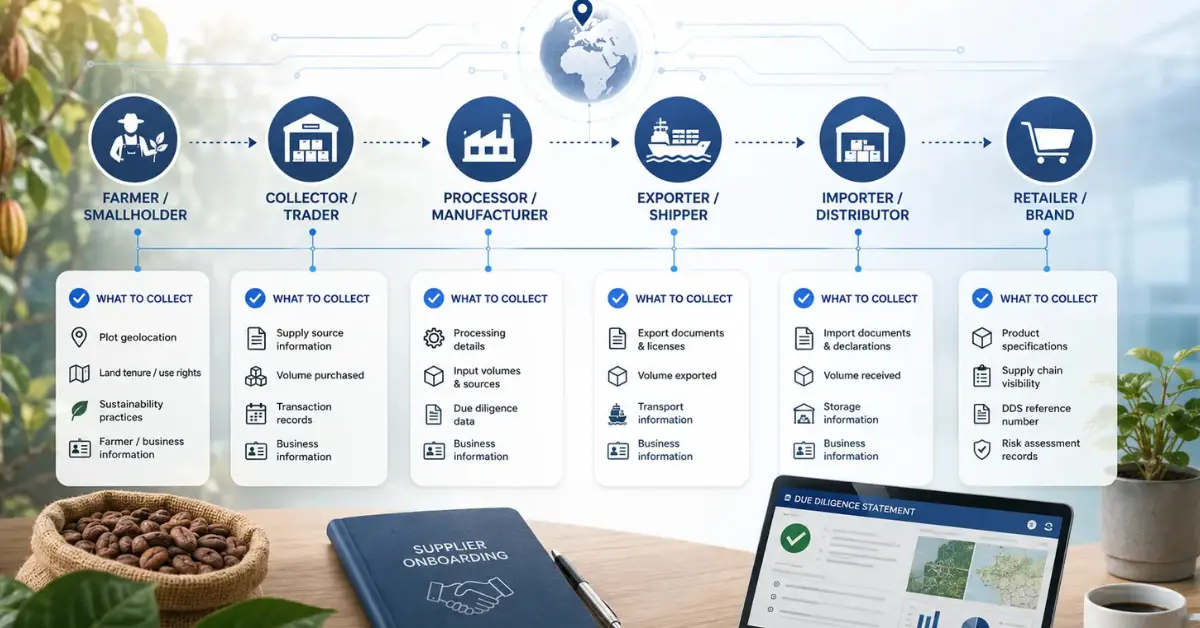
The EUDR runs on a small set of numbers. When a first operator files a DDS, the Information System issues a reference number and a verification number. Downstream non-SME operators and traders don’t repeat the full due diligence under Article 4(9) they must instead collect those numbers from their direct supplier and confirm they are valid. So what you capture at onboarding depends entirely on where a supplier sits:
From a first operator: full Article 9 information — geolocation of plots, country of production, quantity, production period and legality evidence plus their DDS reference and verification numbers.
From a downstream operator or trader: the upstream DDS reference and verification numbers, and enough traceability to link them to the goods you receive.
From a small or micro primary operator: often a simplified declaration identifier, using the lighter obligations the 2025 simplification allows.
The obligation lands on operators from 30 December 2026, and on micro and small operators from 30 June 2027 so the onboarding work sits squarely in 2026.
From Farm Coordinates to Audit-Ready Compliance
Meeting EUDR geolocation requirements demands more than collecting GPS coordinates.
Why Supplier Onboarding in EUDR Decides Your Whole Compliance Burden
Here is the shift most guides miss. Onboarding is not admin that happens before compliance it is the moment your compliance burden is set. When you onboard a supplier who is the first operator and can give you a valid, verifiable DDS reference, you inherit their due diligence: you reference it and move on. When you onboard a supplier who cannot, you inherit their gap and the Article 9 data-gathering, risk assessment and mitigation fall to you.
That means the highest-leverage step in supplier onboarding in EUDR happens before any form is filled in: classifying each supplier by role, SME status and country risk. A low-risk supplier with a clean upstream DDS needs a light touch. A high-risk, first-mile supplier with no digital footprint needs full plot-level onboarding. Treating both the same is how programmes waste months over-collecting from one group while leaving real exposure in the other.
The dependency is unforgiving: only the first operator can originate a DDS, and the whole chain relies on the quality of that upstream assessment. So the real test of supplier onboarding in EUDR is not how many suppliers you’ve logged it’s whether, for every batch, you can trace a valid DDS back to a real first operator.
The TraceX Supplier Assessment Questionnaire (SAQ) is a structured digital assessment designed to evaluate a supplier’s preparedness for compliance with the European Union Deforestation Regulation (EUDR). It enables organizations to systematically collect, validate, and assess supplier information required to demonstrate that commodities and products placed on the EU market are deforestation-free, legally produced, and supported by an effective due diligence system.
The questionnaire serves as the foundation of supplier onboarding by capturing key information related to the supplier’s legal entity, sourcing practices, environmental and human rights policies, due diligence processes, traceability capabilities, production place information, and supporting documentation. Responses are evaluated to identify compliance gaps, assess potential risks, and prioritize mitigation measures before procurement or export.
By digitizing supplier assessments, TraceX helps organizations standardize information collection, improve data quality, accelerate supplier onboarding, and maintain complete, audit-ready records that support EUDR due diligence and regulatory reporting.
Supplier Onboarding in EUDR: Real-World Failure Scenarios
These illustrative field scenarios show how onboarding quietly breaks compliance and the practice that prevents each one.
The flat vendor list
A chocolate manufacturer onboarded 200 cocoa-paste suppliers as one generic vendor list, assuming each would “just send a DDS.” At filing, several suppliers were themselves downstream and could not originate a reference number there was no first-operator DDS to point to. Best practice: classify every supplier’s EUDR role at onboarding and confirm who the actual first operator is.
The reference number nobody checked
A trader dutifully collected DDS reference numbers during onboarding but never validated them in the Information System. At customs, one number failed verification and the shipment was held. Best practice: validate reference and verification numbers at onboarding, and independently confirm the upstream due diligence is trustworthy a number on file is not proof.
The over-collected smallholder
A cooperative demanded full polygons and KYC from 3,000 farmers, many of whom qualified for the simplified declaration route. The result was months of wasted effort and heavy farmer drop-off. Best practice: segment by supplier type and collect only what each role legally requires, so onboarding stays proportionate.
The clause that wasn’t there
An importer’s key supplier refused to share its DDS reference number after shipment because nothing in the purchase contract required it. Filing stalled while the two sides argued. Best practice: write a DDS-disclosure clause into the onboarding contract, so reference numbers are shared by obligation, not goodwill.
Supplier data is the foundation of every EUDR due diligence process
Supplier Onboarding in EUDR That Builds an Audit-Ready Chain
A repeatable onboarding system enforces role and risk at intake, not at filing. A platform built for supplier onboarding in EUDR should do six things.
Classify role and risk first. Tag every supplier as first operator, downstream operator or trader, SME or non-SME, and by country risk so the required data set is set automatically.
Validate DDS reference numbers at intake. Check reference and verification numbers against the Information System during onboarding, flagging invalid or missing numbers before they reach customs.
Capture Article 9 data where you must build it. For first-operator and first-mile suppliers, collect geolocation, quantity, country, period and legality evidence offline where connectivity is poor.
Right-size smallholder onboarding. Use the simplified route for eligible small and micro primary operators so onboarding stays proportionate and farmers don’t drop off.
Embed compliance clauses. Attach DDS-disclosure and data-quality terms to onboarding contracts so obligations travel with the supplier relationship.
Feed the DDS and keep the trail. Push validated supplier data and reference numbers straight into your DDS workflow, and retain the full record for five years.
Whether you source from low-, standard-, or high-risk countries, TraceX helps you centralize supplier data, verify geolocations, assess deforestation risk, and automate due diligence with a single, audit-ready platform.
TraceX EUDR Solutions structures supplier onboarding for EUDR through a centralized, workflow-driven process that transforms fragmented supplier information into verified, audit-ready compliance records. Suppliers are onboarded through a secure self-service portal where they complete standardized supplier assessment questionnaires covering sourcing practices, commodity information, legal compliance, traceability processes, and EUDR-specific due diligence requirements. They can also upload production plot geolocations, legal documents, certifications, and chain-of-custody evidence in a structured format. The platform validates submissions, identifies missing or inconsistent information, assigns risk-based review workflows, and links supplier profiles with geospatial verification, deforestation risk assessments, and due diligence documentation. This creates a single source of truth that enables procurement and compliance teams to assess supplier readiness, manage risks proactively, and maintain complete, audit-ready traceability across the supply chain.
Make supplier onboarding in EUDR the strength of your compliance, not its weak link.
TraceX classifies every supplier by EUDR role and risk, validates DDS reference numbers at intake, onboards smallholders offline, and feeds a five-year audit trail straight into your DDS.
Supplier Onboarding in EUDR: What to Collect, by Supplier Type
Match every supplier to a row before you start collecting data.
Supplier type
Collect at onboarding
Why it matters
First operator
Full Article 9 data (geolocation, country, quantity, period, legality) + DDS reference & verification numbers
They originate the DDS the whole chain relies on your compliance inherits their data quality
Non-SME downstream operator / trader
Upstream DDS reference & verification numbers; proof the numbers are valid
You reference upstream due diligence instead of repeating Article 9
SME trader / downstream (SME)
Upstream reference numbers; traceability and transaction records
Leaner duty and no registration but downstream partners still rely on this data
Small / micro primary operator
Simplified declaration identifier (or postal address, per simplification)
Over-collecting here wastes effort and drives farmer drop-off
Supplier Onboarding in EUDR: Readiness Checklist
Before you trust a supplier chain to hold up, confirm every box.
✓Every supplier is tagged by EUDR role, SME status and country risk.
✓You have confirmed who the first operator is for each commodity flow.
✓DDS reference and verification numbers are validated in the Information System.
✓First-operator and first-mile suppliers have full Article 9 data on file.
✓Small and micro primary operators are onboarded via the simplified route.
✓Onboarding contracts include a DDS-disclosure clause.
✓Validated supplier data feeds the DDS, with records retained for five years.
Frequently Asked Questions
What information must I collect from suppliers under the EUDR?
It depends on their role. From first operators: full Article 9 data — geolocation, country of production, quantity, production period and legality evidence — plus their DDS reference and verification numbers. From downstream suppliers: the upstream reference and verification numbers, validated.
Do downstream operators have to redo due diligence for each supplier?
No. Under the December 2025 amendments, downstream non-SME operators and traders reference upstream DDS by collecting and verifying reference and verification numbers, rather than repeating Article 9 gathering and risk assessment.
What is a DDS reference number and why does it matter at onboarding?
It’s the identifier issued when a first operator files a DDS. Capturing and validating it at onboarding is how you prove, later, that valid due diligence exists upstream catching gaps before customs does.
How should I onboard smallholder suppliers efficiently?
Segment by role and risk. Many small and micro primary operators qualify for a simplified declaration, so collect only what that route requires and use offline tools for first-mile capture to avoid drop-off.
How long do I keep supplier onboarding records?
At least five years from the date the product is placed on the market, made available or exported for operators, downstream operators and traders alike.
Start using TraceX
Transparency, Trust, & Success for your Climate Journey.
We use cookies on our website to give you the most relevant experience by remembering your preferences and repeat visits. By clicking “Accept All”, you consent to the use of ALL the cookies. However, you may visit "Cookie Settings" to provide a controlled consent.
This website uses cookies to improve your experience while you navigate through the website. Out of these, the cookies that are categorized as necessary are stored on your browser as they are essential for the working of basic functionalities of the website. We also use third-party cookies that help us analyze and understand how you use this website. These cookies will be stored in your browser only with your consent. You also have the option to opt-out of these cookies. But opting out of some of these cookies may affect your browsing experience.
Necessary cookies are absolutely essential for the website to function properly. These cookies ensure basic functionalities and security features of the website, anonymously.
Cookie
Duration
Description
cookielawinfo-checkbox-analytics
11 months
This cookie is set by GDPR Cookie Consent plugin. The cookie is used to store the user consent for the cookies in the category "Analytics".
cookielawinfo-checkbox-functional
11 months
The cookie is set by GDPR cookie consent to record the user consent for the cookies in the category "Functional".
cookielawinfo-checkbox-necessary
11 months
This cookie is set by GDPR Cookie Consent plugin. The cookies is used to store the user consent for the cookies in the category "Necessary".
cookielawinfo-checkbox-others
11 months
This cookie is set by GDPR Cookie Consent plugin. The cookie is used to store the user consent for the cookies in the category "Other.
cookielawinfo-checkbox-performance
11 months
This cookie is set by GDPR Cookie Consent plugin. The cookie is used to store the user consent for the cookies in the category "Performance".
viewed_cookie_policy
11 months
The cookie is set by the GDPR Cookie Consent plugin and is used to store whether or not user has consented to the use of cookies. It does not store any personal data.
Functional cookies help to perform certain functionalities like sharing the content of the website on social media platforms, collect feedbacks, and other third-party features.
Performance cookies are used to understand and analyze the key performance indexes of the website which helps in delivering a better user experience for the visitors.
Analytical cookies are used to understand how visitors interact with the website. These cookies help provide information on metrics the number of visitors, bounce rate, traffic source, etc.
Advertisement cookies are used to provide visitors with relevant ads and marketing campaigns. These cookies track visitors across websites and collect information to provide customized ads.
Download the 2026 Traceability Scorecard and Benchmark Your Supply Chain Across 10 Critical Capabilities.
Download our eBook
Don’t Wait for an Audit to Find Your EUDR Gaps
The 2026 Simplification Package changes how HS codes, DDS pass-through and geolocation rules apply to you. Get the free guide and 20-point readiness checklist before enforcement catches you unprepared.