Requirements for Substances in Packaging: Your PPWR Article 5 Compliance Guide
Published
, 10 minute read
Share this article
Quick summary: Requirements for substances in packaging under PPWR Article 5: heavy-metal limits, the 12 Aug 2026 PFAS ban, and Annex VII proof with a compliance checklist.
What are the requirements for substances in packaging under the PPWR?
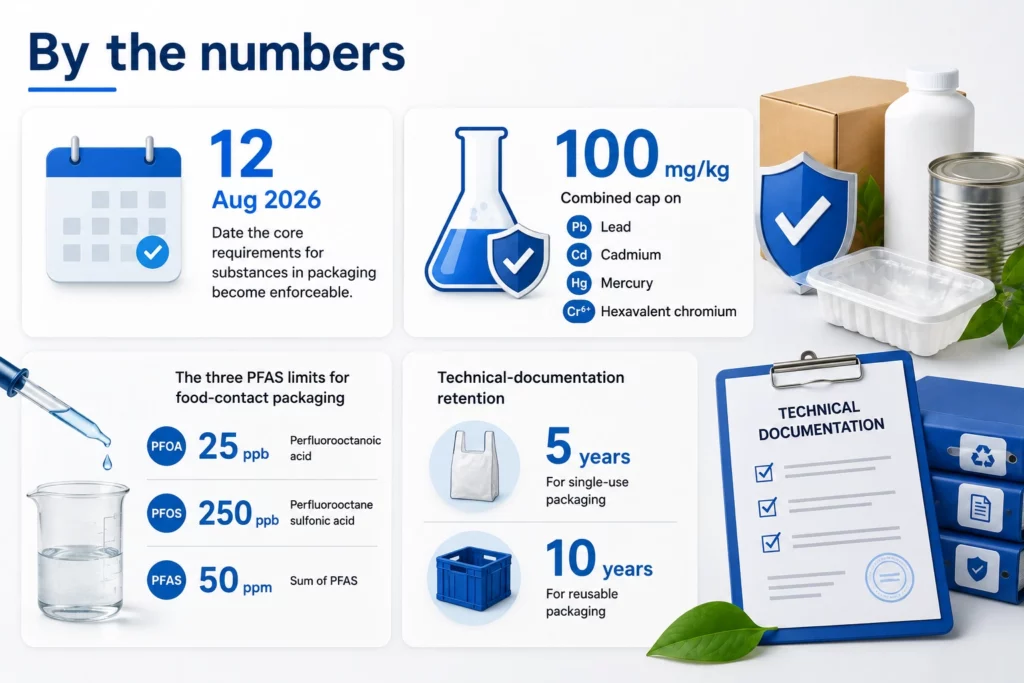
Under Article 5 of Regulation (EU) 2025/40 (PPWR), all packaging placed on the EU market from 12 August 2026 must be manufactured so that substances of concern are minimized. Three obligations are enforceable from that date: (1) the sum of lead, cadmium, mercury and hexavalent chromium must not exceed 100 mg/kg; (2) PFAS in food-contact packaging must stay below 25 ppb (any single PFAS, targeted analysis), 250 ppb (sum of targeted PFAS) and 50 ppm (total PFAS, including polymeric); and (3) manufacturers must prove conformity through technical documentation drawn up under Annex VII and retained for 5 years (single-use) or 10 years (reusable). Suppliers must hand over composition data under Article 16.
Key Takeaways
One deadline anchors everything: the core requirements for substances in packaging apply from 12 August 2026, the PPWR’s general application date.
Two hard limits, one principle: heavy metals (≤100 mg/kg combined) and PFAS in food-contact packaging are numeric caps; “minimization” of all substances of concern is the overarching duty.
Proof lives in Annex VII: compliance is demonstrated through technical documentation and a conformity assessment (Internal Production Control), not self-declaration alone.
Your suppliers are in scope: Article 16 obliges suppliers to give you the composition data you need — but you own the compliance file.
The list will grow: an ECHA-assisted substances-of-concern report is due 31 December 2026, and digital marking of SoCs follows by 1 January 2030.
PPWR Phase 1 Hits 12 August — Are You Ready?
With enforcement approaching fast, guesswork is expensive. See how TraceX helps you get audit-ready before the deadline, not after.
Requirements for Substances in Packaging: What PPWR Article 5 Demands
Requirements for substances in packaging are the chemical-safety rules that decide whether a box, bottle, film or coating is legally allowed on the EU market and, under the Packaging and Packaging Waste Regulation (Regulation (EU) 2025/40, the PPWR), they are no longer a niche concern for chemists. In plain terms, they are the obligation to keep hazardous or recycling-hostile chemicals out of packaging, prove you have done so, and be able to show the evidence to an authority on request.
The pain is familiar to any compliance or sustainability lead: packaging chemistry is scattered across dozens of suppliers, inks, adhesives and coatings, and until now the rules differed in every Member State. The PPWR replaces the old Directive 94/62/EC with a single regulation that applies identically across all 27 Member States from 12 August 2026. That harmonization is the opportunity one compliance file now covers the whole single market but only if you can actually meet these obligations and document them.
Article 5 sits at the foundation of the regulation. It sets a life-cycle principle (minimize substances of concern), two enforceable numeric limits (heavy metals and PFAS), and a proof regime (Annex VII technical documentation). The sections below break each one down, then show how to operationalize the evidence trail.
Requirements for Substances in Packaging Start With Minimization (Article 5(1))
The first requirement is a design principle, not a number. Article 5(1) states that all packaging must be manufactured so that the presence and concentration of substances of concern are minimized across the life-cycle.
What “minimization” covers
Manufacturing: reducing the chemical footprint at the production phase.
Emissions: limiting substances released to air, water or soil during the product’s life.
Waste-management outcomes: ensuring recycled content, ashes and disposal residues do not carry a hazardous legacy the same safety concentrations apply, in principle, to virgin and recycled material.
Article 5(1) also explicitly requires design and manufacture to account for the adverse impact of microplastics. The benefit of getting minimization right is commercial as well as legal: substances of concern will feed into modulated Extended Producer Responsibility (EPR) fees, so “clean” packaging will be cheaper to place on the market than packaging that hinders recycling. Meeting this minimization duty early turns a cost centre into a fee advantage.
If your business manufactures, imports, or sells packaged products in the EU, now is the time to assess your EPR obligations and prepare for compliance.
Heavy-Metal Requirements for Substances in Packaging: The 100 mg/kg Rule (Article 5(4))
The oldest of these packaging substance rules carries over from Directive 94/62/EC. Article 5(4) caps the sum of the concentration of four heavy metals lead, cadmium, mercury and hexavalent chromium at 100 mg/kg (equivalent to 100 ppm) in any packaging or packaging component.
The critical word is sum: even trace amounts of each metal must combine to stay below the single 100 mg/kg threshold, protecting both human health and the integrity of the recycling stream. The Commission can lower these limits in future through delegated acts. Article 5(8) allows narrow, time-limited derogations for recycled materials or closed, controlled loops but only case-by-case and with strict marking and reporting.
PFAS Requirements for Substances in Packaging in Food Contact (Article 5(5))
The most urgent new requirement is the PFAS restriction. From 12 August 2026, food-contact packaging that contains per- and polyfluoroalkyl substances (PFAS) above the following limits cannot be placed on the EU market. PFAS are “forever chemicals” linked to carcinogenicity, reproductive toxicity and organ toxicity, and the limits apply whether the PFAS were intentionally added or not — including via recycled fibre.
PFAS Regulations Are Evolving. Is Your Supply Chain Ready?Learn where PFAS are commonly found, understand emerging regulatory requirements, and discover how to identify and manage PFAS risks across your products and suppliers.
Any single PFAS (targeted analysis, non-polymeric)
25 ppb
Food-contact packaging
Sum of PFAS (targeted analysis, incl. precursors)
250 ppb
Food-contact packaging
Total PFAS (incl. polymeric)
50 ppm
Food-contact packaging
There is a practical testing route: Commission guidance (published 30 March 2026) sets out a stepwise approach beginning with a total-fluorine screen. If total fluorine is below 50 mg/kg, the material can be treated as compliant. If total fluorine exceeds 50 mg/kg, the manufacturer or importer must, on request, prove to the chain of custody how much of that fluorine is PFAS versus non-PFAS.
Note there is still no single harmonized EU PFAS test method, so screening plus supplier assurance is the current working practice exactly where a traceability platform earns its place.
Everything You Need to Understand PPWR — in One Guide
Skip the scattered articles and regulatory PDFs. Our handbook breaks down PPWR obligations, timelines, and requirements into one clear resource.
Proving Requirements for Substances in Packaging: Annex VII & Article 16
A limit you cannot evidence is a liability. The PPWR substance rules place the burden of proof squarely on the manufacturer. Under Article 5(6), compliance with the heavy-metal and PFAS limits must be demonstrated in technical documentation drawn up under Annex VII, backed by a conformity assessment (Internal Production Control / Module A self-assessment no notified body required).
What the technical documentation must contain
A conformity assessment (Internal Production Control).
A full list of materials used including inks, varnishes, adhesives and coatings.
Test reports or other valid evidence (including modelling or simulation) verifying restricted-substance concentrations.
Retention: 5 years for single-use packaging, 10 years for reusable packaging.
Whether you’re a packaging manufacturer, brand owner, importer, or supplier, now is the time to review your documentation processes and ensure you’re ready for PPWR implementation.
You cannot build that file alone. Article 16 requires suppliers of packaging and packaging materials to provide the manufacturer with the information and documentation such as chemical-composition data needed to prove conformity. The compliance obligation, however, stays with you. The recurring failure mode is a supplier attestation that says “no PFAS added” while saying nothing about non-intentionally-added PFAS or total fluorine, leaving a gap an auditor can drive through.
How TraceX operationalizes the requirements for substances in packaging
Capability. TraceX PPWR Solutions centralizes supplier composition declarations, test reports and total-fluorine screens against each SKU and packaging component, and maps them to the specific Article 5 limit they satisfy.
Benefit. Instead of chasing PDFs across email when a market-surveillance authority asks, your Annex VII file assembles itself material list, evidence, and the conformity assessment in one place, retained for the full 5- or 10-year window.
Turn the 12 August Deadline into a Clear Plan
A short call replaces panic with a prioritized roadmap. Get expert guidance on what to tackle first to be ready in time.
How the Requirements for Substances in Packaging Will Expand
Article 5 is deliberately dynamic, so today’s rules are a floor, not a ceiling. Three forward markers matter for planning:
ECHA substances-of-concern report — by 31 December 2026: the Commission, assisted by ECHA, will report on SoCs in packaging, their effect on circularity, and possible new REACH or Design-for-Recycling restrictions.
Digital marking of SoCs — by 1 January 2030: Article 12 provides for standardized, open digital-marking technology so waste operators can read a unit’s chemical composition and route it correctly.
Formal review — by 12 August 2033: Article 5(9) requires the Commission to evaluate whether Article 5 and the Design-for-Recycling criteria have actually minimized SoCs; the PFAS restriction itself is to be reassessed by 12 August 2030.
The direction of travel is one-way: more substances, more evidence, more granular reporting. Building the data spine now means each new restriction becomes a configuration change, not a fire drill.
Requirements for Substances in Packaging: Manual vs. Automated Compliance
Compliance task
Manual / spreadsheet approach
TraceX Cleara AI
Supplier composition data
Chased ad hoc over email; versions drift
Requested, stored and version-controlled per component
PFAS total-fluorine screening
Tracked in scattered lab PDFs
Linked to SKU with pass/fail against 50 mg/kg
Heavy-metal sum (100 mg/kg)
Manual re-calculation per component
Auto-summed and flagged before market entry
Annex VII technical file
Assembled by hand at audit time
Assembled continuously, export-ready
Retention (5/10 yrs)
Depends on inbox and shared drives
Retained to the mandated window automatically
Authority request response
Days of PDF hunting
On-demand export
Buyer’s Checklist: Meeting the Requirements for Substances in Packaging
Use this to evaluate whether your current process or a vendor genuinely covers the requirements for substances in packaging:
Can you produce the full material list (inks, varnishes, adhesives, coatings) for any SKU on demand?
Do you hold total-fluorine screens for all food-contact packaging, with a clear route when fluorine exceeds 50 mg/kg?
Is the heavy-metal sum (≤100 mg/kg) auto-calculated per component, not per substance?
Do supplier declarations address non-intentionally-added PFAS, not just “none added”?
Is your Annex VII technical documentation assembled continuously and retained for the correct 5- or 10-year window?
Can you respond to a market-surveillance request without a manual document hunt?
Are you positioned to absorb the 31 Dec 2026 ECHA report and 2030 digital-marking rules without re-platforming?
Frequently Asked Questions (FAQ’s)
When do the requirements for substances in packaging apply?
The core Article 5 requirements heavy-metal limits, the food-contact PFAS restriction, and the conformity-assessment/technical-documentation duty apply from 12 August 2026, the PPWR’s general application date.
Do the PFAS limits apply to all packaging?
No. The PFAS restriction in Article 5(5) applies only to food-contact packaging. The minimization duty and the heavy-metal limit apply to all packaging regardless of material or contents.
What are the exact PFAS limits?
25 ppb for any single PFAS by targeted analysis, 250 ppb for the sum of targeted PFAS including precursors, and 50 ppm for total PFAS including polymeric variants in food-contact packaging.
What is the heavy-metal limit?
The sum of lead, cadmium, mercury and hexavalent chromium must not exceed 100 mg/kg (100 ppm) in any packaging or component. It is a combined limit, not per substance.
Who is responsible for proving compliance?
The manufacturer (or importer placing packaging on the EU market) owns the technical documentation under Annex VII. Article 16 obliges suppliers to provide the composition data needed, but the compliance file remains the manufacturer’s responsibility.
How long must documentation be kept?
Technical documentation must be retained for 5 years for single-use packaging and 10 years for reusable packaging.
What comes after 2026?
An ECHA-assisted substances-of-concern report is due by 31 December 2026, digital marking of SoCs applies by 1 January 2030, the PFAS restriction is reassessed by 12 August 2030, and Article 5 is formally evaluated by 12 August 2033.
Start using TraceX
Transparency, Trust, & Success for your Climate Journey.
We use cookies on our website to give you the most relevant experience by remembering your preferences and repeat visits. By clicking “Accept All”, you consent to the use of ALL the cookies. However, you may visit "Cookie Settings" to provide a controlled consent.
This website uses cookies to improve your experience while you navigate through the website. Out of these, the cookies that are categorized as necessary are stored on your browser as they are essential for the working of basic functionalities of the website. We also use third-party cookies that help us analyze and understand how you use this website. These cookies will be stored in your browser only with your consent. You also have the option to opt-out of these cookies. But opting out of some of these cookies may affect your browsing experience.
Necessary cookies are absolutely essential for the website to function properly. These cookies ensure basic functionalities and security features of the website, anonymously.
Cookie
Duration
Description
cookielawinfo-checkbox-analytics
11 months
This cookie is set by GDPR Cookie Consent plugin. The cookie is used to store the user consent for the cookies in the category "Analytics".
cookielawinfo-checkbox-functional
11 months
The cookie is set by GDPR cookie consent to record the user consent for the cookies in the category "Functional".
cookielawinfo-checkbox-necessary
11 months
This cookie is set by GDPR Cookie Consent plugin. The cookies is used to store the user consent for the cookies in the category "Necessary".
cookielawinfo-checkbox-others
11 months
This cookie is set by GDPR Cookie Consent plugin. The cookie is used to store the user consent for the cookies in the category "Other.
cookielawinfo-checkbox-performance
11 months
This cookie is set by GDPR Cookie Consent plugin. The cookie is used to store the user consent for the cookies in the category "Performance".
viewed_cookie_policy
11 months
The cookie is set by the GDPR Cookie Consent plugin and is used to store whether or not user has consented to the use of cookies. It does not store any personal data.
Functional cookies help to perform certain functionalities like sharing the content of the website on social media platforms, collect feedbacks, and other third-party features.
Performance cookies are used to understand and analyze the key performance indexes of the website which helps in delivering a better user experience for the visitors.
Analytical cookies are used to understand how visitors interact with the website. These cookies help provide information on metrics the number of visitors, bounce rate, traffic source, etc.
Advertisement cookies are used to provide visitors with relevant ads and marketing campaigns. These cookies track visitors across websites and collect information to provide customized ads.
Download the 2026 Traceability Scorecard and Benchmark Your Supply Chain Across 10 Critical Capabilities.
Download our eBook
Don’t Wait for an Audit to Find Your EUDR Gaps
The 2026 Simplification Package changes how HS codes, DDS pass-through and geolocation rules apply to you. Get the free guide and 20-point readiness checklist before enforcement catches you unprepared.