Manufacturer vs Producer under the EU PPWR: Why They Are Not the Same
Published
, 12 minute read
Share this article
Quick summary: Manufacturer vs producer under the EU PPWR confuses most brand owners. Learn who owns the Declaration of Conformity, who pays EPR, and why it changes per country.
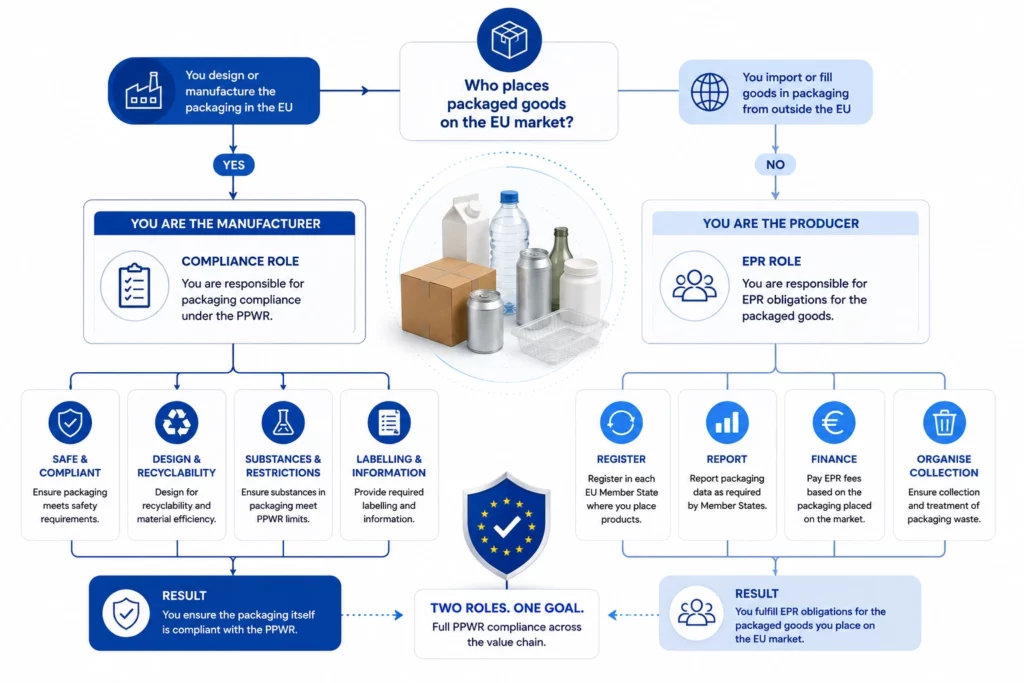
Manufacturer vs producer under the EU PPWR is one of the most misread distinctions in the entire regulation, and the confusion has real financial consequences. Under the EU PPWR (Regulation (EU) 2025/40), the manufacturer and the producer are two distinct legal roles. The manufacturer owns packaging compliance recyclability, packaging minimisation, labelling and the EU Declaration of Conformity and there is only one manufacturer per packaging unit across the entire EU. The producer owns Extended Producer Responsibility (EPR) registration, reporting and financing packaging waste management and there can be a different producer in every Member State where the packaging is first made available. The same company is frequently both roles at once, which is exactly why they get conflated and why the mistake is so costly.
KEY TAKEAWAYS
Manufacturer = compliance. Sustainability, recyclability, minimisation, labelling and the Declaration of Conformity. One manufacturer per packaging item, EU-wide.
Producer = EPR. Registration, reporting and paying for packaging waste management. Defined per Member State, based on who first makes the packaging available there.
The manufacturer is fixed; the producer changes. One packaging item can have one manufacturer and several producers across the countries where it is sold.
Most brand owners are both — and often across several markets at once, which multiplies the registrations they owe.
Get it wrong and it cascades. A single misclassification can trigger duplicate EPR registrations, missed filings, penalties and contractual disputes in every affected Member State.
See What PPWR Actually Requires from You
Every product line has different obligations. In a quick demo, see how TraceX maps your packaging portfolio to specific PPWR requirements – no ambiguity.
Manufacturer vs Producer under the EU PPWR: what the distinction actually means
.Many compliance teams assume the company that physically makes the packaging is automatically the “manufacturer,” and that whoever imports it is the “producer.” Neither assumption is reliable under Regulation (EU) 2025/40.
In plain language: under the PPWR, the manufacturer is the operator legally accountable for making packaging compliant with the product rules (design, recyclability, minimisation, labelling, Declaration of Conformity), while the producer is the operator legally accountable for the waste side Extended Producer Responsibility (registering, reporting volumes and financing collection and recycling). They answer two different questions: “Is this packaging allowed on the market?” versus “Who pays to deal with it once it becomes waste?”
Teams evaluating a traceability or EPR platform usually feel this pain first as spreadsheet chaos the same SKU tagged with different roles in different countries, no single source of truth, and a legal team asking questions the data cannot answer. Naming the roles correctly is the first step; keeping them straight across every SKU and market is the recurring problem software is meant to solve.
Why the PPWR deliberately defines two different roles
The PPWR separates two responsibilities that older national packaging laws often blurred together:
Product compliance — ensuring the packaging itself meets the EU’s sustainability, design and labelling requirements before it is placed on the market.
Waste management responsibility — ensuring someone registers, reports and pays for that packaging when it becomes waste in a given country.
Because the PPWR applies directly and identically in all 27 Member States, the compliance role can sensibly sit with a single operator EU-wide. But waste is collected and financed nationally, so the EPR role has to be assigned country by country. That structural split is the entire reason manufacturer and producer are defined separately and the reason the same company can wear one hat everywhere and the other hat in only some markets.
Learn how Extended Producer Responsibility (EPR) determines who pays, who reports, and who is legally responsible under PPWR.
A manufacturer under the EU PPWR is not necessarily the factory that physically makes the packaging. Under Article 3 of Regulation (EU) 2025/40 : 3(1)(8) or 3(1)(13)], the manufacturer is the operator that either makes the packaging (or packaged product) itself or has it designed or made under its own name or trademark. In practice, that is usually the brand owner.
The manufacturer generally:
decides the packaging design;
places it on the market under its own name or trademark;
bears legal responsibility for compliance.
Manufacturer responsibilities under the PPWR
Substances-of-concern and sustainability requirements
The producer under the EU PPWR has a completely different purpose: it is the Extended Producer Responsibility (EPR) role. Under Article 3(1)(15) of Regulation (EU) 2025/40, the producer is the manufacturer, importer or distributor that regardless of the selling technique, including distance contracts first makes the packaging available within a particular Member State. It is the “first placer on the market” in that country.
The producer is responsible for:
registering under the national EPR scheme;
reporting the packaging placed on that market;
paying EPR fees;
financing packaging waste collection, recovery and recycling.
Unlike the manufacturer, the producer depends on where the packaging first becomes available, where it will become waste, and who first supplies it within that Member State. Because collection and recycling are organised nationally, the producer can be a different entity in each country and only one operator is the producer for a given packaging unit in a given Member State.
Distance selling & non-EU sellers: if you sell directly to end users in a Member State including from a third country you become the producer there. A non-EU producer must appoint an authorised representative for EPR in each Member State where its packaging reaches end users (Art. 45), effective 12 Aug 2026. Without one, placing the packaging on that market is not permitted.
Manufacturer vs producer under the EU PPWR: the core differences at a glance
Usually whoever first makes packaging available in that Member State
Fixed — does not change by country
Variable — depends on country, channel & first availability
(Framing consistent with the European Commission’s role overview and the EUR-Lex text of Regulation (EU) 2025/40.)
Manufacturer vs producer under the EU PPWR: three worked examples
Example 1 — exporter selling into a single EU market
Company A (India) manufactures a tyre and its packaging, then exports to Company B (Germany), which sells the tyres in Germany under its own brand and specified the packaging.
Manufacturer: Company B — it owns the brand and specified the packaging, so it holds the EU-wide compliance role.
Producer: Company B — it also first makes the packaged tyres available in Germany, so it holds the German EPR role.
Here the same company is both manufacturer and producer — which is exactly why the roles get conflated.
Example 2 — the same product sold across multiple EU countries
Now Company B’s brand of tyres is also sold into France, Italy and Spain through local partners. The manufacturer does not change but the producer does:
Germany → Company B is the producer
France → the French distributor that first makes them available is the producer
Italy → the Italian importer is the producer
One manufacturer, multiple producers one for each Member State, based on who first makes the packaging available there.
Example 3 — direct online (distance) sales
An Indian company sells tyres directly to a French consumer online, with no EU distributor in between. Because distance sellers supplying directly to end users become the producer in the destination Member State, the Indian company is the producer in France and, as a non-EU producer, must appoint an authorised representative for EPR in France to discharge those obligations. Marketplaces are also obliged to check that third-party sellers have met these obligations.
Why the producer can change but the manufacturer cannot
This is the insight that resolves most confusion:
Manufacturer — fixed. One operator, EU-wide, tied to who designs and brands the packaging.
Producer — variable. Changes by country, supply-chain structure, who first makes the packaging available, and sales channel.
One manufacturer. Multiple producers. If you remember nothing else about manufacturer vs producer under the EU PPWR, remember that line.
The manufacturer vs producer terminology trap (English vs German PPWR)
A warning that is easy to miss: the English and German language versions of the PPWR use “manufacturer” and “producer” in ways that appear swapped, and this crossover is one of the single biggest pitfalls in the whole role analysis. This article follows the English/EUR-Lex text, where the manufacturer holds the compliance role and the producer holds the EPR role. If your team works from a German-language source (or a national register’s terminology), confirm which language’s definitions you are reading before you assign obligations the labels can point the opposite way.
Common misconceptions about manufacturer vs producer under the EU PPWR
Myth
Reality
“The factory is always the manufacturer.”
False. The manufacturer is usually the brand owner that has the packaging made under its name not necessarily the factory.
“There is one producer for all of Europe.”
False. The producer is defined per Member State; there can be one in each country.
“The manufacturer always pays EPR.”
Not always. EPR is the producer’s obligation. The same company often holds both roles, but the obligations are distinct.
“The producer is always the importer.”
False. It depends on who first makes the packaging available in that Member State which may be a distributor, importer or a distance seller.
How TraceX keeps manufacturer and producer roles straight
The recurring pain: the roles are clear in a diagram and chaotic in a spreadsheet. One SKU can be the same manufacturer everywhere and a different producer in six countries, with EPR deadlines, fee schedules and registers that all differ by Member State. Managed manually, a single reclassification quietly breaks filings in every affected market.
Maps each packaging item and SKU to both its manufacturer role (EU-wide) and its producer role (per Member State), so the two are tracked as separate, linked attributes rather than one overloaded field. It centralises supplier documents (specifications, certificates, test reports), versions your Declarations of Conformity, and flags each market where you are the producer and therefore owe EPR registration or an authorised representative.
Benefit, mapped to the pain:
No duplicate or missed EPR registrations — every Member State where you first place packaging is surfaced automatically.
One source of truth per SKU — compliance role and EPR role stay linked across markets, so a reclassification updates everywhere at once.
Audit-ready evidence — DoCs, technical documentation and role assignments are held per packaging item, ready for regulators.
See how TraceX maps every packaging item to its manufacturer and producer roles across all your EU markets. Book a exploratory call
Manufacturer vs producer under the EU PPWR: a compliance checklist
For brand owners
✓ Are you the legal manufacturer for each packaging item?
✓ Have you prepared the EU Declaration of Conformity?
✓ Do you hold the technical documentation?
For importers / distributors
✓ Are you the producer in your Member State?
✓ Have you registered under the national EPR scheme?
✓ Are EPR fees being reported and paid?
For exporters outside the EU
✓ Who is the manufacturer for this packaging?
✓ Who becomes the producer in each destination country?
✓ Have you appointed an authorised representative for EPR where required?
✓ Do your supply-chain contracts state clearly who holds each PPWR responsibility?
Find Out Which PPWR Rules Apply to Your Packaging
Recyclability, recycled content, labelling, DoCs — the handbook helps you identify what’s relevant to your products so you focus on what matters.
The PPWR deliberately separates compliance responsibility from waste-management responsibility. The manufacturer makes sure the packaging meets the regulation’s sustainability, design and labelling requirements; the producer makes sure that packaging is registered, reported and financed when it becomes waste in the Member State where it is first placed on the market. For any business trading across multiple EU countries, getting manufacturer vs producer under the EU PPWR right is not academic it is how you avoid duplicate EPR registrations, regulatory penalties and contractual disputes.
Frequently Asked Questions (FAQ’s)
Is the manufacturer the same as the producer under the PPWR?
No. Under the EU PPWR they are two distinct legal roles. The manufacturer owns product compliance (recyclability, minimisation, labelling, Declaration of Conformity) EU-wide; the producer owns Extended Producer Responsibility (registration, reporting, fees) per Member State. The same company is often both, but the obligations are separate.
Can one company be both manufacturer and producer?
Yes and most brand owners are. If you brand the packaging and are also the first to make it available in a given Member State, you are the manufacturer (EU-wide) and the producer (in that country). Across several markets you can be one manufacturer and several producers at once.
Who is the manufacturer if a factory makes packaging for my brand?
You are, generally. The manufacturer is the operator that has the packaging designed or made under its own name or trademark usually the brand owner not necessarily the factory that physically produces it.
Why can the producer be different in each EU country?
Because EPR is organised nationally. The producer is whoever first makes the packaging available in a given Member State, so a different operator can hold that role in each country where the product is sold.
Do non-EU companies need an authorised representative under the PPWR?
If a non-EU company is the producer in a Member State for example by selling directly to end users there it must appoint an authorised representative for EPR in that Member State (Art. 45), effective 12 Aug 2026. Verify current status, as suspension proposals have applied to EU-based producers only.
Who issues the Declaration of Conformity – the manufacturer or the producer?
The manufacturer. The Declaration of Conformity and technical documentation sit with the compliance (manufacturer) role, not the EPR (producer) role.
When does the PPWR start to apply?
Regulation (EU) 2025/40 entered into force on 11 February 2025 and generally applies from 12 August 2026, with several specific obligations phasing in later. Confirm the latest dates before publishing.
Start using TraceX
Transparency, Trust, & Success for your Climate Journey.
We use cookies on our website to give you the most relevant experience by remembering your preferences and repeat visits. By clicking “Accept All”, you consent to the use of ALL the cookies. However, you may visit "Cookie Settings" to provide a controlled consent.
This website uses cookies to improve your experience while you navigate through the website. Out of these, the cookies that are categorized as necessary are stored on your browser as they are essential for the working of basic functionalities of the website. We also use third-party cookies that help us analyze and understand how you use this website. These cookies will be stored in your browser only with your consent. You also have the option to opt-out of these cookies. But opting out of some of these cookies may affect your browsing experience.
Necessary cookies are absolutely essential for the website to function properly. These cookies ensure basic functionalities and security features of the website, anonymously.
Cookie
Duration
Description
cookielawinfo-checkbox-analytics
11 months
This cookie is set by GDPR Cookie Consent plugin. The cookie is used to store the user consent for the cookies in the category "Analytics".
cookielawinfo-checkbox-functional
11 months
The cookie is set by GDPR cookie consent to record the user consent for the cookies in the category "Functional".
cookielawinfo-checkbox-necessary
11 months
This cookie is set by GDPR Cookie Consent plugin. The cookies is used to store the user consent for the cookies in the category "Necessary".
cookielawinfo-checkbox-others
11 months
This cookie is set by GDPR Cookie Consent plugin. The cookie is used to store the user consent for the cookies in the category "Other.
cookielawinfo-checkbox-performance
11 months
This cookie is set by GDPR Cookie Consent plugin. The cookie is used to store the user consent for the cookies in the category "Performance".
viewed_cookie_policy
11 months
The cookie is set by the GDPR Cookie Consent plugin and is used to store whether or not user has consented to the use of cookies. It does not store any personal data.
Functional cookies help to perform certain functionalities like sharing the content of the website on social media platforms, collect feedbacks, and other third-party features.
Performance cookies are used to understand and analyze the key performance indexes of the website which helps in delivering a better user experience for the visitors.
Analytical cookies are used to understand how visitors interact with the website. These cookies help provide information on metrics the number of visitors, bounce rate, traffic source, etc.
Advertisement cookies are used to provide visitors with relevant ads and marketing campaigns. These cookies track visitors across websites and collect information to provide customized ads.
Download the 2026 Traceability Scorecard and Benchmark Your Supply Chain Across 10 Critical Capabilities.
Download our eBook
Don’t Wait for an Audit to Find Your EUDR Gaps
The 2026 Simplification Package changes how HS codes, DDS pass-through and geolocation rules apply to you. Get the free guide and 20-point readiness checklist before enforcement catches you unprepared.