Producer Responsibility Organizations in PPWR: A Buyer’s Guide to Compliance Partners
Published
, 11 minute read
Share this article
Quick summary: Producer Responsibility Organizations in PPWR help brands manage packaging EPR registration, fees, reporting, and compliance across EU markets. Learn how PROs work, who must register, what costs to expect, and how to choose the right compliance partner.
Producer Responsibility Organizations in PPWR are compliance bodies that collect fees from producers, importers, and online sellers, then use that funding to finance the collection, sorting, and recycling of packaging waste on their behalf so each business meets its extended producer responsibility (EPR) duties under the EU’s Packaging and Packaging Waste Regulation without building its own waste infrastructure.
Producer Responsibility Organizations in PPWR sit at the center of how packaging producers, importers, and online sellers meet their extended producer responsibility (EPR) duties across the European Union. If you sell physical goods into the EU, one of the least optional line items on your compliance roadmap is choosing or switching the Producer Responsibility Organization that will register you, collect your fees, and report your packaging data to national authorities.
This guide breaks down what these organizations actually do, how the EU Packaging and Packaging Waste Regulation (PPWR) reshapes the older, fragmented national EPR landscape, and what buyers should evaluate before signing a PRO contract. We’ll also flag where the regulatory timeline is still settling, so you know exactly what to double-check before you publish or act on this information.
Key Takeaways
Producer Responsibility Organizations in PPWR act as the outsourced compliance layer for extended producer responsibility (EPR) obligations across the EU.
Core PPWR provisions are widely expected to apply from August 2026, tightening reporting, labeling, and recyclability requirements confirm the current date with official sources.
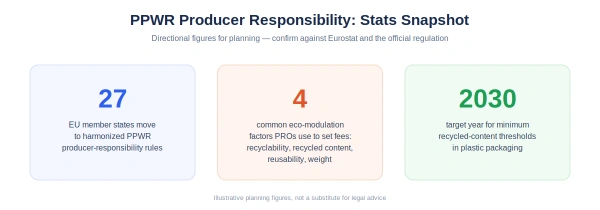
PRO fees are typically eco-modulated based on recyclability, recycled content, reusability, and packaging weight.
Buyers evaluating a Producer Responsibility Organization under PPWR should weigh member-state coverage, reporting technology, fee transparency, and support model.
This guide is educational, not legal advice — confirm current obligations with counsel or your national competent authority before acting.
Master PPWR Compliance Before the Deadlines
PPWR introduces new requirements for packaging design, technical documentation, conformity assessments, and supplier collaboration. Get the practical guidance you need to prepare with confidence.
Producer Responsibility Organizations Under PPWR: What They Are and Why They Exist
National EPR schemes existed long before PPWR, but obligations, fees, and reporting formats varied heavily from country to country.
PPWR (Regulation (EU) 2025/40) harmonizes the core rules while leaving day-to-day compliance execution to PROs in each member state.
The regulation replaces the older Packaging and Packaging Waste Directive with a directly applicable regulation meaning less room for divergent national interpretation.
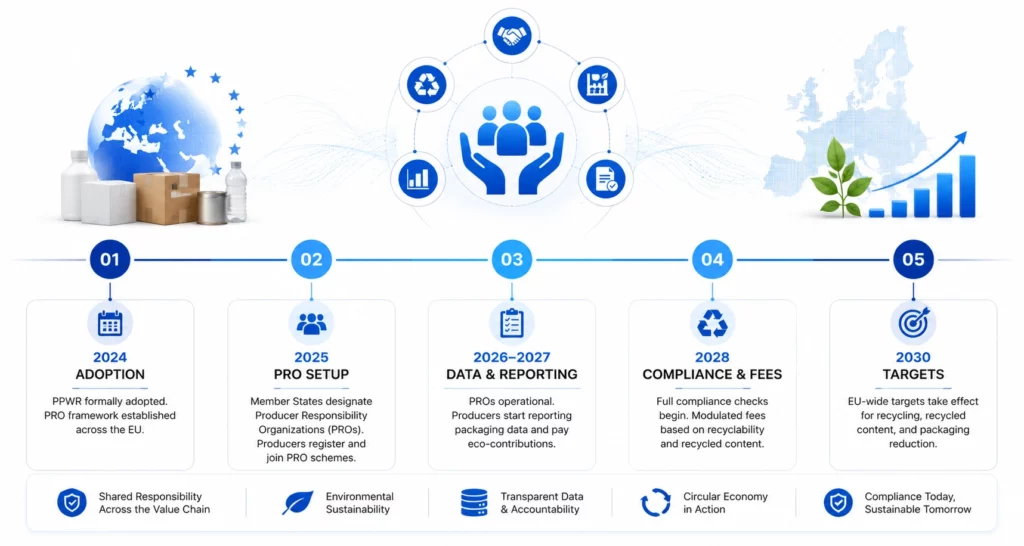
Before PPWR, a company selling packaged goods in ten EU countries could face ten different EPR registration processes, ten fee models, and ten reporting templates. These organizations exist precisely to absorb that complexity: each PRO is licensed within its member state to register producers, collect eco-modulated fees, and channel that funding into municipal or private collection and recycling systems. PPWR doesn’t eliminate PROs it standardizes what they must ask for, how they calculate fees, and what data they must report upward to national and EU authorities.
For a growing SaaS or e-commerce brand, this matters because the administrative burden shifts from ‘figure out compliance yourself’ to ‘select the right compliance partner and integrate with them properly.’ That’s a buying decision, not a legal research project which is exactly why the evaluation criteria later in this guide matter as much as the regulatory background.
How Producer Responsibility Organizations in PPWR Operate
Four core functions every PRO performs, from registration through funding recycling infrastructure.
Registering producers and assigning a unique producer identification number
Calculating and collecting eco-modulated fees based on packaging characteristics
Collecting and submitting packaging placed-on-market and waste data to authorities
Funding the collection, sorting, and recycling systems that process the packaging
PRO Registration and Producer Identification
Before you can place packaged goods on the market in a given EU member state, you (or your PRO on your behalf) must register as a producer and receive an identification number. Online marketplaces and distance sellers are increasingly pulled into this requirement too, since PPWR extends obligations to whoever makes packaging available to end users not just the original manufacturer.
PRO Fee Structures and Eco-Modulation
PPWR pushes PROs toward eco-modulated fee schedules meaning packaging that’s harder to recycle, contains little or no recycled content, or is unnecessarily heavy pays a higher fee than packaging designed for circularity. In practice, most PROs score packaging against four common factors: recyclability, recycled content, reusability, and weight. Getting quoted fees from a PRO without understanding its eco-modulation model is one of the most common budgeting mistakes buyers make.
PRO Reporting and Data-Sharing Duties
PROs must report packaging placed on the market, and increasingly, they expect producers to supply structured data material types, weights, recyclability classifications in formats that plug into national registries. If your internal systems can’t export packaging data cleanly, this becomes the bottleneck, not the PRO relationship itself.
PRO-Funded Collection and Recycling Infrastructure
Fees collected by Producer Responsibility Organizations under PPWR don’t just cover administrative overhead they fund the actual bins, sorting facilities, and recycling contracts that process packaging waste after consumers discard it. This is the mechanism that shifts the cost of end-of-life packaging management from municipalities and taxpayers onto the producers who put that packaging into circulation.
Producer Responsibility Organizations vs. National EPR Schemes Under PPWR
It’s easy to assume PPWR replaced national EPR schemes outright. In reality, PROs still operate at the national level PPWR just narrows how much they can vary. The table below summarizes the practical shift buyers should understand before signing with a PRO in any given market.
Aspect
Legacy National EPR Scheme
PRO Under PPWR
Fee basis
Often flat or loosely tiered by material
Eco-modulated by recyclability, recycled content, reusability, weight
Reporting format
Varies by country, often manual
Moving toward standardized, harmonized data fields
Who’s obligated
Primarily manufacturers/importers
Extends to distance sellers and online marketplaces
Cross-border consistency
Low each country sets its own rules
Higher PPWR sets EU-wide minimum requirements
Packaging design incentives
Weak or absent
Built-in via fee discounts for circular design
Who Must Register With Producer Responsibility Organizations Under PPWR
These PROs don’t just serve large manufacturers. If your business fits any of the profiles below, a registration and fee obligation likely applies to you in every EU member state where you place packaged goods on the market.
Manufacturers and brand owners who package goods under their own name
Importers bringing packaged goods into the EU from outside the bloc
Online marketplaces and distance sellers shipping packaged goods directly to EU consumers
Private-label and contract manufacturers producing packaging on behalf of a brand
Fulfillment partners in certain cases, depending on who is legally deemed the ‘producer’
Determining exactly who is the legally responsible ‘producer’ in a multi-party supply chain is one of the trickiest parts of PPWR compliance and it’s a question worth putting to legal counsel or your prospective PRO directly, since the answer affects who signs the contract and who’s liable for reporting accuracy.
Know Your Role Under PPWR
PPWR assigns different responsibilities to manufacturers, importers, distributors, retailers, brand owners, and other economic operators. Understanding your obligations is the first step toward achieving compliance.
Producer Responsibility Organizations: Budgeting for PPWR Compliance Costs
What will this actually cost? PRO fees are difficult to quote generically because they scale with packaging volume, material mix, and how well your packaging scores on eco-modulation criteria. That said, a few cost drivers show up consistently across markets:
Base registration and administrative fees, typically charged annually per market
Per-tonne or per-unit fees for each packaging material category you place on the market
Eco-modulation adjustments discounts for high recycled content or penalties for hard-to-recycle formats
Reporting or data-integration fees if your PRO requires a specific submission format or API
Multi-country surcharges if you rely on a single PRO’s cross-border compliance service rather than registering separately in each market
The buyers who control this cost line best tend to redesign packaging with eco-modulation criteria in mind before renewing a PRO contract, rather than treating the fee schedule as fixed. Ask any PRO you’re evaluating to model your fees under at least one alternative packaging scenario it’s a fast way to see whether their pricing is genuinely tied to sustainability outcomes or just a flat tax dressed up in compliance language.
Ready to Build a PPWR Compliance Strategy?
Understanding the regulation is only the first step. Achieving PPWR compliance requires the right packaging data, supplier collaboration, technical documentation, and conformity assessment processes.
Beyond PRO Registration: Digitize Your PPWR Compliance with TraceX
Registering with a Producer Responsibility Organization is only one part of PPWR readiness. Organizations must also manage packaging specifications, supplier declarations, technical documentation, conformity assessments, packaging Bills of Materials, and Declarations of Conformity across multiple products and suppliers.
Support multiple regulations from a single platform
Together, PRO services and digital compliance platforms provide a more complete approach to packaging compliance.
Choosing a Producer Responsibility Organization Under PPWR: What Buyers Should Evaluate
Four evaluation criteria that separate a good PRO partner from an expensive administrative headache.
PRO Coverage Across Member States
If you sell into multiple EU countries, ask whether your PRO operates directly in each market or subcontracts to local partners. Direct coverage usually means faster registration and a single point of accountability; subcontracted coverage can mean slower turnaround and murkier fee breakdowns.
PRO Reporting Technology and Data Integration
Look for a PRO that can ingest your packaging data through a spreadsheet upload or, better, an API and that gives you a dashboard showing exactly what’s been reported on your behalf. Manual, email-based reporting is a red flag for scaling companies.
PRO Fee Transparency and Cost Modeling
A trustworthy PRO will walk you through exactly how your fee is calculated material by material, factor by factor rather than handing you a single blended number. Ask for a sample invoice and a written explanation of the eco-modulation scoring before you sign.
PRO Track Record and Support Model
Ask how the PRO handles regulatory changes do they proactively update clients, or do you find out about new obligations after an audit? Also ask about response times for support tickets and whether you get a named contact or a shared inbox.
Common Mistakes Companies Make With PPWR Producer Responsibility Organizations
Registering with a PRO in only one market, assuming it covers EU-wide sales
Treating packaging data reporting as a one-time setup instead of an ongoing process
Ignoring eco-modulation incentives, leaving fee savings on the table by not adjusting packaging design
Failing to clarify who the legally responsible ‘producer’ is across a multi-party supply chain
Choosing a PRO on price alone without checking reporting technology or support quality
Most of these mistakes surface during an audit or a market expansion — exactly when they’re most expensive to fix. Building a relationship with a Producer Responsibility Organization in PPWR early, and revisiting it as you enter new markets, is far cheaper than retrofitting compliance after the fact.
Frequently Asked Questions (FAQ’s)
Do I need a Producer Responsibility Organization in every EU country I sell into?
In most cases, yes. PPWR obligations are generally enforced at the national level, so selling into multiple member states typically means registering with a PRO or a PRO’s local partner in each one, unless a specific market allows direct producer registration instead.
How are PRO fees calculated under PPWR?
Most PROs use an eco-modulated model that scores packaging on recyclability, recycled content, reusability, and weight, then applies a fee rate per material category. Ask for a line-item breakdown rather than accepting a single blended fee.
Can online marketplaces be held responsible under PPWR?
Yes, in many cases. PPWR extends producer obligations further down the distribution chain, which can include distance sellers and marketplaces facilitating sales into the EU confirm the exact scope with legal counsel for your specific business model.
What happens if I don’t register with a Producer Responsibility Organization?
Non-compliance can result in fines, restrictions on placing goods on the market, and reputational risk with retail partners who increasingly require proof of EPR compliance before listing your products.
When do the core PPWR obligations take effect?
Most current guidance points to core provisions applying around August 2026, roughly 24 months after the regulation entered into force but always confirm the latest applicable date with an official EU source before making decisions.
Start using TraceX
Transparency, Trust, & Success for your Climate Journey.
We use cookies on our website to give you the most relevant experience by remembering your preferences and repeat visits. By clicking “Accept All”, you consent to the use of ALL the cookies. However, you may visit "Cookie Settings" to provide a controlled consent.
This website uses cookies to improve your experience while you navigate through the website. Out of these, the cookies that are categorized as necessary are stored on your browser as they are essential for the working of basic functionalities of the website. We also use third-party cookies that help us analyze and understand how you use this website. These cookies will be stored in your browser only with your consent. You also have the option to opt-out of these cookies. But opting out of some of these cookies may affect your browsing experience.
Necessary cookies are absolutely essential for the website to function properly. These cookies ensure basic functionalities and security features of the website, anonymously.
Cookie
Duration
Description
cookielawinfo-checkbox-analytics
11 months
This cookie is set by GDPR Cookie Consent plugin. The cookie is used to store the user consent for the cookies in the category "Analytics".
cookielawinfo-checkbox-functional
11 months
The cookie is set by GDPR cookie consent to record the user consent for the cookies in the category "Functional".
cookielawinfo-checkbox-necessary
11 months
This cookie is set by GDPR Cookie Consent plugin. The cookies is used to store the user consent for the cookies in the category "Necessary".
cookielawinfo-checkbox-others
11 months
This cookie is set by GDPR Cookie Consent plugin. The cookie is used to store the user consent for the cookies in the category "Other.
cookielawinfo-checkbox-performance
11 months
This cookie is set by GDPR Cookie Consent plugin. The cookie is used to store the user consent for the cookies in the category "Performance".
viewed_cookie_policy
11 months
The cookie is set by the GDPR Cookie Consent plugin and is used to store whether or not user has consented to the use of cookies. It does not store any personal data.
Functional cookies help to perform certain functionalities like sharing the content of the website on social media platforms, collect feedbacks, and other third-party features.
Performance cookies are used to understand and analyze the key performance indexes of the website which helps in delivering a better user experience for the visitors.
Analytical cookies are used to understand how visitors interact with the website. These cookies help provide information on metrics the number of visitors, bounce rate, traffic source, etc.
Advertisement cookies are used to provide visitors with relevant ads and marketing campaigns. These cookies track visitors across websites and collect information to provide customized ads.
Download the 2026 Traceability Scorecard and Benchmark Your Supply Chain Across 10 Critical Capabilities.
Download our eBook
Don’t Wait for an Audit to Find Your EUDR Gaps
The 2026 Simplification Package changes how HS codes, DDS pass-through and geolocation rules apply to you. Get the free guide and 20-point readiness checklist before enforcement catches you unprepared.