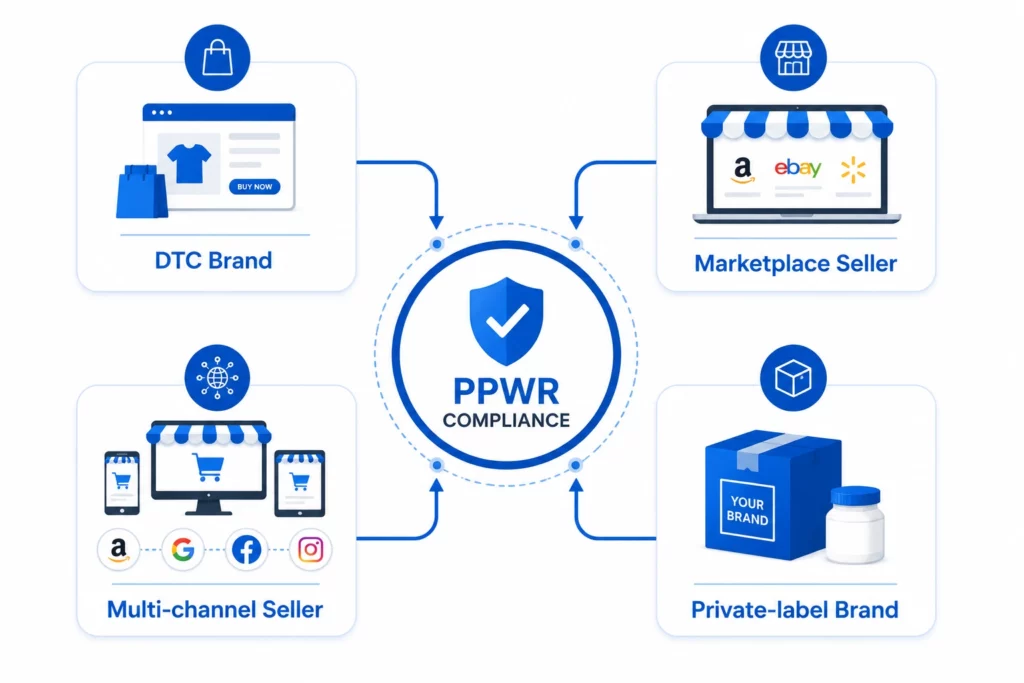
Quick summary: PPWR for ecommerce sellers means that DTC brands, marketplace sellers, and multi-channel retailers shipping packaged goods into the EU must register with a Producer Responsibility Organization, report packaging data, and pay eco-modulated fees obligations that increasingly apply to distance sellers and marketplaces, not just traditional manufacturers. PPWR for ecommerce sellers looks different than PPWR for a […]
PPWR for ecommerce sellers means that DTC brands, marketplace sellers, and multi-channel retailers shipping packaged goods into the EU must register with a Producer Responsibility Organization, report packaging data, and pay eco-modulated fees obligations that increasingly apply to distance sellers and marketplaces, not just traditional manufacturers.
PPWR for ecommerce sellers looks different than PPWR for a traditional manufacturer with one factory and one distribution channel. Ecommerce sellers run multiple sales channels, ship into markets they discover through demand rather than deliberate market entry, and often don’t control their own packaging sourcing. That combination turns a regulation built around ‘who put this packaging on the market’ into a genuinely hard question to answer quickly.
This guide walks through why PPWR hits ecommerce sellers differently, the specific challenges that show up at this stage of growth, and what a dedicated compliance partner actually does to remove them. If you’re evaluating whether to handle this in-house or bring in help, the sections below are built to give you that answer.
Turn the 12 August Deadline into a Clear Plan
A short call replaces panic with a prioritized roadmap. Get expert guidance on what to tackle first to be ready in time.
PPWR for ecommerce sellers extends producer obligations beyond manufacturers to distance sellers and online marketplaces.
Multi-channel and multi-country selling multiplies compliance complexity fast one seller can trigger obligations in a dozen markets at once.
The most common blockers are fragmented data across channels, thin internal compliance resources, and unverified supplier packaging data.
A dedicated compliance partner can absorb registration, reporting, and fee calculation so growth doesn’t stall on regulatory admin.
This guide is educational, not legal advice confirm your specific obligations with your PRO or counsel.
PPWR for Ecommerce Sellers: Why This Regulation Hits You Differently
Three structural differences between ecommerce sellers and traditional manufacturers under PPWR.
Multi-channel exposure a single seller can be in scope via their own site, a marketplace, and a wholesale channel simultaneously
Market discovery vs. market entry ecommerce sellers often accumulate EU sales organically, without a deliberate ‘entering this market’ decision that triggers a compliance review
Reduced packaging control many ecommerce sellers use white-label or overseas contract manufacturing, meaning packaging specs live with a supplier, not internally
The regulation also increasingly captures the marketplace and distance-selling layer directly meaning obligations that used to sit clearly with ‘the manufacturer’ now extend to whoever is making the sale to an EU consumer. If you sell through Amazon, a DTC storefront, and a handful of wholesale accounts, each channel can carry its own compliance thread, and none of them automatically talks to the others.
What Data Ecommerce Sellers Need to Collect Today
PPWR compliance starts with accurate packaging data, not paperwork. Whether you sell through Amazon, Shopify, marketplaces, or your own website, collecting the right information today will make reporting, technical documentation, and EPR compliance much easier as requirements come into force.
Packaging SKU
Assign a unique identifier to every packaging component, such as cartons, mailers, labels, or protective inserts. This helps track packaging consistently across products and simplifies compliance reporting.
Product SKU
Link each packaging component to the product it contains. Product-to-packaging mapping provides traceability and helps determine exactly which packaging is placed on each EU market.
Packaging Weight
Record the weight of every packaging component, including primary, secondary, and transport packaging. Accurate weight data is essential for EPR reporting, fee calculations, and technical documentation.
Material Composition
Document the materials used in each packaging component, including plastic, paper, glass, metal, wood, or composite materials. Detailed material information supports packaging classification, recyclability assessments, and compliance verification.
Supplier Information
Maintain records of the suppliers providing your packaging materials and components. This makes it easier to collect declarations, certificates, and supporting documentation while maintaining traceability across your supply chain.
Country of Placement
Track the EU countries where packaged products are sold or distributed. Since EPR registration and reporting are managed at the national level, knowing where packaging is placed on the market is essential for meeting country-specific obligations.
Recycled Content
Capture the percentage of recycled material used in each packaging component, supported by supplier certifications where applicable. This information helps demonstrate compliance with recycled content requirements and may influence eco-modulated EPR fees.
Packaging Hierarchy
Classify packaging as primary, secondary, or transport packaging. Identifying the role of each packaging component improves reporting accuracy, supports technical documentation, and ensures all packaging placed on the EU market is accounted for.
Best Practice: Rather than storing this information across spreadsheets, ERP systems, and supplier emails, centralize it in a single packaging data repository. Having one source of truth makes it easier to generate reports, collect supplier documentation, and respond quickly to customer or regulatory requests.
PPWR compliance starts with accurate packaging data.
PPWR for Ecommerce Sellers Core Challenges and How to Solve Them
The four challenges below show up across nearly every ecommerce seller we talk to about PPWR compliance regardless of category. For each one, we’ve broken down the underlying job you’re actually trying to get done, not just the surface-level complaint, since that’s usually where the right solution becomes obvious.
Challenge 1: Compliance Data Scattered Across Channels
Your Amazon seller account, your Shopify store, and your wholesale order system don’t share a compliance view. Each channel might report different volumes, and nobody has a single number for “total packaging placed on the market in Germany last quarter.”
What you’re actually trying to do: Pull one accurate packaging dataset whenever a Producer Responsibility Organization (PRO) or regulator requests it not reconcile multiple spreadsheets and exports at the last minute.
How TraceX Helps
TraceX PPWR Solutions centralizes packaging and sales data across ecommerce channels into a single compliance repository. The platform automatically consolidates packaging volumes, product-to-packaging mappings, and country-level sales data, providing a unified view of packaging placed on each EU market. Instead of manually combining reports from multiple systems, compliance teams can generate audit-ready reports and packaging summaries in minutes, significantly reducing reporting effort and improving data accuracy.
Challenge 2: No Dedicated Compliance Headcount
Most ecommerce teams don’t have a dedicated compliance manager. PPWR responsibilities often fall to operations, sustainability, or finance teams that are already managing multiple priorities.
What you’re actually trying to do: Stay compliant without diverting internal resources away from growing the business.
TraceX Solutions automates many of the repetitive tasks involved in PPWR compliance, including supplier engagement, document collection, packaging data validation, and compliance tracking. AI-powered workflows identify missing information, monitor document validity, and notify teams of outstanding actions, reducing the manual workload on internal teams. Combined with TraceX’s compliance expertise, businesses can accelerate PPWR readiness without building a dedicated compliance function from scratch.
Challenge 3: Unverified Supplier Packaging Data
Packaging specifications often come from multiple suppliers, contract manufacturers, and converters. Without regular validation, businesses may rely on outdated material composition, recycled content, or packaging weight information.
What you’re actually trying to do: Report packaging data with confidence, knowing it reflects the latest supplier information.
TraceX Solutions provides a structured supplier collaboration platform that automates the collection, validation, and maintenance of packaging compliance documents. Suppliers can securely submit material composition declarations, recycled content certificates, recyclability evidence, and packaging specifications through a centralized portal. AI-powered validation flags incomplete, inconsistent, or expired documentation, helping businesses maintain accurate packaging data while reducing audit risks and supporting more reliable EPR reporting.
Challenge 4: Ambiguity Over Who’s the ‘Producer’
Selling through marketplaces, distributors, wholesalers, and direct-to-consumer channels can make it difficult to determine who is responsible for PPWR obligations in each EU market.
What you’re actually trying to do: Clearly identify your compliance responsibilities before registration and reporting deadlines.
TraceX Solutions helps businesses map products, packaging, markets, and distribution channels to the applicable PPWR obligations. The platform provides a centralized view of where products are placed on the EU market, supporting businesses as they assess producer responsibilities, maintain country-specific compliance records, and organize the documentation needed for registrations and reporting. By combining packaging data with regulatory workflows, TraceX enables businesses to manage compliance consistently across multiple markets and sales channels while reducing the risk of duplicate registrations or compliance gaps.
Rather than managing packaging data, supplier documentation, and compliance activities across disconnected spreadsheets and emails, TraceXPPWR Solutions brings everything together in one AI-native platform. From centralized packaging inventories and supplier collaboration to technical documentation, Declaration of Conformity management, and audit-ready reporting, the platform helps businesses automate PPWR compliance and stay prepared as regulatory requirements evolve.
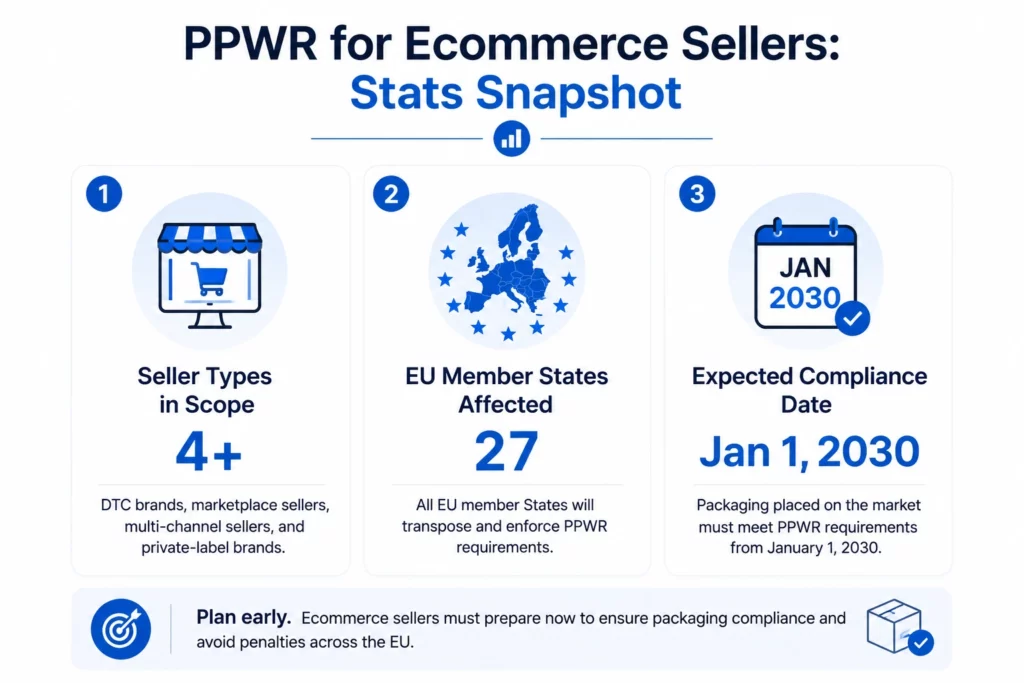
PPWR for Ecommerce Sellers: Stats and Trends Snapshot
Your Practical Checklist for the 12 August Deadline
Know exactly what “Phase 1 ready” looks like. The handbook walks you through the obligations and evidence you need to have in place.
Getting Started With PPWR Compliance as an Ecommerce Seller This Quarter
List every channel you sell through and every EU country you currently ship to
Pull current packaging specs for your top SKUs by volume, not your entire catalog at once
Flag any packaging where recycled content or material data hasn’t been confirmed in the last 12 months
Identify which entity you, your marketplace, or a co-seller is likely the ‘producer’ for each channel
Decide whether that list is manageable in-house or whether it’s time to bring in a dedicated partner
None of these steps require a finished compliance strategy to start they just require an honest inventory of where you currently stand. Most sellers find that step alone clarifies whether they’re dealing with a small cleanup project or a genuinely multi-market compliance program. Either outcome is useful information: it either confirms you can keep managing this internally with a bit more structure, or it makes the case for bringing in help concrete instead of hypothetical.
Understanding PPWR requirements is the first step toward compliance.
Common Mistakes Ecommerce Sellers Make With PPWR Compliance
Assuming a marketplace’s own compliance program covers the seller automatically, without confirming who’s actually registered
Treating EU sales as a side effect of global reach rather than a deliberate market that needs its own compliance review
Letting packaging data go stale after a supplier or formulation change, especially with white-label products
Registering in one country and assuming it covers every EU market a customer might order from
Waiting for a fee estimate request or an audit to start organizing packaging data, instead of building the habit early
PPWR for E Commerce Sellers Real World Scenarios
Scenario 1: Selling on Amazon Europe from the US
You operate an ecommerce business in the US and sell products through Amazon Germany using Fulfilment by Amazon (FBA). Although Amazon manages warehousing and logistics, you may still have packaging compliance responsibilities for the packaged products you place on the EU market. Selling through a marketplace does not automatically transfer your PPWR obligations.
Scenario 2: Running a Shopify Store That Ships Across Europe
Your business is based in the UK, but customers in Germany, France, Italy, and Spain purchase directly from your Shopify store. Every packaged order shipped into the EU may fall within the scope of PPWR. This means you’ll need to understand your producer obligations and maintain the packaging data and documentation required for each market where you sell.
Scenario 3: Importing Private-Label Products from Asia
Your products are manufactured in China, Vietnam, or India and sold under your own brand across Europe. Even though you don’t manufacture the packaging yourself, you are typically responsible for ensuring the packaging complies with applicable PPWR requirements. That includes maintaining packaging specifications, supplier declarations, and technical documentation.
Scenario 4: Using a European 3PL for Order Fulfilment
You store products in a third-party logistics (3PL) warehouse in the Netherlands, which ships orders to customers throughout Europe. While the 3PL handles fulfilment, it generally does not assume your packaging compliance responsibilities. You still need visibility into the packaging placed on each EU market and the supporting compliance documentation.
Scenario 5: Selling Through Multiple Channels Across Europe
Your products are sold through Amazon, Shopify, retail distributors, and wholesale partners across several EU countries. Each sales channel may have different reporting requirements, and packaging volumes can quickly become fragmented across systems. To stay compliant, you need a centralized view of your packaging data, supplier documentation, and country-specific obligations rather than managing compliance separately for each channel.
Not sure where to begin with PPWR?
Book a free consultation with TraceX experts to assess your packaging compliance readiness, identify documentation gaps, and build a practical roadmap to August 2026.
Does PPWR apply if I only sell through a marketplace like Amazon?
In many cases, yes PPWR increasingly extends obligations to marketplaces and distance sellers, not just the original manufacturer. Confirm your specific role and obligations with your PRO or counsel, since marketplace policies and legal responsibility can both factor in.
What if I don’t know how much EU revenue triggers compliance?
There generally isn’t a small-seller exemption based purely on revenue obligations are typically tied to placing packaging on the market in a given country, not a minimum sales threshold. Don’t assume you’re too small to be in scope without checking.
Can I handle PPWR compliance myself if I only sell in one or two EU countries?
Yes, this is often manageable in-house for a small, stable catalog in one or two markets. The calculus shifts once you add channels, countries, or frequent packaging changes that’s usually when a dedicated partner starts paying for itself in saved time.
How fast can an ecommerce seller get compliant with the right support?
With existing playbooks, initial registration in a given market can often happen in days rather than the weeks typical of independent research though exact timelines depend on your channel mix and how complete your packaging data already is.
What’s the first thing I should do if I haven’t started on PPWR at all?
Start with the quarter-one checklist above: list your channels and countries, then check the accuracy of your top SKUs’ packaging data. That single exercise usually reveals the size of the work ahead.
Start using TraceX
Transparency, Trust, & Success for your Climate Journey.
We use cookies on our website to give you the most relevant experience by remembering your preferences and repeat visits. By clicking “Accept All”, you consent to the use of ALL the cookies. However, you may visit "Cookie Settings" to provide a controlled consent.
This website uses cookies to improve your experience while you navigate through the website. Out of these, the cookies that are categorized as necessary are stored on your browser as they are essential for the working of basic functionalities of the website. We also use third-party cookies that help us analyze and understand how you use this website. These cookies will be stored in your browser only with your consent. You also have the option to opt-out of these cookies. But opting out of some of these cookies may affect your browsing experience.
Necessary cookies are absolutely essential for the website to function properly. These cookies ensure basic functionalities and security features of the website, anonymously.
Cookie
Duration
Description
cookielawinfo-checkbox-analytics
11 months
This cookie is set by GDPR Cookie Consent plugin. The cookie is used to store the user consent for the cookies in the category "Analytics".
cookielawinfo-checkbox-functional
11 months
The cookie is set by GDPR cookie consent to record the user consent for the cookies in the category "Functional".
cookielawinfo-checkbox-necessary
11 months
This cookie is set by GDPR Cookie Consent plugin. The cookies is used to store the user consent for the cookies in the category "Necessary".
cookielawinfo-checkbox-others
11 months
This cookie is set by GDPR Cookie Consent plugin. The cookie is used to store the user consent for the cookies in the category "Other.
cookielawinfo-checkbox-performance
11 months
This cookie is set by GDPR Cookie Consent plugin. The cookie is used to store the user consent for the cookies in the category "Performance".
viewed_cookie_policy
11 months
The cookie is set by the GDPR Cookie Consent plugin and is used to store whether or not user has consented to the use of cookies. It does not store any personal data.
Functional cookies help to perform certain functionalities like sharing the content of the website on social media platforms, collect feedbacks, and other third-party features.
Performance cookies are used to understand and analyze the key performance indexes of the website which helps in delivering a better user experience for the visitors.
Analytical cookies are used to understand how visitors interact with the website. These cookies help provide information on metrics the number of visitors, bounce rate, traffic source, etc.
Advertisement cookies are used to provide visitors with relevant ads and marketing campaigns. These cookies track visitors across websites and collect information to provide customized ads.
Download the 2026 Traceability Scorecard and Benchmark Your Supply Chain Across 10 Critical Capabilities.
Download our eBook
Don’t Wait for an Audit to Find Your EUDR Gaps
The 2026 Simplification Package changes how HS codes, DDS pass-through and geolocation rules apply to you. Get the free guide and 20-point readiness checklist before enforcement catches you unprepared.